

 Product
 Brand
Brand Articles
 Tools
Tools
SCC2691 Universal Asynchronous Receiver/Transmitter: Pinout, Equivalent and Datasheet

5V V 2.65mm mm 7.5mm mm Interface - UARTs (Universal Asynchronous Receiver Transmitter) 15.4mm mm 24 260 24


5V V 2.65mm mm 7.5mm mm Interface - UARTs (Universal Asynchronous Receiver Transmitter) 15.4mm mm 24 260 24
The SCC2691 Universal Asynchronous Receiver/Transmitter (UART) is a single-chip CMOS-LSI communications device that provides a full-duplex asynchronous receiver/transmitter. It is fabricated with CMOS technology which combines the benefits of high density and low power consumption. Furthermore, Huge range of Semiconductors, Capacitors, Resistors and IcS in stock. Welcome RFQ.

how does UART work??? (explained clearly)
SCC2691 Pinout
The following figure is the diagram of SCC2691 Pinout.
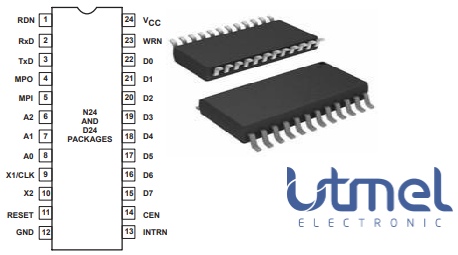
Pinout
SCC2691 CAD Model
The followings are SCC2691 Footprint and 3D Model.
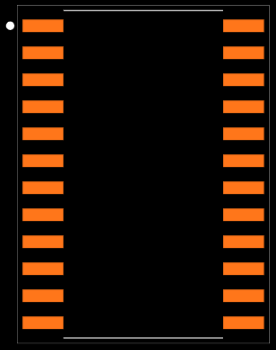
Footprint
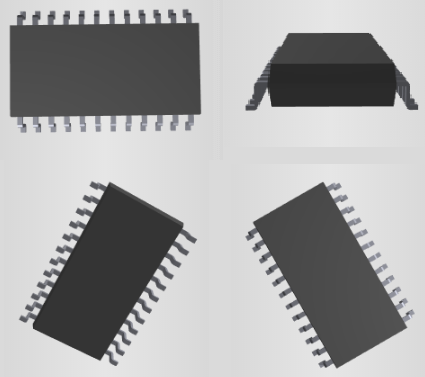
3D Model
SCC2691 Description
The SCC2691 Universal Asynchronous Receiver/Transmitter (UART) is a single-chip CMOS-LSI communications device that provides a full-duplex asynchronous receiver/transmitter. It is fabricated with CMOS technology which combines the benefits of high density and low power consumption. The operating speed of the receiver and transmitter can be selected independently as one of 18 fixed baud rates, a 16X clock derived from a programmable counter/timer, or an external 1X or 16X clock. The baud rate generator and counter/timer can operate directly from a crystal or from external clock inputs. The ability to independently program the operating speed of the receiver and transmitter make the UART particularly attractive for dual-speed channel applications such as clustered terminal systems.
The receiver is quadruple buffered to minimize the potential of receiver overrun or to reduce interrupt overhead in interrupt driven systems. In addition, a handshaking capability is provided to disable a remote UART transmitter when the receiver buffer is full. The UART provides a power-down mode in which the oscillator is frozen but the register contents are stored. This results in reduced power consumption on the order of several magnitudes. The UART is fully TTL compatible and operates from a single +5V power supply.
This article provides you with a basic overview of the SCC2691 Universal Asynchronous Receiver/Transmitter, including its pin descriptions, features and specifications, etc., to help you quickly understand what SCC2691 is.
SCC2691 Features
● Full-duplex asynchronous receiver/transmitter
● Quadruple buffered receiver data register
● Programmable data format:
◆ 5 to 8 data bits plus parity
◆ Odd, even, no parity or force parity
◆ 1, 1.5 or 2 stop bits programmable in 1/16-bit increments
● 16-bit programmable Counter/Timer
● Baud rate for the receiver and transmitter selectable from:
◆ 22 fixed rates: 50 to 115.2K baud
◆ Non-standard rates to 115.2 kb
◆ Non-standard user-defined rate derived from programmable timer/ counter
◆ External 1X or 16X clock
● Parity, framing, and overrun detection
● False start bit detection
● Line break detection and generation
● Programmable channel mode
◆ Normal (full-duplex)
◆ Automatic echo
◆ Local loopback
◆ Remote Loopback
● Multi-function programmable 16-bit counter/timer
● Single interrupt output with seven maskable interrupting conditions
● On-chip crystal oscillator
● Low power mode
● TTL compatible
● Single +5V power supply
● Commercial (0°C to +70°C) and industrial (-40°C to +85°C) temperature versions available
● SOL, PLCC and 300 mil wide DIP packages available
Specifications
- TypeParameter
- Mounting Type
The "Mounting Type" in electronic components refers to the method used to attach or connect a component to a circuit board or other substrate, such as through-hole, surface-mount, or panel mount.
Surface Mount - Package / Case
refers to the protective housing that encases an electronic component, providing mechanical support, electrical connections, and thermal management.
24-SOIC (0.295, 7.50mm Width) - Surface Mount
having leads that are designed to be soldered on the side of a circuit board that the body of the component is mounted on.
YES - Number of I/Os1
- Operating Temperature (Max.)70°C
- Packaging
Semiconductor package is a carrier / shell used to contain and cover one or more semiconductor components or integrated circuits. The material of the shell can be metal, plastic, glass or ceramic.
Tube - Published1997
- JESD-609 Code
The "JESD-609 Code" in electronic components refers to a standardized marking code that indicates the lead-free solder composition and finish of electronic components for compliance with environmental regulations.
e4 - Part Status
Parts can have many statuses as they progress through the configuration, analysis, review, and approval stages.
Obsolete - Moisture Sensitivity Level (MSL)
Moisture Sensitivity Level (MSL) is a standardized rating that indicates the susceptibility of electronic components, particularly semiconductors, to moisture-induced damage during storage and the soldering process, defining the allowable exposure time to ambient conditions before they require special handling or baking to prevent failures
3 (168 Hours) - Number of Terminations24
- Terminal Finish
Terminal Finish refers to the surface treatment applied to the terminals or leads of electronic components to enhance their performance and longevity. It can improve solderability, corrosion resistance, and overall reliability of the connection in electronic assemblies. Common finishes include nickel, gold, and tin, each possessing distinct properties suitable for various applications. The choice of terminal finish can significantly impact the durability and effectiveness of electronic devices.
Nickel/Palladium/Gold (Ni/Pd/Au) - HTS Code
HTS (Harmonized Tariff Schedule) codes are product classification codes between 8-1 digits. The first six digits are an HS code, and the countries of import assign the subsequent digits to provide additional classification. U.S. HTS codes are 1 digits and are administered by the U.S. International Trade Commission.
8542.31.00.01 - Voltage - Supply
Voltage - Supply refers to the range of voltage levels that an electronic component or circuit is designed to operate with. It indicates the minimum and maximum supply voltage that can be applied for the device to function properly. Providing supply voltages outside this range can lead to malfunction, damage, or reduced performance. This parameter is critical for ensuring compatibility between different components in a circuit.
5V - Terminal Position
In electronic components, the term "Terminal Position" refers to the physical location of the connection points on the component where external electrical connections can be made. These connection points, known as terminals, are typically used to attach wires, leads, or other components to the main body of the electronic component. The terminal position is important for ensuring proper connectivity and functionality of the component within a circuit. It is often specified in technical datasheets or component specifications to help designers and engineers understand how to properly integrate the component into their circuit designs.
DUAL - Terminal Form
Occurring at or forming the end of a series, succession, or the like; closing; concluding.
GULL WING - Peak Reflow Temperature (Cel)
Peak Reflow Temperature (Cel) is a parameter that specifies the maximum temperature at which an electronic component can be exposed during the reflow soldering process. Reflow soldering is a common method used to attach electronic components to a circuit board. The Peak Reflow Temperature is crucial because it ensures that the component is not damaged or degraded during the soldering process. Exceeding the specified Peak Reflow Temperature can lead to issues such as component failure, reduced performance, or even permanent damage to the component. It is important for manufacturers and assemblers to adhere to the recommended Peak Reflow Temperature to ensure the reliability and functionality of the electronic components.
260 - Supply Voltage
Supply voltage refers to the electrical potential difference provided to an electronic component or circuit. It is crucial for the proper operation of devices, as it powers their functions and determines performance characteristics. The supply voltage must be within specified limits to ensure reliability and prevent damage to components. Different electronic devices have specific supply voltage requirements, which can vary widely depending on their design and intended application.
5V - Terminal Pitch
The center distance from one pole to the next.
1.27mm - Time@Peak Reflow Temperature-Max (s)
Time@Peak Reflow Temperature-Max (s) refers to the maximum duration that an electronic component can be exposed to the peak reflow temperature during the soldering process, which is crucial for ensuring reliable solder joint formation without damaging the component.
30 - Base Part Number
The "Base Part Number" (BPN) in electronic components serves a similar purpose to the "Base Product Number." It refers to the primary identifier for a component that captures the essential characteristics shared by a group of similar components. The BPN provides a fundamental way to reference a family or series of components without specifying all the variations and specific details.
SCC2691A - Pin Count
a count of all of the component leads (or pins)
24 - JESD-30 Code
JESD-30 Code refers to a standardized descriptive designation system established by JEDEC for semiconductor-device packages. This system provides a systematic method for generating designators that convey essential information about the package's physical characteristics, such as size and shape, which aids in component identification and selection. By using JESD-30 codes, manufacturers and engineers can ensure consistency and clarity in the specification of semiconductor packages across various applications and industries.
R-PDSO-G24 - Qualification Status
An indicator of formal certification of qualifications.
Not Qualified - Power Supplies
an electronic circuit that converts the voltage of an alternating current (AC) into a direct current (DC) voltage.?
5V - Temperature Grade
Temperature grades represent a tire's resistance to heat and its ability to dissipate heat when tested under controlled laboratory test conditions.
COMMERCIAL - Number of Channels1, UART
- uPs/uCs/Peripheral ICs Type
The parameter "uPs/uCs/Peripheral ICs Type" refers to the classification of various integrated circuits used in electronic devices. It encompasses microprocessors (uPs), microcontrollers (uCs), and peripheral integrated circuits that provide additional functionalities. This classification helps in identifying the specific type of chip used for processing tasks, controlling hardware, or interfacing with other components in a system. Understanding this parameter is essential for selecting the appropriate electronic components for a given application.
SERIAL IO/COMMUNICATION CONTROLLER, SERIAL - Clock Frequency
Clock frequency, also known as clock speed, refers to the rate at which a processor or electronic component can execute instructions. It is measured in hertz (Hz) and represents the number of cycles per second that the component can perform. A higher clock frequency typically indicates a faster processing speed and better performance. However, it is important to note that other factors such as architecture, efficiency, and workload also play a significant role in determining the overall performance of a component. In summary, clock frequency is a crucial parameter that influences the speed and efficiency of electronic components in processing data and executing tasks.
4MHz - Supply Current-Max
Supply Current-Max refers to the maximum amount of current that an electronic component or circuit can draw from its power supply under specified operating conditions. It is a critical parameter that determines the power consumption and thermal performance of the device. Exceeding this limit can lead to overheating, potential damage, or failure of the component. Knowing the Supply Current-Max helps in designing circuits that ensure proper operation and reliability.
2mA - Address Bus Width
A computer system has an address bus with 8 parallel lines. This means that the address bus width is 8 bits.
3 - Boundary Scan
Boundary scan is a testing technique used in electronic components to verify the interconnections between integrated circuits on a printed circuit board. It allows for the testing of digital circuits by providing a way to shift data in and out of devices through a serial interface. This method helps in identifying faults such as short circuits, open circuits, and incorrect connections without the need for physical access to the individual components. Boundary scan is commonly used during manufacturing, testing, and debugging processes to ensure the quality and reliability of electronic products.
NO - Low Power Mode
Low Power Mode is a feature found in electronic components, such as microcontrollers, processors, and devices, that allows them to operate at reduced power consumption levels. When activated, the component typically reduces its clock speed, voltage, or disables certain functions to conserve energy. This mode is often used to extend battery life in portable devices or reduce overall power consumption in energy-efficient systems. Low Power Mode can be triggered automatically based on certain conditions, such as low battery levels, or manually by the user or software. It is a crucial feature in modern electronics to balance performance with energy efficiency.
YES - External Data Bus Width
The External Data Bus Width refers to the number of bits that can be transmitted simultaneously between a microprocessor and external components, such as memory or peripherals. It determines the amount of data that can be transferred in a single clock cycle. A wider data bus allows for faster data transfer rates and can improve overall system performance. Common data bus widths include 8-bit, 16-bit, 32-bit, and 64-bit, with larger widths generally offering higher throughput but requiring more complex circuitry. The External Data Bus Width is an important parameter to consider when designing or evaluating electronic components to ensure compatibility and optimal performance.
8 - RAM (words)
RAM (words) is a parameter used to describe the memory capacity of a random access memory (RAM) module in terms of the number of words it can store. In the context of electronic components, a word typically refers to the amount of data that can be processed or stored by the RAM module in a single operation. The RAM (words) specification indicates the total number of words that can be stored in the RAM module, with each word typically consisting of a fixed number of bits. This parameter is important for determining the overall memory capacity and performance of the RAM module in electronic devices.
0 - Number of Serial I/Os1
- Data Transfer Rate-Max
The parameter "Data Transfer Rate-Max" in electronic components refers to the maximum rate at which data can be transferred between different devices or components within a system. It is typically measured in bits per second (bps) or bytes per second (Bps) and indicates the peak speed at which data can be transmitted. This parameter is crucial for determining the overall performance and efficiency of a system, especially in applications where high-speed data transfer is essential, such as in networking equipment, storage devices, and communication systems. Manufacturers often specify the Data Transfer Rate-Max to help users understand the capabilities and limitations of the component when it comes to transferring data quickly and reliably.
0.0046875 MBps - Communication Protocol
In electronic components, the communication protocol refers to a set of rules and conventions that devices use to exchange information with each other. It defines the format, timing, sequencing, and error checking of data transmission between devices. Different communication protocols are used for various applications, such as serial communication (e.g., UART, SPI, I2C) and network communication (e.g., Ethernet, Wi-Fi, Bluetooth). Choosing the appropriate communication protocol is crucial for ensuring compatibility and reliable data transfer between electronic components in a system.
ASYNC, BIT - Data Encoding/Decoding Method
Data Encoding/Decoding Method in electronic components refers to the process of converting data from one format to another for transmission or storage purposes. This method involves encoding the data into a specific format before transmission and decoding it back to its original form upon reception. The encoding process typically involves converting the data into a series of bits or symbols that can be easily transmitted over a communication channel. Common encoding methods include techniques such as Manchester encoding, NRZ (Non-Return-to-Zero) encoding, and differential encoding. Decoding, on the other hand, involves reversing the encoding process to retrieve the original data from the received signals. The choice of data encoding/decoding method can impact factors such as data transmission speed, error detection, and compatibility with different communication protocols.
NRZ - Features
In the context of electronic components, the term "Features" typically refers to the specific characteristics or functionalities that a particular component offers. These features can vary depending on the type of component and its intended use. For example, a microcontroller may have features such as built-in memory, analog-to-digital converters, and communication interfaces like UART or SPI.When evaluating electronic components, understanding their features is crucial in determining whether they meet the requirements of a particular project or application. Engineers and designers often look at features such as operating voltage, speed, power consumption, and communication protocols to ensure compatibility and optimal performance.In summary, the "Features" parameter in electronic components describes the unique attributes and capabilities that differentiate one component from another, helping users make informed decisions when selecting components for their electronic designs.
Configurable GPIO, Internal Oscillator, Timer/Counter - With Auto Flow Control
They regulate the flow of a fluid (gases, liquids, fluidized solids, or slurries) by opening, closing, or partially obstructing various passageways. They are technically pipe fittings but are usually discussed as a separate category.
Yes - Length15.4mm
- Height Seated (Max)
Height Seated (Max) is a parameter in electronic components that refers to the maximum allowable height of the component when it is properly seated or installed on a circuit board or within an enclosure. This specification is crucial for ensuring proper fit and alignment within the overall system design. Exceeding the maximum seated height can lead to mechanical interference, electrical shorts, or other issues that may impact the performance and reliability of the electronic device. Manufacturers provide this information to help designers and engineers select components that will fit within the designated space and function correctly in the intended application.
2.65mm - Width7.5mm
- RoHS Status
RoHS means “Restriction of Certain Hazardous Substances” in the “Hazardous Substances Directive” in electrical and electronic equipment.
ROHS3 Compliant
SCC2691 Functional Block Diagram
The following is the Block Diagram of SCC2691.
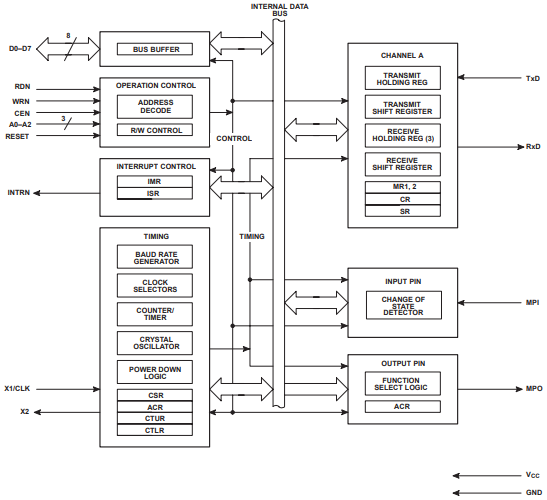
Block Diagram
SCC2691 Equivalent
| Model number | Manufacturer | Description |
| SCC2691AC1D24 | Philips Semiconductors | Serial I/O Controller, CMOS, PDSO24 |
| 935002730118 | NXP Semiconductors | IC 1 CHANNEL(S), 115.2K bps, SERIAL COMM CONTROLLER, PDSO24, 7.50 MM, PLASTIC, MS-013AD, SOT-137-1, SO-24, Serial IO/Communication Controller |
| 935002730512 | NXP Semiconductors | IC 1 CHANNEL(S), 115.2K bps, SERIAL COMM CONTROLLER, PDSO24, 7.50 MM, PLASTIC, MS-013AD, SOT-137-1, SO-24, Serial IO/Communication Controller |
| 935002730529 | NXP Semiconductors | 1 CHANNEL(S), 38.4Kbps, SERIAL COMM CONTROLLER, PDSO24, 7.50 MM, PLASTIC, MS-013, SOT-137-1, SOL-24 |
| SCC2691AC1D24,518 | NXP Semiconductors | SCC2691 - Universal asynchronous receiver/transmitter (UART) SOP 24-Pin |
SCC2691 Package
The following diagrams show the SCC2691 Package.
SO24: plastic small outline package; 24 leads; body width 7.5 mm
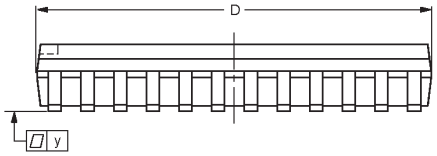
View A
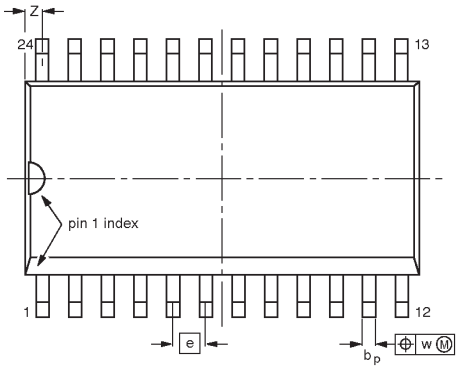
View B
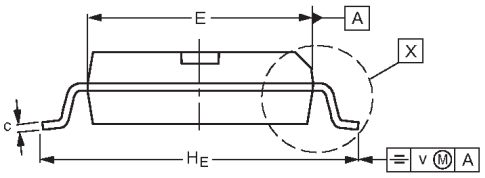
View C
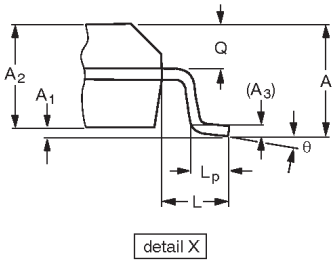
View D
SCC2691 Manufacturer
NXP Semiconductors enables secure connections and infrastructure for a smarter world, advancing solutions that make lives easier, better and safer. As the world leader in secure connectivity solutions for embedded applications, NXP is driving innovation in the secure connected vehicle, end-to-end security & privacy and smart connected solutions markets. Built on more than 60 years of combined experience and expertise, the company has 45,000 employees in more than 35 countries. Freescale Semiconductor has been acquired by NXP Semiconductor. Freescale Semiconductor parts are now a part of the NXP family (Dec 2015).
Datasheet PDF
- Datasheets :
How many pins of SCC2691AC1D24,512?
24 Pins.
What’s the maximum operating temperature of SCC2691AC1D24,512?
70°C.
What’s the maximum supply current of SCC2691AC1D24,512?
2mA.
What is the essential property of the SCC2691?
The SCC2691 Universal Asynchronous Receiver/Transmitter (UART) is a single-chip CMOS-LSI communications device that provides a full-duplex asynchronous receiver/transmitter.
 BQ51050BRHLR: Wireless Power Receiver
12 March 20221378
 IRLB8721PBF Power MOSFET: Pinout, Datasheet, and Test Circutis
14 August 202110554
 SI5351 Clock Generator: Datasheet, Pinout and Applications
31 August 20217426
![How to Use AP7366-W5-7 Linear Regulator?[Datasheet&Pinout]](https://res.utmel.com/Images/Article/0d92e404-f6b3-4194-8608-519674dc1ace.png) How to Use AP7366-W5-7 Linear Regulator?[Datasheet&Pinout]
How to Use AP7366-W5-7 Linear Regulator?[Datasheet&Pinout]20 February 20231149
 MIC803 3-Pin Microprocessor Supervisor Circuit: Pinout, Equivalent and Datasheet
08 January 20221566
 EP2C35F672I8N FPGA: Features, Specifications and Pins
17 April 20251099
 Generating Negative Rails with LMC7660: A Deep Dive into CMOS Voltage Conversion
28 February 2026266
 PIC16F917IML Microcontroller: Technical Specifications and Features Overview
29 February 2024221
 VRLA Battery: Working Principle, Capacity and Maintenance
12 March 202111027
 Application of Wide Bandgap Devices in EV Converters
12 April 20231451
 VSC Light Meaning, Causes, and Step-by-Step Diagnostics
19 May 20264134
 What is Gallium Nitride(GaN)?
19 January 20218861
 JSCJ Authorized Distributor | UTMEL Electronics
21 November 20234405
 Analog-to-Digital Converters (ADCs): Decrypting Resolutions and Sampling Rates
24 February 20225668
 Revolutionizing Semiconductor Manufacturing with New Plasma Power Technologies
23 September 20232474
 Nexperia Enters the Analog Chip Market
23 March 20221162
NXP USA Inc.
In Stock
United States
China
Canada
Japan
Russia
Germany
United Kingdom
Singapore
Italy
Hong Kong(China)
Taiwan(China)
France
Korea
Mexico
Netherlands
Malaysia
Austria
Spain
Switzerland
Poland
Thailand
Vietnam
India
United Arab Emirates
Afghanistan
Åland Islands
Albania
Algeria
American Samoa
Andorra
Angola
Anguilla
Antigua & Barbuda
Argentina
Armenia
Aruba
Australia
Azerbaijan
Bahamas
Bahrain
Bangladesh
Barbados
Belarus
Belgium
Belize
Benin
Bermuda
Bhutan
Bolivia
Bonaire, Sint Eustatius and Saba
Bosnia & Herzegovina
Botswana
Brazil
British Indian Ocean Territory
British Virgin Islands
Brunei
Bulgaria
Burkina Faso
Burundi
Cabo Verde
Cambodia
Cameroon
Cayman Islands
Central African Republic
Chad
Chile
Christmas Island
Cocos (Keeling) Islands
Colombia
Comoros
Congo
Congo (DRC)
Cook Islands
Costa Rica
Côte d’Ivoire
Croatia
Cuba
Curaçao
Cyprus
Czechia
Denmark
Djibouti
Dominica
Dominican Republic
Ecuador
Egypt
El Salvador
Equatorial Guinea
Eritrea
Estonia
Eswatini
Ethiopia
Falkland Islands
Faroe Islands
Fiji
Finland
French Guiana
French Polynesia
Gabon
Gambia
Georgia
Ghana
Gibraltar
Greece
Greenland
Grenada
Guadeloupe
Guam
Guatemala
Guernsey
Guinea
Guinea-Bissau
Guyana
Haiti
Honduras
Hungary
Iceland
Indonesia
Iran
Iraq
Ireland
Isle of Man
Israel
Jamaica
Jersey
Jordan
Kazakhstan
Kenya
Kiribati
Kosovo
Kuwait
Kyrgyzstan
Laos
Latvia
Lebanon
Lesotho
Liberia
Libya
Liechtenstein
Lithuania
Luxembourg
Macao(China)
Madagascar
Malawi
Maldives
Mali
Malta
Marshall Islands
Martinique
Mauritania
Mauritius
Mayotte
Micronesia
Moldova
Monaco
Mongolia
Montenegro
Montserrat
Morocco
Mozambique
Myanmar
Namibia
Nauru
Nepal
New Caledonia
New Zealand
Nicaragua
Niger
Nigeria
Niue
Norfolk Island
North Korea
North Macedonia
Northern Mariana Islands
Norway
Oman
Pakistan
Palau
Palestinian Authority
Panama
Papua New Guinea
Paraguay
Peru
Philippines
Pitcairn Islands
Portugal
Puerto Rico
Qatar
Réunion
Romania
Rwanda
Samoa
San Marino
São Tomé & Príncipe
Saudi Arabia
Senegal
Serbia
Seychelles
Sierra Leone
Sint Maarten
Slovakia
Slovenia
Solomon Islands
Somalia
South Africa
South Sudan
Sri Lanka
St Helena, Ascension, Tristan da Cunha
St. Barthélemy
St. Kitts & Nevis
St. Lucia
St. Martin
St. Pierre & Miquelon
St. Vincent & Grenadines
Sudan
Suriname
Svalbard & Jan Mayen
Sweden
Syria
Tajikistan
Tanzania
Timor-Leste
Togo
Tokelau
Tonga
Trinidad & Tobago
Tunisia
Turkey
Turkmenistan
Turks & Caicos Islands
Tuvalu
U.S. Outlying Islands
U.S. Virgin Islands
Uganda
Ukraine
Uruguay
Uzbekistan
Vanuatu
Vatican City
Venezuela
Wallis & Futuna
Yemen
Zambia
Zimbabwe
![SC16IS741AIPWJ]() SC16IS741AIPWJ
SC16IS741AIPWJNXP USA Inc.
![SC28L92A1B,528]() SC28L92A1B,528
SC28L92A1B,528NXP USA Inc.
![SC16C654BIB64,151]() SC16C654BIB64,151
SC16C654BIB64,151NXP USA Inc.
![SC16C554BIB64,157]() SC16C554BIB64,157
SC16C554BIB64,157NXP USA Inc.
![SC28L198A1BE,557]() SC28L198A1BE,557
SC28L198A1BE,557NXP USA Inc.
![SC28C94A1A,518]() SC28C94A1A,518
SC28C94A1A,518NXP USA Inc.
![SC26C92C1A,518]() SC26C92C1A,518
SC26C92C1A,518NXP USA Inc.
![SC28L202A1DGG,118]() SC28L202A1DGG,118
SC28L202A1DGG,118NXP USA Inc.
![SC16C554BIB80,528]() SC16C554BIB80,528
SC16C554BIB80,528NXP USA Inc.
![SC16C2552BIA44,518]() SC16C2552BIA44,518
SC16C2552BIA44,518NXP USA Inc.


