

 Product
 Brand
Brand Articles
 Tools
Tools
The Complete Guide to DC-DC Converters
📑 Table of Contents
The DC-DC converter plays a crucial role in modern electronic devices. Whether it's a smartphone, a laptop, an electric car or a solar system, this small but mighty power management device is essential. In this article, we'll explain in detail how DC-DC converters work, the main types, and what to look for to help you find the best solution for your needs amidst the complexity of the technical specifications.
❓ Are you experiencing any of these troubles?
- Not sure how to choose the right type of DC-DC converter?
- Confused about the difference between Buck, Boost, Buck-Boost?
- Worried about conversion efficiency and thermal management?
- Want to stay up-to-date with the latest industry trends?
What is a DC-DC converter?
A DC-DC converter is an electronic circuit device used to convert one direct current voltage to another. It operates in either switching mode or linear mode, and is capable of voltage step-up (Boost), step-down (Buck), or bi-directional regulation (Buck-Boost).
With higher conversion efficiencies (typically up to 85%-95%), smaller size and lower heat generation than traditional linear regulators, switching DC-DC converters are the preferred solution for power management in modern electronic devices.
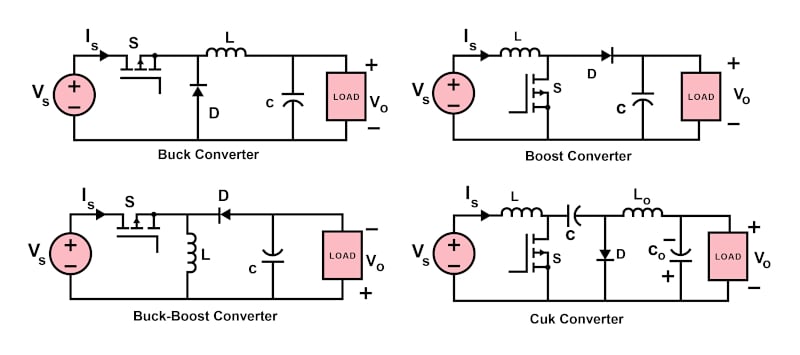
Main types of DC-DC converters
↓ Buck converter (step-down)
Buck converters are the most common buck DC-DC converters where the output voltage is always lower than the input voltage. The principle of operation is based on the property of an inductor to store and release energy.
Typical applications:
- Computer CPU power supply (12V → 1.2V)
- Cell phone charger (5V → 3.7V)
- LED Driver Circuitry

↑ Boost converter (step-up)
Boost converters are capable of converting low voltages to high voltages and are widely used where voltage boosting is required. The output voltage is regulated by controlling the duty cycle of the switch.
Typical applications:
- Solar power systems
- Electric Vehicle Battery Management
- Portable Device Boost Circuit

↔ Buck-Boost Converter (Buck-Boost)
Buck-Boost converters combine boost and buck functions, and the output voltage can be above or below the input voltage. This flexibility makes it particularly useful in battery-powered devices.
Typical applications:
- Uninterruptible Power Supply (UPS)
- Battery Management System
- Renewable energy systems
To learn more details about Buck-Boost converters, please refer to this professional guide.

▶ Video tutorial: DC-DC converter working principle
This detailed video tutorial will help you better understand how a Buck converter works and the design points.
DC-DC converter advantages and disadvantages analysis
Key Benefits
✓ High Conversion Efficiency: Modern switching DC-DC converters are up to 95% efficient.
✓ Compact Size: 60%-80% smaller than linear regulators.
✓ Low heat generation: Significantly reduces thermal design complexity.
✓ Flexible regulation: Supports wide-range voltage regulation and precise control.
✓ Cost-effectiveness: Low long-term cost of use and high return on investment.
⚠ Areas for improvement
✗Switching Noise: High-frequency switching may generate electromagnetic interference, requiring appropriate filtering design.
✗Design Complexity: More complex circuit design and debugging than linear regulators.
✗Initial Cost: The upfront investment for high performance devices is relatively high.
💡Professional Tip: Choosing products and suppliers with good EMI design can effectively alleviate the above problems.
Thinking Time: Testing Your Understanding
Question 1:
What type of DC-DC converter should you choose if you need to convert 12V battery voltage to 5V to power a microcontroller?
Question 2:
What converter is best for boosting from a 3.7V LiPo battery to 48V system voltage in an electric vehicle?
Question 3:
Why are switching DC-DC converters better than linear regulators for high-power applications?
Question 4:
How to choose the right DC-DC converter topology when designing a solar charging system?
DC-DC Converter Buying Guide
Key Technical Parameters Comparison
| parameters | Buck Converter | Boost Converter | Buck-Boost Converter |
|---|---|---|---|
| Input Voltage Range | Higher than output | Below Output | Can be high or low |
| Conversion Efficiency | 90-95% | 85-92% | 80-90% |
| Circuit Complexity | Simple | Medium | Complicated |
| Cost | Low | Center | High |
| Application Scenarios | Most extensive | Specialized for Boosting | Flexible application |
★ Recommended Suppliers
- Texas Instruments (TI) - The industry's leading provider of switching power solutions.
- ADI - High Precision Power Management ICs.
- Infineon - The Power Device Experts.
- MicroSource Systems (MPS) - Innovative Power Solutions.
🛠 Selection Tool Recommendations
- TI WEBENCH Power Designer.
- ADI Design Simulation Tool.
- Online Calculator and Selection Wizard.
✔ Real user experience sharing
"When our company was developing a new generation of e-bike controllers, we initially chose a linear regulator, but found that the heat generation was serious and the battery life was not ideal. Then we switched to TI's Buck-Boost converter program, which not only improved efficiency by 15%, but also reduced the overall temperature by 20°C. Now our products are very popular in the market!"
- Engineer Zhang, Hardware Supervisor of a well-known electric vehicle manufacturing company
"As a beginner, I was initially confused about the selection of a DC-DC converter. Through studying various materials and actual testing, I realized that the key lies in clarifying the application requirements. Now I am able to quickly select the most suitable solution for my project, and the success rate of my project has greatly improved."
- Li, Graduate Student, Electrical Engineering
❗ Common Misconceptions Clarification
❌ Myth: The more efficient the better, the more efficient you should be, and you should strive for maximum efficiency
✅ Correct View: Efficiency is important, but you need to consider cost, size, EMI and other factors. Sometimes a 95% efficiency solution may be more suitable for your application than a 98% efficiency solution.
❌ Myth: Buck-Boost converter is always the best choice because it is the most flexible
✅ Correct view: Buck-Boost converters, while flexible, are typically more costly and slightly less efficient. If the application scenario is clear, a dedicated Buck or Boost converter is often a better choice.
❌ Myth: The higher the switching frequency, the better the converter performance
✅ Right View: High switching frequency does reduce component size, but it also increases switching losses and EMI. A balance needs to be found between size, efficiency and cost.
Frequently Asked Questions
Q1. How to calculate the power loss of a DC-DC converter?
Power loss mainly includes switching loss, conduction loss and static loss. The basic formula is: P_loss = P_in - P_out, where the efficiency η = P_out/P_in. The actual calculation needs to consider the load current, switching frequency, device parameters and other factors.
Q2. How to solve EMI problem in DC-DC converter?
The main methods include: choosing the right switching frequency, optimizing the PCB layout, adding input and output filter capacitors, using a shielded enclosure, and choosing a low EMI chip solution. Prevention at the design stage is more effective than rectification at a later stage.
Q3. What is the difference between isolated and non-isolated DC-DC converters?
Isolated converter through the transformer to achieve input and output electrical isolation, higher security but more expensive, slightly lower efficiency. Non-isolated converter input and output common ground, high efficiency, low cost, but security requirements of the occasion to be used with caution.
Q4. How to choose the right switching frequency?
The choice of switching frequency requires a trade-off between size, efficiency and EMI. In general: low frequency (20-100kHz) is suitable for high power applications, mid frequency (100kHz-1MHz) is the most commonly used range, and high frequency (>1MHz) is suitable for applications where size is critical.
Q5. How is the life and reliability of a DC-DC converter evaluated?
Key considerations include: electrolytic capacitor life (usually the weakest link), operating temperature, load variation, input voltage fluctuations, etc. Selection of industrial grade devices, sound thermal design and protection circuitry can significantly improve reliability. Life expectancy is typically 5-15 years.
🔗 Extended Reading Resources
Technical standards and norms:
Learning and development tools:
Summary
Mastering DC-DC Converters for Modern Power Technologies
✔✔ Review of key points
- Buck converter for step-down applications with high efficiency and low cost.
- Boost converter focuses on boost function and is the first choice for solar and battery applications.
- Buck-Boost converters provide maximum flexibility for complex applications.
- Selection requires a combination of efficiency, cost, size and reliability.
🚀 Recommendations for next steps
- Selection of the right type of converter for specific needs.
- Preliminary design using vendor-supplied design tools.
- Emphasis on PCB layout and thermal management design.
- Adequate test validation to ensure system reliability.
The importance of DC-DC converters will continue to grow with the rapid development of electric vehicles, renewable energy and Internet of Things technologies. Mastering this core technology will provide you with strong support for your career in the field of electronic design.
💬 Share your experience!
What challenges have you encountered with DC-DC converters? What experiences would you like to share? Feel free to share with us in the comments section!
 UTMEL
UTMEL
We are the professional distributor of electronic components, providing a large variety of products to save you a lot of time, effort, and cost with our efficient self-customized service. careful order preparation fast delivery service
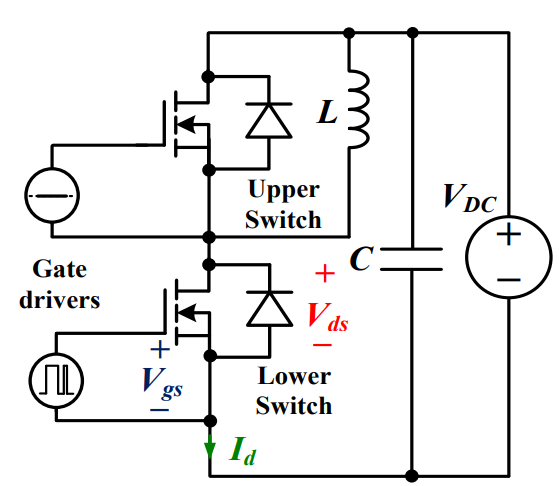 Discovering New and Advanced Methodology for Determining the Dynamic Characterization of Wide Bandgap DevicesSaumitra Jagdale15 March 20242861
For a long era, silicon has stood out as the primary material for fabricating electronic devices due to its affordability, moderate efficiency, and performance capabilities. Despite its widespread use, silicon faces several limitations that render it unsuitable for applications involving high power and elevated temperatures. As technological advancements continue and the industry demands enhanced efficiency from devices, these limitations become increasingly vivid. In the quest for electronic devices that are more potent, efficient, and compact, wide bandgap materials are emerging as a dominant player. Their superiority over silicon in crucial aspects such as efficiency, higher junction temperatures, power density, thinner drift regions, and faster switching speeds positions them as the preferred materials for the future of power electronics.
Read More Applications of FPGAs in Artificial Intelligence: A Comprehensive GuideUTMEL29 August 20255532
This comprehensive guide explores FPGAs as powerful AI accelerators that offer distinct advantages over traditional GPUs and CPUs. FPGAs provide reconfigurable hardware that can be customized for specific AI workloads, delivering superior energy efficiency, ultra-low latency, and deterministic performance—particularly valuable for edge AI applications. While GPUs excel at parallel processing for training, FPGAs shine in inference tasks through their adaptability and power optimization. The document covers practical implementation challenges, including development complexity and resource constraints, while highlighting solutions like High-Level Synthesis tools and vendor-specific AI development suites from Intel and AMD/Xilinx. Real-world applications span telecommunications, healthcare, autonomous vehicles, and financial services, demonstrating FPGAs' versatility in mission-critical systems requiring real-time processing and minimal power consumption.
Read More The 2026 Engineer’s Guide: Choosing the Right MCU for Your Next IoT & New Energy ProjectUTMEL30 April 20261754
A comprehensive comparison of 2026's leading MCUs from ST, NXP, and Microchip across power efficiency, processing performance, connectivity, and ecosystems to help engineers select the optimal chip for next-gen IoT and new energy projects.
Read More AI Server Components: Engineering Next-Gen Data Center Hardware for 100kW RacksUTMEL15 May 2026963
The transition from traditional enterprise IT to AI-driven workloads has rendered legacy data center hardware obsolete, forcing infrastructure planners to re-engineer server components for extreme thermal environments.
Read More The Practical Engineer’s Guide to the NE555N Timer: Pinout, Setup, and TroubleshootingUTMEL29 May 2026745
This comprehensive guide explores the NE555N timer, detailing its 8-pin layout, internal architecture, and key datasheet specifications. It compares the bipolar IC to CMOS variants and details setup configurations for astable, monostable, and bistable modes. Additionally, the guide offers practical troubleshooting advice to prevent common breadboard failures, such as floating reset pins and electrical noise issues.
Read More
Subscribe to Utmel !
![ATSHA204A-MAHDA-S]() ATSHA204A-MAHDA-S
ATSHA204A-MAHDA-SMicrochip Technology
![HCS360-I/SN]() HCS360-I/SN
HCS360-I/SNMicrochip Technology
![AT88SC0204CA-SH]() AT88SC0204CA-SH
AT88SC0204CA-SHMicrochip Technology
![CS8190EDWFR20G]() CS8190EDWFR20G
CS8190EDWFR20GON Semiconductor
![ATECC608A-MAHDA-T]() ATECC608A-MAHDA-T
ATECC608A-MAHDA-TMicrochip Technology
![ATSHA204A-MAHCZ-T]() ATSHA204A-MAHCZ-T
ATSHA204A-MAHCZ-TMicrochip Technology
![HCS301/SN]() HCS301/SN
HCS301/SNMicrochip Technology
![AT88SC0808CA-Y6H-T]() AT88SC0808CA-Y6H-T
AT88SC0808CA-Y6H-TMicrochip Technology
![ATAES132A-SHEQ-T]() ATAES132A-SHEQ-T
ATAES132A-SHEQ-TMicrochip Technology
![HCS201-I/P]() HCS201-I/P
HCS201-I/PMicrochip Technology


