

 Product
 Brand
 Articles
 Tools

NXP’s Third Letter, Foundry/OSAT Pass-Through, and a Year-End Price-Lock Checklist
According to November 2, 2026 supply-chain and financial media reports, NXP Semiconductors issued its third price-adjustment notice of 2026, scheduling price increases across selected distribution and direct-supply product lines effective January 1, 2027. This adjustment coincides with a broader January 2027 semiconductor price increase window driven by TSMC’s January 2027 wafer-out pricing updates and industry-wide outsourced semiconductor assembly and test (OSAT) cost increases highlighted during Microchip Technology’s early-November 2026 earnings commentary. Because NXP has not published a uniform blanket percentage or a public list of affected ordering part numbers (MPNs), procurement teams must audit exposure by exact ordering code and convert open quotes into a written fixed-price component price lock PO before mid-December operational cutoffs.
Pre-Checklist Decision Framework: 3-Variable BOM Triage Before You Act
Before executing a year-end purchase order lock, commodity managers and hardware sourcing teams should classify every active Bill of Materials (BOM) line across three operational variables. How a part falls across these boundaries determines whether you can lock 2026 pricing immediately or must budget for post-January cost escalation. For broader fourth-quarter supply and purchasing context before running this part-level audit, review our 2026 Q4 Electronic Components Market Analysis Report: Supply, Pricing, and Procurement Outlook.
| Triage Variable | Low-Exposure / Immediate Lock Candidate | High-Exposure / Escalation Candidate | Immediate Sourcing Action |
|---|---|---|---|
| 1. Contract & Backlog Status | Written fixed-price PO or active 30-day quote ready for immediate PO conversion | Unquoted rolling forecast, EDI forecast, or unallocated Blanket PO (BPO) | Convert active quotes to firm written POs before mid-December ERP cutoffs |
| 2. Inventory & Delivery Window | In-stock authorized distributor inventory available for pre-January shipment | 2027 build-to-order factory backlog governed by ship-date pricing clauses | Pull in allocatable stock into a December shipment or obtain a written ship-date repricing waiver |
| 3. Qualification Horizon | Dual-source BOM line with an approved pin-to-pin alternate already on the AVL | Single-source automotive/industrial MPN locked by customer registration or PCN rules | Initiate engineering second-source and OSAT qualification in Q4 to unlock 2H 2027 leverage |
Use the following decision branches to route each high-spend MPN on your BOM:
Is the exact MPN currently in stock at an authorized distributor and covered by an unexpired 2026 quote?
YES: Issue a firm written purchase order before mid-December requesting physical shipment or dedicated warehouse allocation prior to December 31, 2026.
NO: Proceed to the next branch.
Does your scheduled 2027 Blanket PO include a countersigned clause waiving the supplier’s "Right to Adjust Pricing Prior to Shipment"?
YES: Retain the scheduled releases under your Segment A (Pre-January Locked) budget and verify written PO acknowledgment numbers.
NO: Reclassify the 2027 delivery volume into Segment B (Post-January Escalation-Exposed) and initiate parallel alternate qualification if the part is single-sourced.
1. NXP’s Third 2026 Price-Increase Letter: What Is Confirmed for January 1, 2027 (and What Is Not)
According to November 2, 2026 industry reporting from Sina Finance / Cailianpress[1] and Jiemian News[2], NXP Semiconductors notified channel partners and customers that it will implement price adjustments across selected distribution and direct-supply product lines effective January 1, 2027. Supply-chain reporting identifies the November 2 communication as NXP’s third price-adjustment notice in 2026, following earlier pricing updates issued in the spring and autumn of 2026. Readers tracking how earlier quarterly adjustments evolved across the broader component landscape can reference our background overview on 2026 Semiconductor and Electronic Components Price Trends.
In the reported November 2 notice, NXP cited persistent, broad-based inflationary pressure across raw materials, energy, labor, logistics, and upstream manufacturing inputs that can no longer be fully absorbed internally. Channel advisories indicate that the adjustment spans selected automotive, industrial, and IoT product portfolios across both direct OEM accounts and authorized distribution channels.
Debunking Two Common Procurement Misconceptions
When a major integrated device manufacturer (IDM) issues a year-end pricing letter, secondary broker blogs and social media summaries frequently circulate oversimplified claims that lead to costly budgeting errors:
The "Blanket Percentage" Myth: NXP has not published a uniform blanket percentage increase across its product catalog for the NXP price increase 2027. Assuming a flat percentage across every NXP line item on your BOM will either overstate your 2027 standard cost on stable high-volume parts or severely underestimate Purchase Price Variance (PPV) on constrained mature-node and specialty-packaged devices.
The "Public MPN List" Myth: NXP has not released an open-web public PDF listing every affected ordering code. Price adjustments are communicated at the individual customer contract, distributor book-price feed, and part-number quotation level.
| Parameter | What Industry Reporting Confirms | What Requires Direct Quote / Account Verification | Procurement Action |
|---|---|---|---|
| Notice & Effective Dates | Notice reported November 2, 2026; effective January 1, 2027 | Distributor-specific ERP cutoffs for 2026 quote conversion (typically mid-December) | Submit quote refresh and PO lock requests before December 15, 2026 |
| 2026 Cadence | Third reported price-adjustment notice issued by NXP during calendar year 2026 | Whether your specific contract tier was exempted from earlier 2026 adjustments | Audit historical 2026 invoice unit prices against current Q4 quotes |
| Channel & Product Scope | Selected distribution and direct-supply lines across automotive, industrial, and IoT | Which specific MPNs, package suffixes, and temperature grades carry price revisions | Pull top-spend MPNs and request line-by-line 2027 book price verification |
| Percentage Adjustment | No uniform blanket rate disclosed; varies by product line and upstream cost inputs | Exact unit-price delta per ordering MPN and volume bracket | Never apply a flat catalog-wide percentage in 2027 finance models |
| Backlog Repricing Rules | Standard terms often reprice unshipped backlog on the effective date | Whether your existing BPO or LTA includes fixed-price shipment protection | Audit PO terms for "price at time of shipment" clauses immediately |
2. Same-Window Foundry and OSAT Pass-Through: TSMC’s January 2027 Wafer-Out Pricing and Microchip’s Cost Warning
NXP’s January 1, 2027 effective date is not an isolated vendor event. Instead, it aligns with a synchronized upstream repricing window across front-end wafer foundries and back-end outsourced semiconductor assembly and test (OSAT) providers taking effect at the start of 2027. When upstream wafer fabrication and back-end packaging rate cards reset in January, IDMs and fabless semiconductor suppliers that rely on external foundry and OSAT capacity pass those unabsorbed costs downstream to component buyers.
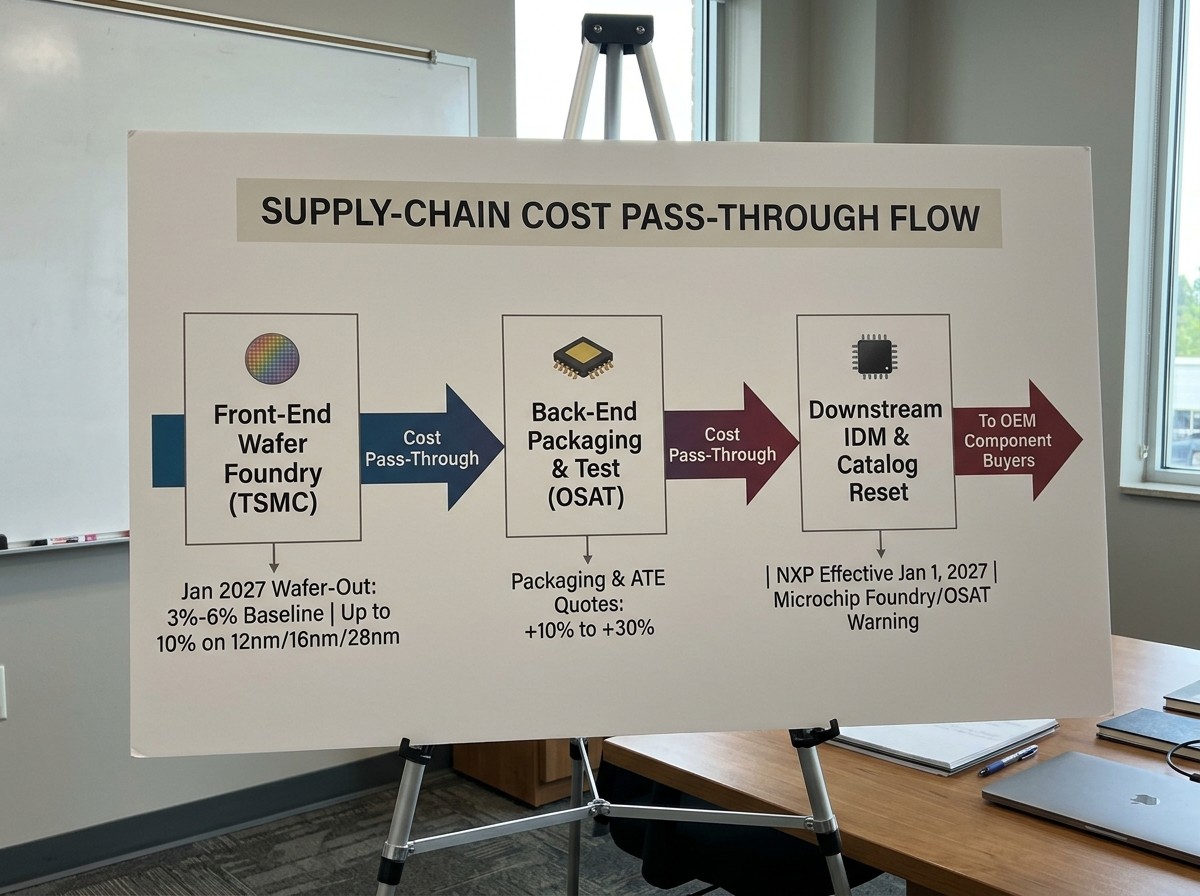
Why Reports Disagree on TSMC’s January 2027 Rate (3%–6% vs. Up to 10%)
Procurement teams presenting 2027 cost models to finance leadership often encounter conflicting headlines regarding TSMC’s 2027 foundry price adjustments. Some financial sources cite a 3% to 6% increase, while major business publications report increases of up to 10%. Both figures stem from verified supply-chain reporting, but they describe different commercial tiers and process nodes:
The 3% to 6% Baseline Wafer-Out Band: Supply-chain reports covered by Benzinga[4] and BigGo Finance[5] indicate that TSMC finalized a 3% to 6% baseline price increase starting on January 2027 wafer-out orders. These reports note that 8-inch wafer fabs have exceeded 100% utilization and process nodes at 45nm and below remain heavily booked entering 2027.
The 5% to 10% Node-Specific Ceiling: Earlier client negotiation reporting by Nikkei Asia[3], corroborated by trade analyses in TechRepublic[6] and DigiTimes[7], indicates that TSMC held discussions with clients for 2027 price hikes ranging from 5% to 10%. Specifically, mature-node processes—including 12nm, 16nm, and 28nm lines, which account for roughly 23% of revenue—face price increases of up to 10% to offset rising global fab construction costs (in Arizona, Kumamoto, and Dresden), equipment overhead, and raw material inflation.
For industrial and automotive buyers, this distinction is critical: many high-reliability microcontrollers, automotive radar processors, and industrial connectivity ICs are fabricated on 28nm, 16nm, and 40nm/45nm foundry nodes. Consequently, components tied to heavily utilized mature nodes or urgent capacity allocations face upstream pass-through pressures closer to the upper end of the reported range.
Back-End OSAT Inflation Confirmed in Microchip’s Early-November Commentary
Front-end wafer fabrication is only half of the January 2027 cost equation. According to market analyses from CM Telec and Chuangxin Cloud[8] summarizing Microchip Technology’s Q2 FY2027 earnings call in early November 2026 (reported November 5, 2026), Microchip CEO Steve Sanghi and management warned that surging AI demand has displaced capacity at major OSAT suppliers. Management noted that this back-end bottleneck impacts both internally fabricated and externally sourced wafers, confirming that most foundry and OSAT partners are implementing another round of price increases around January 2027.
Broader supply-chain reporting summarised in those market radars indicates that OSAT packaging and test quotes have climbed roughly 10% to 30% due to extended automated test equipment (ATE) cycle times, substrate shortages, and gold/copper wirebonding material inflation. Because mature industrial and automotive ICs have a higher ratio of packaging-and-test cost to raw silicon die cost than leading-edge processors, back-end OSAT hikes hit standard catalog components directly.
| Supply Chain Layer | Representative Industry Signal | Effective Window | Reported Scope / Magnitude | Downstream Buyer Impact |
|---|---|---|---|---|
| Front-End Wafer Foundry (TSMC) | Client negotiations & supply-chain wafer-out reports | January 2027 wafer-out orders | 3%–6% baseline wafer-out increase; up to 10% reported on selected advanced & mature nodes (12nm, 16nm, 28nm) | Direct wafer cost pass-through on fab-lite IDM and fabless MCU, SoC, and analog lines |
| Back-End Packaging & Test (OSAT Sector) | Industry-wide assembly & test rate adjustments | January 2027 | Packaging and test quotes reported up 10%–30% amid AI capacity displacement and extended test times | Disproportionate cost impact on high-pin-count QFP/BGA, automotive grade, and legacy packaged ICs |
| Peer IDM Industry Signal (Microchip) | Early-November 2026 Q2 FY2027 earnings commentary | Around January 2027 | Management confirmed most foundry and OSAT suppliers are raising prices again around January | Validates that January 2027 repricing is an industry-wide structural pass-through |
| Target IDM Notice (NXP Semiconductors) | Third 2026 customer/channel pricing notice (issued Nov 2, 2026) | January 1, 2027 | Selected direct and distribution product lines; part-specific adjustments (no uniform blanket rate) | Unprotected backlog and post-January quotes will reflect updated 2027 book pricing |
3. The 4-Step Year-End Component Price-Lock Checklist (Execute Before Mid-December)
To protect 2027 product margins without triggering panic-driven overbuying, procurement and engineering teams must execute a coordinated four-step workflow before mid-December operational cutoffs: (1) split 2027 budgets into pre-January and post-January segments, (2) lock written fixed-price POs before mid-December, (3) audit exposure by exact MPN and packaging specifications, and (4) initiate alternate component qualification immediately to beat the six-month OSAT requalification lag.
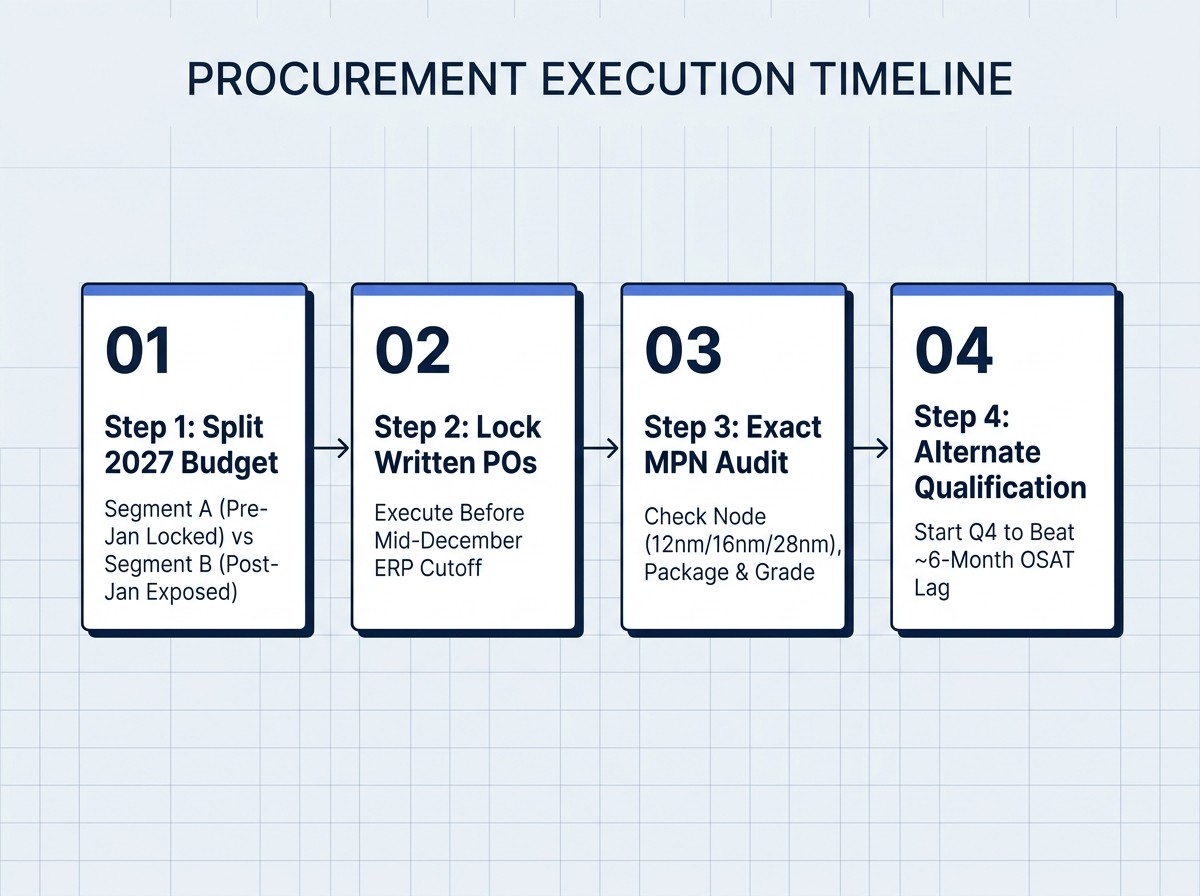
3.1 Step 1 — Split 2027 Cost Budgets into Pre-January and Post-January Segments
Setting a single static 2027 Standard Cost across your entire annual production volume guarantees immediate Purchase Price Variance (PPV) shocks in Q1 2027. Because components physically shipped or contractually locked at 2026 book prices carry a different unit cost than build-to-order backlog shipping after January 1, sourcing teams should instruct finance to bifurcate the 2027 BOM budget into two distinct segments.
| Budget Parameter | Segment A: Pre-January Locked Inventory | Segment B: Post-January Escalation-Exposed Backlog |
|---|---|---|
| Inventory & Order Source | In-stock authorized components shipped before Dec 31, 2026, or BPO releases backed by a signed fixed-price waiver | Build-to-order Q1–Q4 2027 factory backlog, unquoted rolling forecasts, and spot replenishment |
| Applicable Price Baseline | Confirmed Q4 2026 quoted unit price | Post-January 1, 2027 re-quoted book price (incorporating IDM, foundry, and OSAT pass-through) |
| Q1 2027 PPV Risk Level | Low (unit price is invoiced prior to or exempted from the Jan 1 reset) | High (subject to ship-date repricing 10–30 days prior to factory dispatch) |
| Finance Accounting Treatment | Lock as 1H 2027 Baseline Standard Cost for covered production lots | Apply a part-specific escalation buffer based on refreshed distributor quotes |
3.2 Step 2 — Lock Written Fixed-Price POs Before the Mid-December Operational Cutoff
Even though NXP’s pricing notice takes effect on January 1, 2027, waiting until the final week of December to submit purchase orders is an operational trap. Authorized distributors and IDM regional sales desks enforce mid-December cutoffs for quote re-validation, credit limit clearance, factory backlog booking, and year-end warehouse ERP freezes. A purchase order submitted on December 26 that sits unacknowledged in an order-entry queue until January 2 will automatically be rejected and re-quoted at 2027 book prices.
To execute a binding component price lock PO or scheduled Blanket Purchase Order (BPO) before mid-December, ensure the written order and supplier acknowledgment explicitly contain six mandatory elements:
Full Ordering MPN: The complete manufacturer ordering code, including package identifier, tape-and-reel/tray suffix, and temperature grade.
Locked Unit Price & Valid Quote Reference: The exact unit price tied to an unexpired written distributor or manufacturer quote number.
Order-Date Governing Clause: Explicit language confirming that unit pricing is governed by the confirmed PO acceptance date rather than the future delivery or invoice date.
Binding Delivery Schedule: Confirmed dock dates and release quantities (rather than open "TBD" call-off schedules).
Currency and Incoterms Lock: Fixed billing currency and freight/duty terms so logistics surcharges cannot be bundled into unit pricing after January 1.
Written Pre-Shipment Repricing Waiver: A countersigned acknowledgment overriding standard terms and conditions that otherwise permit unilateral price adjustments prior to shipment.
3.3 Step 3 — Review Lead Times and Price Exposure by Exact MPN and Key Specifications (Not by Broad Category)
Two integrated circuits within the exact same NXP or Microchip product family can experience completely different price adjustments and lead-time shifts on January 1, 2027. Broad category assumptions ("all microcontrollers up X%" or "all power management ICs flat") fail because upstream foundry and OSAT pass-through costs attach to physical manufacturing attributes.
When auditing your BOM, evaluate each part by exact MPN across five technical and commercial specifications:
Process Node and Die Complexity: Parts fabricated on heavily booked 12nm, 16nm, 28nm, or <=45nm foundry lines or 8-inch wafers operating above 100% utilization carry higher wafer-out cost pass-through than devices on underutilized legacy nodes.
Package Type and OSAT Complexity: High-pin-count BGA, LQFP, and specialty automotive packages require longer ATE test cycles and constrained OSAT assembly lines (where industry quotes have risen 10%–30%), whereas standard SOIC or QFN packages face less back-end bottleneck pressure.
Interconnect and Material Inputs: Legacy devices utilizing gold wirebonding or specialized multi-layer organic substrates absorb steeper raw material surcharges than standard copper-wirebond lead-frame parts.
Temperature and Qualification Suffix: Automotive AEC-Q100 Grade 0 and Grade 1 suffixes require multi-temperature hot/cold ATE testing at OSAT facilities, amplifying test-time cost pass-through compared to commercial or industrial temperature variants of the same base die.
Channel Stock Depth: An MPN with deep, immediately allocatable stock in authorized distribution can be pulled in at 2026 pricing, whereas a build-to-order MPN with a 16-to-26-week factory lead time is structurally exposed to 2027 ship-date pricing.
Following practical procurement triage workflows highlighted by Rapid Online, sourcing teams should apply a Pareto filter: pull the top 20% of BOM lines driving 80% of annual component spend immediately and request refreshed, line-by-line quotes by exact MPN before mid-December, rather than waiting until annual contract renewal dates.
3.4 Step 4 — Start Alternate Qualification Now to Beat the ~6-Month OSAT Requalification Lag
As engineering cost-management analysis in EE Times demonstrates, while buyers typically expect around a 30% price variance across different customers for the same electronic component, actual prices paid in the market vary by multiples of that amount. A primary driver of this extreme price dispersion is restrictive manufacturer part registration and rigid customer qualification locks that prevent buyers from switching suppliers when prices rise.
Waiting until higher January 2027 invoices arrive in Q1 to ask hardware engineering for a second source forfeits your negotiation leverage for almost the entire year. Qualifying a pin-to-pin drop-in alternate IC—or validating a primary vendor’s Product Change Notification (PCN) for a new OSAT assembly and test site—typically requires approximately six months (two full quarters) of electrical bench characterization, thermal cycling, EMI/EMC verification, and customer quality sign-off. Teams looking for a deeper breakdown of how engineering qualification timelines interact with industrial and automotive BOMs can consult our related guide on Automotive MCU Allocation Spillover 2026: Lead Times, Industrial Buyers, and Second-Source Qualification.
To compress both the pre-December PO lock and the six-month qualification cycle, procurement and hardware engineering teams can use an authorized and traceable distributor like Utmel.com to execute two parallel tracks:
Immediate Pre-January Stock & Scheduled Order Locks: Cross-check real-time inventory availability by exact ordering MPN (including package and temperature suffix) to secure in-stock lots with full manufacturer lot traceability and Certificates of Conformance (CoC) before the January 1 reset.
Drop-In Cross-Reference & Lifecycle Verification: Identify compatible second-source candidates and verify lifecycle statuses across industrial, automotive, and OEM BOM lines so engineering can begin six-month sample validation in Q4 2026—unlocking commercial price leverage in time for 2H 2027 production releases.
4. Hidden Contractual Risks, Common Mistakes, and Who Should NOT Lock Long-Term Fixed-Price POs
Placing a purchase order in December does not automatically shield a buyer from a January 1 price hike. Before committing working capital or signing Non-Cancellable, Non-Returnable (NCNR) agreements, sourcing teams must audit the legal and commercial mechanics of their orders.
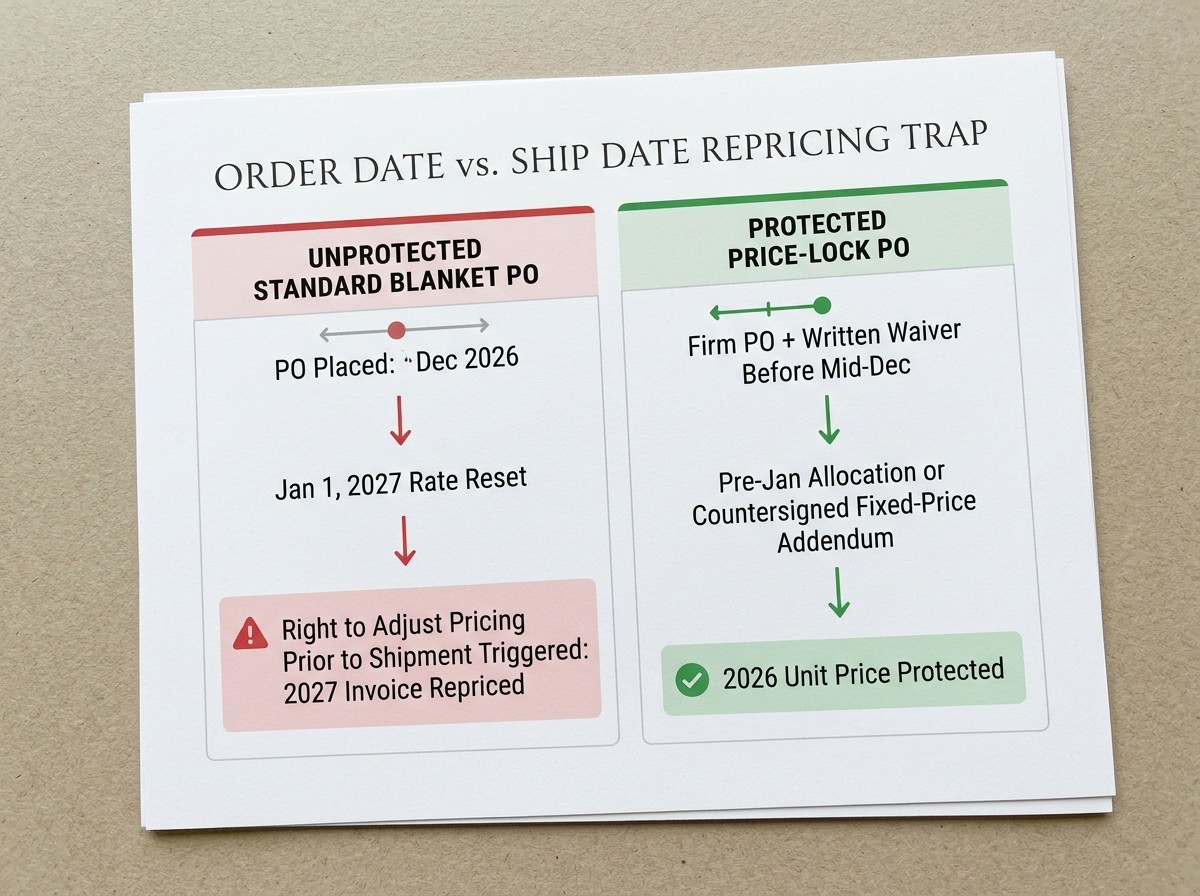
The "Order Date vs. Ship Date" Repricing Trap (Right to Adjust Pricing Prior to Shipment)
The single most expensive mistake procurement teams make during a Q4 price-increase window is assuming that an ordinary Blanket PO placed in December locks in 2026 pricing for deliveries scheduled in Q2 or Q3 2027. Standard terms and conditions used by major semiconductor manufacturers and franchises frequently contain a Right to Adjust Pricing Prior to Shipment clause.
Under this standard provision, if upstream factory or OSAT costs increase, the supplier reserves the right to reprice unshipped backlog—often up to 10 to 30 days prior to the scheduled factory ship date—regardless of the price printed on the original December PO. Unless you either take physical allocation/delivery before January 1, 2027, or secure an explicit written fixed-price addendum that waives pre-shipment repricing, your 2027 scheduled releases remain exposed.
Three Common Mistakes When Responding to a Price-Increase Letter
Treating Rolling Forecasts as Price Locks: Rolling 12-month EDI forecasts and non-binding vendor-managed inventory (VMI) projections reserve rough capacity planning, not unit pricing. Suppliers reprice forecasted buckets automatically on January 1.
Bundling In-Stock and Long-Lead Parts on One Unsplit PO: If a buyer places an in-stock MPN and a 20-week build-to-order MPN on a single purchase order marked "Ship Complete," the entire order will hold until 2027—exposing the in-stock line to post-January billing rules.
Panic-Buying Unverified Broker Stock: Rushing into unvetted gray-market channels in late December to beat a single-digit or low-double-digit price adjustment introduces counterfeit, remarked, or improperly stored moisture-sensitive (MSL) devices whose field-failure cost far exceeds the January price increase.
Comparison of Component Price-Lock Mechanisms
| Price-Lock Mechanism | Best For | Core Strength | Hidden Risk / Trade-Off | Who Should NOT Choose This Option |
|---|---|---|---|---|
| 1. Immediate Pre-January Stock Pull-In (Firm In-Stock PO) | High-spend active MPNs with verified distributor stock ready to ship before Dec 31 | Completely eliminates ship-date repricing risk; locks 2026 invoice price | Consumes Q4 working capital and increases local warehouse carrying cost | Cash-constrained teams or projects where the PCB is undergoing active EVT/DVT schematic changes |
| 2. Scheduled Blanket PO (BPO) with Written Fixed-Price Clause | Steady-run production BOMs requiring staggered Q1–Q2 2027 deliveries | Preserves cash flow via scheduled releases while capping unit cost | Vulnerable to "price at time of shipment" overrides if the fixed-price waiver is not countersigned | Buyers relying on standard portal click-through terms without written account-rep confirmation |
| 3. 12-Month Long-Term Supply Agreement (LTA / NCNR) | Single-source, high-volume automotive/industrial MPNs with frozen designs | Secures factory allocation and negotiated price ceilings through 2027 | Strict Non-Cancellable, Non-Returnable (NCNR) liability even if spot demand softens later in 2027 | Teams with volatile end-customer demand, products nearing End-of-Life (EOL), or multi-sourced passives |
| 4. Parallel Second-Source / Alternate MPN Qualification | High-margin-impact ICs where the primary vendor refuses 2027 price protection | Creates permanent commercial leverage and dual-source resilience from 2H 2027 onward | Requires ~6 months of engineering validation and PCN sign-off; provides zero relief for Q1 2027 invoices | Frozen medical or automotive safety designs where customer re-registration costs exceed the price hike |
Final Datasheet, Quote, and PO Verification Checklist
Before submitting your year-end purchase orders ahead of the mid-December cutoff, verify every high-spend BOM line against these six sign-off criteria:
Exact Ordering Code Match: Does the PO line item match the complete manufacturer ordering code on the datasheet, including package code, tape-and-reel/tray suffix, and automotive/industrial temperature grade?
Quote Validity Window: Does the referenced distributor or manufacturer quote remain valid through the actual date of written PO acknowledgment (not merely the date of PO submission)?
Pre-Shipment Repricing Waiver: For deliveries scheduled after January 1, 2027, has the supplier confirmed in writing that the order is exempt from "Right to Adjust Pricing Prior to Shipment" escalations?
Physical Stock vs. Backlog Split: Are in-stock lines separated onto an immediate-ship December PO so backordered lines do not delay pre-January invoicing?
Authorized Traceability Check: Are full manufacturer lot traceability and Certificates of Conformance (CoC) specified on the PO to prevent unauthorized broker substitutions?
Engineering PCN & Alternate Flag: Have all high-spend single-source MPNs without 2027 price protection been flagged for Q4 engineering alternate evaluation to beat the six-month qualification lag?
5. Frequently Asked Questions (FAQ): January 2027 Semiconductor Price Increases
When does the NXP 2027 price increase take effect, and how much are prices going up?
According to November 2, 2026 industry reporting, NXP’s third 2026 price-adjustment notice takes effect on January 1, 2027 across selected distribution and direct-supply product lines. NXP has not published a uniform blanket percentage or a public MPN list; actual adjustments vary by exact part number, product family, and customer contract.
Does placing a standard purchase order in December automatically lock in 2026 component pricing?
No. Standard semiconductor distributor and manufacturer terms frequently include a "Right to Adjust Pricing Prior to Shipment" clause. To lock 2026 pricing, buyers must either take physical delivery or allocation before January 1, 2027, or secure a written fixed-price PO acknowledgment before mid-December that explicitly waives pre-shipment repricing.
Why do reports on TSMC’s January 2027 wafer price increase vary between 3%–6% and up to 10%?
Supply-chain reports citing a 3% to 6% increase refer to baseline January 2027 wafer-out adjustments, whereas reports of 5% to 10% (such as Nikkei Asia’s coverage of client negotiations) reflect node-specific ceilings across selected advanced and mature (12nm, 16nm, and 28nm) processes facing steeper global fab expansion and capacity costs.
Why should engineering teams start alternate component qualification now if price hikes hit in January 2027?
Qualifying a drop-in alternate IC or validating an OSAT packaging and test site change typically requires around six months of electrical testing, thermal validation, and customer PCN approval. Starting qualification in Q4 2026 is necessary to unlock second-source pricing leverage in time for 2H 2027 deliveries.
Sources and references used for this guide
Sina Finance / Cailianpress: NXP Issues Price Increase Notice Effective January 1, 2027
Source type: reputable professional source
Used for: Supports the November 2, 2026 issuance date and January 1, 2027 effective date of NXP's third 2026 price-adjustment notice.
Caution: Financial media report on channel correspondence; NXP has not published a uniform rate or public MPN list.Jiemian News: November 2, 2026 Industry Report on NXP Pricing Adjustments
Source type: ai cited source
Used for: Corroborates NXP's January 1, 2027 price adjustment across selected distribution and direct-supply lines and cites raw material, energy, labor, and logistics cost drivers.
Caution: Industry news report; exact MPN pricing must be confirmed directly with authorized distributors or NXP sales representatives.Exclusive: TSMC to raise chipmaking prices by up to 10% from 2027
Source type: reputable professional source
Used for: Supports upper-bound industry reporting that TSMC held client discussions to raise advanced and mature chipmaking prices by up to 10% in 2027.
Caution: Journalistic reporting on client negotiations rather than an official public TSMC rate card; pair with 3%-6% baseline wafer-out reports.TSMC to Raise Wafer Prices 3%-6% in 2027: Report
Source type: reputable professional source
Used for: Supports supply-chain reporting that TSMC plans a 3% to 6% baseline wafer foundry price increase starting in January 2027.
Caution: Secondary financial news report; actual wafer pricing varies by process node, customer tier, and volume commitment.TSMC reportedly to raise foundry prices 3%-6% from January 2027
Source type: background source
Used for: Corroborates the January 2027 wafer-out timing and 3% to 6% overall foundry price adjustment range.
Caution: Aggregated financial news summary; use alongside Nikkei Asia and TechRepublic to frame the reported 3%-10% range.TSMC Reportedly Plans Chip Manufacturing Price Hikes
Source type: reputable professional source
Used for: Supports analysis of rising global fab expansion and manufacturing overhead driving 2027 foundry price adjustments.
Caution: Trade publication coverage of reported foundry pricing trends; not an official vendor notice.TSMC leads foundry price hikes as second-tier firms see cost pressure
Source type: reputable professional source
Used for: Supports broader semiconductor foundry pricing momentum and upstream cost pressure.
Caution: Supply-chain trade reporting; do not extrapolate unverified percentages to individual downstream MPNs.Chuangxin Cloud: TSMC, NXP, and Microchip January 2027 Price Increases
Source type: background source
Used for: Synthesizes the same-window January 2027 convergence of TSMC wafer-out pricing, NXP's November 2 notice, and Microchip's early-November commentary on foundry/OSAT costs.
Caution: Industry supply-chain blog; use for cross-vendor timeline context rather than official primary documentation.
 UTMEL

We are the professional distributor of electronic components, providing a large variety of products to save you a lot of time, effort, and cost with our efficient self-customized service. careful order preparation fast delivery service
 Power Semiconductor Procurement After the Nexperia Shake-Up—NXP for Stability, ON for Technology, or Nexperia for Value?UTMEL04 November 20255110
The recent supply chain turmoil surrounding Netherlands-based Nexperia has sent shockwaves through the global semiconductor industry, forcing procurement professionals to re-evaluate their sourcing strategies.
Read More AI Computing Power Gap: How Token Consumption is Reshaping Server Component SourcingUTMEL23 June 20261135
As global token consumption drives the transition to high-density 100kW+ AI data centers, power delivery networks require advanced Wide-Bandgap semiconductors (SiC/GaN) and high-capacitance MLCCs. This shift has triggered a component procurement crisis with lead times exceeding 24 weeks. To bypass shortages, hardware buyers must abandon just-in-time manufacturing and leverage independent global distributor networks to secure critical power and passive components.
Read More The BSPDN Revolution: Overcoming IR Drop in Sub-2nm GAAFET Nodes with Backside Power DeliveryUTMEL25 June 20261282
As semiconductor manufacturing enters the sub-2nm era, Backside Power Delivery Networks (BSPDN) are replacing traditional front-side routing to overcome critical IR drop bottlenecks. By separating power and signal delivery, chipmakers like Intel and TSMC drastically improve performance and density in GAAFET designs. However, this radical shift introduces manufacturing complexities, thermal challenges, and demands advanced packaging and power management solutions.
Read More Power Management ICs Trends 2026: AI Demand, Supply Risks, and Sourcing StrategiesUTMEL06 July 20261755
As AI server racks surpass 100kW by 2026, data centers are shifting toward wide-bandgap semiconductors like SiC and GaN. However, this demand has triggered a critical shortage of mature-node Power Management ICs (PMICs). To prevent production halts, sourcing teams must abandon 'just-in-time' models, implement proactive 'just-in-case' strategies, and rapidly qualify pin-to-pin alternative components to secure their supply chains.
Read More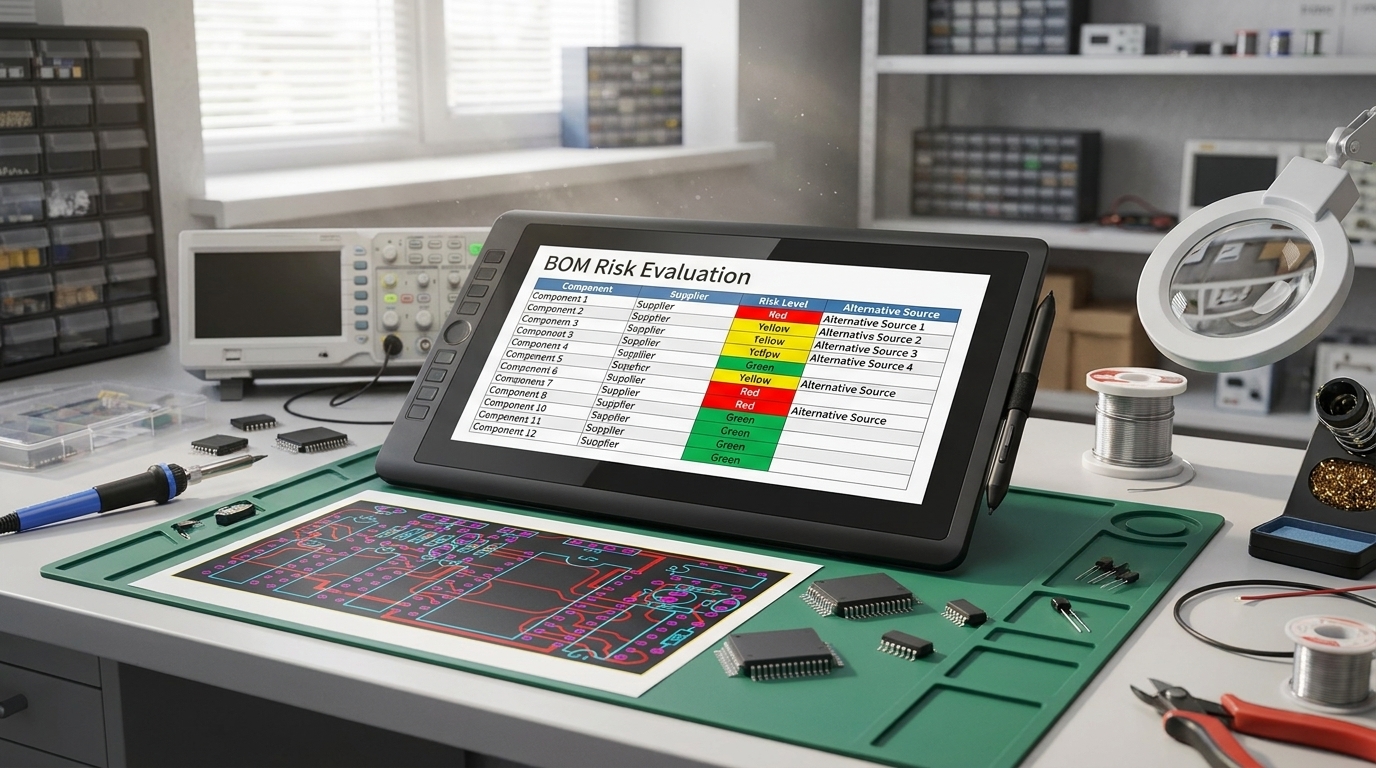 onsemi Synaptics Acquisition Impact: BOM Risk Checklist and Second-Source Strategy for Edge AI DesignsUTMEL27 July 2026496
The onsemi acquisition of Synaptics provides hardware program managers a 12-to-18-month window before potential product cancellations occur in mid-2027. This guide outlines how to audit BOM exposure across overlap and non-core product lines, calculate Last-Time-Buy volumes including hidden storage costs, establish proactive second-sourcing triggers, and implement supply chain monitoring to prevent line-down events.
Read More
Subscribe to Utmel !
![7BB-20-6L0]() 7BB-20-6L0
Murata Electronics
![PKMCS1818E20A0-R1]() PKMCS1818E20A0-R1
Murata Electronics
![AVRM0603C200MT150N]() AVRM0603C200MT150N
TDK Corporation
![CYBLE-202007-01]() CYBLE-202007-01
Cypress Semiconductor Corp
![BLM03AX121SN1D]() BLM03AX121SN1D
Murata Electronics
![BLM03AG601SN1D]() BLM03AG601SN1D
Murata Electronics
![BLM15GA750SN1D]() BLM15GA750SN1D
Murata Electronics
![BLM03AX241SN1D]() BLM03AX241SN1D
Murata Electronics
![BLA31BD102SN4D]() BLA31BD102SN4D
Murata Electronics
![ATA5283]() ATA5283
Atmel (Microchip Technology)


