Product
 Brand
Brand Articles
 Tools
Tools
The Rise of Co-Packaged Optics (CPO) and Silicon Photonics in AI Superclusters
As generative AI models scale to trillions of parameters, the data centers supporting them are hitting a severe physical bottleneck. The limitation is no longer just compute density; it is the sheer power required to move data between GPUs. In modern AI superclusters, traditional pluggable optical transceivers are approaching a power-performance wall. To bypass this barrier, network hardware architects are turning to Co-packaged Optics (CPO) and Silicon Photonics—architectural shifts that move optical engines directly onto the switch substrate to unlock ultra-low power consumption and massive bandwidth density.
The "Power-Performance Wall": Why Traditional Pluggable Optics Are Failing
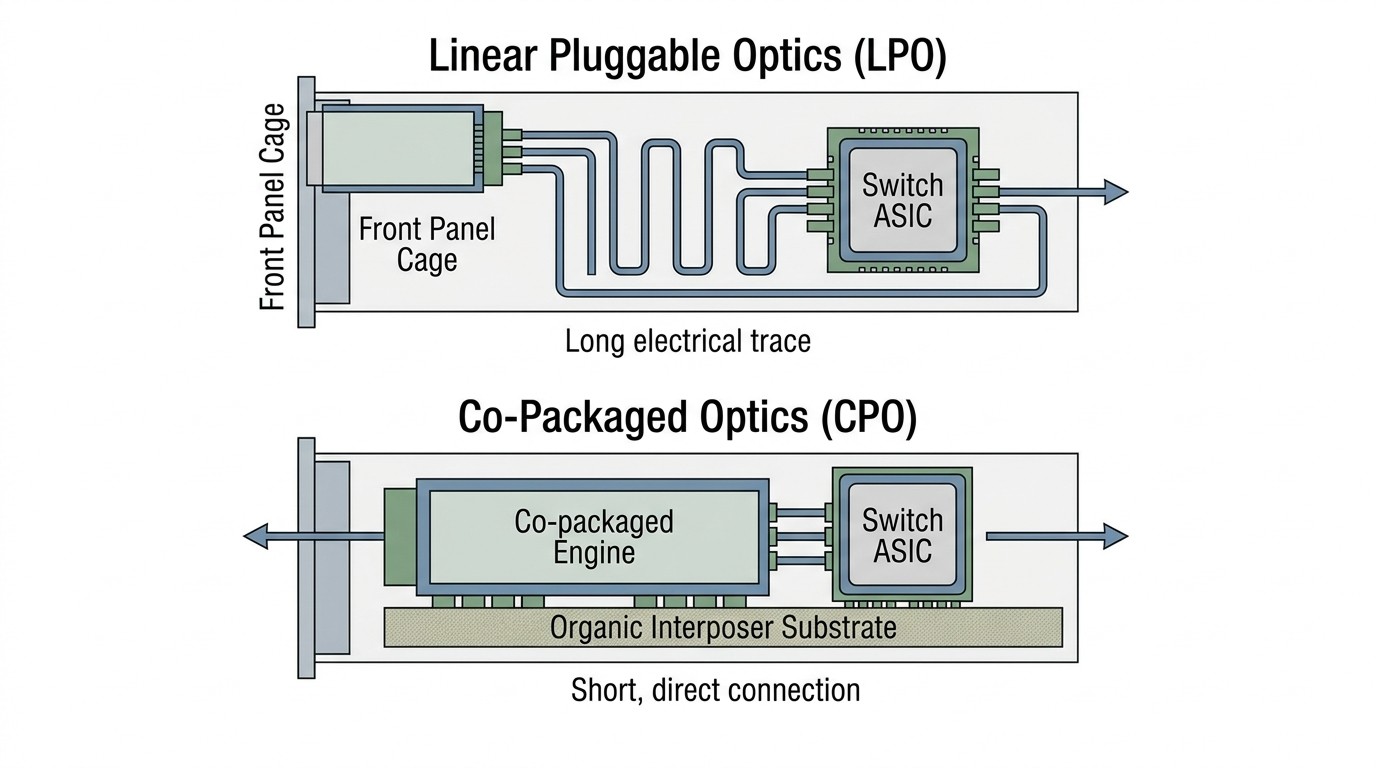
Data centers currently consume roughly 1.5% of global electricity, making power efficiency a hard constraint for scaling AI. In traditional network architectures, data travels from a switch ASIC across long copper printed circuit board (PCB) traces to reach pluggable optical modules at the front panel.
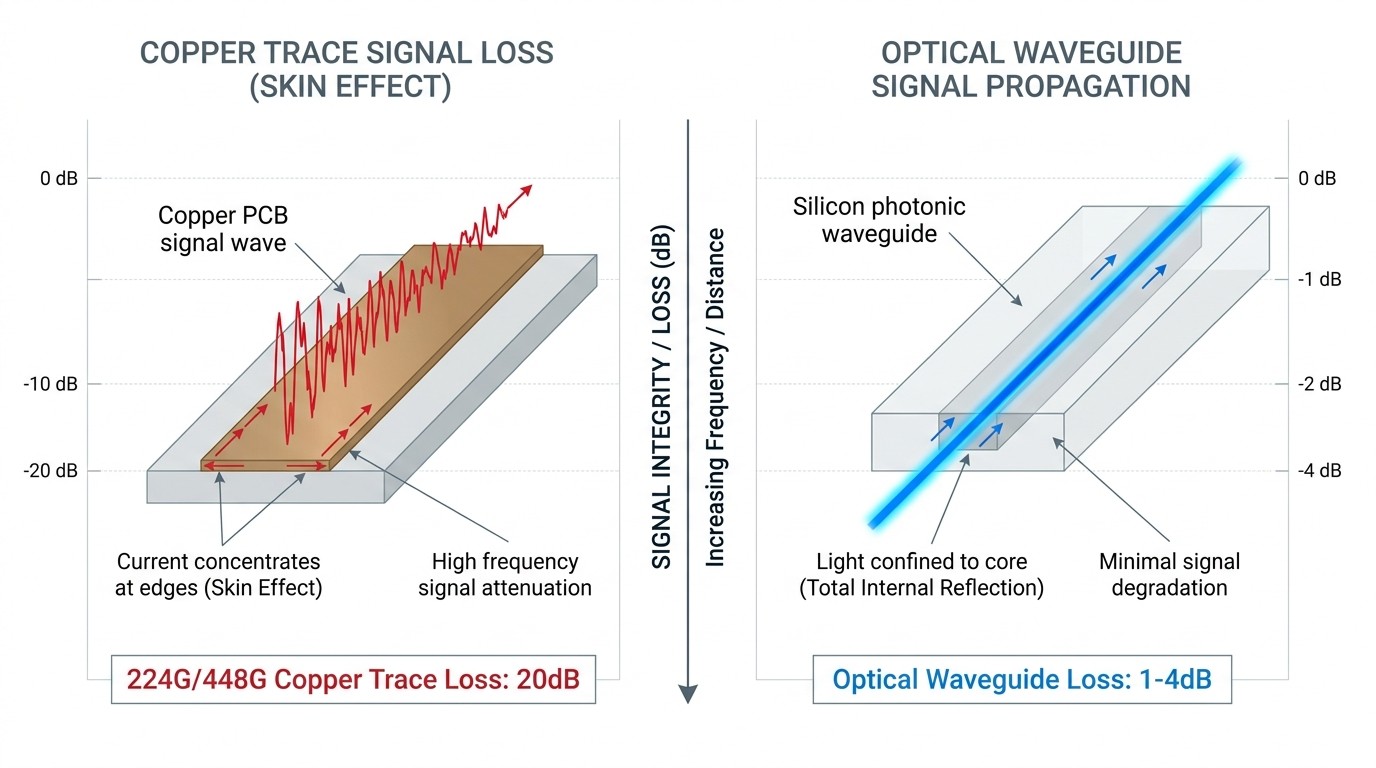
As SerDes (Serializer/Deserializer) speeds escalate to 224G and 448G, these copper traces suffer from the "skin effect," where high-frequency signals degrade exponentially over distance. To compensate for this massive signal attenuation, traditional pluggable modules rely on power-hungry Digital Signal Processors (DSPs) for signal retiming and equalization.
This architecture is mathematically unsustainable for next-generation AI. Visual demonstrations of upcoming 1-million GPU superclusters reveal a stark reality: a single traditional GPU optical transceiver burns roughly 30 watts, consuming about 15 picojoules (pJ) per transmitted bit. At a million-GPU scale, the system would require a staggering 180 megawatts just to move light. Shaving this power consumption is no longer an optimization—it is a strict prerequisite for scaling.
Co-Packaged Optics (CPO): Shrinking the SerDes Distance
Co-packaged Optics (CPO) fundamentally restructures the switch by moving the entire optical engine (modulators, photodetectors, and waveguides) off the front panel and integrating it directly alongside the host ASIC on a shared substrate.
By utilizing advanced 2.5D and 3D stacking technologies, CPO reduces the electrical trace length from several centimeters to mere micrometers. This physical proximity yields profound structural benefits:
Signal Loss Reduction: SerDes losses drop from roughly 20dB in traditional pluggables to just 1-4dB in CPO architectures.
Power Efficiency: By eliminating the need for heavy DSP retiming circuitry on the module, CPO drops energy consumption from 15 pJ/bit to near 5 pJ/bit, with industry roadmaps aiming for sub-1 pJ/bit. An 800G CPO module consumes approximately 5W, compared to 16W for a traditional pluggable—a 70% reduction in interconnect power.
Bandwidth Density: CPO enables the integration of 16x100G channels, providing the necessary density to support massive 51.2T and 102.4T switches without being constrained by front-panel physical space.
For engineers planning current and future deployments, understanding the transition from traditional 800G optical transceivers to integrated CPO systems is critical for managing thermal and power budgets.
Linear Pluggable Optics (LPO) vs. CPO: The DSP-Less Alternatives
While CPO represents the ultimate integration, it requires a complete overhaul of switch design and cooling infrastructure. Consequently, Linear Pluggable Optics (LPO) has emerged as a parallel solution. LPO removes the DSP retiming circuitry from both the transmit and receive paths of a pluggable module, relying entirely on the host ASIC for signal correction.
While some industry factions view LPO as a stepping stone to full CPO, others see them as permanent, complementary solutions: LPO for high-density, short-reach edge links (100-500m), and CPO for core aggregation.
Decision Framework: Pluggable vs. LPO vs. CPO
| Feature | Traditional Pluggable | Linear Pluggable Optics (LPO) | Co-Packaged Optics (CPO) |
|---|---|---|---|
| DSP Requirement | Yes (Heavy power tax) | No (Relies on host ASIC) | No (Integrated into package) |
| Power per 800G | ~16W | <4W | ~5W |
| Electrical Path | Centimeters (High loss) | Centimeters (Moderate loss) | Micrometers (Ultra-low loss) |
| Field Serviceability | Excellent (Hot-swappable) | Excellent (Hot-swappable) | Poor (Soldered to substrate) |
| Primary Use Case | Legacy data centers, long-haul | Short-reach AI clusters (100-500m) | High-density 51.2T/102.4T core switches |
📺 What is Co Packaged Optics?
Engineering Challenges: Silicon Photonics and Laser Integration
The foundation of CPO is Silicon Photonics, which allows optical components to be manufactured using standard, high-volume CMOS semiconductor processes. However, silicon is an indirect bandgap material, meaning it cannot efficiently generate light.
To solve this, engineers must integrate III-V materials, such as Indium Phosphide (InP) distributed feedback (DFB) lasers or Electro-absorption Modulated Lasers (EML), onto the silicon substrate. This presents severe advanced packaging challenges:
Sub-Micron Alignment: Coupling light from an InP laser into a silicon nitride waveguide requires alignment precision within 500 nanometers. Any deviation results in massive coupling losses.
Heterogeneous Integration: Foundries are relying on advanced manufacturing processes, such as flip-chip bonding and hybrid bonding (e.g., TSMC's COUPE platform), to weld these disparate chips together at the atomic level.
Thermal Management: Lasers are highly sensitive to heat. Placing them millimeters away from a switch ASIC that generates hundreds of watts of thermal energy causes laser noise (RIN) and linewidth degradation.
Mastering these physical layer challenges is essential. For a deeper dive into the underlying physics, review this introduction to Photonic Integrated Circuits (PICs) and the specific methods for overcoming challenges in Silicon Photonics.
The Reliability Trade-Off: Detachable Lasers and Field Serviceability
The most glaring vulnerability of Co-packaged Optics (CPO) is repairability. In a traditional network, if a transceiver fails, a technician simply swaps it out. In a pure CPO architecture, the optical engines are soldered directly onto the switch package. A single dead photonic engine or degraded laser has the potential to sideline an entire multi-million-dollar switch.
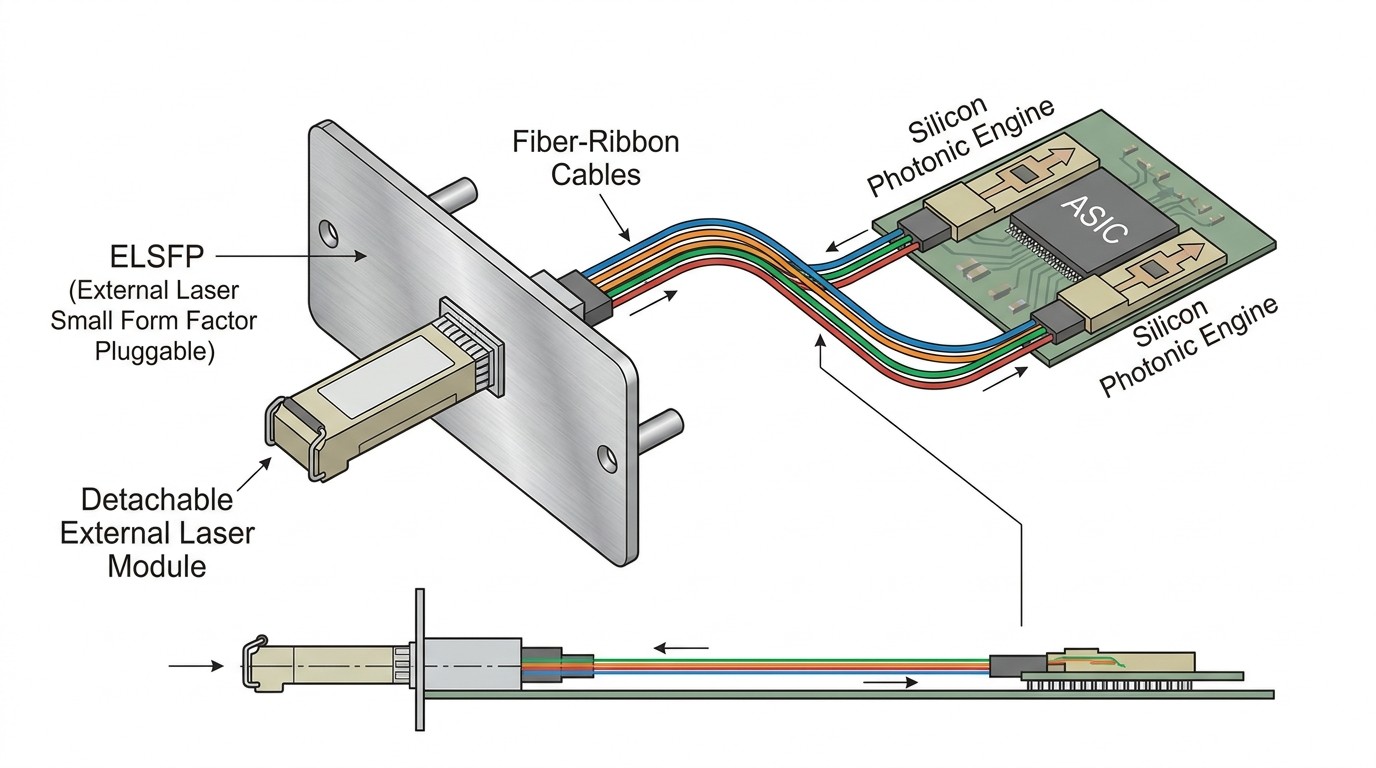
To combat this, leading hardware developers are employing a "detachable" hack. Industry teardowns of upcoming CPO switches (such as NVIDIA's Quantum-X architecture) reveal that while the silicon photonics engines are co-packaged with the ASIC, the lasers remain external. By using removable light-source modules that feed into the integrated photonic engines via fiber arrays, network operators can maintain field serviceability for the most failure-prone component—the laser diode—while still reaping the power-saving benefits of CPO.
Navigating the Optoelectronics Supply Chain
While 2026 is projected to be the commercialization milestone for CPO, mainstream, large-scale deployment is not expected until the 2028–2030 window. In the interim, network architects must aggressively scale AI infrastructure using a mix of high-speed pluggables, LPO, and early-stage CPO components.
This rapid scaling has created severe structural supply chain bottlenecks. Procurement teams frequently face 20-to-50-week OEM lead times for critical components like high-frequency optical transceivers, laser driver ICs, and DSPs. Waiting half a year for components is not viable for agile AI deployments.
To maintain deployment velocity, B2B electronic component buyers require strategic sourcing partners. UTMEL Electronics provides an extensive inventory of high-speed optoelectronics, laser diodes, fiber optic connectors, and laser driver ICs from leading global manufacturers. By leveraging a reliable independent distributor, network hardware architects can bypass OEM bottlenecks, secure the necessary optical transceiver components, and keep AI supercluster build-outs on schedule.
What to Ignore in the CPO Hype
When researching CPO and Silicon Photonics, filter out the following noise:
"CPO will replace all pluggables tomorrow": Ignore claims of immediate total market replacement. 2024/2025 hardware represents first-generation proof points. Pluggables and LPO will dominate the edge and short-reach links for years to come.
Proprietary Ecosystem Lock-in Pitches: Be wary of vendor marketing that frames their specific CPO implementation as the only viable standard. There is an ongoing ecosystem war between proprietary, closed-switch architectures and open, multi-vendor CPO consortiums.
Optical I/O (OIO) Distractions: While die-to-die Optical I/O is the theoretical endgame for chiplet communication, it is still largely in the R&D phase. Focus your immediate engineering and procurement efforts on CPO and LPO, which are solving today's switch-to-switch bottlenecks.
Frequently Asked Questions (FAQs)
Q: What is the main difference between Co-packaged Optics (CPO) and Linear Pluggable Optics (LPO)?
A: CPO integrates the optical engine directly onto the switch ASIC substrate to minimize the electrical trace distance, offering the highest power savings but sacrificing hot-swappability. LPO keeps the familiar pluggable module form factor but removes the power-hungry DSP, relying on the host switch for signal correction.
Q: Why are DSPs being removed from modern optical transceivers?
A: Digital Signal Processors (DSPs) are used to clean up signal degradation over copper traces. However, at 800G and 1.6T speeds, DSPs consume too much power (often up to 50% of a module's total power budget) and add latency. Removing them is necessary to keep AI data center power consumption manageable.
Q: How do engineers solve the problem of laser failure in CPO switches?
A: Because lasers are highly sensitive to heat and prone to failure, many CPO designs use External Laser Small Form Factor Pluggable (ELSFP) modules. The silicon photonics (modulators/detectors) are co-packaged with the switch, but the lasers are kept in detachable, field-replaceable modules at the front panel.
Q: What is the "skin effect" and why does it matter for AI networks?
A: The skin effect is a physical phenomenon where high-frequency alternating current (like 224G SerDes signals) travels primarily near the surface of a copper conductor, leading to massive signal attenuation and heat generation over distance. This forces the industry to replace copper with optics closer to the compute chip.
Q: How can procurement teams mitigate the 50-week lead times for optoelectronic components?
A: Buyers should diversify their supply chains beyond direct OEM channels. Partnering with established electronic component distributors who hold extensive, ready-to-ship inventories of laser driver ICs, optoelectronics, and transceivers can bypass structural bottlenecks and accelerate deployment timelines.
References
Evolving pluggable optics to reduce power consumption — Nokia
Scaling AI Infrastructure: Overcoming Interconnect Bottlenecks via CPO and Heterogeneous Integration — ASE
Wafer-Scale Hybrid Integration of InP DFB Lasers on Si Photonics by Flip-Chip Bonding — imec
光速革命:矽光子點亮AI資料中心的下一座引擎 — 經濟部產業技術司
下一代智算中心XPU扩展的光解耦技术演进 — 新华三集团 (H3C)
 UTMEL
UTMEL
We are the professional distributor of electronic components, providing a large variety of products to save you a lot of time, effort, and cost with our efficient self-customized service. careful order preparation fast delivery service
 Power Semiconductor Procurement After the Nexperia Shake-Up—NXP for Stability, ON for Technology, or Nexperia for Value?UTMEL04 November 20254869
The recent supply chain turmoil surrounding Netherlands-based Nexperia has sent shockwaves through the global semiconductor industry, forcing procurement professionals to re-evaluate their sourcing strategies.
Read More AI Computing Power Gap: How Token Consumption is Reshaping Server Component SourcingUTMEL23 June 2026942
As global token consumption drives the transition to high-density 100kW+ AI data centers, power delivery networks require advanced Wide-Bandgap semiconductors (SiC/GaN) and high-capacitance MLCCs. This shift has triggered a component procurement crisis with lead times exceeding 24 weeks. To bypass shortages, hardware buyers must abandon just-in-time manufacturing and leverage independent global distributor networks to secure critical power and passive components.
Read More The BSPDN Revolution: Overcoming IR Drop in Sub-2nm GAAFET Nodes with Backside Power DeliveryUTMEL25 June 2026907
As semiconductor manufacturing enters the sub-2nm era, Backside Power Delivery Networks (BSPDN) are replacing traditional front-side routing to overcome critical IR drop bottlenecks. By separating power and signal delivery, chipmakers like Intel and TSMC drastically improve performance and density in GAAFET designs. However, this radical shift introduces manufacturing complexities, thermal challenges, and demands advanced packaging and power management solutions.
Read More Power Management ICs Trends 2026: AI Demand, Supply Risks, and Sourcing StrategiesUTMEL06 July 20261412
As AI server racks surpass 100kW by 2026, data centers are shifting toward wide-bandgap semiconductors like SiC and GaN. However, this demand has triggered a critical shortage of mature-node Power Management ICs (PMICs). To prevent production halts, sourcing teams must abandon 'just-in-time' models, implement proactive 'just-in-case' strategies, and rapidly qualify pin-to-pin alternative components to secure their supply chains.
Read More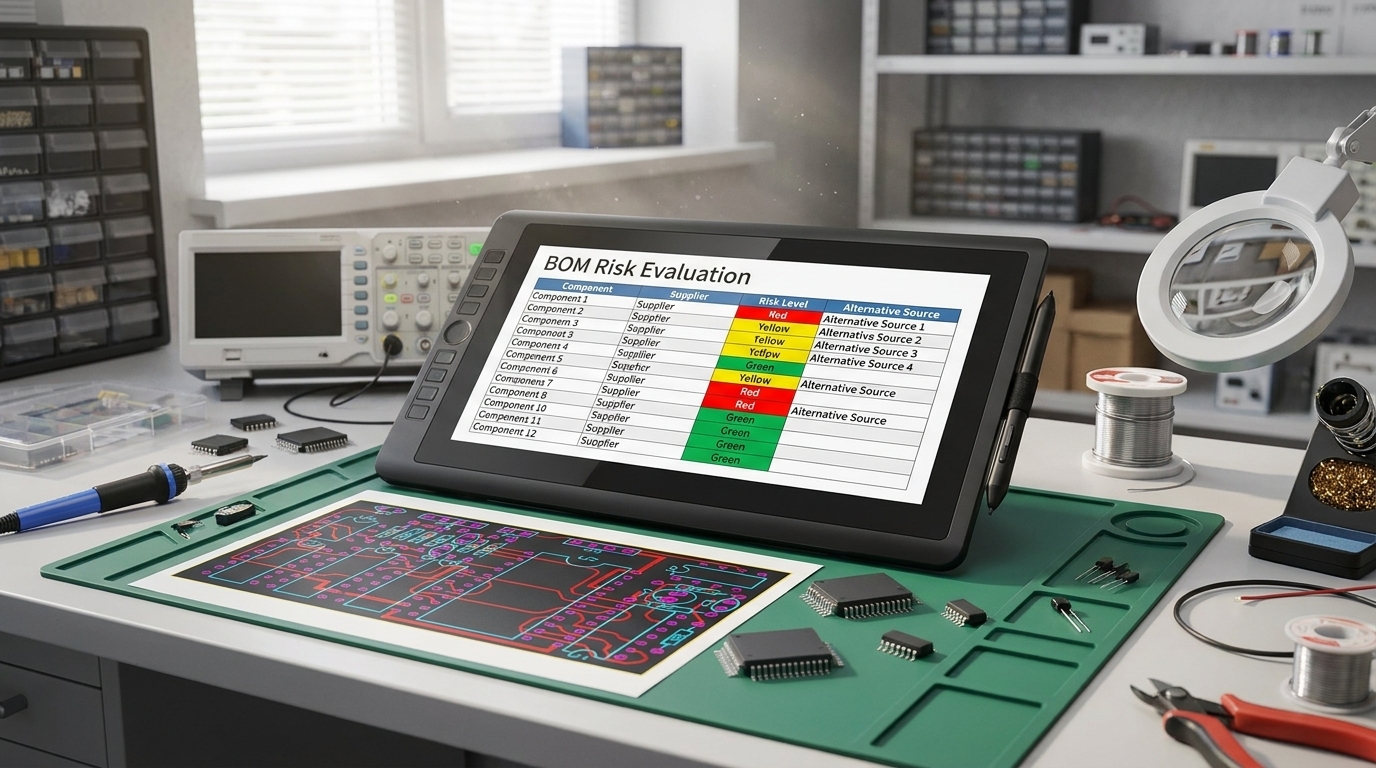 onsemi Synaptics Acquisition Impact: BOM Risk Checklist and Second-Source Strategy for Edge AI DesignsUTMEL27 July 2026337
The onsemi acquisition of Synaptics provides hardware program managers a 12-to-18-month window before potential product cancellations occur in mid-2027. This guide outlines how to audit BOM exposure across overlap and non-core product lines, calculate Last-Time-Buy volumes including hidden storage costs, establish proactive second-sourcing triggers, and implement supply chain monitoring to prevent line-down events.
Read More
Subscribe to Utmel !
![SLD8S22A]() SLD8S22A
SLD8S22ALittelfuse Inc.
![SPHV12-01ETG]() SPHV12-01ETG
SPHV12-01ETGLittelfuse Inc.
![TZY2Z060AC01R00]() TZY2Z060AC01R00
TZY2Z060AC01R00Murata Electronics
![SI8275GB-IS1]() SI8275GB-IS1
SI8275GB-IS1Silicon Labs
![MX25L25673GMI-10G]() MX25L25673GMI-10G
MX25L25673GMI-10GMacronix
![SML-S13RTT86]() SML-S13RTT86
SML-S13RTT86ROHM Semiconductor
![TZY2Z100AC01R00]() TZY2Z100AC01R00
TZY2Z100AC01R00Murata Electronics
![SD05C-7]() SD05C-7
SD05C-7Diodes Incorporated
![TEN-HS5]() TEN-HS5
TEN-HS5Traco Power
![UR030-006]() UR030-006
UR030-006Tripp Lite