

 Product
 Brand
Brand Articles
 Tools
Tools
74HC595D Shift Register: Pinout, Datasheet, and System Diagram

Toshiba Semiconductor and Storage
Shift Register -40°C~125°C Shift Register 74HC Series 16-SOIC (0.154, 3.90mm Width)


Shift Register -40°C~125°C Shift Register 74HC Series 16-SOIC (0.154, 3.90mm Width)
The 74HC595D is a high speed 8-BIT SHIFT REGISTER/LATCH fabricated with silicon gate C2MOS technology.

Julian's Logic: The 74HC595 Shift Register
74HC595D Description
The 74HC595D is a high speed 8-BIT SHIFT REGISTER/LATCH fabricated with silicon gate C2MOS technology. It achieve the high speed operation similar to equivalent LSTTL while maintaining the CMOS low power dissipation.
The 74HC595D contains an 8-bit static shift register which feeds an 8-bit storage register. Shift operation is accomplished on the positive going transition of the SCK input. The output register is loaded with the contents of the shift register on the positive going transition of the RCK input. Since RCK and SCK signal are independent, parallel outputs can be held stable during the shift operation. And, since the parallel outputs are 3-state, it can be directly connected to 8-bit bus.
This register can be used in serial-to-parallel conversion, data receivers, etc. All inputs are equipped with protection circuits against static discharge or transient excess voltage.
74HC595D Pinout
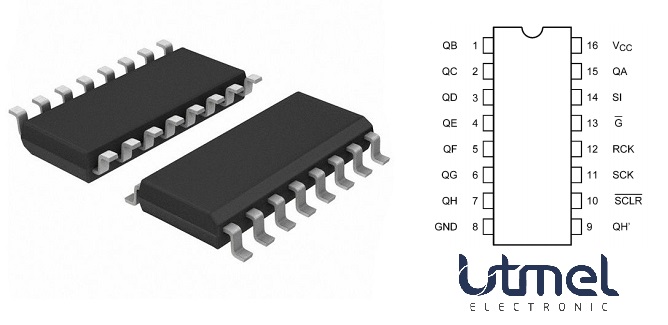
74HC595D CAD Model
Symbol

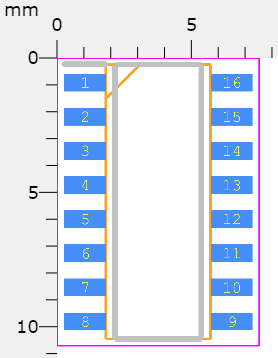
Footprint
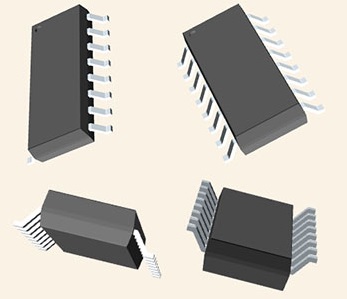
3D Model
74HC595D Features
High speed: fMAX = 55 MHz (typ.) at VCC = 5 V
Low power dissipation: ICC = 4.0 µA (max) at Ta = 25
Balanced propagation delays: tPLH ≈ tPHL
Wide operating voltage range: VCC(opr) = 2.0 V to 6.0 V
Specifications
- TypeParameter
- Factory Lead Time12 Weeks
- Mounting Type
The "Mounting Type" in electronic components refers to the method used to attach or connect a component to a circuit board or other substrate, such as through-hole, surface-mount, or panel mount.
Surface Mount - Package / Case
refers to the protective housing that encases an electronic component, providing mechanical support, electrical connections, and thermal management.
16-SOIC (0.154, 3.90mm Width) - Number of Elements1
- Operating Temperature
The operating temperature is the range of ambient temperature within which a power supply, or any other electrical equipment, operate in. This ranges from a minimum operating temperature, to a peak or maximum operating temperature, outside which, the power supply may fail.
-40°C~125°C - Packaging
Semiconductor package is a carrier / shell used to contain and cover one or more semiconductor components or integrated circuits. The material of the shell can be metal, plastic, glass or ceramic.
Cut Tape (CT) - Series
In electronic components, the "Series" refers to a group of products that share similar characteristics, designs, or functionalities, often produced by the same manufacturer. These components within a series typically have common specifications but may vary in terms of voltage, power, or packaging to meet different application needs. The series name helps identify and differentiate between various product lines within a manufacturer's catalog.
74HC - Part Status
Parts can have many statuses as they progress through the configuration, analysis, review, and approval stages.
Active - Moisture Sensitivity Level (MSL)
Moisture Sensitivity Level (MSL) is a standardized rating that indicates the susceptibility of electronic components, particularly semiconductors, to moisture-induced damage during storage and the soldering process, defining the allowable exposure time to ambient conditions before they require special handling or baking to prevent failures
1 (Unlimited) - Voltage - Supply
Voltage - Supply refers to the range of voltage levels that an electronic component or circuit is designed to operate with. It indicates the minimum and maximum supply voltage that can be applied for the device to function properly. Providing supply voltages outside this range can lead to malfunction, damage, or reduced performance. This parameter is critical for ensuring compatibility between different components in a circuit.
2V~6V - Function
The parameter "Function" in electronic components refers to the specific role or purpose that the component serves within an electronic circuit. It defines how the component interacts with other elements, influences the flow of electrical signals, and contributes to the overall behavior of the system. Functions can include amplification, signal processing, switching, filtering, and energy storage, among others. Understanding the function of each component is essential for designing effective and efficient electronic systems.
Serial to Parallel - Output Type
The "Output Type" parameter in electronic components refers to the type of signal or data that is produced by the component as an output. This parameter specifies the nature of the output signal, such as analog or digital, and can also include details about the voltage levels, current levels, frequency, and other characteristics of the output signal. Understanding the output type of a component is crucial for ensuring compatibility with other components in a circuit or system, as well as for determining how the output signal can be utilized or processed further. In summary, the output type parameter provides essential information about the nature of the signal that is generated by the electronic component as its output.
Tri-State - Logic Type
Logic Type in electronic components refers to the classification of circuits based on the logical operations they perform. It includes types such as AND, OR, NOT, NAND, NOR, XOR, and XNOR, each defining the relationship between binary inputs and outputs. The logic type determines how the inputs affect the output state based on specific rules of Boolean algebra. This classification is crucial for designing digital circuits and systems, enabling engineers to select appropriate components for desired functionalities.
Shift Register - Number of Bits per Element8
- RoHS Status
RoHS means “Restriction of Certain Hazardous Substances” in the “Hazardous Substances Directive” in electrical and electronic equipment.
RoHS Compliant
74HC595D IEC Logic Symbol
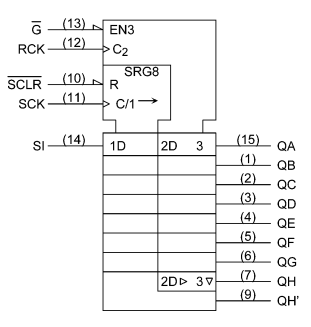
74HC595D System Diagram

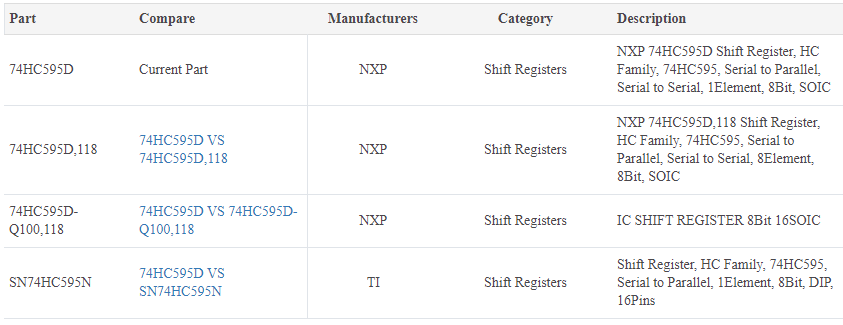
74HC595D Alternatives
Where to use 74HC595D
The 74HC595D can be used in various applications, especially in LED Boards. It is often used in projects where relatively a large number of LEDs has to be controlled through the Microcontroller. It can also be used to interface LCD screen since they can acts as the data bit for the LCD displays. It is also capable of controlling 5V loads like relays through a 3.3V microcontroller since the high-level voltage is only 3.15.
74HC595D Applications
Serial-to-parallel data conversion
Remote control holding register
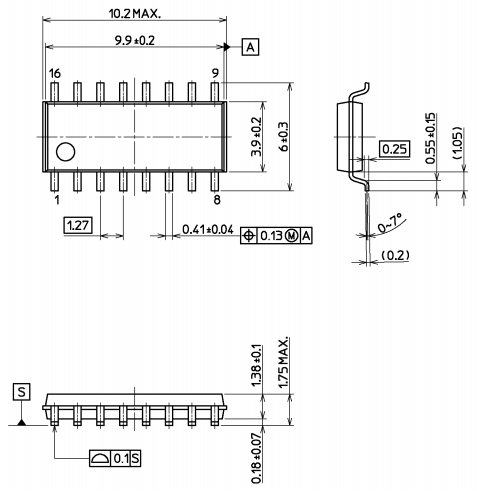
74HC595D Dimensions
74HC595D Manufacturer
Toshiba Semiconductor & Storage offers a broad range of enabling technology solutions that allow OEMs, ODMs, CMs and fabless chip companies to develop advanced integrated products for the computing, networking, communications, digital consumer, automotive and other markets.
Trend Analysis
Datasheet PDF
- Datasheets :
1.What is 74HC595D?
The 74HC595D is an 8 stage serial shift register with a storage register and 3 state outputs. The registers have separate clocks. Data is shifted on the positive going transitions of the shift register clock input (SHCP). Data in the storage register appears at the output whenever the output enable input (OE) is LOW.
2.How does the 74HC595 work?
The 74HC595 is a shift register which works on Serial IN Parallel OUT protocol. It receives data serially from the microcontroller and then sends out this data through parallel pins. We can increase our output pins by 8 using the single chip. We can also connect more than 1 shift register in parallel.
3.What’s the difference between 74HC595 and 74HC595D?
SN are TI parts. 74HC595 is the generic name. A suffix like D usually indicates a particular packaging or different temperature ranges. In that case it justs means SOIC package.
 2SD2499 NPN Transistor: 1500V, TO-3PF, 2SD2499 Equivalents and Pinout
08 January 20222141
 SN65HVD1781DR Transceiver: Circuit, RS-485
28 March 20222664
 2SC5200 NPN Transistor: Pinout, Datasheet, and Circuit
02 September 202143777
![STP16NF06L N-Channel 60 V 16A Through Hole TO-220[Voideo]: Datasheet, Pinout, and Applications](https://res.utmel.com/Images/Article/d449711c-40c5-4202-a31c-5065166507ad.jpg) STP16NF06L N-Channel 60 V 16A Through Hole TO-220[Voideo]: Datasheet, Pinout, and Applications
STP16NF06L N-Channel 60 V 16A Through Hole TO-220[Voideo]: Datasheet, Pinout, and Applications28 March 20221460
 PCM5100APWR Audio Stereo DAC: Diagram, Pinout, and Datasheet
11 April 20221583
 STM32F56x/76x: Comprehensive Technical Overview
29 February 2024323
 ADXL357BEZ Accelerometers: Pinout, Specification, Datasheet
14 August 20243968
 LSM6DSOXTR: 3.6V, iNEMO, Accelerometer and Datasheet
28 April 20227602
 How does the CPU Calculate 1+1?
12 January 20224755
 Hydrogen Fuel Cell: Features, Working and Applications
21 June 20216679
 Latest Pushbutton Switch Designs Transforming Modern Devices
11 July 20253108
 Semiconductor Material Industry Guide
21 January 20227164
 What is UART(Universal Asynchronous Receiver And Transmitter) ?
25 September 20216468
![Comprehensive Guide to Car Chips [FAQs]](https://res.utmel.com/Images/Article/e686e156-9363-4bbc-b1fd-c44fbe3ecbda.jpg) Comprehensive Guide to Car Chips [FAQs]
Comprehensive Guide to Car Chips [FAQs]11 January 20226302
 Analysis of Wide Bandgap Devices in Renewable Energy Systems
11 April 20235151
 How to Find the Ideal Voltage Reference for Your Application
11 July 20251275
Toshiba Semiconductor and Storage
In Stock
United States
China
Canada
Japan
Russia
Germany
United Kingdom
Singapore
Italy
Hong Kong(China)
Taiwan(China)
France
Korea
Mexico
Netherlands
Malaysia
Austria
Spain
Switzerland
Poland
Thailand
Vietnam
India
United Arab Emirates
Afghanistan
Åland Islands
Albania
Algeria
American Samoa
Andorra
Angola
Anguilla
Antigua & Barbuda
Argentina
Armenia
Aruba
Australia
Azerbaijan
Bahamas
Bahrain
Bangladesh
Barbados
Belarus
Belgium
Belize
Benin
Bermuda
Bhutan
Bolivia
Bonaire, Sint Eustatius and Saba
Bosnia & Herzegovina
Botswana
Brazil
British Indian Ocean Territory
British Virgin Islands
Brunei
Bulgaria
Burkina Faso
Burundi
Cabo Verde
Cambodia
Cameroon
Cayman Islands
Central African Republic
Chad
Chile
Christmas Island
Cocos (Keeling) Islands
Colombia
Comoros
Congo
Congo (DRC)
Cook Islands
Costa Rica
Côte d’Ivoire
Croatia
Cuba
Curaçao
Cyprus
Czechia
Denmark
Djibouti
Dominica
Dominican Republic
Ecuador
Egypt
El Salvador
Equatorial Guinea
Eritrea
Estonia
Eswatini
Ethiopia
Falkland Islands
Faroe Islands
Fiji
Finland
French Guiana
French Polynesia
Gabon
Gambia
Georgia
Ghana
Gibraltar
Greece
Greenland
Grenada
Guadeloupe
Guam
Guatemala
Guernsey
Guinea
Guinea-Bissau
Guyana
Haiti
Honduras
Hungary
Iceland
Indonesia
Iran
Iraq
Ireland
Isle of Man
Israel
Jamaica
Jersey
Jordan
Kazakhstan
Kenya
Kiribati
Kosovo
Kuwait
Kyrgyzstan
Laos
Latvia
Lebanon
Lesotho
Liberia
Libya
Liechtenstein
Lithuania
Luxembourg
Macao(China)
Madagascar
Malawi
Maldives
Mali
Malta
Marshall Islands
Martinique
Mauritania
Mauritius
Mayotte
Micronesia
Moldova
Monaco
Mongolia
Montenegro
Montserrat
Morocco
Mozambique
Myanmar
Namibia
Nauru
Nepal
New Caledonia
New Zealand
Nicaragua
Niger
Nigeria
Niue
Norfolk Island
North Korea
North Macedonia
Northern Mariana Islands
Norway
Oman
Pakistan
Palau
Palestinian Authority
Panama
Papua New Guinea
Paraguay
Peru
Philippines
Pitcairn Islands
Portugal
Puerto Rico
Qatar
Réunion
Romania
Rwanda
Samoa
San Marino
São Tomé & Príncipe
Saudi Arabia
Senegal
Serbia
Seychelles
Sierra Leone
Sint Maarten
Slovakia
Slovenia
Solomon Islands
Somalia
South Africa
South Sudan
Sri Lanka
St Helena, Ascension, Tristan da Cunha
St. Barthélemy
St. Kitts & Nevis
St. Lucia
St. Martin
St. Pierre & Miquelon
St. Vincent & Grenadines
Sudan
Suriname
Svalbard & Jan Mayen
Sweden
Syria
Tajikistan
Tanzania
Timor-Leste
Togo
Tokelau
Tonga
Trinidad & Tobago
Tunisia
Turkey
Turkmenistan
Turks & Caicos Islands
Tuvalu
U.S. Outlying Islands
U.S. Virgin Islands
Uganda
Ukraine
Uruguay
Uzbekistan
Vanuatu
Vatican City
Venezuela
Wallis & Futuna
Yemen
Zambia
Zimbabwe
![74VHC164FT]() 74VHC164FT
74VHC164FTToshiba Semiconductor and Storage
![74VHC595FT]() 74VHC595FT
74VHC595FTToshiba Semiconductor and Storage
![TC74HC595AFN]() TC74HC595AFN
TC74HC595AFNToshiba
![74VHC165FT]() 74VHC165FT
74VHC165FTToshiba Semiconductor and Storage
![TC74VHC595F(EL,K,F]() TC74VHC595F(EL,K,F
TC74VHC595F(EL,K,FToshiba Semiconductor and Storage
![74HC166D]() 74HC166D
74HC166DToshiba Semiconductor and Storage
![74HC595D(BJ)]() 74HC595D(BJ)
74HC595D(BJ)Toshiba
![TC74HC165AP(F)]() TC74HC165AP(F)
TC74HC165AP(F)Toshiba Semiconductor and Storage
![74HC164D]() 74HC164D
74HC164DToshiba Semiconductor and Storage
![TC74HC165AF(EL,F)]() TC74HC165AF(EL,F)
TC74HC165AF(EL,F)Toshiba Semiconductor and Storage


