

 Product
 Brand
Brand Articles
 Tools
Tools
Arduino Leonardo: Specifications,Documentation and FAQs


ARDUINO A000052ATMEGA32U4, ARDUINO LEONARDO, BOARD
The Arduino Leonardo is an advanced microcontroller development board based around the ATmega32u4 microcontroller.

Why you should buy an Arduino Leonardo
Arduino Leonardo overview

The Arduino Leonardo is an advanced microcontroller development board based around the ATmega32u4 microcontroller. It represents an evolution of previous boards like the Arduino Uno, providing built-in USB communication capabilities through the ATmega32u4 chip.
At the heart of the Leonardo is the 8-bit ATmega32u4 AVR RISC microcontroller running at 16 MHz and featuring 32KB of flash memory, 2.5KB of SRAM, and 1KB of EEPROM. The chip natively supports USB communication, allowing the Leonardo to interface with a connected computer by appearing as a virtual serial port and also acting as a keyboard/mouse. This eliminates the need for extra chips found on prior boards.
Technical specifications of the ATmega32u4 microcontroller:
| Specification | Value |
|---|---|
| Microcontroller Type | 8-bit AVR |
| Flash Memory | 32 KB |
| SRAM | 2.5 KB |
| EEPROM | 1 KB |
| Operating Voltage | 2.7 to 5.5V |
| Operating Frequency | 16 MHz |
| Operating Temperature | -40 to 85 C |
| UART Ports | 1 |
| SPI Peripheral | 4 |
| I2C Pins | 1 |
| Digital I/O Pins | 20 |
| PWM Outputs | 7 |
| Analog Inputs | 12 |
*Please note that these are the general specifications and the actual performance may vary depending on the specific model and usage conditions.
The Leonardo has 20 digital I/O pins that can be used for digitalRead()/digitalWrite() or as analog inputs using analogRead(). 7 of these pins can provide 8-bit PWM output using analogWrite(). There is also a standard 6-pin ISP header for external programming and debugging. Power can be provided over USB or via an external source.

*As the official partner of Arduino, Utmel provides you with official original Arduino products. Welcome to shop at the page dedicated to Arduino products.
Specifications
- TypeParameter
- Factory Lead Time3 Weeks
- Mounting Type
The "Mounting Type" in electronic components refers to the method used to attach or connect a component to a circuit board or other substrate, such as through-hole, surface-mount, or panel mount.
Fixed - Weight9.071847g
- Series
In electronic components, the "Series" refers to a group of products that share similar characteristics, designs, or functionalities, often produced by the same manufacturer. These components within a series typically have common specifications but may vary in terms of voltage, power, or packaging to meet different application needs. The series name helps identify and differentiate between various product lines within a manufacturer's catalog.
AVR® ATmega - Published2012
- Part Status
Parts can have many statuses as they progress through the configuration, analysis, review, and approval stages.
Active - Moisture Sensitivity Level (MSL)
Moisture Sensitivity Level (MSL) is a standardized rating that indicates the susceptibility of electronic components, particularly semiconductors, to moisture-induced damage during storage and the soldering process, defining the allowable exposure time to ambient conditions before they require special handling or baking to prevent failures
Not Applicable - TypeMCU 8-Bit
- Operating Supply Voltage
The voltage level by which an electrical system is designated and to which certain operating characteristics of the system are related.
12V - Interface
In electronic components, the term "Interface" refers to the point at which two different systems, devices, or components connect and interact with each other. It can involve physical connections such as ports, connectors, or cables, as well as communication protocols and standards that facilitate the exchange of data or signals between the connected entities. The interface serves as a bridge that enables seamless communication and interoperability between different parts of a system or between different systems altogether. Designing a reliable and efficient interface is crucial in ensuring proper functionality and performance of electronic components and systems.
USB - Number of Bits8
- Core Processor
The term "Core Processor" typically refers to the central processing unit (CPU) of a computer or electronic device. It is the primary component responsible for executing instructions, performing calculations, and managing data within the system. The core processor is often considered the brain of the device, as it controls the overall operation and functionality. It is crucial for determining the speed and performance capabilities of the device, as well as its ability to handle various tasks and applications efficiently. In modern devices, core processors can have multiple cores, allowing for parallel processing and improved multitasking capabilities.
AVR - Data Bus Width
The data bus width in electronic components refers to the number of bits that can be transferred simultaneously between the processor and memory. It determines the amount of data that can be processed and transferred in a single operation. A wider data bus allows for faster data transfer speeds and improved overall performance of the electronic device. Common data bus widths include 8-bit, 16-bit, 32-bit, and 64-bit, with higher numbers indicating a larger capacity for data transfer. The data bus width is an important specification to consider when evaluating the speed and efficiency of a computer system or other electronic device.
10b - Utilized IC / Part
Utilized IC / Part is a parameter that refers to the extent to which an integrated circuit (IC) or electronic component is being used or consumed within a system or application. It typically indicates the percentage or ratio of the component's capabilities that are being utilized in a given scenario. This parameter is important for assessing the efficiency and performance of the component, as well as for determining if the component is being underutilized or overburdened in a particular application. Monitoring and optimizing the utilization of ICs and electronic parts can help improve overall system reliability, efficiency, and cost-effectiveness.
ATmega32U4 - Evaluation Kit
An Evaluation Kit is a collection of hardware and software components designed to help engineers and developers assess and test the functionality of a particular electronic component or system. It typically includes a development board, sample code, utilities, and documentation to facilitate development and prototype testing. Evaluation Kits enable users to quickly prototype applications, evaluate performance characteristics, and determine compatibility with other systems. They are commonly used in the design and development phases of electronic projects to simplify the integration of complex components.
Yes - Core Architecture
In electronic components, the term "Core Architecture" refers to the fundamental design and structure of the component's internal circuitry. It encompasses the arrangement of key components, such as processors, memory units, and input/output interfaces, within the device. The core architecture plays a crucial role in determining the component's performance, power efficiency, and overall capabilities. Different core architectures are optimized for specific applications and requirements, such as high-speed processing, low power consumption, or specialized functions. Understanding the core architecture of electronic components is essential for engineers and designers to select the most suitable components for their projects.
AVR - ContentsBoard(s)
- Board Type
Board Type refers to the specific configuration or category of a printed circuit board (PCB) used in electronic devices. It defines the characteristics and design of the board, such as single-sided, double-sided, or multilayer constructions. The Board Type impacts factors like signal integrity, power distribution, and thermal management, influencing the overall performance and functionality of the electronic component. Different applications and environments may require specific Board Types to meet durability and operational requirements.
Evaluation Platform - Platform
In the context of electronic components, the parameter "Platform" typically refers to the specific hardware or software environment on which the component is designed to operate. This could include the type of operating system, processor architecture, communication protocols, or other technical specifications that the component is compatible with. Understanding the platform requirements of electronic components is crucial for ensuring proper functionality and integration within a larger system. Manufacturers often provide detailed information about the supported platforms to help users select the right components for their applications.
Arduino Leonardo without Headers - Height1.27mm
- Length76.2mm
- Width63.5mm
- REACH SVHC
The parameter "REACH SVHC" in electronic components refers to the compliance with the Registration, Evaluation, Authorization, and Restriction of Chemicals (REACH) regulation regarding Substances of Very High Concern (SVHC). SVHCs are substances that may have serious effects on human health or the environment, and their use is regulated under REACH to ensure their safe handling and minimize their impact.Manufacturers of electronic components need to declare if their products contain any SVHCs above a certain threshold concentration and provide information on the safe use of these substances. This information allows customers to make informed decisions about the potential risks associated with using the components and take appropriate measures to mitigate any hazards.Ensuring compliance with REACH SVHC requirements is essential for electronics manufacturers to meet regulatory standards, protect human health and the environment, and maintain transparency in their supply chain. It also demonstrates a commitment to sustainability and responsible manufacturing practices in the electronics industry.
Unknown - RoHS Status
RoHS means “Restriction of Certain Hazardous Substances” in the “Hazardous Substances Directive” in electrical and electronic equipment.
Non-RoHS Compliant
Arduino Leonardo pinout diagram
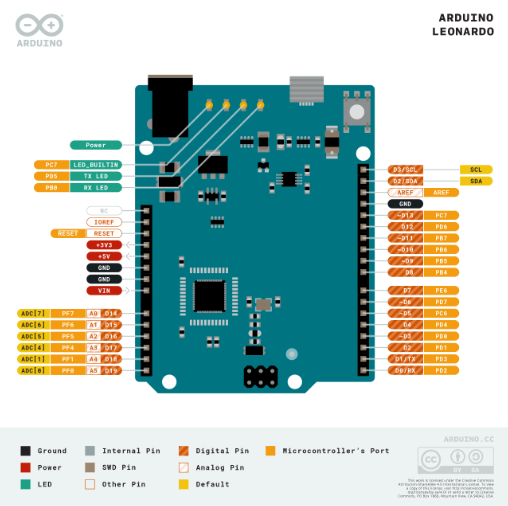
Arduino Leonardo features
-Microcontroller: ATmega32u4 with built-in USB communication
-Operating Voltage: 5V
-Digital I/O Pins: 20
-PWM Pins: 7
-Analog Input Pins: 12
-Flash Memory: 32 KB
-SRAM: 2.5 KB
-EEPROM: 1 KB
-USB 2.0 capabilities
-In-built LED on pin 13
Arduino Leonardo related boards
Arduino Leonardo vs. Arduino Micro
| Feature | Arduino Leonardo | Arduino Micro |
|---|---|---|
| Microcontroller | ATmega32u4 | ATmega32U4 |
| Digital I/O Pins | 20 | 20 |
| PWM Pins | 7 | 7 |
| Analog Input Pins | 12 | 12 |
| Clock Speed | 16 MHz | 16 MHz |
| SRAM | 2.5kb | 2.5kb |
| Flash Memory | 32kb | 32kb |
| EEPROM | 1kb | 1kb |
| Length | 68.6 mm | 48 mm |
| Width | 53.3 mm | 18 mm |
| Weight | 20 g | 13 g |
Both boards are based on the ATmega32U4 microcontroller and have similar features, but the Arduino Micro is smaller and lighter than the Arduino Leonardo.
Arduino Leonardo applications
-USB HID devices (mouse, keyboard, etc)
-Universal remote controls
-Advanced robotics and animatronics
-Musical instruments and effects
-Educational and prototyping purposes
-Home automation systems
Arduino Leonardo Project Example
USB Game Controller using Arduino Leonardo
The Arduino Leonardo has built-in USB communication, which allows it to emulate a mouse, keyboard, or other types of USB devices. This makes it perfect for creating a custom USB game controller.
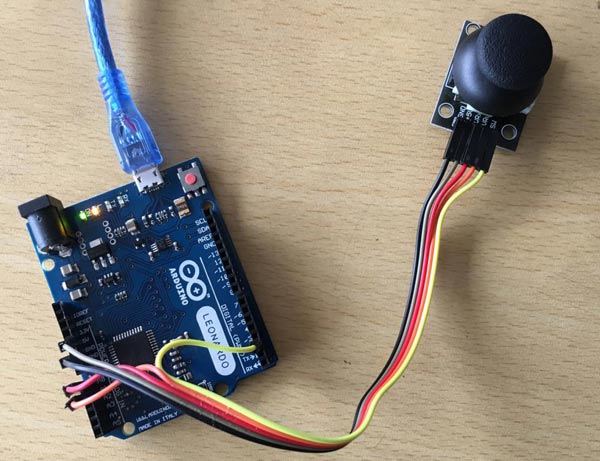
image source: circuitdigest
Components Required:
1. Arduino Leonardo
2. Joystick Module
3. Push Buttons (as many as you need for your game controls)
4. 10k Ohm Resistors (for the push buttons)
5. Breadboard and Jumper Wires
Connections:
1. Connect the VCC and GND of the joystick module to the 5V and GND on the Arduino respectively. Connect the VRx to A0 and VRy to A1 on the Arduino.
2. Connect one terminal of each push button to a digital pin on the Arduino (starting from 2) and the other terminal to GND through a 10k Ohm resistor (for pull-down).

Arduino Code:
You'll need to include the Joystick library in your Arduino IDE before uploading the following code:
```C++
#include <Joystick.h>
Joystick_ Joystick(JOYSTICK_DEFAULT_REPORT_ID, JOYSTICK_TYPE_GAMEPAD, 12, 0, true, true, false, false, false, false, false, false, false, false, false);
void setup() {
  Joystick.begin();
  pinMode(2, INPUT_PULLUP);
  // Add more pinModes for more buttons
}
void loop() {
  int xValue = analogRead(A0);
  int yValue = analogRead(A1);
  Joystick.setXAxis(map(xValue, 0, 1023, 0, 255));
  Joystick.setYAxis(map(yValue, 0, 1023, 0, 255));
  if (digitalRead(2) == LOW) {
    Joystick.setButton(0, 1);
  } else {
    Joystick.setButton(0, 0);
  }
  // Add more if conditions for more buttons
}
This code reads the joystick and button inputs and sends them to the computer as a USB gamepad. The gamepad has two axes (x and y) and as many buttons as you need. This USB game controller is a fun and interactive project that demonstrates the unique capabilities of the Arduino Leonardo.
Arduino Leonardo documentation
EAGLE FILES IN .ZIP SCHEMATICS IN .PDF
Datasheet PDF
- Datasheets :
- Design Resources :
Does the Leonardo need a separate power supply?
No, the Leonardo can be powered via USB so a separate power supply is optional.
What is the operating voltage range for Leonardo?
The recommended input voltage is 7-12V, though the board can operate from 6-20V. Lower than 7V risks instability.
What is the max current per I/O pin on the Leonardo?
Each I/O pin can sink or source a maximum of 40 mA. The total for all I/O pins should not exceed 200 mA.
Does the Leonardo support wireless communication?
Not directly, but it can communicate with wi-fi and bluetooth modules via its serial ports or I2C/SPI.
Can I program the Leonardo without the Arduino IDE?
Yes, you can program it directly through the ISP header using another programmer, without using the USB connection.
 LM358AP OPAMP: Pinout, Specification, Datasheet
14 August 20246746
 PCA9615DP IC-Bus Buffer: Pinout, Datasheet and Advantages
13 September 20212671
 STUSB4500 USB PD Controller: Pinout, Features and Datasheet
06 January 202212725
 AD9520-0BCPZ Clock Generators: Pinout, Feature, Specification
14 August 2024589
 ATMEGA328P-PU Microcontroller: Features, Pinout, and Datasheet
23 September 202327013
 VB300 3-Axis G-Force Datalogger:Battery Replacement, Features and Application
08 January 20221313
 A Comprehensive Guide to OP97EN8#PBF Linear Amplifier
06 March 2024156
 ADXL326 Accelerometer: Datasheet, Pinout and Applications
19 August 20213072
 What is ARM Processor?
17 March 20224934
 The Introduction to PCB Inspection Knowledge and Methods
22 December 20214653
 AC/DC, DC/DC Converter Fundamental Guide
04 June 202614643
 Structure and Working Principle of Field Effect Transistors
07 April 202540534
 The Strongest Introductory Science on Semiconductor Storage
10 October 20223701
 How does an Inverter Work?
06 April 202110389
 nF Capacitors: Definition, Conversion, Circuit Applications, and Selection
12 August 20257945
 Ceramic Capacitors vs Film Capacitors: A Comprehensive Comparison Guide
14 May 20256427
Arduino
In Stock: 96
United States
China
Canada
Japan
Russia
Germany
United Kingdom
Singapore
Italy
Hong Kong(China)
Taiwan(China)
France
Korea
Mexico
Netherlands
Malaysia
Austria
Spain
Switzerland
Poland
Thailand
Vietnam
India
United Arab Emirates
Afghanistan
Åland Islands
Albania
Algeria
American Samoa
Andorra
Angola
Anguilla
Antigua & Barbuda
Argentina
Armenia
Aruba
Australia
Azerbaijan
Bahamas
Bahrain
Bangladesh
Barbados
Belarus
Belgium
Belize
Benin
Bermuda
Bhutan
Bolivia
Bonaire, Sint Eustatius and Saba
Bosnia & Herzegovina
Botswana
Brazil
British Indian Ocean Territory
British Virgin Islands
Brunei
Bulgaria
Burkina Faso
Burundi
Cabo Verde
Cambodia
Cameroon
Cayman Islands
Central African Republic
Chad
Chile
Christmas Island
Cocos (Keeling) Islands
Colombia
Comoros
Congo
Congo (DRC)
Cook Islands
Costa Rica
Côte d’Ivoire
Croatia
Cuba
Curaçao
Cyprus
Czechia
Denmark
Djibouti
Dominica
Dominican Republic
Ecuador
Egypt
El Salvador
Equatorial Guinea
Eritrea
Estonia
Eswatini
Ethiopia
Falkland Islands
Faroe Islands
Fiji
Finland
French Guiana
French Polynesia
Gabon
Gambia
Georgia
Ghana
Gibraltar
Greece
Greenland
Grenada
Guadeloupe
Guam
Guatemala
Guernsey
Guinea
Guinea-Bissau
Guyana
Haiti
Honduras
Hungary
Iceland
Indonesia
Iran
Iraq
Ireland
Isle of Man
Israel
Jamaica
Jersey
Jordan
Kazakhstan
Kenya
Kiribati
Kosovo
Kuwait
Kyrgyzstan
Laos
Latvia
Lebanon
Lesotho
Liberia
Libya
Liechtenstein
Lithuania
Luxembourg
Macao(China)
Madagascar
Malawi
Maldives
Mali
Malta
Marshall Islands
Martinique
Mauritania
Mauritius
Mayotte
Micronesia
Moldova
Monaco
Mongolia
Montenegro
Montserrat
Morocco
Mozambique
Myanmar
Namibia
Nauru
Nepal
New Caledonia
New Zealand
Nicaragua
Niger
Nigeria
Niue
Norfolk Island
North Korea
North Macedonia
Northern Mariana Islands
Norway
Oman
Pakistan
Palau
Palestinian Authority
Panama
Papua New Guinea
Paraguay
Peru
Philippines
Pitcairn Islands
Portugal
Puerto Rico
Qatar
Réunion
Romania
Rwanda
Samoa
San Marino
São Tomé & Príncipe
Saudi Arabia
Senegal
Serbia
Seychelles
Sierra Leone
Sint Maarten
Slovakia
Slovenia
Solomon Islands
Somalia
South Africa
South Sudan
Sri Lanka
St Helena, Ascension, Tristan da Cunha
St. Barthélemy
St. Kitts & Nevis
St. Lucia
St. Martin
St. Pierre & Miquelon
St. Vincent & Grenadines
Sudan
Suriname
Svalbard & Jan Mayen
Sweden
Syria
Tajikistan
Tanzania
Timor-Leste
Togo
Tokelau
Tonga
Trinidad & Tobago
Tunisia
Turkey
Turkmenistan
Turks & Caicos Islands
Tuvalu
U.S. Outlying Islands
U.S. Virgin Islands
Uganda
Ukraine
Uruguay
Uzbekistan
Vanuatu
Vatican City
Venezuela
Wallis & Futuna
Yemen
Zambia
Zimbabwe


