

Brief introduction of TPS92692QPWPRQ1 LED Controller

0.65mm PMIC Automotive, AEC-Q100 Series TPS92692 20 Pin 80kHz~800kHz 14V 20-PowerTSSOP (0.173, 4.40mm Width)


0.65mm PMIC Automotive, AEC-Q100 Series TPS92692 20 Pin 80kHz~800kHz 14V 20-PowerTSSOP (0.173, 4.40mm Width)
TPS92692QPWPRQ1 is a kind of high accuracy LED Controller to deal with step-up/down LED driver topologies. This article will cover the TPS92692QPWPRQ1 datasheet, TPS92692QPWPRQ1 description, TPS92692QPWPRQ1 manufacturer, and TPS92692QPWPRQ1 pinout.
TPS92692QPWPRQ1 Description
The TPS92692QPWPRQ1 High Accuracy LED Controller from Texas Instruments is designed to work with step-up/down LED driver topologies. To monitor LED current, each device has a rail-to-rail current amplifier, as well as a spread spectrum frequency modulation approach for better EMI performance. Using analog or PWM dimming techniques, this LED controller may independently modify the LED current, Varying the voltage across the high impedance analog adjust (IADJ) input produces a linear analog dimming response with a range of over 15:1. PWM dimming of LED current can be accomplished by either directly modulating the DIM/PWM input pin with the required duty cycle or by turning on the internal PWM generator circuit. By comparing the DC voltage at the DIM/PWM pin to the internal triangle wave generator, the PWM generator converts it to the corresponding duty cycle.
TPS92692QPWPRQ1 Features
• Wide Input Voltage: 4.5 V to 65 V
• Better than ± 4% LED Current Accuracy over–40°C to 150°C Junction Temperature Range
• Spread Spectrum Frequency Modulation for Improved EMI
• Comprehensive Fault Protection Circuitry with Current Monitor output and Open Drain Fault Flag Indicator
• Internal Analog Voltage to PWM Duty Cycle Generator for stand-alone Dimming Operation
• Compatible with Direct PWM Input with over 1000:1 Dimming Range
• Analog LED Current Adjust Input (IADJ) with over 15:1 Contrast Ratio
• Integrated P-Channel Driver to enable Series FET Dimming and LED Protection
• TPS92692-Q1: Automotive Q100 Grade 1 Qualified
TPS92692QPWPRQ1 Applications
1, Automotive
Advanced driver assistance systems (ADAS)/Body electronics & lighting/Hybrid, electric & powertrain systems/Infotainment & cluster/Driver Monitoring Systems (DMS)/LED General Lighting Applications/Exit Signs and Emergency Lighting/Automotive Exterior Lighting Applications
2. Communications equipment
Broadband fixed-line access/Datacom module/Wired networking/Wireless infrastructure
3. Personal electronics
Connected peripherals & printers/Data storage/Gaming/Home theater & entertainment/Mobile phones/PC & notebooks/Portable electronics/Tablets/TV/Wearables (non-medical)
TPS92692QPWPRQ1 Manufacturer
Texas Instruments Incorporated (TI) is an American technology company based in Dallas, Texas, that designs and manufactures semiconductors and integrated circuits for electronic designers and manufacturers around the world. Based on sales volume, it is one of the top ten semiconductor companies in the world. Analog chips and embedded processors, which account for more than 80% of the company's revenue, are the company's main focus. TI also makes calculators, microcontrollers, and multi-core processors, as well as TI digital light processing technology and education technology. As of 2016, the company had 45,000 patents worldwide.
TPS92692QPWPRQ1 Package
TPS92692QPWPRQ1 Substitutes
TPS92692QPWPRQ1 Pin Configuration and Functions
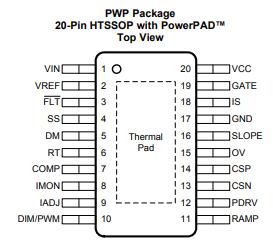
| PIN | |||
| Name | NO. | I/O | DESCRIPTION |
| COMP | 7 | I/O | Transconductance error amplifier output. Connect compensation network to achieve a desired closed-loop response. |
| CSN | 13 | I | Current sense amplifier negative input (–). Connect directly to the negative node of the LED current sense resistor, RCS. |
| CSP | 14 | I | Current sense amplifier positive input (+). Connect directly to the positive node of LED current sense resistor, RCS. |
| DIM/PWM | 10 | I | External analog to PWM dimming command or direct PWM dimming input. |
| DM | 5 | I/O | Triangle wave spread spectrum modulation frequency, fm, programming pin. |
| FLT | 3 | O | Open-drain fault indicator. Connect to VREF with a resistor to create active low fault signal output |
| GATE | 19 | O | N-channel MOSFET gate driver output. Connect to gate of external main switching N-channel MOSFET |
| GND | 17 | - | Analog and Power ground connection pin. Connect to circuit ground to complete return path. |
| IADJ | 9 | I | LED current reference input. |
| IMON | 8 | O | LED current report pin |
| IS | 18 | I | Switch current sense input. |
| OV | 15 | I | Output voltage input. |
| PDRV | 12 | O | Series dimming P-channel FET gate driver output. |
| RAMP | 11 | I/O | Programming input for internal PWM generator |
| RT | 6 | I/O | Oscillator frequency programming pin |
| SLOPE | 16 | I/O | Slope compensation input. |
| SS | 4 | I/O | Soft-start programming pin |
| VCC | 20 | - | VCC (7.5 V) bias supply pin. |
| VIN | 1 | - | Input supply for the internal regulators. |
| VREF | 2 | - | VREF (5 V) bias supply pin |
Specifications
- TypeParameter
- Factory Lead Time6 Weeks
- Lifecycle Status
Lifecycle Status refers to the current stage of an electronic component in its product life cycle, indicating whether it is active, obsolete, or transitioning between these states. An active status means the component is in production and available for purchase. An obsolete status indicates that the component is no longer being manufactured or supported, and manufacturers typically provide a limited time frame for support. Understanding the lifecycle status is crucial for design engineers to ensure continuity and reliability in their projects.
ACTIVE (Last Updated: 1 day ago) - Mounting Type
The "Mounting Type" in electronic components refers to the method used to attach or connect a component to a circuit board or other substrate, such as through-hole, surface-mount, or panel mount.
Surface Mount - Package / Case
refers to the protective housing that encases an electronic component, providing mechanical support, electrical connections, and thermal management.
20-PowerTSSOP (0.173, 4.40mm Width) - Surface Mount
having leads that are designed to be soldered on the side of a circuit board that the body of the component is mounted on.
YES - Number of Pins20
- Operating Temperature
The operating temperature is the range of ambient temperature within which a power supply, or any other electrical equipment, operate in. This ranges from a minimum operating temperature, to a peak or maximum operating temperature, outside which, the power supply may fail.
-40°C~125°C TA - Packaging
Semiconductor package is a carrier / shell used to contain and cover one or more semiconductor components or integrated circuits. The material of the shell can be metal, plastic, glass or ceramic.
Tape & Reel (TR) - Series
In electronic components, the "Series" refers to a group of products that share similar characteristics, designs, or functionalities, often produced by the same manufacturer. These components within a series typically have common specifications but may vary in terms of voltage, power, or packaging to meet different application needs. The series name helps identify and differentiate between various product lines within a manufacturer's catalog.
Automotive, AEC-Q100 - JESD-609 Code
The "JESD-609 Code" in electronic components refers to a standardized marking code that indicates the lead-free solder composition and finish of electronic components for compliance with environmental regulations.
e4 - Pbfree Code
The "Pbfree Code" parameter in electronic components refers to the code or marking used to indicate that the component is lead-free. Lead (Pb) is a toxic substance that has been widely used in electronic components for many years, but due to environmental concerns, there has been a shift towards lead-free alternatives. The Pbfree Code helps manufacturers and users easily identify components that do not contain lead, ensuring compliance with regulations and promoting environmentally friendly practices. It is important to pay attention to the Pbfree Code when selecting electronic components to ensure they meet the necessary requirements for lead-free applications.
yes - Part Status
Parts can have many statuses as they progress through the configuration, analysis, review, and approval stages.
Active - Moisture Sensitivity Level (MSL)
Moisture Sensitivity Level (MSL) is a standardized rating that indicates the susceptibility of electronic components, particularly semiconductors, to moisture-induced damage during storage and the soldering process, defining the allowable exposure time to ambient conditions before they require special handling or baking to prevent failures
2 (1 Year) - Number of Terminations20
- ECCN Code
An ECCN (Export Control Classification Number) is an alphanumeric code used by the U.S. Bureau of Industry and Security to identify and categorize electronic components and other dual-use items that may require an export license based on their technical characteristics and potential for military use.
EAR99 - TypeDC DC Controller
- Terminal Finish
Terminal Finish refers to the surface treatment applied to the terminals or leads of electronic components to enhance their performance and longevity. It can improve solderability, corrosion resistance, and overall reliability of the connection in electronic assemblies. Common finishes include nickel, gold, and tin, each possessing distinct properties suitable for various applications. The choice of terminal finish can significantly impact the durability and effectiveness of electronic devices.
Nickel/Palladium/Gold (Ni/Pd/Au) - Applications
The parameter "Applications" in electronic components refers to the specific uses or functions for which a component is designed. It encompasses various fields such as consumer electronics, industrial automation, telecommunications, automotive, and medical devices. Understanding the applications helps in selecting the right components for a particular design based on performance, reliability, and compatibility requirements. This parameter also guides manufacturers in targeting their products to relevant markets and customer needs.
Automotive, Lighting, Signage - Terminal Position
In electronic components, the term "Terminal Position" refers to the physical location of the connection points on the component where external electrical connections can be made. These connection points, known as terminals, are typically used to attach wires, leads, or other components to the main body of the electronic component. The terminal position is important for ensuring proper connectivity and functionality of the component within a circuit. It is often specified in technical datasheets or component specifications to help designers and engineers understand how to properly integrate the component into their circuit designs.
DUAL - Terminal Form
Occurring at or forming the end of a series, succession, or the like; closing; concluding.
GULL WING - Number of Functions1
- Supply Voltage
Supply voltage refers to the electrical potential difference provided to an electronic component or circuit. It is crucial for the proper operation of devices, as it powers their functions and determines performance characteristics. The supply voltage must be within specified limits to ensure reliability and prevent damage to components. Different electronic devices have specific supply voltage requirements, which can vary widely depending on their design and intended application.
14V - Terminal Pitch
The center distance from one pole to the next.
0.65mm - Frequency
In electronic components, the parameter "Frequency" refers to the rate at which a signal oscillates or cycles within a given period of time. It is typically measured in Hertz (Hz) and represents how many times a signal completes a full cycle in one second. Frequency is a crucial aspect in electronic components as it determines the behavior and performance of various devices such as oscillators, filters, and communication systems. Understanding the frequency characteristics of components is essential for designing and analyzing electronic circuits to ensure proper functionality and compatibility with other components in a system.
80kHz~800kHz - Base Part Number
The "Base Part Number" (BPN) in electronic components serves a similar purpose to the "Base Product Number." It refers to the primary identifier for a component that captures the essential characteristics shared by a group of similar components. The BPN provides a fundamental way to reference a family or series of components without specifying all the variations and specific details.
TPS92692 - Number of Outputs1
- Topology
In the context of electronic components, "topology" refers to the arrangement or configuration of the components within a circuit or system. It defines how the components are connected to each other and how signals flow between them. The choice of topology can significantly impact the performance, efficiency, and functionality of the electronic system. Common topologies include series, parallel, star, mesh, and hybrid configurations, each with its own advantages and limitations. Designers carefully select the appropriate topology based on the specific requirements of the circuit to achieve the desired performance and functionality.
Step-Down (Buck), Step-Up (Boost) - Internal Switch(s)
The term "Internal Switch(s)" in electronic components typically refers to a built-in mechanism within a device that allows for the control of electrical current flow. These internal switches can be used to turn circuits on or off, change the direction of current, or regulate the flow of electricity within the component. They are often designed to be controlled externally, either manually or automatically, to enable various functions or operations within the electronic device. Internal switches play a crucial role in the overall functionality and performance of electronic components by providing a means to manage and manipulate electrical signals effectively.
No - fmax-Min
fmax-Min refers to the frequency range that an electronic component or system can operate within. It represents the difference between the maximum frequency (fmax) and the minimum frequency (Min) limits of operation. This parameter is crucial in defining the bandwidth of the component, indicating how effectively it can transmit or receive signals over that range. A wider fmax-Min value typically signifies better performance for applications that require broad frequency response.
0.002 MHz - Dimming
Dimming is a feature in electronic components, such as LED lights or display screens, that allows the user to adjust the brightness level of the device. It is a method of controlling the amount of light output by the component, typically by varying the voltage or current supplied to it. Dimming can be achieved through various techniques, such as pulse-width modulation (PWM) or analog dimming. This feature is commonly used to save energy, create ambiance, or enhance visual comfort in different applications.
Analog, PWM - Number of Segments1
- Voltage - Supply (Max)
Voltage - Supply (Max) is a parameter in electronic components that specifies the maximum voltage that can be safely applied to the component for proper operation. This parameter is crucial for ensuring the component's longevity and preventing damage due to overvoltage conditions. Exceeding the maximum supply voltage can lead to component failure, reduced performance, or even permanent damage. Designers must carefully consider this parameter when selecting components and designing circuits to ensure reliable and safe operation within the specified voltage limits.
65V - Voltage - Supply (Min)
Voltage - Supply (Min) is a parameter in electronic components that specifies the minimum voltage required for the component to operate within its specified performance range. This parameter indicates the lowest voltage level that can be safely applied to the component without causing malfunctions or damage. It is crucial to ensure that the supply voltage provided to the component is equal to or higher than the specified minimum voltage to guarantee proper functionality and reliability. Failure to meet this requirement may result in erratic behavior, reduced performance, or even permanent damage to the component.
4.5V - Multiplexed Display Capability
Multiplexed Display Capability refers to the ability of an electronic component or system to control multiple display elements using fewer input/output lines. This is achieved by rapidly switching between different displays or segments, allowing for efficient communication and reduced wiring complexity. In multiplexed systems, each display is activated sequentially, creating the illusion of simultaneous display to the user. This capability is commonly utilized in devices like LED matrices and LCD screens to enhance functionality while conserving space and resources.
NO - Width4.4mm
- Length6.5mm
- Height1.2mm
- Thickness
Thickness in electronic components refers to the measurement of how thick a particular material or layer is within the component structure. It can pertain to various aspects, such as the thickness of a substrate, a dielectric layer, or conductive traces. This parameter is crucial as it impacts the electrical, mechanical, and thermal properties of the component, influencing its performance and reliability in electronic circuits.
1mm - RoHS Status
RoHS means “Restriction of Certain Hazardous Substances” in the “Hazardous Substances Directive” in electrical and electronic equipment.
ROHS3 Compliant
Trend Analysis
Parts with Similar Specs
What’s the recommended operating conditions of TPS92692QPWPRQ1?
Supply input voltage(VIN) is between 6.5 and 65v. Supply input, battery crank voltage is above 4.5v. The current sense common mode is between 6.5 and 60v. The switching frequency is between 80 and 800kHz. The spread-spectrum modulation frequency is between 0.1 and 12kHz. Internal PWM ramp generator frequency is between 100 and 2000Hz. The current reference voltage is above 0.14v. Operating ambient temperature is between -40 and 125℃.
How does TPS92692QPWPRQ1 to supply power correctly?
This gadget is designed to work with input voltages ranging from 4.5 to 65 volts. A car battery or another regulated power supply could be used as the input. Additional bulk capacitance or an input filter, in addition to the ceramic bypass capacitors, may be necessary if the input supply is positioned more than a few inches from the TPS92692QPWPRQ1 device to address noise and EMI problems.
What’s the dimensions of TPS92692QPWPRQ1 ?
Height:1.2mm/Length:6.5mm/Thickness:1mm/Width:4.4mm
What’s the main parameters of TPS92692QPWPRQ1?
The main parameters of this part are LED Driver 46000uA Supply Current Automotive 20-Pin HTSSOP EP T/R.
What is TPS92692QPWPRQ1 ?
Texas Instruments TPS92692/TPS92692-Q1 High Accuracy LED Controllers are designed to support step-up/down LED driver topologies.
 H5521 CO2 ETHERNET TWO RELAYS: Technical Data, Datasheet, and Equivalents
10 January 2022292
 Exploring the Renesas R5F21193SPU0 series Microcontrollers: An Extensive Analysis
29 February 2024153
 JRC4558 Dual Operational Amplifier: Equivalent, Datasheet and Pinout
15 October 202130192
 W25Q128JVSIQ 8SOIC 3V 128M-bit serial flash memory:Datasheet, Pinout ang Package
10 January 20226297
 PIC10F200 Microcontroller: Circuit, Pinout, and Datasheet
26 October 20214038
 Microchip PIC16F1527IMR: In-Depth Overview of Features and Applications
29 February 2024142
 Intel EPCS4SI8N What You Need to Know
30 August 2025180
 H6 vs H7 Battery: Which One Do You Like Better?
01 April 202244488
 What Determines the Maximum Operating Frequency of a Diode?
29 June 202211546
 Neural Processing Unit (NPU) Explained
15 October 202557181
 LDO vs Buck Converter: Which Power Regulator Is Best For Your Application?
16 May 20253701
 Robotics and Semiconductor Industries Face Challenges and Opportunities
09 September 20232140
 TinyML Takes a Major Step Forward as Israeli Company Releases New Chip
19 April 2022972
 Top Batteries That Can Replace LR44
09 June 20251360
 What is Brushless DC Motors (BLDC) ?
03 April 20256185
 Comprehensive Analysis of Each Functional Circuit of Switching Power Supply
06 May 20223654
Texas Instruments
In Stock: 13941
United States
China
Canada
Japan
Russia
Germany
United Kingdom
Singapore
Italy
Hong Kong(China)
Taiwan(China)
France
Korea
Mexico
Netherlands
Malaysia
Austria
Spain
Switzerland
Poland
Thailand
Vietnam
India
United Arab Emirates
Afghanistan
Åland Islands
Albania
Algeria
American Samoa
Andorra
Angola
Anguilla
Antigua & Barbuda
Argentina
Armenia
Aruba
Australia
Azerbaijan
Bahamas
Bahrain
Bangladesh
Barbados
Belarus
Belgium
Belize
Benin
Bermuda
Bhutan
Bolivia
Bonaire, Sint Eustatius and Saba
Bosnia & Herzegovina
Botswana
Brazil
British Indian Ocean Territory
British Virgin Islands
Brunei
Bulgaria
Burkina Faso
Burundi
Cabo Verde
Cambodia
Cameroon
Cayman Islands
Central African Republic
Chad
Chile
Christmas Island
Cocos (Keeling) Islands
Colombia
Comoros
Congo
Congo (DRC)
Cook Islands
Costa Rica
Côte d’Ivoire
Croatia
Cuba
Curaçao
Cyprus
Czechia
Denmark
Djibouti
Dominica
Dominican Republic
Ecuador
Egypt
El Salvador
Equatorial Guinea
Eritrea
Estonia
Eswatini
Ethiopia
Falkland Islands
Faroe Islands
Fiji
Finland
French Guiana
French Polynesia
Gabon
Gambia
Georgia
Ghana
Gibraltar
Greece
Greenland
Grenada
Guadeloupe
Guam
Guatemala
Guernsey
Guinea
Guinea-Bissau
Guyana
Haiti
Honduras
Hungary
Iceland
Indonesia
Iran
Iraq
Ireland
Isle of Man
Israel
Jamaica
Jersey
Jordan
Kazakhstan
Kenya
Kiribati
Kosovo
Kuwait
Kyrgyzstan
Laos
Latvia
Lebanon
Lesotho
Liberia
Libya
Liechtenstein
Lithuania
Luxembourg
Macao(China)
Madagascar
Malawi
Maldives
Mali
Malta
Marshall Islands
Martinique
Mauritania
Mauritius
Mayotte
Micronesia
Moldova
Monaco
Mongolia
Montenegro
Montserrat
Morocco
Mozambique
Myanmar
Namibia
Nauru
Nepal
New Caledonia
New Zealand
Nicaragua
Niger
Nigeria
Niue
Norfolk Island
North Korea
North Macedonia
Northern Mariana Islands
Norway
Oman
Pakistan
Palau
Palestinian Authority
Panama
Papua New Guinea
Paraguay
Peru
Philippines
Pitcairn Islands
Portugal
Puerto Rico
Qatar
Réunion
Romania
Rwanda
Samoa
San Marino
São Tomé & Príncipe
Saudi Arabia
Senegal
Serbia
Seychelles
Sierra Leone
Sint Maarten
Slovakia
Slovenia
Solomon Islands
Somalia
South Africa
South Sudan
Sri Lanka
St Helena, Ascension, Tristan da Cunha
St. Barthélemy
St. Kitts & Nevis
St. Lucia
St. Martin
St. Pierre & Miquelon
St. Vincent & Grenadines
Sudan
Suriname
Svalbard & Jan Mayen
Sweden
Syria
Tajikistan
Tanzania
Timor-Leste
Togo
Tokelau
Tonga
Trinidad & Tobago
Tunisia
Turkey
Turkmenistan
Turks & Caicos Islands
Tuvalu
U.S. Outlying Islands
U.S. Virgin Islands
Uganda
Ukraine
Uruguay
Uzbekistan
Vanuatu
Vatican City
Venezuela
Wallis & Futuna
Yemen
Zambia
Zimbabwe
![UCC25710DWR]() UCC25710DWR
UCC25710DWRTexas Instruments
![LM3447MTX/NOPB]() LM3447MTX/NOPB
LM3447MTX/NOPBTexas Instruments
![TPS61040DBVR]() TPS61040DBVR
TPS61040DBVRTexas Instruments
![TPS61041DBVR]() TPS61041DBVR
TPS61041DBVRTexas Instruments
![TPS61165DRVR]() TPS61165DRVR
TPS61165DRVRTexas Instruments
![LM3409HVMY/NOPB]() LM3409HVMY/NOPB
LM3409HVMY/NOPBTexas Instruments
![TLC59116IRHBR]() TLC59116IRHBR
TLC59116IRHBRTexas Instruments
![TLC5971PWPR]() TLC5971PWPR
TLC5971PWPRTexas Instruments
![TLC5940PWPR]() TLC5940PWPR
TLC5940PWPRTexas Instruments
![TLC5922DAP]() TLC5922DAP
TLC5922DAPTexas Instruments


