

 Product
 Brand
Brand Articles
 Tools
Tools
ESP32S2 WiFi 802.11b/g/n Transceiver Module: Datasheet, Pinout, and Application

2.4GHz WiFi -40°C~125°C 2.8V~3.6V ADC, I2C, I2S, SPI, PWM, UART Antenna Not Included 150Mbps 19.5dBm 802.11b/g/n -97dBm 56-VFQFN Exposed Pad


2.4GHz WiFi -40°C~125°C 2.8V~3.6V ADC, I2C, I2S, SPI, PWM, UART Antenna Not Included 150Mbps 19.5dBm 802.11b/g/n -97dBm 56-VFQFN Exposed Pad
ESP32S2 is WiFi Transceiver Module. This article is going to introduce pinout, applications, features, and more details about ESP32S2.

The new ESP32-S2: How relevant is it for the Makers?
Overview of ESP32S2
ESP32-S2 family is a highly-integrated, low-power, 2.4 GHz Wi-Fi System-on-Chip (SoC) solution. With its state-of-the-art power and RF performance, this SoC is an ideal choice for a wide variety of application scenarios relating to the Internet of Things (IoT), wearable electronics, and smart homes. ESP32-S2 family includes a Wi-Fi subsystem that integrates a Wi-Fi MAC, Wi-Fi radio and baseband, RF switch, RF balun, power amplifier, low noise amplifier (LNA), etc. The chip is fully compliant with the IEEE 802.11b/g/n protocol and offers a complete Wi-Fi solution. At the core of this chip is an Xtensa® 32-bit LX7 CPU that operates at up to 240 MHz. The chip supports application development, without the need for a host MCU. The on-chip memory includes 320 KB SRAM and 128 KB ROM. It also supports multiple external SPI/QSPI/OSPI flash and external RAM chips for more memory space.
ESP32S2 Features
ESP32-S2-WROOM or ESP32-S2-WROVER module with Xtensa® 32-bit LX7 CPU 240 MHz
320 KB SRAM, 128KB ROM, 16 KB SRAM in RTC
4MB Flash
2MB PSRAM in ESP32-S2-WROVER-DevKit-Lipo
WiFi 1T1R 150Mbps
LiPo battery charger
Battery monitoring
External power sense
Low consumption
RGB LED
CH340T programmer works with Espressif SDK, Arduino, Platform IO
Reset button
User button
Pin-to-pin compatible with ESP32-S2-SAOLA-1
Specifications
- TypeParameter
- Factory Lead Time8 Weeks
- Mounting Type
The "Mounting Type" in electronic components refers to the method used to attach or connect a component to a circuit board or other substrate, such as through-hole, surface-mount, or panel mount.
Surface Mount - Package / Case
refers to the protective housing that encases an electronic component, providing mechanical support, electrical connections, and thermal management.
56-VFQFN Exposed Pad - Operating Temperature
The operating temperature is the range of ambient temperature within which a power supply, or any other electrical equipment, operate in. This ranges from a minimum operating temperature, to a peak or maximum operating temperature, outside which, the power supply may fail.
-40°C~125°C - Series
In electronic components, the "Series" refers to a group of products that share similar characteristics, designs, or functionalities, often produced by the same manufacturer. These components within a series typically have common specifications but may vary in terms of voltage, power, or packaging to meet different application needs. The series name helps identify and differentiate between various product lines within a manufacturer's catalog.
ESP32 - Part Status
Parts can have many statuses as they progress through the configuration, analysis, review, and approval stages.
Active - Moisture Sensitivity Level (MSL)
Moisture Sensitivity Level (MSL) is a standardized rating that indicates the susceptibility of electronic components, particularly semiconductors, to moisture-induced damage during storage and the soldering process, defining the allowable exposure time to ambient conditions before they require special handling or baking to prevent failures
3 (168 Hours) - Voltage - Supply
Voltage - Supply refers to the range of voltage levels that an electronic component or circuit is designed to operate with. It indicates the minimum and maximum supply voltage that can be applied for the device to function properly. Providing supply voltages outside this range can lead to malfunction, damage, or reduced performance. This parameter is critical for ensuring compatibility between different components in a circuit.
2.8V~3.6V - Frequency
In electronic components, the parameter "Frequency" refers to the rate at which a signal oscillates or cycles within a given period of time. It is typically measured in Hertz (Hz) and represents how many times a signal completes a full cycle in one second. Frequency is a crucial aspect in electronic components as it determines the behavior and performance of various devices such as oscillators, filters, and communication systems. Understanding the frequency characteristics of components is essential for designing and analyzing electronic circuits to ensure proper functionality and compatibility with other components in a system.
2.4GHz - Memory Size
The memory capacity is the amount of data a device can store at any given time in its memory.
128kB ROM 320kB SRAM - Data Rate
Data Rate is defined as the amount of data transmitted during a specified time period over a network. It is the speed at which data is transferred from one device to another or between a peripheral device and the computer. It is generally measured in Mega bits per second(Mbps) or Mega bytes per second(MBps).
150Mbps - Utilized IC / Part
Utilized IC / Part is a parameter that refers to the extent to which an integrated circuit (IC) or electronic component is being used or consumed within a system or application. It typically indicates the percentage or ratio of the component's capabilities that are being utilized in a given scenario. This parameter is important for assessing the efficiency and performance of the component, as well as for determining if the component is being underutilized or overburdened in a particular application. Monitoring and optimizing the utilization of ICs and electronic parts can help improve overall system reliability, efficiency, and cost-effectiveness.
ESP32-S2 - Protocol
In electronic components, the parameter "Protocol" refers to a set of rules and standards that govern the communication between devices. It defines the format, timing, sequencing, and error checking methods for data exchange between different components or systems. Protocols ensure that devices can understand and interpret data correctly, enabling them to communicate effectively with each other. Common examples of protocols in electronics include USB, Ethernet, SPI, I2C, and Bluetooth, each with its own specifications for data transmission. Understanding and adhering to protocols is essential for ensuring compatibility and reliable communication between electronic devices.
802.11b/g/n - Power - Output
Power Output in electronic components refers to the amount of electrical power that a device can deliver to a load. It is typically measured in watts and indicates the effectiveness of the component in converting electrical energy into usable work or signal. Power Output can vary based on the component's design, operating conditions, and intended application, making it a critical factor in the performance of amplifiers, power supplies, and other electronic devices. Understanding the Power Output helps in selecting appropriate components for specific applications to ensure efficiency and reliability.
19.5dBm - RF Family/Standard
The parameter "RF Family/Standard" in electronic components refers to the specific radio frequency (RF) technology or standard that the component complies with or is designed for. RF technology encompasses a wide range of frequencies used for wireless communication, such as Wi-Fi, Bluetooth, cellular networks, and more. Different RF standards dictate the frequency bands, modulation techniques, data rates, and other specifications for communication systems. Understanding the RF family/standard of a component is crucial for ensuring compatibility and optimal performance in RF applications.
WiFi - Antenna Type
There are several different types of antennas in three broad categories: omni-directional, directional, and semi-directional.
Antenna Not Included - Sensitivity
Sensitivity in electronic components refers to the degree to which the output of a device responds to changes in input. It indicates how effectively a component translates a specific input signal into an observable output. High sensitivity means that even small variations in input can produce significant changes in output, making the device more responsive to signals. Sensitivity is crucial in applications where precise measurements or signal detection are required.
-97dBm - Serial Interfaces
A serial interface is a communication interface between two digital systems that transmits data as a series of voltage pulses down a wire. Essentially, the serial interface encodes the bits of a binary number by their "temporal" location on a wire rather than their "spatial" location within a set of wires.
ADC, I2C, I2S, SPI, PWM, UART - Current - Receiving
Current - Receiving refers to the amount of electrical current that an electronic component or device is capable of accepting from a power source or another component in a circuit. It indicates the maximum current that can be safely received without causing damage or malfunction. This parameter is crucial for ensuring compatibility and reliability in electronic designs, as exceeding the rated receiving current can lead to overheating or failure of the component.
63mA~68mA - Current - Transmitting
Current - Transmitting is a parameter used to describe the maximum amount of electrical current that an electronic component can handle while in the transmitting mode. This parameter is crucial for components such as transistors, diodes, and integrated circuits that are involved in transmitting signals or power within a circuit. Exceeding the specified current transmitting rating can lead to overheating, component failure, or even damage to the entire circuit. Designers and engineers must carefully consider this parameter when selecting components to ensure the reliability and performance of the electronic system.
160mA~310mA
ESP32S2 Pinout
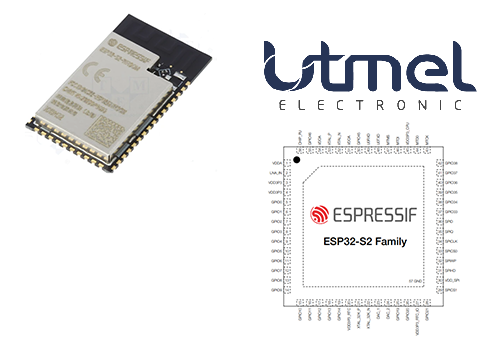
ESP32S2 Pinout
ESP32S2 Block Diagram
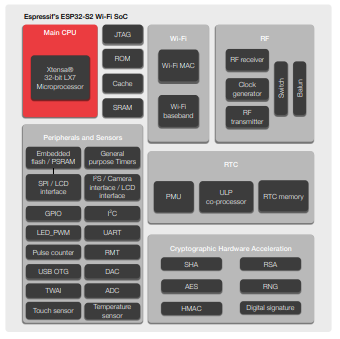
ESP32S2 Block Diagram
ESP32S2 Applications
• Generic Low-power IoT Sensor Hubs
• Generic Low-power IoT Data Loggers
• Cameras for Video Streaming
• Over-the-top (OTT) Devices
• USB Devices
• Speech Recognition
• Image Recognition
• Mesh Networks
• Home Automation
– Light control
– Smart plugs
– Smart door locks
• Smart Buildings
– Smart lighting
– Energy monitoring
• Industrial Automation
– Industrial wireless control
– Industrial robotics
• Smart Agriculture
– Smart greenhouses
– Smart irrigation
– Agriculture robotics
• Audio Applications
– Internet music players
– Live streaming devices
– Internet radio players
– Audio headsets
• Health Care Applications
– Health monitoring
– Baby monitors
• Wi-Fi-enabled Toys
– Remote control toys
– Proximity sensing toys
– Educational toys
• Wearable Electronics
– Smart watches
– Smart bracelets
• Retail & Catering Applications
– POS machines
– Service robots
• Touch Sensing Applications
– Waterproof design
– Distance sensing applications
– Linear slider, wheel slider designs
ESP32S2 Package information
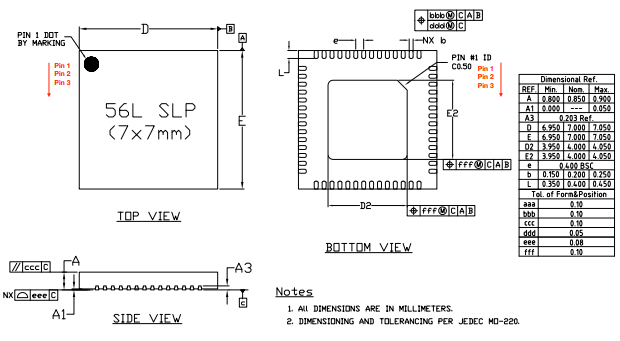
ESP32S2 Package information
ESP32S2 Manufacturer
Espressif Systems is a world-leading Internet-of-Things (IoT) company. They are an innovative team of chip-design specialists, software/firmware developers, and marketers. They are committed to providing some of the best IoT devices and software platforms in the industry. They also help their customers build their own solutions and connect with other partners in the IoT ecosystem. Their passion lies in creating state-of-the-art chipsets and enabling their partners to deliver great products. Espressif’s products are widely deployed in the tablet, OTT boxes, cameras, and IoT markets.
Datasheet PDF
- Datasheets :
Popularity by Region
Parts with Similar Specs
How many pins of ESP32S2 ?
56 pins.
What’s the operating temperature of the ESP32S2?
-40°C~125°C
 MMBT3906 PNP Switching Transistor: MMBT3906 Datasheet, Pinout, Alternatives
28 January 20224991
 ADG1408 Multiplexer: Datasheet, Circuit and Price
12 November 20213780
 PIC18F46K22 Microcontroller: Features, Pinout, and Datasheet
27 October 20216822
 TPS2H160BQPWPRQ1 High-Side Switch: Layout, Pinout, and Datasheet
19 April 20221554
 DS3231M RTC: Pinout, Application, Circuit
16 August 20213831
 NXP MINISASTOCSI Camera Module Guide and Community Solutions
09 June 2025166
 LM224 Operational Amplifier : Application, Pinout and Datasheet
06 September 20214316
 TDA7377 Class AB Car Radio Amplifier: Pinout, Datasheet pdf and Circuit
07 December 202124476
 What is an Accelerometer Sensor?
20 April 202111882
 Leading Fiber Optic Connectors Every Installer Should Know
17 July 20252510
 How to Design a High-precision ADC?
13 December 20212288
 What is the Difference between DCS and PLC?
28 June 20224552
 What Is An Intrinsic Semiconductor?
03 November 202010457
 Opportunities and Challenges for 2D Materials
22 March 20225052
 ON Semiconductor Provides Soft Fourth-Quarter Guidance. The Stock Drops.
13 March 20242659
 Using SiC-GaN to Create Two-Phase Interleaved DC-DC Converters for Plug-in Electric Vehicles
03 February 20232478
Espressif Systems
In Stock: 25
United States
China
Canada
Japan
Russia
Germany
United Kingdom
Singapore
Italy
Hong Kong(China)
Taiwan(China)
France
Korea
Mexico
Netherlands
Malaysia
Austria
Spain
Switzerland
Poland
Thailand
Vietnam
India
United Arab Emirates
Afghanistan
Åland Islands
Albania
Algeria
American Samoa
Andorra
Angola
Anguilla
Antigua & Barbuda
Argentina
Armenia
Aruba
Australia
Azerbaijan
Bahamas
Bahrain
Bangladesh
Barbados
Belarus
Belgium
Belize
Benin
Bermuda
Bhutan
Bolivia
Bonaire, Sint Eustatius and Saba
Bosnia & Herzegovina
Botswana
Brazil
British Indian Ocean Territory
British Virgin Islands
Brunei
Bulgaria
Burkina Faso
Burundi
Cabo Verde
Cambodia
Cameroon
Cayman Islands
Central African Republic
Chad
Chile
Christmas Island
Cocos (Keeling) Islands
Colombia
Comoros
Congo
Congo (DRC)
Cook Islands
Costa Rica
Côte d’Ivoire
Croatia
Cuba
Curaçao
Cyprus
Czechia
Denmark
Djibouti
Dominica
Dominican Republic
Ecuador
Egypt
El Salvador
Equatorial Guinea
Eritrea
Estonia
Eswatini
Ethiopia
Falkland Islands
Faroe Islands
Fiji
Finland
French Guiana
French Polynesia
Gabon
Gambia
Georgia
Ghana
Gibraltar
Greece
Greenland
Grenada
Guadeloupe
Guam
Guatemala
Guernsey
Guinea
Guinea-Bissau
Guyana
Haiti
Honduras
Hungary
Iceland
Indonesia
Iran
Iraq
Ireland
Isle of Man
Israel
Jamaica
Jersey
Jordan
Kazakhstan
Kenya
Kiribati
Kosovo
Kuwait
Kyrgyzstan
Laos
Latvia
Lebanon
Lesotho
Liberia
Libya
Liechtenstein
Lithuania
Luxembourg
Macao(China)
Madagascar
Malawi
Maldives
Mali
Malta
Marshall Islands
Martinique
Mauritania
Mauritius
Mayotte
Micronesia
Moldova
Monaco
Mongolia
Montenegro
Montserrat
Morocco
Mozambique
Myanmar
Namibia
Nauru
Nepal
New Caledonia
New Zealand
Nicaragua
Niger
Nigeria
Niue
Norfolk Island
North Korea
North Macedonia
Northern Mariana Islands
Norway
Oman
Pakistan
Palau
Palestinian Authority
Panama
Papua New Guinea
Paraguay
Peru
Philippines
Pitcairn Islands
Portugal
Puerto Rico
Qatar
Réunion
Romania
Rwanda
Samoa
San Marino
São Tomé & Príncipe
Saudi Arabia
Senegal
Serbia
Seychelles
Sierra Leone
Sint Maarten
Slovakia
Slovenia
Solomon Islands
Somalia
South Africa
South Sudan
Sri Lanka
St Helena, Ascension, Tristan da Cunha
St. Barthélemy
St. Kitts & Nevis
St. Lucia
St. Martin
St. Pierre & Miquelon
St. Vincent & Grenadines
Sudan
Suriname
Svalbard & Jan Mayen
Sweden
Syria
Tajikistan
Tanzania
Timor-Leste
Togo
Tokelau
Tonga
Trinidad & Tobago
Tunisia
Turkey
Turkmenistan
Turks & Caicos Islands
Tuvalu
U.S. Outlying Islands
U.S. Virgin Islands
Uganda
Ukraine
Uruguay
Uzbekistan
Vanuatu
Vatican City
Venezuela
Wallis & Futuna
Yemen
Zambia
Zimbabwe
![ESP32-WROVER]() ESP32-WROVER
ESP32-WROVEREspressif Systems
![ESP-WROOM-02]() ESP-WROOM-02
ESP-WROOM-02Espressif Systems
![ESP-WROOM-02D (4MB)]() ESP-WROOM-02D (4MB)
ESP-WROOM-02D (4MB)Espressif Systems
![ESP32-SOLO-1]() ESP32-SOLO-1
ESP32-SOLO-1Espressif Systems
![ESP32-WROVER-I]() ESP32-WROVER-I
ESP32-WROVER-IEspressif Systems
![ESP32-WROOM-32U]() ESP32-WROOM-32U
ESP32-WROOM-32UEspressif Systems
![ESP32-C3-WROOM-02-H4]() ESP32-C3-WROOM-02-H4
ESP32-C3-WROOM-02-H4Espressif Systems
![ESP32-S2-SOLO-N4]() ESP32-S2-SOLO-N4
ESP32-S2-SOLO-N4Espressif Systems
![ESP32-WROVER(M203QL3264PH3Q0)]() ESP32-WROVER(M203QL3264PH3Q0)
ESP32-WROVER(M203QL3264PH3Q0)Espressif Systems
![ESP32-WROOM-32(M103QH2800PH3Q0)]() ESP32-WROOM-32(M103QH2800PH3Q0)
ESP32-WROOM-32(M103QH2800PH3Q0)Espressif Systems


