

 Product
 Brand
Brand Articles
 Tools
Tools
H1102NL How to use H1102NL?[FAQ&Video]

Telecom Transformer 2(1: 1) 0.65Ohm Prim. DCR 0.65Ohm Sec. DCR 16 Terminal Gull Wing SMD


Telecom Transformer 2(1: 1) 0.65Ohm Prim. DCR 0.65Ohm Sec. DCR 16 Terminal Gull Wing SMD
H1102NL is one such transformer, with two magnetics for transmitting and receiving sections. This article is going to talk about the pinout, equivalents, and more detailed information about the H1102NL.

This video demonstrates detailed information about H1102NL.
Overview of H1102NL
Ethernet is a wired networking technology that transfers data at high bitrates using twisted pair differential wires. Various effects such as static charge and common mode noise are picked up due to the distances over which it can be carried. A component known as an ethernet transformer is utilized to prevent this from influencing the transmitting and receiving circuits. The H1102NL is one such transformer, with two magnetics for transmitting and receiving sections, as well as common mode protection.
Specifications
- TypeParameter
- Factory Lead Time9 Weeks
- Mount
In electronic components, the term "Mount" typically refers to the method or process of physically attaching or fixing a component onto a circuit board or other electronic device. This can involve soldering, adhesive bonding, or other techniques to secure the component in place. The mounting process is crucial for ensuring proper electrical connections and mechanical stability within the electronic system. Different components may have specific mounting requirements based on their size, shape, and function, and manufacturers provide guidelines for proper mounting procedures to ensure optimal performance and reliability of the electronic device.
Surface Mount - Mounting Type
The "Mounting Type" in electronic components refers to the method used to attach or connect a component to a circuit board or other substrate, such as through-hole, surface-mount, or panel mount.
Surface Mount - Package / Case
refers to the protective housing that encases an electronic component, providing mechanical support, electrical connections, and thermal management.
Module - Number of Pins16
- Weight0.03oz 0.85g
- Operating Temperature
The operating temperature is the range of ambient temperature within which a power supply, or any other electrical equipment, operate in. This ranges from a minimum operating temperature, to a peak or maximum operating temperature, outside which, the power supply may fail.
0°C~70°C - Packaging
Semiconductor package is a carrier / shell used to contain and cover one or more semiconductor components or integrated circuits. The material of the shell can be metal, plastic, glass or ceramic.
Tube - Published2007
- Size / Dimension
In electronic components, the parameter "Size / Dimension" refers to the physical dimensions of the component, such as its length, width, and height. These dimensions are crucial for determining how the component will fit into a circuit or system, as well as for ensuring compatibility with other components and the overall design requirements. The size of a component can also impact its performance characteristics, thermal properties, and overall functionality within a given application. Engineers and designers must carefully consider the size and dimensions of electronic components to ensure proper integration and functionality within their designs.
0.500Lx0.280W 12.70mmx7.11mm - Pbfree Code
The "Pbfree Code" parameter in electronic components refers to the code or marking used to indicate that the component is lead-free. Lead (Pb) is a toxic substance that has been widely used in electronic components for many years, but due to environmental concerns, there has been a shift towards lead-free alternatives. The Pbfree Code helps manufacturers and users easily identify components that do not contain lead, ensuring compliance with regulations and promoting environmentally friendly practices. It is important to pay attention to the Pbfree Code when selecting electronic components to ensure they meet the necessary requirements for lead-free applications.
yes - Part Status
Parts can have many statuses as they progress through the configuration, analysis, review, and approval stages.
Active - Moisture Sensitivity Level (MSL)
Moisture Sensitivity Level (MSL) is a standardized rating that indicates the susceptibility of electronic components, particularly semiconductors, to moisture-induced damage during storage and the soldering process, defining the allowable exposure time to ambient conditions before they require special handling or baking to prevent failures
1 (Unlimited) - Termination
Termination in electronic components refers to the practice of matching the impedance of a circuit to prevent signal reflections and ensure maximum power transfer. It involves the use of resistors or other components at the end of transmission lines or connections. Proper termination is crucial in high-frequency applications to maintain signal integrity and reduce noise.
SMD/SMT - ECCN Code
An ECCN (Export Control Classification Number) is an alphanumeric code used by the U.S. Bureau of Industry and Security to identify and categorize electronic components and other dual-use items that may require an export license based on their technical characteristics and potential for military use.
EAR99 - Applications
The parameter "Applications" in electronic components refers to the specific uses or functions for which a component is designed. It encompasses various fields such as consumer electronics, industrial automation, telecommunications, automotive, and medical devices. Understanding the applications helps in selecting the right components for a particular design based on performance, reliability, and compatibility requirements. This parameter also guides manufacturers in targeting their products to relevant markets and customer needs.
GENERAL PURPOSE - Additional Feature
Any Feature, including a modified Existing Feature, that is not an Existing Feature.
HEIGHT DIMENSION INCLUDE TERMINAL ALSO - Shielding
Shielding in electronic components refers to the practice of enclosing or surrounding sensitive electronic circuits or components with a conductive material to protect them from electromagnetic interference (EMI) or radio frequency interference (RFI). The shielding material acts as a barrier that blocks or absorbs unwanted electromagnetic signals, preventing them from affecting the performance of the electronic device. Shielding can be achieved using materials such as metal enclosures, conductive coatings, or shielding tapes. Proper shielding is essential in electronic design to ensure the reliable operation of electronic devices in environments where electromagnetic interference is present.
Unshielded - Number of Functions1
- Depth
In electronic components, "Depth" typically refers to the measurement of the distance from the front to the back of the component. It is an important parameter to consider when designing or selecting components for a project, as it determines how much space the component will occupy within a circuit or device. The depth of a component can impact the overall size and layout of the circuit board or enclosure in which it will be installed. It is usually specified in millimeters or inches and is crucial for ensuring proper fit and functionality within the intended application.
9.53mm - Physical Dimension
The parameter "Physical Dimension" in electronic components refers to the measurable size and shape characteristics of a component. This includes dimensions such as length, width, height, and diameter, which are critical for ensuring proper fit and integration into electronic circuits and systems. Physical dimensions also influence the component's performance, thermal management, and overall reliability in application environments. Understanding these dimensions is essential for designers to maintain compatibility with circuit boards and reduce issues related to space constraints.
L12.7XB7.11XH5.97 (mm) - Inductance
Inductance is a property of an electrical component that quantifies its ability to store energy in a magnetic field when electric current flows through it. It is measured in henries and indicates how much voltage is induced in the component as a result of a change in current. Inductance is an essential characteristic in coils, inductors, and transformers, affecting the behavior of electrical circuits, particularly in alternating current applications. Higher inductance values usually correlate with larger coils or more turns of wire in the component.
350 μH - DC Resistance (DCR)
DC Resistance (DCR) is a measure of the resistance of an electronic component when a direct current (DC) is applied. It quantifies how much opposition the component presents to the flow of electrical current under steady-state conditions. DCR is crucial for understanding power loss, heating, and efficient performance in circuits, as it affects the overall behavior of components such as inductors, transformers, and resistors. Lower DCR values typically indicate better efficiency and performance in a given application.
650mOhm - Lead/Base Style
The parameter "Lead/Base Style" in electronic components refers to the physical configuration of the leads or terminals of the component in relation to its base or body. This parameter describes how the leads are attached to the component and how they are positioned in relation to the base. Common lead/base styles include through-hole, surface mount, gull-wing, J-lead, and many others. Understanding the lead/base style is important for proper installation and connection of the component in a circuit, as different styles may require different soldering techniques or mounting considerations.
Gull Wing - Insertion Loss (dB)
Insertion Loss (dB) is a parameter used to measure the amount of signal loss that occurs when a component is inserted into a transmission line or circuit. It is typically expressed in decibels (dB) and represents the difference in signal power before and after the insertion of the component. A higher insertion loss value indicates greater signal attenuation or reduction in signal strength. Insertion loss is an important consideration in electronic components such as filters, amplifiers, and connectors, as it can impact the overall performance and efficiency of a system. Minimizing insertion loss is often a key design goal to ensure optimal signal integrity and transmission quality.
-1.1 dB - Isolation Voltage
Isolation voltage refers to a test of the ability of an insulator to minimize the flow of electric current with a high applied voltage.
1.5kV - Transformer Type
A variety of types of electrical transformer are made for different purposes. Despite their design differences, the various types employ the same basic principle as discovered in 1831 by Michael Faraday, and share several key functional parts.
Isolation and Data Interface (Encapsulated) - Turns Ratio - Primary:Secondary
The parameter "Turns Ratio - Primary:Secondary" in electronic components refers to the ratio of the number of turns in the primary winding to the number of turns in the secondary winding of a transformer or inductor. It is a crucial specification that determines the voltage transformation capability of the component. A higher turns ratio results in a higher voltage output relative to the input, while a lower turns ratio results in a lower voltage output. This parameter is essential for designing and selecting transformers and inductors for various applications, such as voltage regulation, impedance matching, and signal isolation.
1:1 - Return Loss
In telecommunications, return loss is a measure in relative terms of the power of the signal reflected by a discontinuity in a transmission line or optical fiber.
-20 dB - Height6.09mm
- Height Seated (Max)
Height Seated (Max) is a parameter in electronic components that refers to the maximum allowable height of the component when it is properly seated or installed on a circuit board or within an enclosure. This specification is crucial for ensuring proper fit and alignment within the overall system design. Exceeding the maximum seated height can lead to mechanical interference, electrical shorts, or other issues that may impact the performance and reliability of the electronic device. Manufacturers provide this information to help designers and engineers select components that will fit within the designated space and function correctly in the intended application.
0.245 6.22mm - Length12.7mm
- Width7.11mm
- Radiation Hardening
Radiation hardening is the process of making electronic components and circuits resistant to damage or malfunction caused by high levels of ionizing radiation, especially for environments in outer space (especially beyond the low Earth orbit), around nuclear reactors and particle accelerators, or during nuclear accidents or nuclear warfare.
No - RoHS Status
RoHS means “Restriction of Certain Hazardous Substances” in the “Hazardous Substances Directive” in electrical and electronic equipment.
RoHS Compliant - Lead Free
Lead Free is a term used to describe electronic components that do not contain lead as part of their composition. Lead is a toxic material that can have harmful effects on human health and the environment, so the electronics industry has been moving towards lead-free components to reduce these risks. Lead-free components are typically made using alternative materials such as silver, copper, and tin. Manufacturers must comply with regulations such as the Restriction of Hazardous Substances (RoHS) directive to ensure that their products are lead-free and environmentally friendly.
Lead Free
H1102NL Pinout
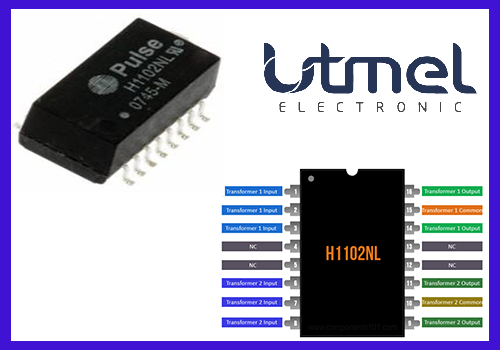
H1102NL Pinout
H1102NL CAD Model
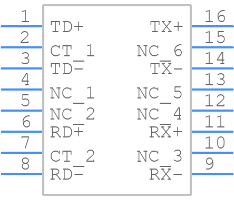
H1102NL Symbol
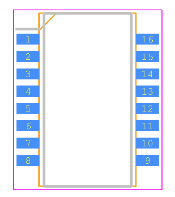
H1102NL Footprint
H1102NL Circuit

H1102NL Circuit
H1102NL Schematic
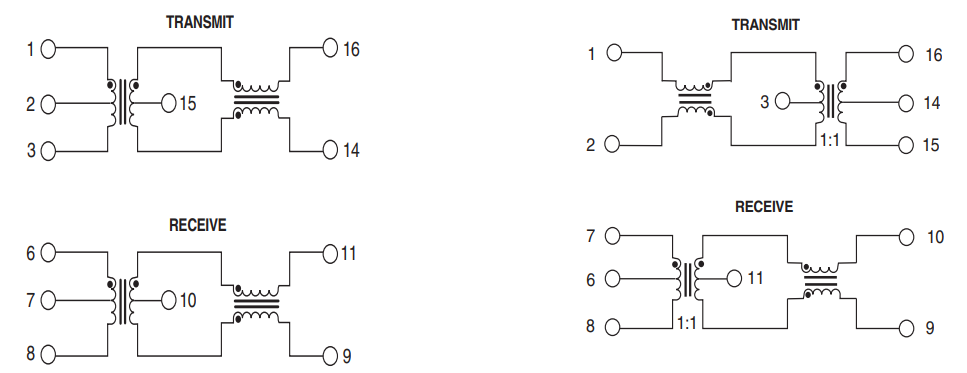 H1102NL Schematic
Parts with Similar Specs
- ImagePart NumberManufacturerInductanceIsolation VoltageTurns Ratio - Primary:SecondaryECCN CodeMountDepthLengthMoisture Sensitivity Level (MSL)View Compare
![H1102NL]()
H1102NL
350 μH
1.5 kV
1:1
EAR99
Surface Mount
9.53 mm
12.7 mm
1 (Unlimited)
![HX1188NL]()
440 μH
1.5 kV
1:1
EAR99
Surface Mount
9.53 mm
12.7 mm
1 (Unlimited)
![HX1260FNL]()
350μH
1.5 kV
1:1
EAR99
Surface Mount
9.53 mm
12.7 mm
1 (Unlimited)
![H1102FNL]()
350μH
1.5 kV
1:1
EAR99
Surface Mount
9.53 mm
12.7 mm
1 (Unlimited)
![FA2925-ALB]()
40 μH
-
1:1
EAR99
-
-
13.46 mm
-



How To Use H1102NL?
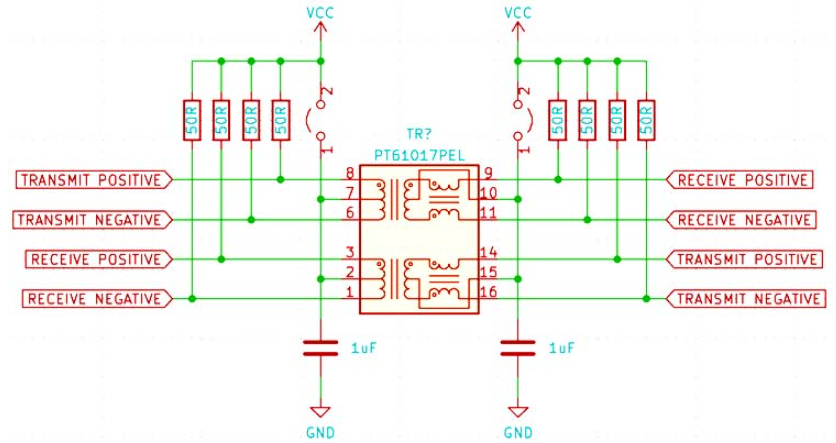
The majority of Ethernet cables are run across great distances. This increases the likelihood of picking up electromagnetic noise from the mains, high-frequency switching converters, and other sources. Static charges generated by the plastic insulating cable can cause dangerous high-voltage arcing, which can destroy the transmitting and receiving devices.
As a result, on both the transmitting and receiving sides of the circuit, an isolating transformer is employed. Two windings on the primary side share the same terminal. If the transmitting IC has open-drain outputs, the middle terminal is connected to VDD; if the transmitting IC has push-pull outputs, it is left floating. The differential negative and positive outputs of the transmitting IC are connected to each of the outer pins. On the secondary side, a similar method is used, but the center tap is connected to either ground or a reference voltage generated on the receiving side.
H1102NL Package information
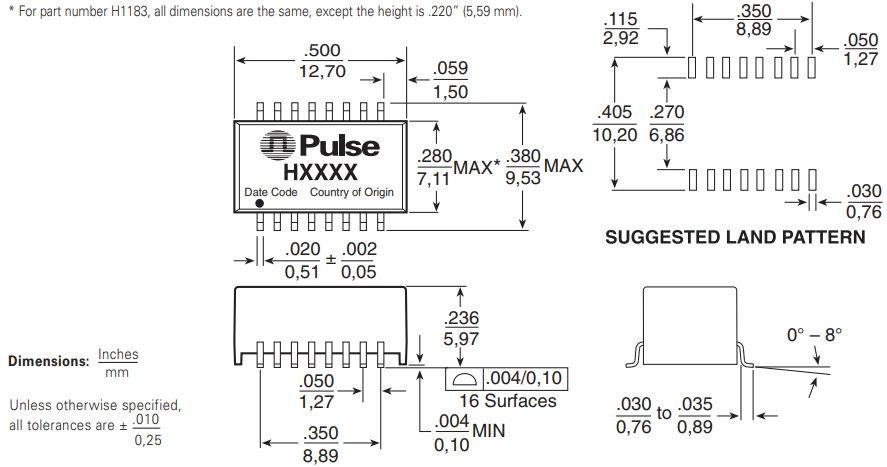
H1102NL Package information
H1102NL Manufacturer
Pulse Electronics is an electronic component partner that assists customers in developing the next big thing by delivering technical solutions. Pulse has a lengthy history of magnetics, antennae, and connectors innovation, as well as the capacity to quickly ramp into high-quality, high-volume production. Wireless and wireline communications, power management, military/aerospace, and automotive industries are all served by the company. IEEE, ATIS, ETSI, HDMI, the DSL Forum, CommNexus, and MoCA are all members of Pulse.
Datasheet PDF
- PCN Design/Specification :
- Datasheets :
- PCN Assembly/Origin :
- PCN Other :
Popularity by Region
What is the H1102NL?
H1102NL is one such transformer, with two magnetics for transmitting and receiving sections.
How many pins of H1102NL?
16 pins.
What’s the operating temperature of H1102NL?
0°C~70°C.
What’s the isolation voltage of H1102NL?
1.5kV.
 LTC6951IUHF-1#PBF Clock Generator: A Comprehensive Technical Overview
06 March 2024397
 MIC2545A Programmable Current-Limit High-Side Switch: Pinout, Equivalent and Datasheet
29 March 2022777
 CD4069 Inverter CMOS: Pinout, Datasheet pdf and Circuit
04 December 202111015
 Advantech Corp 96MPXE-2.1-16M36: A Discontinued Skylake Microprocessor Module
11 March 20243695
 DS9490R USB to 1-Wire Adapter: Datasheet, Pin Configuration, DS9490R vs. DS9490B
03 November 20213284
 PIC10F200/202/204/206 Microcontrollers: Technical Insights
29 February 2024266
 AD7768 24-Bit 8-Channel ADC: High-Speed Simultaneous Sampling Deep Dive
10 March 20261059
 AK4490EQ 32-bit 2ch DAC, AKM AK4490EQ 48LQFP and AK4490 Datasheet pdf
08 February 20224791
 Basic Knowledge of Various Types of Mixers
03 January 20236788
 What are Proximity Sensors?
24 October 20258913
 How Many do You Know About the 12 Components Included in the Circuit Board?
12 February 20229185
 An Analysis of Current-Source Inverters Using High-Frequency WBG Switches
09 May 20235091
 What is PLL(Phase Locked Loop)?
29 November 20217042
 Amorphous Silicon Solar Cells: Features, Structure and Applications
22 August 20226935
 What is a Projector?
14 October 202116014
 What are the Testing Method and Types of Transistors?
21 October 202514873
Pulse Electronics Network
In Stock
United States
China
Canada
Japan
Russia
Germany
United Kingdom
Singapore
Italy
Hong Kong(China)
Taiwan(China)
France
Korea
Mexico
Netherlands
Malaysia
Austria
Spain
Switzerland
Poland
Thailand
Vietnam
India
United Arab Emirates
Afghanistan
Åland Islands
Albania
Algeria
American Samoa
Andorra
Angola
Anguilla
Antigua & Barbuda
Argentina
Armenia
Aruba
Australia
Azerbaijan
Bahamas
Bahrain
Bangladesh
Barbados
Belarus
Belgium
Belize
Benin
Bermuda
Bhutan
Bolivia
Bonaire, Sint Eustatius and Saba
Bosnia & Herzegovina
Botswana
Brazil
British Indian Ocean Territory
British Virgin Islands
Brunei
Bulgaria
Burkina Faso
Burundi
Cabo Verde
Cambodia
Cameroon
Cayman Islands
Central African Republic
Chad
Chile
Christmas Island
Cocos (Keeling) Islands
Colombia
Comoros
Congo
Congo (DRC)
Cook Islands
Costa Rica
Côte d’Ivoire
Croatia
Cuba
Curaçao
Cyprus
Czechia
Denmark
Djibouti
Dominica
Dominican Republic
Ecuador
Egypt
El Salvador
Equatorial Guinea
Eritrea
Estonia
Eswatini
Ethiopia
Falkland Islands
Faroe Islands
Fiji
Finland
French Guiana
French Polynesia
Gabon
Gambia
Georgia
Ghana
Gibraltar
Greece
Greenland
Grenada
Guadeloupe
Guam
Guatemala
Guernsey
Guinea
Guinea-Bissau
Guyana
Haiti
Honduras
Hungary
Iceland
Indonesia
Iran
Iraq
Ireland
Isle of Man
Israel
Jamaica
Jersey
Jordan
Kazakhstan
Kenya
Kiribati
Kosovo
Kuwait
Kyrgyzstan
Laos
Latvia
Lebanon
Lesotho
Liberia
Libya
Liechtenstein
Lithuania
Luxembourg
Macao(China)
Madagascar
Malawi
Maldives
Mali
Malta
Marshall Islands
Martinique
Mauritania
Mauritius
Mayotte
Micronesia
Moldova
Monaco
Mongolia
Montenegro
Montserrat
Morocco
Mozambique
Myanmar
Namibia
Nauru
Nepal
New Caledonia
New Zealand
Nicaragua
Niger
Nigeria
Niue
Norfolk Island
North Korea
North Macedonia
Northern Mariana Islands
Norway
Oman
Pakistan
Palau
Palestinian Authority
Panama
Papua New Guinea
Paraguay
Peru
Philippines
Pitcairn Islands
Portugal
Puerto Rico
Qatar
Réunion
Romania
Rwanda
Samoa
San Marino
São Tomé & Príncipe
Saudi Arabia
Senegal
Serbia
Seychelles
Sierra Leone
Sint Maarten
Slovakia
Slovenia
Solomon Islands
Somalia
South Africa
South Sudan
Sri Lanka
St Helena, Ascension, Tristan da Cunha
St. Barthélemy
St. Kitts & Nevis
St. Lucia
St. Martin
St. Pierre & Miquelon
St. Vincent & Grenadines
Sudan
Suriname
Svalbard & Jan Mayen
Sweden
Syria
Tajikistan
Tanzania
Timor-Leste
Togo
Tokelau
Tonga
Trinidad & Tobago
Tunisia
Turkey
Turkmenistan
Turks & Caicos Islands
Tuvalu
U.S. Outlying Islands
U.S. Virgin Islands
Uganda
Ukraine
Uruguay
Uzbekistan
Vanuatu
Vatican City
Venezuela
Wallis & Futuna
Yemen
Zambia
Zimbabwe
![B8546ENL]() B8546ENL
B8546ENLPulse Electronics Network
![T1233QNL]() T1233QNL
T1233QNLPulse Electronics Network
![T1142NLT]() T1142NLT
T1142NLTPulse Electronics Network
![H5020NL]() H5020NL
H5020NLPulse Electronics Network
![H5120NLT]() H5120NLT
H5120NLTPulse Electronics Network
![HX5020NLT]() HX5020NLT
HX5020NLTPulse Electronics Network
![H1197NLT]() H1197NLT
H1197NLTPulse Electronics Network
![H1102T]() H1102T
H1102TPulse Electronics Network
![HX5084NLT]() HX5084NLT
HX5084NLTPulse Electronics Network
![PE-68026]() PE-68026
PE-68026Pulse Electronics Network


