

 Product
 Brand
Brand Articles
 Tools
Tools
CD4069 Inverter CMOS: Pinout, Datasheet pdf and Circuit

50 ns ns 90 ns ns Gates & Inverters 8.8mA mA Through Hole Surface Mount 3V~15V V 1μA μA


50 ns ns 90 ns ns Gates & Inverters 8.8mA mA Through Hole Surface Mount 3V~15V V 1μA μA
The CD4069 is made up of six inverter circuits and is made with complementary MOS (CMOS) technology to produce a wide operating range, low power consumption, good noise immunity, and symmetric controlled rise and fall timings. This article is going to explain datasheet pdf, pinout, applications, circuit, equivalents, and other details about CD4069 Inverter CMOS.
Chip-Chat #1 - CMOS CD 4069 Inverter - Ec-Projects
- What is CD4069 Inverter?
- CD4069 Inverter Pinout
- CD4069 Inverter CAD Model
- Specifications
- CD4069 Inverter Schematics Diagram
- CD4069 Inverter Functional Block Diagram
- CD4069 Inverter Features
- CD4069 Inverter Equivalents
- CD4069 Inverter Applications
- CD4069 Inverter Circuit
- CD4069 Inverter Dimensions
- CD4069 Inverter Manufacturer
- Datasheet PDF
What is CD4069 Inverter?
The CD4069 is made up of six inverter circuits and is made with complementary MOS (CMOS) technology to produce a wide operating range, low power consumption, good noise immunity, and symmetric controlled rise and fall timings.
This device is designed for all general-purpose inverter applications that do not require the specific features of the MM74C901, MM74C907, or CD4049A Hex Inverter/Buffers. The MM74C14 or MM74C914 Hex Schmitt Trigger is recommended for situations requiring higher noise immunity.
Diode clamps to VDD and VSS safeguard all inputs from harm caused by static discharge.
CD4069 Inverter Pinout

CD4069 Inverter Pinout
| Pin No | Pin Name | Description |
| 1 | A | the input of inverter A |
| 2 | A’ | the inverted output of A |
| 3 | B | the input of inverter B |
| 4 | B’ | the inverted output of B |
| 5 | C | the input of inverter C |
| 6 | C’ | the inverted output of C |
| 7 | VSS | source supply |
| 8 | D’ | the inverted output of D |
| 9 | D | the input of inverter D |
| 10 | E’ | the inverted output of E |
| 11 | E | the input of inverter E |
| 12 | F’ | the inverted output of F |
| 13 | F | the input of inverter F |
| 14 | VDD | Drain supply |
CD4069 Inverter CAD Model

CD4069 Inverter Symbol
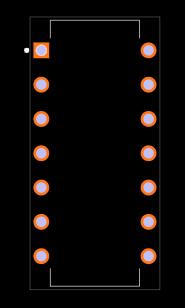
CD4069 Inverter Footprint
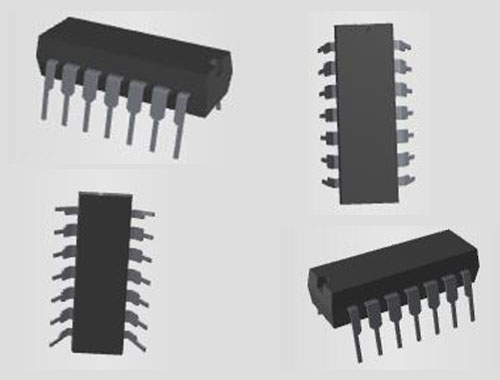
CD4069 Inverter 3D Model
Specifications
- TypeParameter
- Mount
In electronic components, the term "Mount" typically refers to the method or process of physically attaching or fixing a component onto a circuit board or other electronic device. This can involve soldering, adhesive bonding, or other techniques to secure the component in place. The mounting process is crucial for ensuring proper electrical connections and mechanical stability within the electronic system. Different components may have specific mounting requirements based on their size, shape, and function, and manufacturers provide guidelines for proper mounting procedures to ensure optimal performance and reliability of the electronic device.
Through Hole - Mounting Type
The "Mounting Type" in electronic components refers to the method used to attach or connect a component to a circuit board or other substrate, such as through-hole, surface-mount, or panel mount.
Through Hole - Package / Case
refers to the protective housing that encases an electronic component, providing mechanical support, electrical connections, and thermal management.
14-DIP (0.300, 7.62mm) - Number of Pins14
- Supplier Device Package
The parameter "Supplier Device Package" in electronic components refers to the physical packaging or housing of the component as provided by the supplier. It specifies the form factor, dimensions, and layout of the component, which are crucial for compatibility and integration into electronic circuits and systems. The supplier device package information typically includes details such as the package type (e.g., DIP, SOP, QFN), number of pins, pitch, and overall size, allowing engineers and designers to select the appropriate component for their specific application requirements. Understanding the supplier device package is essential for proper component selection, placement, and soldering during the manufacturing process to ensure optimal performance and reliability of the electronic system.
14-PDIP - Logic Level-High4V ~ 12V
- Logic Level-Low1V ~ 3V
- Number of Elements6
- Operating Temperature
The operating temperature is the range of ambient temperature within which a power supply, or any other electrical equipment, operate in. This ranges from a minimum operating temperature, to a peak or maximum operating temperature, outside which, the power supply may fail.
-55°C~125°C - Packaging
Semiconductor package is a carrier / shell used to contain and cover one or more semiconductor components or integrated circuits. The material of the shell can be metal, plastic, glass or ceramic.
Tube - Series
In electronic components, the "Series" refers to a group of products that share similar characteristics, designs, or functionalities, often produced by the same manufacturer. These components within a series typically have common specifications but may vary in terms of voltage, power, or packaging to meet different application needs. The series name helps identify and differentiate between various product lines within a manufacturer's catalog.
4000B - Published2002
- Part Status
Parts can have many statuses as they progress through the configuration, analysis, review, and approval stages.
Obsolete - Moisture Sensitivity Level (MSL)
Moisture Sensitivity Level (MSL) is a standardized rating that indicates the susceptibility of electronic components, particularly semiconductors, to moisture-induced damage during storage and the soldering process, defining the allowable exposure time to ambient conditions before they require special handling or baking to prevent failures
1 (Unlimited) - Max Operating Temperature
The Maximum Operating Temperature is the maximum body temperature at which the thermistor is designed to operate for extended periods of time with acceptable stability of its electrical characteristics.
125°C - Min Operating Temperature
The "Min Operating Temperature" parameter in electronic components refers to the lowest temperature at which the component is designed to operate effectively and reliably. This parameter is crucial for ensuring the proper functioning and longevity of the component, as operating below this temperature may lead to performance issues or even damage. Manufacturers specify the minimum operating temperature to provide guidance to users on the environmental conditions in which the component can safely operate. It is important to adhere to this parameter to prevent malfunctions and ensure the overall reliability of the electronic system.
-55°C - Voltage - Supply
Voltage - Supply refers to the range of voltage levels that an electronic component or circuit is designed to operate with. It indicates the minimum and maximum supply voltage that can be applied for the device to function properly. Providing supply voltages outside this range can lead to malfunction, damage, or reduced performance. This parameter is critical for ensuring compatibility between different components in a circuit.
3V~15V - Base Part Number
The "Base Part Number" (BPN) in electronic components serves a similar purpose to the "Base Product Number." It refers to the primary identifier for a component that captures the essential characteristics shared by a group of similar components. The BPN provides a fundamental way to reference a family or series of components without specifying all the variations and specific details.
4069 - Voltage
Voltage is a measure of the electric potential difference between two points in an electrical circuit. It is typically represented by the symbol "V" and is measured in volts. Voltage is a crucial parameter in electronic components as it determines the flow of electric current through a circuit. It is responsible for driving the movement of electrons from one point to another, providing the energy needed for electronic devices to function properly. In summary, voltage is a fundamental concept in electronics that plays a key role in the operation and performance of electronic components.
15V - Number of Circuits6
- Max Supply Voltage
In general, the absolute maximum common-mode voltage is VEE-0.3V and VCC+0.3V, but for products without a protection element at the VCC side, voltages up to the absolute maximum rated supply voltage (i.e. VEE+36V) can be supplied, regardless of supply voltage.
15V - Min Supply Voltage
The minimum supply voltage (V min ) is explored for sequential logic circuits by statistically simulating the impact of within-die process variations and gate-dielectric soft breakdown on data retention and hold time.
3V - Output Current
The rated output current is the maximum load current that a power supply can provide at a specified ambient temperature. A power supply can never provide more current that it's rated output current unless there is a fault, such as short circuit at the load.
8.8mA - Propagation Delay
the flight time of packets over the transmission link and is limited by the speed of light.
50 ns - Quiescent Current
The quiescent current is defined as the current level in the amplifier when it is producing an output of zero.
1μA - Turn On Delay Time
Turn-on delay, td(on), is the time taken to charge the input capacitance of the device before drain current conduction can start.
90 ns - Logic Function
In electronic components, the term "Logic Function" refers to the specific operation or behavior of a component based on its input signals. It describes how the component processes the input signals to produce the desired output. Logic functions are fundamental to digital circuits and are used to perform logical operations such as AND, OR, NOT, and XOR.Each electronic component, such as logic gates or flip-flops, is designed to perform a specific logic function based on its internal circuitry. By understanding the logic function of a component, engineers can design and analyze complex digital systems to ensure proper functionality and performance. Different logic functions can be combined to create more complex operations, allowing for the creation of sophisticated digital devices and systems.
Buffer, Inverter - Number of Inputs6
- Logic Type
Logic Type in electronic components refers to the classification of circuits based on the logical operations they perform. It includes types such as AND, OR, NOT, NAND, NOR, XOR, and XNOR, each defining the relationship between binary inputs and outputs. The logic type determines how the inputs affect the output state based on specific rules of Boolean algebra. This classification is crucial for designing digital circuits and systems, enabling engineers to select appropriate components for desired functionalities.
Inverter - Number of Gates
The number of gates per IC varies depending on the number of inputs per gate. Two?input gates are common, but if only a single input is required, such as in the 744 NOT(or inverter) gates, a 14 pin IC can accommodate 6 (or Hex) gates.
6 - Max Propagation Delay @ V, Max CL
The parameter "Max Propagation Delay @ V, Max CL" in electronic components refers to the maximum amount of time it takes for a signal to propagate through the component from input to output when operating at a specific voltage (V) and driving a maximum specified load capacitance (CL). This parameter is crucial in determining the speed and performance of the component in a circuit. A shorter propagation delay indicates faster signal processing and better overall performance. Designers use this parameter to ensure that signals can be transmitted and received within the required timing constraints in their electronic systems.
50ns @ 15V, 50pF - High Level Output Current
High-level Output Current IOH The current flowing into the output at a specified high- level voltage. Low-level Output Current IOL The current flowing into the output at a specified low- level output voltage.
-4.2mA - Low Level Output Current
The current into the output terminal with input conditions applied that, according to the product specification, will establish a low level at the output.
4.2mA - Current - Quiescent (Max)
The parameter "Current - Quiescent (Max)" in electronic components refers to the maximum amount of current that a device consumes when it is in a quiescent or idle state. This parameter is important because it indicates the minimum power consumption of the device when it is not actively performing any tasks. It is typically measured in units of amperes (A) and helps in determining the overall power efficiency and battery life of the electronic component. Designers and engineers use this parameter to ensure that the device meets power consumption requirements and operates within specified limits during standby or idle modes.
1μA - REACH SVHC
The parameter "REACH SVHC" in electronic components refers to the compliance with the Registration, Evaluation, Authorization, and Restriction of Chemicals (REACH) regulation regarding Substances of Very High Concern (SVHC). SVHCs are substances that may have serious effects on human health or the environment, and their use is regulated under REACH to ensure their safe handling and minimize their impact.Manufacturers of electronic components need to declare if their products contain any SVHCs above a certain threshold concentration and provide information on the safe use of these substances. This information allows customers to make informed decisions about the potential risks associated with using the components and take appropriate measures to mitigate any hazards.Ensuring compliance with REACH SVHC requirements is essential for electronics manufacturers to meet regulatory standards, protect human health and the environment, and maintain transparency in their supply chain. It also demonstrates a commitment to sustainability and responsible manufacturing practices in the electronics industry.
No SVHC - Radiation Hardening
Radiation hardening is the process of making electronic components and circuits resistant to damage or malfunction caused by high levels of ionizing radiation, especially for environments in outer space (especially beyond the low Earth orbit), around nuclear reactors and particle accelerators, or during nuclear accidents or nuclear warfare.
No - RoHS Status
RoHS means “Restriction of Certain Hazardous Substances” in the “Hazardous Substances Directive” in electrical and electronic equipment.
RoHS Compliant - Lead Free
Lead Free is a term used to describe electronic components that do not contain lead as part of their composition. Lead is a toxic material that can have harmful effects on human health and the environment, so the electronics industry has been moving towards lead-free components to reduce these risks. Lead-free components are typically made using alternative materials such as silver, copper, and tin. Manufacturers must comply with regulations such as the Restriction of Hazardous Substances (RoHS) directive to ensure that their products are lead-free and environmentally friendly.
Lead Free
CD4069 Inverter Schematics Diagram

CD4069 Inverter Functional Block Diagram

CD4069 Inverter Functional Block Diagram
CD4069 Inverter Features
Wide supply voltage range: 3.0V to 15V
High noise immunity: 0.45 VDD type.
Low power TTL compatibility: Fan out of 2 driving 74L or 1 driving 74LS
Equivalent to MM74C04
CD4069 Inverter Equivalents
MC14069, TC14069, HD14069, MM74C04
CD4069 Inverter Applications
Logic inversion
Pulse shaping
Oscillators
High-input-impedance amplifiers
CD4069 Inverter Circuit

CD4069 Inverter 1 kHz Clock pulse generator
The output is a square wave frequency or pulse form. And F = 1 / 1.4 RC.

CD4069 Inverter Bounceless Switch circuit


CD4069 Inverter High-Input Impedance Amplifier
If your input signals aren't strong enough. It may cause a circuit malfunction. Before a feed to the circuit, we need to increase it. As a high-impedance amplifier, an Inverter or buffer gate is a simple solution.
We'll see a power amplifier with a digital logic gate later.
CD4069 Inverter Dimensions


CD4069 Inverter Dimensions
CD4069 Inverter Manufacturer
On Semiconductor (Nasdaq: ON) is a manufacturer engaging itself in reducing energy use. It features a comprehensive portfolio of power, signal management, and logic, custom solutions that are energy efficient. It acts as a world-class supply chain with high reliability and a network of manufacturing facilities, sales, offices, and design centers in key markets through North America, Europe, and the Asia Pacific regions.
Datasheet PDF
- ReachStatement :
- Datasheets :
What is CD4069 used for?
The CD4069 device consists of six CMOS inverter circuits. These devices are intended for all general-purpose inverter applications where the medium-power TTL-drive and logic-level-conversion capabilities of circuits such as the CD4009 and CD4049 hex inverter and buffers are not required.
How does CD4069 work?
As the voltage increases from zero, the first LED grows in brightness. Just when that LED is fully lit, the next LED begins to glow slightly. Each LED represents about 1 volt of change when the circuit is operating from 9 volts.
How many NOT gates are on the 4069?
You use the C-MOS IC 4069, which has six NOT gates. The circuit shown is therefore only one example, since you can use any of the six gates.
What is CMOS inverter?
A CMOS inverter is a field-effect transistor that is composed of a metal gate that lies on top of an insulating layer of oxygen, which lies on top of a semiconductor. CMOS inverters are found in most electronic devices and are responsible for producing data within small circuits.
What is the voltage of CD4069?
3.0V to 15V
 MPC5668x Microcontroller: Technical Overview and Applications
29 February 2024178
 MC1458 Dual Op-Amp: Specifications, Design Limitations, and Modern Replacement Options
08 June 2026485
 STM32F407IGT6 Microcontroller: Features, Applications and Datasheet
22 December 20232106
 Unveiling the Atmel SAM D21E / SAM D21G / SAM D21J Microcontroller
28 February 2024465
 ST3485EBDR Transceiver: Features, Applications and Datasheet
13 December 20231891
 MIC29302WU Voltage Regulator: Pinout, Applications and Datasheet
24 October 20232443
 AD9856ASTZ IC Upconverter: Specification, Pinout, Datasheet
14 August 2024497
 Unveiling the Microchip PIC32MX1XX/2XX 32-bit Microcontrollers: A Technical Investigation
29 February 2024235
 Role of Direct Memory Access in Modern Computing
12 November 20246371
 What is a Gyroscope Sensor?
11 September 202018172
 Latest MLPerf Results: NVIDIA H100 GPUs Ride to the Top
13 September 20224469
 Toroidal transformer: Principles, Features, Types and Applications
13 November 20209505
 Applications of Sensors on CNC Machine Tools
13 September 202119535
 What Makes a CPU?
30 March 20221795
 L1154F Battery Features and What Makes It Unique
22 August 20252076
 Humidity Sensor: Classification, Package and Application
13 November 20255486
ON Semiconductor
In Stock: 20
United States
China
Canada
Japan
Russia
Germany
United Kingdom
Singapore
Italy
Hong Kong(China)
Taiwan(China)
France
Korea
Mexico
Netherlands
Malaysia
Austria
Spain
Switzerland
Poland
Thailand
Vietnam
India
United Arab Emirates
Afghanistan
Åland Islands
Albania
Algeria
American Samoa
Andorra
Angola
Anguilla
Antigua & Barbuda
Argentina
Armenia
Aruba
Australia
Azerbaijan
Bahamas
Bahrain
Bangladesh
Barbados
Belarus
Belgium
Belize
Benin
Bermuda
Bhutan
Bolivia
Bonaire, Sint Eustatius and Saba
Bosnia & Herzegovina
Botswana
Brazil
British Indian Ocean Territory
British Virgin Islands
Brunei
Bulgaria
Burkina Faso
Burundi
Cabo Verde
Cambodia
Cameroon
Cayman Islands
Central African Republic
Chad
Chile
Christmas Island
Cocos (Keeling) Islands
Colombia
Comoros
Congo
Congo (DRC)
Cook Islands
Costa Rica
Côte d’Ivoire
Croatia
Cuba
Curaçao
Cyprus
Czechia
Denmark
Djibouti
Dominica
Dominican Republic
Ecuador
Egypt
El Salvador
Equatorial Guinea
Eritrea
Estonia
Eswatini
Ethiopia
Falkland Islands
Faroe Islands
Fiji
Finland
French Guiana
French Polynesia
Gabon
Gambia
Georgia
Ghana
Gibraltar
Greece
Greenland
Grenada
Guadeloupe
Guam
Guatemala
Guernsey
Guinea
Guinea-Bissau
Guyana
Haiti
Honduras
Hungary
Iceland
Indonesia
Iran
Iraq
Ireland
Isle of Man
Israel
Jamaica
Jersey
Jordan
Kazakhstan
Kenya
Kiribati
Kosovo
Kuwait
Kyrgyzstan
Laos
Latvia
Lebanon
Lesotho
Liberia
Libya
Liechtenstein
Lithuania
Luxembourg
Macao(China)
Madagascar
Malawi
Maldives
Mali
Malta
Marshall Islands
Martinique
Mauritania
Mauritius
Mayotte
Micronesia
Moldova
Monaco
Mongolia
Montenegro
Montserrat
Morocco
Mozambique
Myanmar
Namibia
Nauru
Nepal
New Caledonia
New Zealand
Nicaragua
Niger
Nigeria
Niue
Norfolk Island
North Korea
North Macedonia
Northern Mariana Islands
Norway
Oman
Pakistan
Palau
Palestinian Authority
Panama
Papua New Guinea
Paraguay
Peru
Philippines
Pitcairn Islands
Portugal
Puerto Rico
Qatar
Réunion
Romania
Rwanda
Samoa
San Marino
São Tomé & Príncipe
Saudi Arabia
Senegal
Serbia
Seychelles
Sierra Leone
Sint Maarten
Slovakia
Slovenia
Solomon Islands
Somalia
South Africa
South Sudan
Sri Lanka
St Helena, Ascension, Tristan da Cunha
St. Barthélemy
St. Kitts & Nevis
St. Lucia
St. Martin
St. Pierre & Miquelon
St. Vincent & Grenadines
Sudan
Suriname
Svalbard & Jan Mayen
Sweden
Syria
Tajikistan
Tanzania
Timor-Leste
Togo
Tokelau
Tonga
Trinidad & Tobago
Tunisia
Turkey
Turkmenistan
Turks & Caicos Islands
Tuvalu
U.S. Outlying Islands
U.S. Virgin Islands
Uganda
Ukraine
Uruguay
Uzbekistan
Vanuatu
Vatican City
Venezuela
Wallis & Futuna
Yemen
Zambia
Zimbabwe
![MC74LCX08DTR2G]() MC74LCX08DTR2G
MC74LCX08DTR2GON Semiconductor
![MC74HC1G08DTT1G]() MC74HC1G08DTT1G
MC74HC1G08DTT1GON Semiconductor
![MC14011BDR2G]() MC14011BDR2G
MC14011BDR2GON Semiconductor
![NC7SZ04P5X]() NC7SZ04P5X
NC7SZ04P5XON Semiconductor
![MC74HC04ADR2G]() MC74HC04ADR2G
MC74HC04ADR2GON Semiconductor
![NC7SZ04M5X]() NC7SZ04M5X
NC7SZ04M5XON Semiconductor
![NC7WZ14P6X]() NC7WZ14P6X
NC7WZ14P6XON Semiconductor
![NC7WZ04P6X]() NC7WZ04P6X
NC7WZ04P6XON Semiconductor
![MM74HC14MX]() MM74HC14MX
MM74HC14MXON Semiconductor
![74VHC14MTCX]() 74VHC14MTCX
74VHC14MTCXON Semiconductor


