

 Product
 Brand
Brand Articles
 Tools
Tools
AD7689 8-Channel 16-Bit ADC: Performance Analysis and SPI Design Guide


16 Bit 0.5mm Copper, Silver, Tin ADC AD7689 20-UFBGA, WLCSP
Master the AD7689 8-channel 16-bit ADC from Analog Devices. Explore specs, pinout, and SPI timing fixes for medical or IoT designs. Optimize your BOM today.
- Executive Summary: What is the AD7689?
- 1. Technical Specifications & Performance Analysis
- 2. Pinout, Package, and Configuration
- 3. Design & Integration Guide (For Engineers & Makers)
- 4. Typical Applications & Use Cases
- 5. Alternatives and Cross-Reference Guide
- 6. Frequently Asked Questions (FAQ)
- 7. Resources
- Specifications
- Parts with Similar Specs
- Datasheet PDF
Executive Summary: What is the AD7689?
The AD7689 is an 8-channel, 16-bit, charge redistribution successive approximation register (SAR) analog-to-digital converter (ADC) designed for high-precision multichannel data acquisition. It operates from a single power supply and integrates a channel sequencer, temperature sensor, and internal reference to minimize external component count.
Market Position: High-performance, integrated multi-channel ADC favored for its balance of resolution and power efficiency.
Top Features: 16-bit resolution with no missing codes, 8-channel multiplexer, and a low-power standby mode of only 50 nA.
Primary Audience: Ideal for medical instrumentation designers, industrial process control engineers, and developers of battery-operated IoT sensors.
Supply Status: Active; widely available through major electronics distributors.
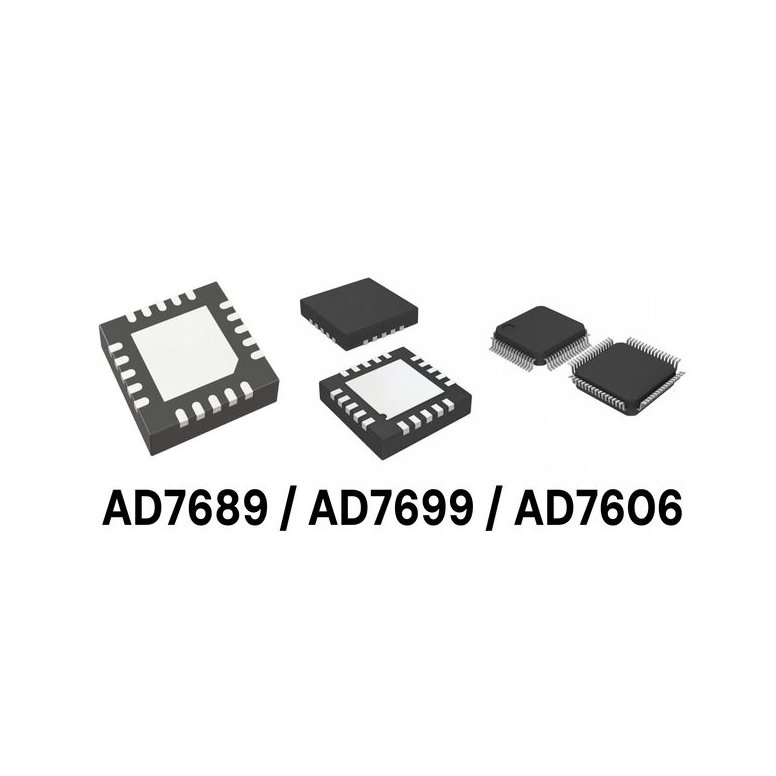
1. Technical Specifications & Performance Analysis
The AD7689 is engineered for applications where PCB real estate and power consumption are critical but high precision cannot be sacrificed.
1.1 Core Architecture (SAR ADC)
The device utilizes a Successive Approximation Register (SAR) architecture. Unlike Delta-Sigma ADCs, SAR converters like the AD7689 offer zero-latency conversion, making them the superior choice for multichannel systems where the multiplexer switches between different signals rapidly.
1.2 Key Electrical Characteristics
Resolution & Throughput: Provides 16-bit precision at a throughput rate of 250 kSPS (kilosamples per second).
Supply Voltage Range: Operates on a main supply (VDD) of 2.3 V to 5.5 V, with a flexible I/O logic interface (VIO) spanning 1.8 V to 5.5 V.
Power Efficiency: Consumes only 12.5 mW at 5 V while operating at full speed, dropping significantly in standby mode (50 nA).
Dynamic Performance: Features a dynamic range of 93.8 dB, ensuring high signal integrity for sensitive measurements.
1.3 Interfaces and Connectivity
The AD7689 features a versatile serial interface compatible with SPI, QSPI, MICROWIRE, and DSPs. This allows for seamless integration with microcontrollers like the STM32 or TI Tiva series.
2. Pinout, Package, and Configuration
Understanding the physical layout and ordering codes is essential for both PCB layout and procurement.
2.1 Pin Configuration Guide
CH0–CH7: The 8 analog input channels. These can be configured as unipolar, differential, or pseudobipolar.
CNVST: Convert Start input. This pin initiates the conversion process and transitions the device from acquisition to conversion mode.
DIN/DOUT/SCK: The standard SPI interface pins for data input (configuration), data output (conversion results), and clocking.
REF: The internal reference output or external reference input.
2.2 Naming Convention & Ordering Codes
The AD7689 is typically found with suffixes such as: - BCPZ: Indicates an LFCSP (Lead Frame Chip Scale Package). - BRUZ: Indicates a TSSOP (Thin Shrink Small Outline Package). - RL7: Denotes the part is shipped on a 7-inch Tape and Reel.
2.3 Available Packages
| Package Type | Dimensions | Common Use Case |
|---|---|---|
| LFCSP-20 | 4mm x 4mm | Space-constrained IoT & Mobile devices. |
| TSSOP-20 | 6.5mm x 4.4mm | Prototyping and easier manual debugging. |
3. Design & Integration Guide (For Engineers & Makers)
Pro Tip: Always verify pin compatibility before migrating from older 12-bit or 14-bit SAR series to ensure the VIO and VDD rails are correctly decoupled.
3.1 Hardware Implementation
Bypass Capacitors: Use a 10 µF and 0.1 µF ceramic capacitor pair on the VDD and VIO pins, placed as close to the chip as possible to minimize noise.
PCB Layout: Use a solid ground plane. Keep analog input traces away from high-speed digital lines (SCK/DOUT) to prevent coupling.
Reference Selection: While the internal 2.5 V/4.096 V reference is convenient, using a high-precision external reference like the ADR43x series can improve absolute accuracy in medical applications.
3.2 Common Design Challenges
SPI Timing Issues: Users often see "garbage" data. This is usually due to updating the DIN register simultaneously with the SCK edge. Fix: Strictly adhere to the $t_{DATA}$ requirements in the datasheet and ensure the microcontroller captures data on the correct clock edge.
Input Ghosting: High-impedance sources can cause crosstalk between channels. Fix: Use a low-noise op-amp (e.g., ADA4807) as a buffer before the ADC inputs.
Linux Driver Bug: Some IIO drivers send 0xFF during reads, which can reset the configuration. Fix: Modify the driver to send 0x00 (NOP) during data retrieval to preserve the CFG register.
4. Typical Applications & Use Cases
Watch Tutorial: AD7689
4.1 Real-World Example: Medical ECG Monitoring
In an EKG/ECG machine, the AD7689’s 8 channels allow for the simultaneous monitoring of multiple leads. The 16-bit resolution is vital for detecting the millivolt-level electrical signals of the heart, while the low power consumption extends the battery life of portable heart monitors.
5. Alternatives and Cross-Reference Guide
If the AD7689 is unavailable or doesn't meet specific project needs, consider these alternatives:
Direct Replacements:
LTC1867: A similar 16-bit, 8-channel ADC from Analog Devices (formerly Linear Tech) with slightly different timing.
Higher Performance:
ADS8860 (TI): A 16-bit SAR ADC, though typically used in single-channel configurations, offers higher throughput.
Cost-Effective Options:
AD7685: A single-channel version of the same family, ideal if you do not require a multiplexer.
MCP3421 (Microchip): A much slower Delta-Sigma ADC for low-speed, low-cost applications.
6. Frequently Asked Questions (FAQ)
Q: What is the difference between AD7689 and AD7682?
A: The AD7689 is an 8-channel version, whereas the AD7682 is a 4-channel version of the same architecture.
Q: Can the AD7689 be used for automotive applications?
A: Yes, provided you select the version rated for the appropriate temperature range (check the datasheet for "W" grade parts).
Q: How do I handle the internal temperature sensor?
A: The temperature sensor is accessed via the channel sequencer. It provides a voltage proportional to the die temperature, which is useful for compensating for thermal drift in the system.
Q: Does it support Arduino or Raspberry Pi?
A: Yes, via the SPI bus. However, due to the 16-bit requirement and specific timing, using a dedicated C/C++ library is recommended over standard bit-banging.
7. Resources
AD7689 Datasheet: Available on the Analog Devices website.
Evaluation Boards: EVAL-AD7689EDZ for rapid prototyping.
Software: ADI IIO Oscilloscope for visualizing conversion data.
Specifications
Parts with Similar Specs
- ImagePart NumberManufacturerPackage / CaseNumber of InputsNumber of PinsNumber of BitsSampling RatePolarityInterfaceIntegral Nonlinearity (INL)Number of A/D ConvertersMin Supply VoltageSupply VoltageView Compare
![AD7689BCBZ-RL7]()
AD7689BCBZ-RL7
20-UFBGA, WLCSP
8
20
16
250 ksps
Bipolar, Unipolar
SPI
2 LSB
1
2.3 V
2.5 V
![TLV2548IDW]()
20-WFQFN Exposed Pad, CSP
4
20
16
250 ksps
Bipolar, Unipolar
SPI
1.5 LSB
-
2.3 V
5 V
![AD7689BCPZ]()
20-WFQFN Exposed Pad, CSP
4
20
16
8 ksps
Bipolar, Unipolar
SPI
1.5 LSB
-
2.3 V
5 V
![AD7682BCPZRL7]()
20-WFQFN Exposed Pad, CSP
8
20
16
250 ksps
Bipolar, Unipolar
SPI
1.5 LSB
-
2.3 V
5 V
![AD7682BCPZ]()
20-SOIC (0.295, 7.50mm Width)
-
20
12
200 ksps
Unipolar
SPI
1 LSB
1
2.7 V
3.3 V


Datasheet PDF
- Datasheets :
- Other Related Documents :
- ConflictMineralStatement :
 Exploring the STM32F103x8 and STM32F103xB Series Microcontrollers by STMicroelectronics
29 February 20242056
 TL084CN Operational Amplifier: Pinout, Equivalent, Application
24 August 202123562
![CP2104 USB-to-UART Bridge: Features, Pinout, CP2102 vs. CP2104 [Video&FAQ]](https://res.utmel.com/Images/Article/1b31b768-9825-4c49-a68b-dc56d2fd6121.png) CP2104 USB-to-UART Bridge: Features, Pinout, CP2102 vs. CP2104 [Video&FAQ]
CP2104 USB-to-UART Bridge: Features, Pinout, CP2102 vs. CP2104 [Video&FAQ]06 May 20228415
 ATmega8535 8-Bit Microcontroller: ATmega8535, Datasheet, Pinout
27 December 20216151
 A Comprehensive Guide to LTC6405IUD#PBF - ADC Driver Amplifier
06 March 2024216
 IRL520 Power MOSFET: DV/DT, Vishay, IRL520 Datasheet
30 December 20212827
 CR2016 vs. CR2032: Specifications, Applications, Differences
04 November 202192406
 STM32MP157CAA3 Development: From Setup and Configuration to Advanced Features Implementation
07 June 20251481
 What is Sequential Logic?
15 October 20208292
 Wiring and Mounting Photoelectric Sensors in 2025
15 July 20251748
 What is First In First Out (FIFO)?
30 November 20213900
 What is Chiplet?
17 November 20214592
 What is the Difference between MOM, MIM and MOS Capacitors?
17 April 202571934
 What is Inter-Integrated Circuit (I2C)?
23 February 20224079
 Understanding Electronic Speed Controllers (ESCs): Working Principles, Key Specifications, and Sourcing Guide
15 June 20261242
 Low-Power Design of Operational Amplifiers
27 March 20257636
Analog Devices Inc.
In Stock: 5000
United States
China
Canada
Japan
Russia
Germany
United Kingdom
Singapore
Italy
Hong Kong(China)
Taiwan(China)
France
Korea
Mexico
Netherlands
Malaysia
Austria
Spain
Switzerland
Poland
Thailand
Vietnam
India
United Arab Emirates
Afghanistan
Åland Islands
Albania
Algeria
American Samoa
Andorra
Angola
Anguilla
Antigua & Barbuda
Argentina
Armenia
Aruba
Australia
Azerbaijan
Bahamas
Bahrain
Bangladesh
Barbados
Belarus
Belgium
Belize
Benin
Bermuda
Bhutan
Bolivia
Bonaire, Sint Eustatius and Saba
Bosnia & Herzegovina
Botswana
Brazil
British Indian Ocean Territory
British Virgin Islands
Brunei
Bulgaria
Burkina Faso
Burundi
Cabo Verde
Cambodia
Cameroon
Cayman Islands
Central African Republic
Chad
Chile
Christmas Island
Cocos (Keeling) Islands
Colombia
Comoros
Congo
Congo (DRC)
Cook Islands
Costa Rica
Côte d’Ivoire
Croatia
Cuba
Curaçao
Cyprus
Czechia
Denmark
Djibouti
Dominica
Dominican Republic
Ecuador
Egypt
El Salvador
Equatorial Guinea
Eritrea
Estonia
Eswatini
Ethiopia
Falkland Islands
Faroe Islands
Fiji
Finland
French Guiana
French Polynesia
Gabon
Gambia
Georgia
Ghana
Gibraltar
Greece
Greenland
Grenada
Guadeloupe
Guam
Guatemala
Guernsey
Guinea
Guinea-Bissau
Guyana
Haiti
Honduras
Hungary
Iceland
Indonesia
Iran
Iraq
Ireland
Isle of Man
Israel
Jamaica
Jersey
Jordan
Kazakhstan
Kenya
Kiribati
Kosovo
Kuwait
Kyrgyzstan
Laos
Latvia
Lebanon
Lesotho
Liberia
Libya
Liechtenstein
Lithuania
Luxembourg
Macao(China)
Madagascar
Malawi
Maldives
Mali
Malta
Marshall Islands
Martinique
Mauritania
Mauritius
Mayotte
Micronesia
Moldova
Monaco
Mongolia
Montenegro
Montserrat
Morocco
Mozambique
Myanmar
Namibia
Nauru
Nepal
New Caledonia
New Zealand
Nicaragua
Niger
Nigeria
Niue
Norfolk Island
North Korea
North Macedonia
Northern Mariana Islands
Norway
Oman
Pakistan
Palau
Palestinian Authority
Panama
Papua New Guinea
Paraguay
Peru
Philippines
Pitcairn Islands
Portugal
Puerto Rico
Qatar
Réunion
Romania
Rwanda
Samoa
San Marino
São Tomé & Príncipe
Saudi Arabia
Senegal
Serbia
Seychelles
Sierra Leone
Sint Maarten
Slovakia
Slovenia
Solomon Islands
Somalia
South Africa
South Sudan
Sri Lanka
St Helena, Ascension, Tristan da Cunha
St. Barthélemy
St. Kitts & Nevis
St. Lucia
St. Martin
St. Pierre & Miquelon
St. Vincent & Grenadines
Sudan
Suriname
Svalbard & Jan Mayen
Sweden
Syria
Tajikistan
Tanzania
Timor-Leste
Togo
Tokelau
Tonga
Trinidad & Tobago
Tunisia
Turkey
Turkmenistan
Turks & Caicos Islands
Tuvalu
U.S. Outlying Islands
U.S. Virgin Islands
Uganda
Ukraine
Uruguay
Uzbekistan
Vanuatu
Vatican City
Venezuela
Wallis & Futuna
Yemen
Zambia
Zimbabwe
![ADV7513BSWZ]() ADV7513BSWZ
ADV7513BSWZAnalog Devices, Inc.
![AD9877ABSZ]() AD9877ABSZ
AD9877ABSZAnalog Devices, Inc.
![LTC2245CUH#TRPBF]() LTC2245CUH#TRPBF
LTC2245CUH#TRPBFLinear Technology/Analog Devices
![AD7791BRMZ-REEL]() AD7791BRMZ-REEL
AD7791BRMZ-REELAnalog Devices Inc.
![AD7799BRUZ-REEL]() AD7799BRUZ-REEL
AD7799BRUZ-REELAnalog Devices Inc.
![AD7190BRUZ-REEL]() AD7190BRUZ-REEL
AD7190BRUZ-REELAnalog Devices Inc.
![AD7705BRZ-REEL]() AD7705BRZ-REEL
AD7705BRZ-REELAnalog Devices Inc.
![AD7175-2BRUZ-RL7]() AD7175-2BRUZ-RL7
AD7175-2BRUZ-RL7Analog Devices Inc.
![AD7192BRUZ-REEL]() AD7192BRUZ-REEL
AD7192BRUZ-REELAnalog Devices Inc.
![AD9283BRSZ-RL100]() AD9283BRSZ-RL100
AD9283BRSZ-RL100Analog Devices Inc.


