Product
 Brand
Brand Articles
 Tools
Tools
MAX30100 Heart-Rate Sensor IC : Specification, Pinout and Datasheet
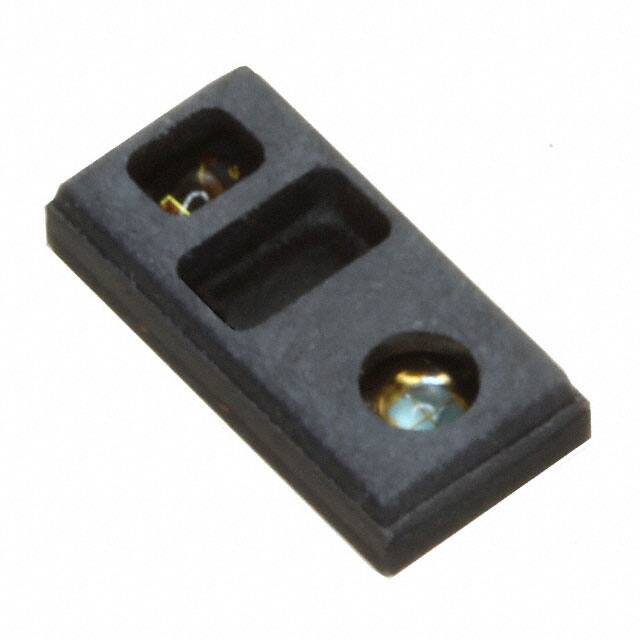


Pulse Oximeter and Heart-Rate Sensor IC 14-Pin OLGA
Hi, fellas. Welcome back to the new post today. MAX30100 is a Pulse Oximeter and Heart-Rate Sensor IC which is used to check the health of a person with any condition that affects blood oxygen levels. This article mainly introduces specification, pinout, datasheet, and other detailed information about Maxim Integrated MAX30100.

Blood Oxygen & Heart Rate Measurement with MAX30100/02 Pulse Oximeter & Arduino
MAX30100 Description
MAX30100 is a Pulse Oximeter and Heart-Rate Sensor IC which is used to check the health of a person with any condition that affects blood oxygen levels, such as Heart Attack, Heart failure, Lungs Cancer Asthma, etc.
The MAX30100 operates from 1.8V and 3.3V power supplies and can be powered down through software with negligible standby current, permitting the power supply to remain connected at all times.
The sensor comprises two Light Emitting Diodes, a photodetector, and a series of low noise signal processing devices to detect heart rate and to perform pulse oximetry.
MAX30100 Pinout

MAX30100 Pinout
| Pin Number | Pin Name | Description |
| 1,7,8,14 | N.C. | No Connection. Connect to PCB Pad for Mechanical Stability. |
| 2 | SCL | I2C Clock Input |
| 3 | SDA | I2C Clock Data, Bidirectional (Open-Drain) |
| 4 | PGND | Power Ground of the LED Driver Blocks |
| 5 | IR_DRV | IR LED Cathode and LED Driver Connection Point. Leave floating in the circuit. |
| 6 | R_DRV | Red LED Cathode and LED Driver Connection Point. Leave floating in the circuit. |
| 9 | R_LED+ | Power Supply (Anode Connection) for Red LED. Bypass to PGND for best performance. Connected to IR_LED+ internally. |
| 10 | IR_LED+ | Power Supply (Anode Connection) for IR LED. Bypass to PGND for best performance. Connected to R_LED+ internally |
| 11 | VDD | Analog Power Supply Input. Bypass to GND for best performance. |
| 12 | GND | Analog Ground |
| 13 | INT | Active-Low Interrupt (Open-Drain) |
MAX30100 Pin Description
MAX30100 Features
●Operating Voltage - 1.8V to 3.3V
●Input Current - 20mA
●Integrated Ambient Light Cancellation
●High Sample Rate Capability
●Fast Data Output Capability
Specifications
- TypeParameter
- Factory Lead Time6 Weeks
- Mount
In electronic components, the term "Mount" typically refers to the method or process of physically attaching or fixing a component onto a circuit board or other electronic device. This can involve soldering, adhesive bonding, or other techniques to secure the component in place. The mounting process is crucial for ensuring proper electrical connections and mechanical stability within the electronic system. Different components may have specific mounting requirements based on their size, shape, and function, and manufacturers provide guidelines for proper mounting procedures to ensure optimal performance and reliability of the electronic device.
Surface Mount - Number of Pins14
- Packaging
Semiconductor package is a carrier / shell used to contain and cover one or more semiconductor components or integrated circuits. The material of the shell can be metal, plastic, glass or ceramic.
Tray - Published2015
- Part Status
Parts can have many statuses as they progress through the configuration, analysis, review, and approval stages.
Obsolete - Moisture Sensitivity Level (MSL)
Moisture Sensitivity Level (MSL) is a standardized rating that indicates the susceptibility of electronic components, particularly semiconductors, to moisture-induced damage during storage and the soldering process, defining the allowable exposure time to ambient conditions before they require special handling or baking to prevent failures
3 (168 Hours) - Max Operating Temperature
The Maximum Operating Temperature is the maximum body temperature at which the thermistor is designed to operate for extended periods of time with acceptable stability of its electrical characteristics.
85°C - Min Operating Temperature
The "Min Operating Temperature" parameter in electronic components refers to the lowest temperature at which the component is designed to operate effectively and reliably. This parameter is crucial for ensuring the proper functioning and longevity of the component, as operating below this temperature may lead to performance issues or even damage. Manufacturers specify the minimum operating temperature to provide guidance to users on the environmental conditions in which the component can safely operate. It is important to adhere to this parameter to prevent malfunctions and ensure the overall reliability of the electronic system.
-40°C - Output Type
The "Output Type" parameter in electronic components refers to the type of signal or data that is produced by the component as an output. This parameter specifies the nature of the output signal, such as analog or digital, and can also include details about the voltage levels, current levels, frequency, and other characteristics of the output signal. Understanding the output type of a component is crucial for ensuring compatibility with other components in a circuit or system, as well as for determining how the output signal can be utilized or processed further. In summary, the output type parameter provides essential information about the nature of the signal that is generated by the electronic component as its output.
Analog - Max Supply Voltage
In general, the absolute maximum common-mode voltage is VEE-0.3V and VCC+0.3V, but for products without a protection element at the VCC side, voltages up to the absolute maximum rated supply voltage (i.e. VEE+36V) can be supplied, regardless of supply voltage.
2V - Min Supply Voltage
The minimum supply voltage (V min ) is explored for sequential logic circuits by statistically simulating the impact of within-die process variations and gate-dielectric soft breakdown on data retention and hold time.
1.7V - Sensor Type
In electronic components, the parameter "Sensor Type" refers to the specific type of sensor technology used in a particular component to detect and measure physical phenomena such as light, temperature, pressure, motion, or proximity. Different sensor types utilize various principles and mechanisms to convert the detected input into an electrical signal that can be processed by the electronic component. Common sensor types include photodiodes, thermistors, accelerometers, and proximity sensors, each designed for specific applications and environments. Understanding the sensor type is crucial for selecting the right component for a given task and ensuring accurate and reliable sensing capabilities in electronic systems.
Oximeter/Heart Rate - REACH SVHC
The parameter "REACH SVHC" in electronic components refers to the compliance with the Registration, Evaluation, Authorization, and Restriction of Chemicals (REACH) regulation regarding Substances of Very High Concern (SVHC). SVHCs are substances that may have serious effects on human health or the environment, and their use is regulated under REACH to ensure their safe handling and minimize their impact.Manufacturers of electronic components need to declare if their products contain any SVHCs above a certain threshold concentration and provide information on the safe use of these substances. This information allows customers to make informed decisions about the potential risks associated with using the components and take appropriate measures to mitigate any hazards.Ensuring compliance with REACH SVHC requirements is essential for electronics manufacturers to meet regulatory standards, protect human health and the environment, and maintain transparency in their supply chain. It also demonstrates a commitment to sustainability and responsible manufacturing practices in the electronics industry.
Unknown - RoHS Status
RoHS means “Restriction of Certain Hazardous Substances” in the “Hazardous Substances Directive” in electrical and electronic equipment.
ROHS3 Compliant
MAX30100 Functional Diagram
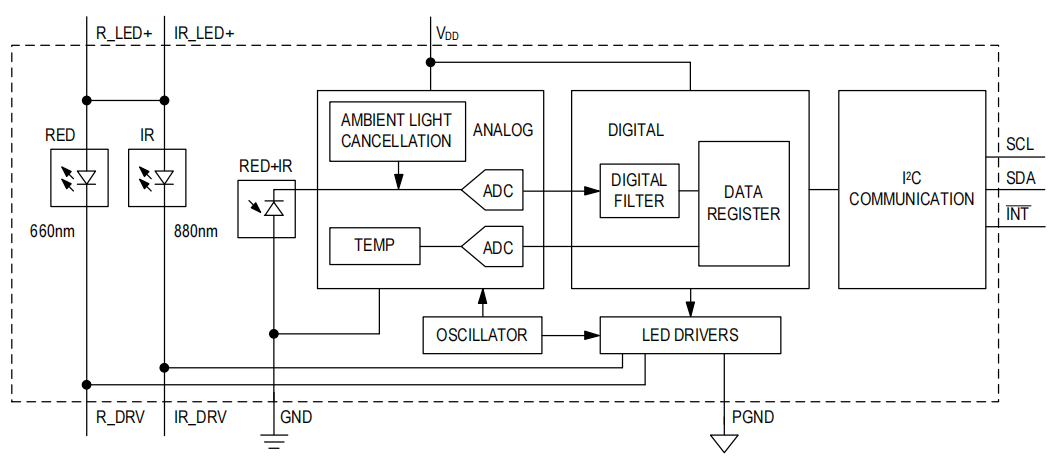
MAX30100 Functional Diagram
MAX30100 System Block Diagram
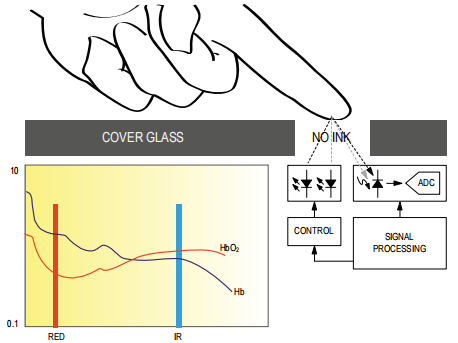
System Block Diagram
As the system block diagram is shown, there should be a small distance between the sensor and finger.
MAX30100 Advantages
● Complete Pulse Oximeter and Heart-Rate Sensor Solution Simplifies Design
• Integrated LEDs, Photo Sensor, and High-Performance Analog Front -End
• Tiny 5.6mm x 2.8mm x 1.2mm 14-Pin Optically Enhanced System-in-Package
● Ultra-Low-Power Operation Increases Battery Life for Wearable Devices
• Programmable Sample Rate and LED Current for Power Savings
• Ultra-Low Shutdown Current (0.7µA, typ)
● Advanced Functionality Improves Measurement Performance
• High SNR Provides Robust Motion Artifact Resilience
• Integrated Ambient Light Cancellation
• High Sample Rate Capability
• Fast Data Output Capability
MAX30100 Disadvantages
1. If the fingers are not placed properly, incorrect readings may be produced. Ambient light falling on the sensor will affect the final reading. When using the Max30100 oximeter, make sure that your fingers are not moving, as this may cause incorrect readings.
2. Do not press the sensor forcefully, as this will affect blood flow and cause incorrect readings. Place your fingers as gently as possible and make sure that they do not move, so that you can get the most accurate readings.
MAX30100 Arduino
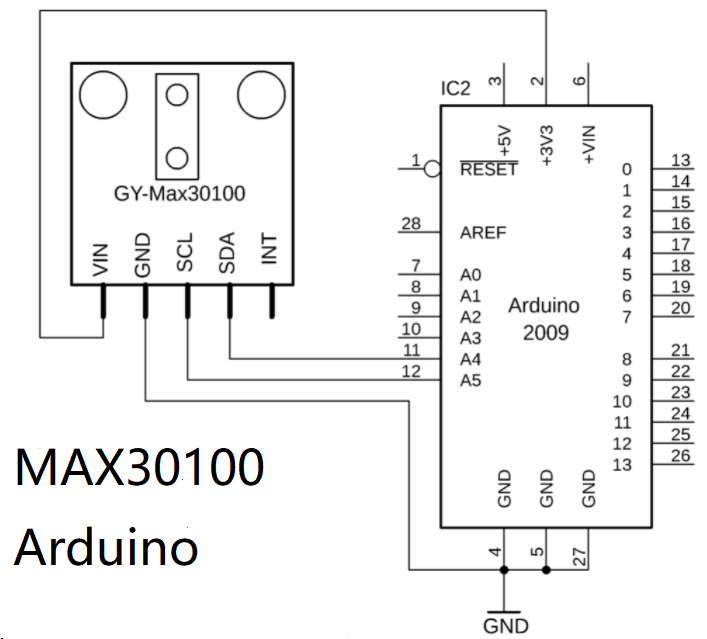
Interfacing Max30100 Pulse Oximeter Sensor with Arduino Circuit Diagram
First, let's start with a very basic circuit diagram. As you can see the VIN and GND pins of the Max30100 sensor are connected with the Arduino’s 3.3v and GND pins. The SCL pin is connected with the Analog pin A5, SDA pin is connected with the Analog pin A4. While the INT pin is not connected.
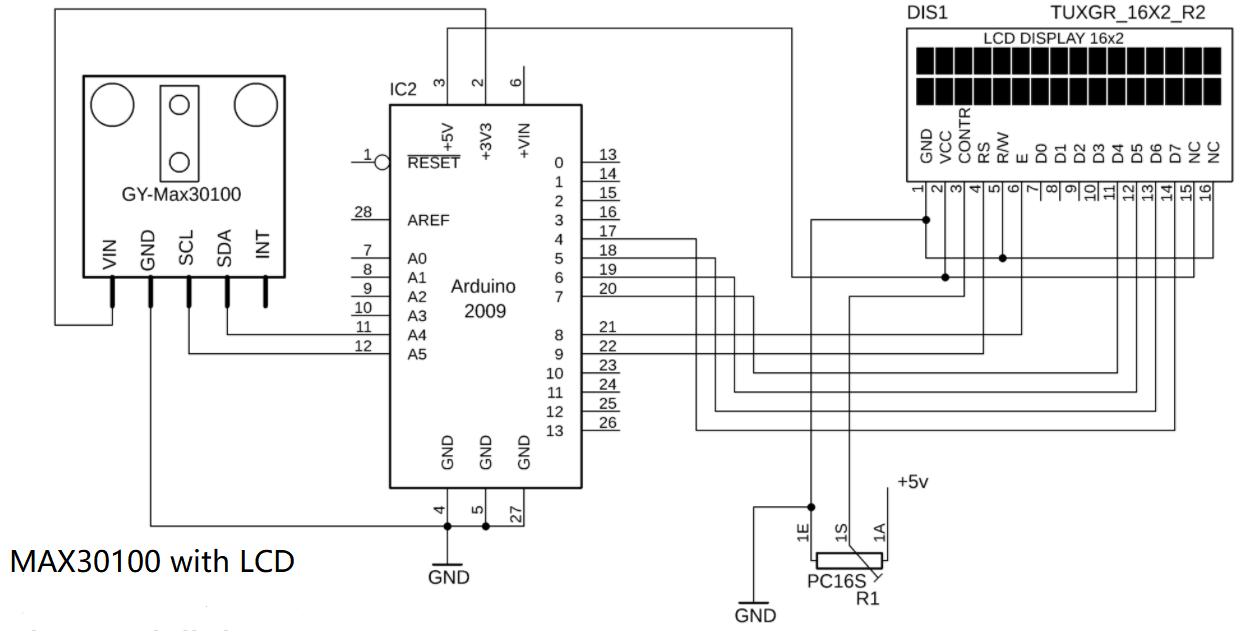
Interfacing Max30100 Pulse Oximeter Sensor and 16×2 LCD with Arduino Circuit Diagram
This is the modified circuit diagram. The max30100 pulse Oximeter sensor connection with the Arduino remains the same. This time I added a 16×2 LCD. As you can see, pin number 1 and pin number 16 are connected with the Arduino’s ground. Pin number 2 and pin number 15 are connected with the Arduino’s 5 volts. Pin number 3 is the contrast pin and is connected with the middle leg of the potentiometer this is used for the LCD contrast adjustment.
The RS pin of the LCD is connected with the Arduino’s pin number 9, the R/W pin is connected with the ground, Enable pin is connected with the Arduino’s pin number 8. Pins D4 to D7 of the 16X2 LCD is connected with the Arduino’s pins 7, 6, 5, and 4.
MAX30100 Equivalent
MAX30102
MAX30100 Applications
-Used in medical oxygen measurement devices
-Used in wearable devices
-Used in fitness assistant systems
MAX30100 Manufacturer
Maxim Integrated, a subsidiary of Analog Devices, designs, manufactures and sells analog and mixed-signal integrated circuits for the automotive, industrial, communications, consumer, and computing markets. Maxim's product portfolio includes power and battery management ICs, sensors, analog ICs, interface ICs, communication solutions, digital ICs, embedded security, and microcontrollers. The company is headquartered in San Jose, California, with design centers, manufacturing facilities, and sales offices around the world.
Datasheet PDF
- Datasheets :
- Application Notes :
- PCN Obsolescence/ EOL :
- ConflictMineralStatement :
1.How to connect the MAX30100 chip to the MCU?
You only need to connect to the I2C interface, if the microcontroller does not have an I2C interface, you can use IO to simulate an I2C.
2.What electronic component is MX30100?
MAX30100 is a sensor chip that can collect heart rate, blood oxygen temperature, and the communication serial port uses I2C.
MAX30100 is a sensor that can read heart rate and blood oxygen. The communication method is through IIC.
Its working principle is to get the ADC value of heart rate through infrared LED light.
3.Will the red LED light up when the MAX30100 is powered on?
It is not appropriate to use 12V voltage to directly bring 4 red LED lights. It is easy to cause damage to one or several of the four LED lights, so it will not light up.
Because the forward voltage drop of a general red LED light-emitting tube is only about 2.2V
![STM8S103F3P6 Microcontroller, STM8 Pin, and STM8S103F3P6 VS ATMEGA328P [FAQ]](https://res.utmel.com/Images/Article/d220b99f-cbb6-497d-ad90-2a70241d0d99.jpg) STM8S103F3P6 Microcontroller, STM8 Pin, and STM8S103F3P6 VS ATMEGA328P [FAQ]
STM8S103F3P6 Microcontroller, STM8 Pin, and STM8S103F3P6 VS ATMEGA328P [FAQ]17 December 20214451
 TPS92638QPWPRQ1 LED Lighting Driver: Alternatives, Pinout, Datasheet
18 March 20221239
 A4988 Vs. TMC2208
09 March 202211854
 AT89S8253 Microcontroller: Pinout, Equivalent and Datasheet
25 February 20223711
 IRF640 vs IRF640N: Datasheet, Specifications, and FAQ
05 November 20249991
 SiM3C154B/GM 32-bit ARM Cortex-M3 Microcontroller: Technical Overview and Applications
29 February 2024244
 PMEG3050EP Schottky Barrier Rectifier: 30V, 5A, Datasheet PDF
22 February 20221420
 DRV8835DSSR: Pinout, Datasheet
18 March 20221401
 Power Semiconductors Shortage Outlook 2026: Supply, Lead Times, and Sourcing Options
04 July 20263550
 Software Tools for NXP Microcontroller Development
06 June 20252032
 Characteristics, Types, and Functions of Electrolytic Capacitors
17 October 202510957
 What to Know Before Buying CR1225 Battery Equivalent
05 September 20252350
 Applications of Sensors on CNC Machine Tools
13 September 202119666
 Power Transformer Basics and Operation Cautions
16 October 20206036
 Introduction to Reluctance Motor
08 March 20216374
 Power Semiconductor Procurement After the Nexperia Shake-Up—NXP for Stability, ON for Technology, or Nexperia for Value?
04 November 20254846
Maxim Integrated
In Stock: 6250
United States
China
Canada
Japan
Russia
Germany
United Kingdom
Singapore
Italy
Hong Kong(China)
Taiwan(China)
France
Korea
Mexico
Netherlands
Malaysia
Austria
Spain
Switzerland
Poland
Thailand
Vietnam
India
United Arab Emirates
Afghanistan
Åland Islands
Albania
Algeria
American Samoa
Andorra
Angola
Anguilla
Antigua & Barbuda
Argentina
Armenia
Aruba
Australia
Azerbaijan
Bahamas
Bahrain
Bangladesh
Barbados
Belarus
Belgium
Belize
Benin
Bermuda
Bhutan
Bolivia
Bonaire, Sint Eustatius and Saba
Bosnia & Herzegovina
Botswana
Brazil
British Indian Ocean Territory
British Virgin Islands
Brunei
Bulgaria
Burkina Faso
Burundi
Cabo Verde
Cambodia
Cameroon
Cayman Islands
Central African Republic
Chad
Chile
Christmas Island
Cocos (Keeling) Islands
Colombia
Comoros
Congo
Congo (DRC)
Cook Islands
Costa Rica
Côte d’Ivoire
Croatia
Cuba
Curaçao
Cyprus
Czechia
Denmark
Djibouti
Dominica
Dominican Republic
Ecuador
Egypt
El Salvador
Equatorial Guinea
Eritrea
Estonia
Eswatini
Ethiopia
Falkland Islands
Faroe Islands
Fiji
Finland
French Guiana
French Polynesia
Gabon
Gambia
Georgia
Ghana
Gibraltar
Greece
Greenland
Grenada
Guadeloupe
Guam
Guatemala
Guernsey
Guinea
Guinea-Bissau
Guyana
Haiti
Honduras
Hungary
Iceland
Indonesia
Iran
Iraq
Ireland
Isle of Man
Israel
Jamaica
Jersey
Jordan
Kazakhstan
Kenya
Kiribati
Kosovo
Kuwait
Kyrgyzstan
Laos
Latvia
Lebanon
Lesotho
Liberia
Libya
Liechtenstein
Lithuania
Luxembourg
Macao(China)
Madagascar
Malawi
Maldives
Mali
Malta
Marshall Islands
Martinique
Mauritania
Mauritius
Mayotte
Micronesia
Moldova
Monaco
Mongolia
Montenegro
Montserrat
Morocco
Mozambique
Myanmar
Namibia
Nauru
Nepal
New Caledonia
New Zealand
Nicaragua
Niger
Nigeria
Niue
Norfolk Island
North Korea
North Macedonia
Northern Mariana Islands
Norway
Oman
Pakistan
Palau
Palestinian Authority
Panama
Papua New Guinea
Paraguay
Peru
Philippines
Pitcairn Islands
Portugal
Puerto Rico
Qatar
Réunion
Romania
Rwanda
Samoa
San Marino
São Tomé & Príncipe
Saudi Arabia
Senegal
Serbia
Seychelles
Sierra Leone
Sint Maarten
Slovakia
Slovenia
Solomon Islands
Somalia
South Africa
South Sudan
Sri Lanka
St Helena, Ascension, Tristan da Cunha
St. Barthélemy
St. Kitts & Nevis
St. Lucia
St. Martin
St. Pierre & Miquelon
St. Vincent & Grenadines
Sudan
Suriname
Svalbard & Jan Mayen
Sweden
Syria
Tajikistan
Tanzania
Timor-Leste
Togo
Tokelau
Tonga
Trinidad & Tobago
Tunisia
Turkey
Turkmenistan
Turks & Caicos Islands
Tuvalu
U.S. Outlying Islands
U.S. Virgin Islands
Uganda
Ukraine
Uruguay
Uzbekistan
Vanuatu
Vatican City
Venezuela
Wallis & Futuna
Yemen
Zambia
Zimbabwe
![MAX86171ENI]() MAX86171ENI
MAX86171ENIAnalog Devices Inc./Maxim Integrated
![MAX86176ENX T]() MAX86176ENX T
MAX86176ENX TMaxim
![MAX86176ENX T]() MAX86176ENX T
MAX86176ENX TAnalog Devices Inc./Maxim Integrated
![MAX25205EQP/VY T]() MAX25205EQP/VY T
MAX25205EQP/VY TAnalog Devices Inc./Maxim Integrated
![MAX25205EQP/VY]() MAX25205EQP/VY
MAX25205EQP/VYAnalog Devices Inc./Maxim Integrated
![MAX25205EQP/VY T]() MAX25205EQP/VY T
MAX25205EQP/VY TMaxim
![MAX30102EFD]() MAX30102EFD
MAX30102EFDMaxim Integrated
![MAX30102EFD T]() MAX30102EFD T
MAX30102EFD TMaxim Integrated
![MAX86140ENP]() MAX86140ENP
MAX86140ENPMaxim Integrated
![MAX86141ENP T]() MAX86141ENP T
MAX86141ENP TMaxim Integrated