

 Product
 Brand
Brand Articles
 Tools
Tools
MCP4151 Dual SPI Digital POT: Pinout, Equivalent and Datasheet

8 Terminations 5V 8 Pin MCP4151 Digital Potentiometers SPI 256 Positions
Unit Price: $1.555007
Ext Price: $1.56


8 Terminations 5V 8 Pin MCP4151 Digital Potentiometers SPI 256 Positions
The MCP4151 device offers a wide range of product offerings using an SPI interface. This device supports 8-bit resistor network, and Potentiometer and Rheostat pinouts. Furthermore, Huge range of Semiconductors, Capacitors, Resistors and IcS in stock. Welcome RFQ.

Arduino SPI DigiPot Control Tutorial
MCP4151 Pinout
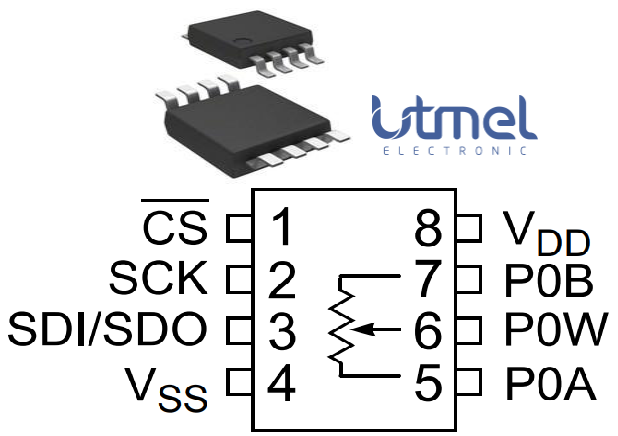
Pinout
MCP4151 CAD Model
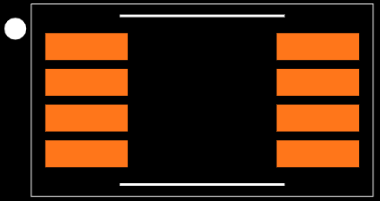
Footprint
MCP4151 Overview
The MCP41XX devices offer a wide range of product offerings using an SPI interface. This family of devices support 7-bit and 8-bit resistor networks, and Potentiometer and Rheostat pinouts. The MCP415X devices can be used to replace the common mechanical trim pot in applications where the operating and terminal voltages are within CMOS process limitations (VDD = 2.7V to 5.5V).
This article provides you with a basic overview of the MCP4151 Dual SPI Digital POT, including its pin descriptions, features and specifications, etc., to help you quickly understand what MCP4151 is.
MCP4151 Features
● Dual Resistor Network option
● Potentiometer or Rheostat configuration options
● Resistor Network Resolution:
◆ 8-bit: 256 Resistors (257 Steps)
● RAB Resistances options of: 10 kΩ
● Zero Scale to Full-Scale Wiper operation
● Low Wiper Resistance: 75Ω (typical)
● Low Tempco:
◆ Absolute (Rheostat): 50 ppm typical (0°C to 70°C)
◆ Ratiometric (Potentiometer): 15 ppm typical
● SPI Serial Interface (10 MHz, modes 0,0 & 1,1)
◆ High-Speed Read/Writes to wiper registers
◆ SDI/SDO multiplexing
● Resistor Network Terminal Disconnect Feature via:
◆ Shutdown pin (SHDN)
◆ Terminal Control (TCON) Register
● Brown-out reset protection (1.5V typical)
● Serial Interface Inactive current (2.5 uA typical)
● High-Voltage Tolerant Digital Inputs: Up to 12.5V
● Supports Split Rail Applications
● Internal weak pull-up on all digital inputs
● Wide Operating Voltage: 1.8V to 5.5V
● Extended temperature range (-40°C to +125°C)
Specifications
- TypeParameter
- Factory Lead Time14 Weeks
- Mount
In electronic components, the term "Mount" typically refers to the method or process of physically attaching or fixing a component onto a circuit board or other electronic device. This can involve soldering, adhesive bonding, or other techniques to secure the component in place. The mounting process is crucial for ensuring proper electrical connections and mechanical stability within the electronic system. Different components may have specific mounting requirements based on their size, shape, and function, and manufacturers provide guidelines for proper mounting procedures to ensure optimal performance and reliability of the electronic device.
Surface Mount - Mounting Type
The "Mounting Type" in electronic components refers to the method used to attach or connect a component to a circuit board or other substrate, such as through-hole, surface-mount, or panel mount.
Surface Mount - Package / Case
refers to the protective housing that encases an electronic component, providing mechanical support, electrical connections, and thermal management.
8-TSSOP, 8-MSOP (0.118, 3.00mm Width) - Number of Pins8
- Memory TypesVolatile
- Operating Temperature
The operating temperature is the range of ambient temperature within which a power supply, or any other electrical equipment, operate in. This ranges from a minimum operating temperature, to a peak or maximum operating temperature, outside which, the power supply may fail.
-40°C~125°C - Packaging
Semiconductor package is a carrier / shell used to contain and cover one or more semiconductor components or integrated circuits. The material of the shell can be metal, plastic, glass or ceramic.
Tube - Published2008
- Tolerance
In electronic components, "tolerance" refers to the acceptable deviation or variation from the specified or ideal value of a particular parameter, such as resistance, capacitance, or voltage. It indicates the range within which the actual value of the component can fluctuate while still being considered acceptable for use in a circuit. Tolerance is typically expressed as a percentage or a specific value and is important for ensuring the accuracy and reliability of electronic devices. Components with tighter tolerances are more precise but may also be more expensive. It is crucial to consider tolerance when selecting components to ensure proper functionality and performance of the circuit.
±20% - JESD-609 Code
The "JESD-609 Code" in electronic components refers to a standardized marking code that indicates the lead-free solder composition and finish of electronic components for compliance with environmental regulations.
e3 - Pbfree Code
The "Pbfree Code" parameter in electronic components refers to the code or marking used to indicate that the component is lead-free. Lead (Pb) is a toxic substance that has been widely used in electronic components for many years, but due to environmental concerns, there has been a shift towards lead-free alternatives. The Pbfree Code helps manufacturers and users easily identify components that do not contain lead, ensuring compliance with regulations and promoting environmentally friendly practices. It is important to pay attention to the Pbfree Code when selecting electronic components to ensure they meet the necessary requirements for lead-free applications.
yes - Part Status
Parts can have many statuses as they progress through the configuration, analysis, review, and approval stages.
Active - Moisture Sensitivity Level (MSL)
Moisture Sensitivity Level (MSL) is a standardized rating that indicates the susceptibility of electronic components, particularly semiconductors, to moisture-induced damage during storage and the soldering process, defining the allowable exposure time to ambient conditions before they require special handling or baking to prevent failures
2 (1 Year) - Number of Terminations8
- ECCN Code
An ECCN (Export Control Classification Number) is an alphanumeric code used by the U.S. Bureau of Industry and Security to identify and categorize electronic components and other dual-use items that may require an export license based on their technical characteristics and potential for military use.
EAR99 - Temperature Coefficient
The resistance-change factor per degree Celsius of temperature change is called the temperature coefficient of resistance. This factor is represented by the Greek lower-case letter “alpha” (α). A positive coefficient for a material means that its resistance increases with an increase in temperature.
150 ppm/°C - Resistance
Resistance is a fundamental property of electronic components that measures their opposition to the flow of electric current. It is denoted by the symbol "R" and is measured in ohms (Ω). Resistance is caused by the collisions of electrons with atoms in a material, which generates heat and reduces the flow of current. Components with higher resistance will impede the flow of current more than those with lower resistance. Resistance plays a crucial role in determining the behavior and functionality of electronic circuits, such as limiting current flow, voltage division, and controlling power dissipation.
10kOhm - Number of Positions256
- Terminal Finish
Terminal Finish refers to the surface treatment applied to the terminals or leads of electronic components to enhance their performance and longevity. It can improve solderability, corrosion resistance, and overall reliability of the connection in electronic assemblies. Common finishes include nickel, gold, and tin, each possessing distinct properties suitable for various applications. The choice of terminal finish can significantly impact the durability and effectiveness of electronic devices.
Matte Tin (Sn) - Voltage - Supply
Voltage - Supply refers to the range of voltage levels that an electronic component or circuit is designed to operate with. It indicates the minimum and maximum supply voltage that can be applied for the device to function properly. Providing supply voltages outside this range can lead to malfunction, damage, or reduced performance. This parameter is critical for ensuring compatibility between different components in a circuit.
1.8V~5.5V - Terminal Position
In electronic components, the term "Terminal Position" refers to the physical location of the connection points on the component where external electrical connections can be made. These connection points, known as terminals, are typically used to attach wires, leads, or other components to the main body of the electronic component. The terminal position is important for ensuring proper connectivity and functionality of the component within a circuit. It is often specified in technical datasheets or component specifications to help designers and engineers understand how to properly integrate the component into their circuit designs.
DUAL - Terminal Form
Occurring at or forming the end of a series, succession, or the like; closing; concluding.
GULL WING - Peak Reflow Temperature (Cel)
Peak Reflow Temperature (Cel) is a parameter that specifies the maximum temperature at which an electronic component can be exposed during the reflow soldering process. Reflow soldering is a common method used to attach electronic components to a circuit board. The Peak Reflow Temperature is crucial because it ensures that the component is not damaged or degraded during the soldering process. Exceeding the specified Peak Reflow Temperature can lead to issues such as component failure, reduced performance, or even permanent damage to the component. It is important for manufacturers and assemblers to adhere to the recommended Peak Reflow Temperature to ensure the reliability and functionality of the electronic components.
260 - Number of Functions1
- Supply Voltage
Supply voltage refers to the electrical potential difference provided to an electronic component or circuit. It is crucial for the proper operation of devices, as it powers their functions and determines performance characteristics. The supply voltage must be within specified limits to ensure reliability and prevent damage to components. Different electronic devices have specific supply voltage requirements, which can vary widely depending on their design and intended application.
5V - Terminal Pitch
The center distance from one pole to the next.
0.65mm - Time@Peak Reflow Temperature-Max (s)
Time@Peak Reflow Temperature-Max (s) refers to the maximum duration that an electronic component can be exposed to the peak reflow temperature during the soldering process, which is crucial for ensuring reliable solder joint formation without damaging the component.
40 - Base Part Number
The "Base Part Number" (BPN) in electronic components serves a similar purpose to the "Base Product Number." It refers to the primary identifier for a component that captures the essential characteristics shared by a group of similar components. The BPN provides a fundamental way to reference a family or series of components without specifying all the variations and specific details.
MCP4151 - Pin Count
a count of all of the component leads (or pins)
8 - Operating Supply Voltage
The voltage level by which an electrical system is designated and to which certain operating characteristics of the system are related.
5V - Configuration
The parameter "Configuration" in electronic components refers to the specific arrangement or setup of the components within a circuit or system. It encompasses how individual elements are interconnected and their physical layout. Configuration can affect the functionality, performance, and efficiency of the electronic system, and may influence factors such as signal flow, impedance, and power distribution. Understanding the configuration is essential for design, troubleshooting, and optimizing electronic devices.
Potentiometer - Interface
In electronic components, the term "Interface" refers to the point at which two different systems, devices, or components connect and interact with each other. It can involve physical connections such as ports, connectors, or cables, as well as communication protocols and standards that facilitate the exchange of data or signals between the connected entities. The interface serves as a bridge that enables seamless communication and interoperability between different parts of a system or between different systems altogether. Designing a reliable and efficient interface is crucial in ensuring proper functionality and performance of electronic components and systems.
SPI - Number of Circuits1
- Nominal Supply Current
Nominal current is the same as the rated current. It is the current drawn by the motor while delivering rated mechanical output at its shaft.
1mA - Bandwidth
In electronic components, "Bandwidth" refers to the range of frequencies over which the component can effectively operate or pass signals without significant loss or distortion. It is a crucial parameter for devices like amplifiers, filters, and communication systems. The bandwidth is typically defined as the difference between the upper and lower frequencies at which the component's performance meets specified criteria, such as a certain level of signal attenuation or distortion. A wider bandwidth indicates that the component can handle a broader range of frequencies, making it more versatile for various applications. Understanding the bandwidth of electronic components is essential for designing and optimizing circuits to ensure proper signal transmission and reception within the desired frequency range.
1 kHz - Taper
In electronic components, the parameter "Taper" refers to the rate at which a variable resistor's resistance changes as the control knob is adjusted. Taper is commonly used to describe potentiometers and trimmer resistors. There are different types of tapers, such as linear taper, logarithmic taper, and audio taper, each affecting how the resistance changes in relation to the physical position of the control knob. The taper of a component is important in determining how the device responds to adjustments and can impact the overall performance and usability of the electronic circuit.
Linear - Number of Taps257
- Total Resistance
Total resistance in electronic components refers to the overall resistance encountered by an electric current as it flows through a circuit. It is the combined resistance of all the resistors or other components in the circuit. Total resistance is calculated by adding up the individual resistances in series circuits or by using formulas for parallel circuits. Understanding total resistance is crucial for determining the overall impedance of a circuit and for ensuring proper current flow and voltage distribution. It plays a key role in designing and analyzing electronic circuits to achieve desired performance and functionality.
10000Ohm - Resistance - Wiper (Ω) (Typ)
The parameter "Resistance - Wiper (Ω) (Typ)" in electronic components refers to the typical resistance value between the wiper terminal and one of the end terminals in a potentiometer or variable resistor. The wiper is a movable contact that can be adjusted to vary the resistance value of the component. This parameter indicates the expected resistance value at a specific position of the wiper, providing information on the component's performance and characteristics. It helps in understanding how the resistance changes as the wiper is adjusted, allowing for precise control and customization of the circuit.
75 - Resistor Terminal Voltage-Max
Resistor Terminal Voltage-Max refers to the maximum voltage that can be safely applied across the terminals of a resistor without causing damage or failure. This parameter is critical in circuit design as exceeding this voltage can lead to overheating, degradation of the resistor material, or even complete failure of the component. It is essential for engineers to consider this limit to ensure reliable and safe operation of electronic circuits.
5V - Length3mm
- Width3mm
- Radiation Hardening
Radiation hardening is the process of making electronic components and circuits resistant to damage or malfunction caused by high levels of ionizing radiation, especially for environments in outer space (especially beyond the low Earth orbit), around nuclear reactors and particle accelerators, or during nuclear accidents or nuclear warfare.
No - RoHS Status
RoHS means “Restriction of Certain Hazardous Substances” in the “Hazardous Substances Directive” in electrical and electronic equipment.
ROHS3 Compliant
MCP4151 Functional Block Diagram
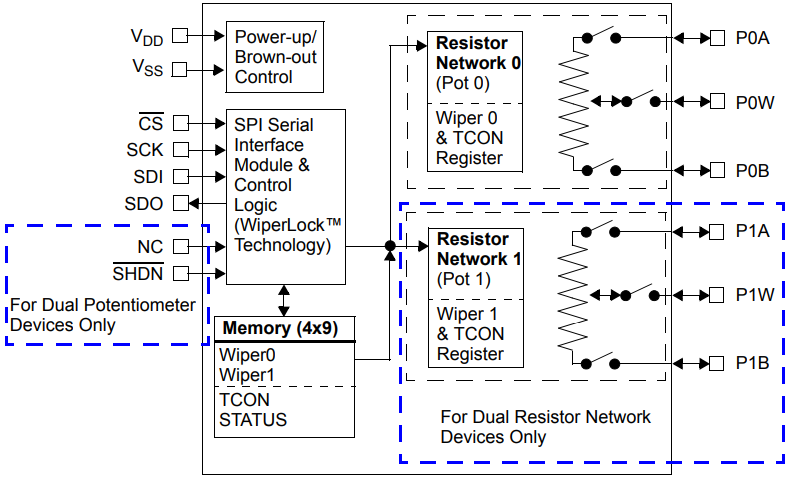
Block Diagram
MCP4151 Equivalent
| Model number | Manufacturer | Description |
| MCP4151T-103E/UN | Microchip Technology Inc | 10K DIGITAL POTENTIOMETER, INCREMENT/DECREMENT CONTROL INTERFACE, 129 POSITIONS, PDSO10, PLASTIC, MSOP-10 |
| MCP4151-103E/UN | Microchip Technology Inc | 10K DIGITAL POTENTIOMETER, INCREMENT/DECREMENT CONTROL INTERFACE, 129 POSITIONS, PDSO10, PLASTIC, MSOP-10 |
| MCP4151T-103E/P | Microchip Technology Inc | 10K DIGITAL POTENTIOMETER, INCREMENT/DECREMENT CONTROL INTERFACE, 129 POSITIONS, PDIP8, 0.300 INCH, PLASTIC, DIP-8 |
| MCP4151-103I/MS | Microchip Technology Inc | DIGITAL POTENTIOMETER, PDSO8, PLASTIC, MSOP-8 |
| MCP4151-103I/SN | Microchip Technology Inc | DIGITAL POTENTIOMETER, PDSO8, 3.90 MM, PLASTIC, SOIC-8 |
| MAX5450EUB-T | Maxim Integrated Products | Digital Potentiometer, 2 Func, 10000ohm, Increment/decrement Control Interface, 256 Positions, CMOS, PDSO10, MO-187C-BA, MICRO, SOP-10 |
| MCP4151T-103I/MF | Microchip Technology Inc | DIGITAL POTENTIOMETER, PDSO8, 3 X 3 MM, 0.90 MM HEIGHT, PLASTIC, DFN-8 |
| MCP4151-103E/SL | Microchip Technology Inc | 10K DIGITAL POTENTIOMETER, INCREMENT/DECREMENT CONTROL INTERFACE, 129 POSITIONS, PDSO14, 3.90 MM, PLASTIC, SOIC-14 |
| MCP4151T-103E/SL | Microchip Technology Inc | 10K DIGITAL POTENTIOMETER, INCREMENT/DECREMENT CONTROL INTERFACE, 129 POSITIONS, PDSO14, 3.90 MM, PLASTIC, SOIC-14 |
| MCP4151T-103E/ML | Microchip Technology Inc | 10K DIGITAL POTENTIOMETER, INCREMENT/DECREMENT CONTROL INTERFACE, 129 POSITIONS, PQCC16, 4 X 4 MM, 0.90 MM HEIGHT, PLASTIC, QFN-16 |
Parts with Similar Specs
- ImagePart NumberManufacturerPackage / CaseNumber of PinsResistanceNumber of TapsToleranceTemperature CoefficientMemory TypeInterfaceView Compare
![MCP4151-103E/MS]()
MCP4151-103E/MS
8-TSSOP, 8-MSOP (0.118, 3.00mm Width)
8
10 kΩ
257
±20%
150 ppm/°C
Volatile
SPI
![MCP4551T-103E/MS]()
8-TSSOP, 8-MSOP (0.118, 3.00mm Width)
8
10 kΩ
257
±20%
150 ppm/°C
Volatile
I2C
![MCP4151T-103E/MS]()
8-TSSOP, 8-MSOP (0.118, 3.00mm Width)
8
10 kΩ
257
±20%
150 ppm/°C
Volatile
SPI
![MCP4552-103E/MS]()
8-TSSOP, 8-MSOP (0.118, 3.00mm Width)
8
10 kΩ
257
±20%
150 ppm/°C
Volatile
I2C

MCP4151 Package
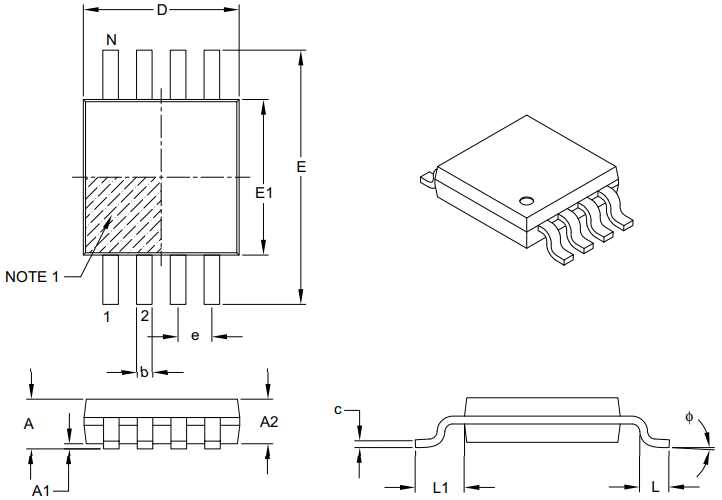
Package
MCP4151 Package Marking Information
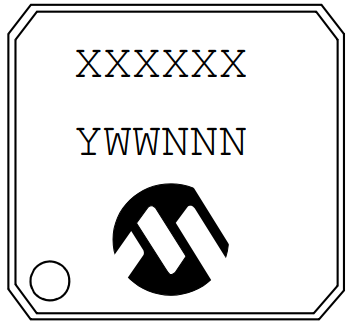
8-Lead MSOP
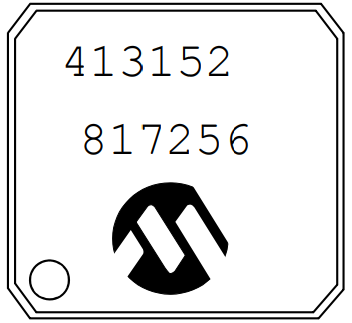
Example
MCP4151 Manufacturer
Microchip Technology Inc. is a leading provider of microcontroller and analog semiconductors, providing low-risk product development, lower total system cost and faster time to market for thousands of diverse customer applications worldwide. Headquartered in Chandler, Arizona, Microchip offers outstanding technical support along with dependable delivery and quality.
Trend Analysis
Datasheet PDF
- Datasheets :
- PCN Design/Specification :
- PCN Assembly/Origin :
- PCN Packaging :
- ConflictMineralStatement :
What are the prerequisites for MCP415X equipment to be used to replace ordinary mechanical trim pot?
The MCP415X devices can be used to replace the common mechanical trim pot in applications where the operating and terminal voltages are within CMOS process limitations (VDD = 2.7V to 5.5V).
Why can MCP4XXX devices be used to split power rail applications?
All inputs that would be used to interface to a Host Controller support High Voltage on their input pin. This allows the MCP4XXX device to be used in split power rail applications.
 VL53L0X LIDAR Distance Sensor: Pinout, Datasheet, and Applications
11 September 20213189
 A3144 Hall Effect Sensor: Datasheet, Circuit and Pinout
11 November 202166485
 AT24C512C-XHD-B I²C Serial EEPROM: Pinout, Equivalent and Datasheet
19 April 20221566
 LM2902DG Op-Amp: Pinout, Equivalent and Datasheet
06 December 20212791
 74HC125 Quad buffer/line driver: Circuit, Pinout and Datasheet
17 August 20213203
 IRFZ24N Transistor: Datasheet, Pinout, IRFZ24N MOSFET
07 December 20218944
 2P4M SCR: Datasheet, Pin and Circuit
09 November 20219379
 Introduction to MSP430G2x11 and MSP430G2x01 Mixed-Signal Microcontrollers
29 February 2024116
 Everything You Need to Know about RF Chip
14 January 202618572
 What is a Thermoelectric Cooler?
08 April 20216150
 Is ON Semiconductor's Stock Overvalued? A Detailed Analysis
28 September 20233366
 When Designing a Power Supply, How to Consider the Selection of Topology?
07 March 20223874
 Oregon's Semiconductor Boost: Governor Announces $240 Million Investment
06 October 20232929
 What is Spectrum Analyzer?
17 December 20214736
 Introduction to Optical Amplifier
27 March 20259399
 What is Oscilloscope?
24 September 20217386
Microchip Technology
In Stock: 523
Minimum: 1 Multiples: 1
Qty
Unit Price
Ext Price
1
$1.555007
$1.56
10
$1.466988
$14.67
100
$1.383951
$138.40
500
$1.305614
$652.81
1000
$1.231711
$1,231.71
Not the price you want? Send RFQ Now and we'll contact you ASAP.
Inquire for More Quantity
![MCP4017T-104E/LT]() MCP4017T-104E/LT
MCP4017T-104E/LTMicrochip Technology
![MCP41100-I/SN]() MCP41100-I/SN
MCP41100-I/SNMicrochip Technology
![MCP4141-103E/SN]() MCP4141-103E/SN
MCP4141-103E/SNMicrochip Technology
![MCP4018T-502E/LT]() MCP4018T-502E/LT
MCP4018T-502E/LTMicrochip Technology
![MCP4342-104E/ST]() MCP4342-104E/ST
MCP4342-104E/STMicrochip Technology
![MCP42010-I/ST]() MCP42010-I/ST
MCP42010-I/STMicrochip Technology
![MCP42050-I/P]() MCP42050-I/P
MCP42050-I/PMicrochip Technology
![MCP41100-E/SN]() MCP41100-E/SN
MCP41100-E/SNMicrochip Technology
![MCP41010-E/P]() MCP41010-E/P
MCP41010-E/PMicrochip Technology
![MCP42010-I/P]() MCP42010-I/P
MCP42010-I/PMicrochip Technology


