

 Product
 Brand
Brand Articles
 Tools
Tools
Basic Introduction to Filter Capacitor
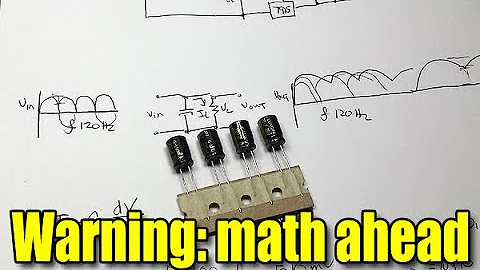
How to choose filter capacitors for power supply
Catalog
Ⅰ Introduction
A capacitor is two conductors that are close to each other and insulated from each other. The filter capacitor refers to an energy storage device installed at both ends of the rectifier circuit to reduce the ripple coefficient of AC pulsation and improve the efficient and smooth DC output. Because the filter circuit requires a large capacity for the energy storage capacitor. Therefore, most filter circuits use electrolytic capacitors. Electrolytic capacitors get their name because they use an electrolyte as the electrode (negative electrode).
One end of the electrolytic capacitor is the positive electrode, and the other end is the negative electrode. The positive terminal is connected to the positive terminal of the rectifier output circuit, and the negative terminal is connected to the negative terminal of the circuit. In all circuits that need to convert alternating current to direct current, the installation of filter capacitors will make the working performance of the electronic circuit more stable, and also reduce the interference of the alternating pulsation ripple on the electronic circuit. The symbol of the filter capacitor in the circuit is generally represented by "C", and the capacitance should be determined according to the load resistance and the output current. The higher the power supply voltage U, the greater the charge q carried by the capacitor. When the filter capacitor reaches a certain capacity, increasing the capacity of the capacitor will adversely affect other indicators.

n-35g main filter capacitor
The filter capacitor is an energy storage device connected in parallel to the output of the rectifier power circuit to reduce the ripple coefficient of AC pulsation and smooth the DC output. In the electronic circuits that convert AC to DC power supply, the filter capacitor not only makes the DC output of the power supply smooth and stable, reduces the impact of alternating pulsating current on the electronic circuit, but also absorbs the current fluctuations and passages generated during the operation of the electronic circuit. The interference of the AC power supply makes the working performance of the electronic circuit more stable.
To obtain a good filtering effect, the discharge of the capacitor must be slow. The slower the discharge of the capacitor, the smoother the output voltage and the better the filtering effect. The discharge speed of the capacitor is related to the capacitance C and the load R. The larger C and R, the slower the discharge of the capacitor. At the same time, the capacitance of the filter capacitor selected in the filter circuit is relatively large. The most commonly used electrolytic capacitors are hundreds to thousands of microfarads, and tantalum capacitors or niobium capacitors are also used in high-demand occasions; but even at tens of kilohertz or higher frequencies, the requirements for frequency characteristics are much more important than the requirements for capacity.
Ⅱ Function
The filter capacitor is used in the power rectifier circuit to filter out AC components and to make the output DC smoother. For precision circuits, a combination of parallel capacitor circuits is often used at this time to improve the working effect of the filter capacitor.

filter capacitor cd293 series
The low-frequency filter capacitor is mainly used for the filtering of the mains power supply or the filtering after the rectification of the transformer, and its working frequency is the same as that of the mains power for 50Hz. The high-frequency filter capacitor mainly works in the filtering after the switching power supply is rectified, and its operating frequency is several thousand Hz to tens of thousands Hz. The filter capacitor plays a very important role in the switching power supply. How to select the filter capacitor correctly, especially the choice of the output filter capacitor, is a problem that every engineering and technical personnel is very concerned about.
Common electrolytic capacitors used in 50 Hz power frequency circuits. Its pulsating voltage frequency is only 100 Hz, and the charging and discharging time is on the order of milliseconds. In order to obtain a smaller ripple coefficient, the required capacitance is as high as hundreds of thousands of microfarads. Therefore, the goal of ordinary low-frequency aluminum electrolytic capacitors is to increase the capacitance. The capacitance, loss tangent value, and leakage current of the capacitor are the main parameters to identify its pros and cons. The output filter electrolytic capacitor in the switching power supply has a sawtooth voltage frequency as high as tens of thousands of hertz, or even tens of megahertz. At this time, capacitance is not its main indicator. The standard to measure the quality of high-frequency aluminum electrolytic capacitors is the "impedance-frequency" characteristic. It is required to have a lower equivalent impedance within the operating frequency of the switching power supply, and at the same time, it has a good filtering effect on the high-frequency spikes generated when the semiconductor device is working.
Ordinary low-frequency electrolytic capacitors begin to be inductive around 10,000 Hz, which cannot meet the requirements of switching power supplies. The special high-frequency aluminum electrolytic capacitor for switching power supply has four terminals. Both ends of the positive aluminum sheet are led out as the positive electrode of the capacitor, and both ends of the negative aluminum sheet are also led out as the negative electrode. The current flows in from one positive terminal of the four-terminal capacitor pass through the capacitor, and then flows from the other positive terminal to the load; the current returning from the load also flows in from one negative terminal of the capacitor and then flows from the other negative terminal to the negative terminal of the power supply.
Ⅲ Features
Low-temperature rise: The harmonic filter loop is composed of a capacitor series reactor, which forms the lowest impedance at a certain harmonic order to absorb a large amount of harmonic current. The quality of the capacitor will affect the stable absorption effect of the harmonic filter. The service life of the filter is closely related to the temperature. The higher the temperature, the lower the service life. The filter full film capacitor has the characteristics of low-temperature rise, which can ensure its service life.
Low loss: Dielectric loss tangent value (tgδ): ≤0.0003.
Safety: In line with GB and IEC standards, the internal single capacitors are equipped with protection devices. When the circuit or single capacitors are abnormal, the protection device will act immediately and automatically cut off the power supply to prevent secondary disasters. It is equipped with a discharge resistor to ensure the safety of electricity and maintenance. The outer shell is made of steel stamping, and the inside and outside are coated with high-temperature baking paint with good weather resistance, which is very safe.
Convenience: small size and lightweight, extremely convenient for transportation and installation.
Ⅳ Calculation method of power supply filter capacitor size
C=Q/U----------Q=C*U
I=dQ/dt---------I=d(C*U)/dt=C*dU/dt
C=I*dt/dU
It can be seen from the above formula that the size of the filter capacitor is related to the output current of the power supply and the rate of change of the capacitor voltage per unit time, and the larger the output current, the larger the capacitor. The smaller the voltage change per unit time, the larger the capacitor.
We can assume that the capacitance-voltage per unit time changes 1v (dV = 1), then the above formula Becomes C=I*dt.
Then we can calculate the minimum capacitor size we need according to the current and burst time required for a maximum burst of high-power signals. Take lm3886 as an example, its maximum output power is 125W, then we can assume that the maximum power provided by the power supply is 150W, the maximum current provided by the power supply is I=150/(30+30)=2.5A (2.5A for positive and negative power supply), and high power is generally a low-frequency signal, we can use a 100Hz signal instead, then dt=1/100=0.01s, with the above formula, C=2.5×0.01=0.025=25000uF.
The above calculation is based on the maximum power of the power amplifier. If we usually listen with a small volume, the capacitor does not need to be so large. I think that a certain ripple coefficient is enough. 4700u may be enough.
If calculated according to dV = 0.1v, then C = 250,000 uF, you can imagine how much you will spend on the power supply, and it is difficult to say how much the impact on the sound quality. From the above calculation, it can be concluded that the power of the transformer for lm3886 must be greater than 150W, and if a transformer is used to supply dual power, it must be greater than 300W.
Some people may also say your calculation is not correct because when the capacitor is supplying power to the circuit, the transformer is still charging it, there should be no need for such a large capacitor. We can also calculate that when the power supply is 30v, the current is 2.5A, which is equivalent to a 12-ohm load connected to the capacitor (this is the instantaneous minimum resistance), then the time for the transformer to charge the capacitor is T=R×c=12× 0.025=0.3s. The transformer can't charge the capacitor much within 0.01s, and the power amplifier circuit's energy must be supplied by the capacitor.
Ⅴ Selection of filter capacitor size
When there are contactors, relays, buttons, and other components in the printed board. Large spark discharges are generated when operating them, and an RC absorption circuit must be used to absorb the discharge current. Generally, R is 1~2kΩ, and C is 2.2~4.7μF. A general capacitor of about 10PF is used to filter out high-frequency interference signals, and a capacitor of about 0.1UF is used to filter out low-frequency ripple interference. The specific selection of the filter capacitor depends on the main operating frequency on your PCB and the harmonic frequency that may affect the system. You can check the capacitor information of the relevant manufacturer or refer to the database software provided by the manufacturer, according to specific needs select. As for the number, it depends on your specific needs. It’s good to add one or two more. If you don’t use it for the time being, you can leave it alone and choose the capacitance value according to the actual debugging situation. If the main operating frequency on your PCB is relatively low, just add two capacitors, one to eliminate ripple and the other to eliminate high-frequency signals. If there is a relatively large instantaneous current, it is recommended to add a relatively large tantalum capacitor. In fact, filtering should also include two aspects, that is, the large capacitance value and the small capacitance value, namely decoupling and bypass.
Generally, digital circuits can be decoupled by 0.1uF and used below 10M; above 20M, use 1 to 10 uF to remove high-frequency noise. The bypass is generally relatively small. Generally speaking, the capacitor is generally 0.1 or 0.01uF according to the resonance frequency. Bypass capacitors, decoupling capacitors, filter capacitors, etc. No matter how you call it, its principle is the same, that is, it uses the characteristics of low impedance to AC signals. This can be seen by the equivalent impedance formula of the capacitor: Xcap=1/2лfC, the higher the working frequency and the capacitance value, the smaller the impedance.
In the circuit, if the main function of the capacitor is to provide a low-impedance path for the AC signal, it is called a bypass capacitor; if it is mainly to increase the AC coupling between the power supply and the ground and reduce the impact of the AC signal on the power supply, it can be called It is a decoupling capacitor; if used in a filter circuit, it can also be called a filter capacitor. Besides, for DC voltage, the capacitor can also be used as a circuit energy storage, using charge and discharge to play the role of a battery. In the actual situation, the role of the capacitor is often multi-faceted, and we don't need to spend too much time thinking about how to define it.
In this article, we uniformly refer to these capacitors used in high-speed PCB design as bypass capacitors. The essence of the capacitor is to pass AC and block DC. In theory, the larger the capacitor for power supply filtering, the better. However, due to the wiring and PCB wiring, the capacitor is actually a parallel circuit of an inductor and a capacitor (and the resistance of the capacitor itself, sometimes not negligible), which introduces the concept of resonance frequency: ω=1/(LC)1/ 2 The capacitor is capacitive below the resonant frequency and inductive above the resonant frequency. Therefore, generally, large capacitors filter low-frequency waves, and small capacitors filter high-frequency waves. This can also explain why the capacitor filter frequency of the STM package with the same capacitance value is higher than that of the DIP package.
The selection of specific capacitors can use the formula C=4Pi*Pi/(R*f*f) How to select the power supply filter capacitor and grasp its essence and method, it is not difficult in fact.
1) Theoretically, the impedance of an ideal capacitor decreases as the frequency increases (1/jwc), but due to the inductive effect of the pins at both ends of the capacitor, the capacitor should be regarded as an LC series resonant circuit. The self-resonant frequency is the FSR parameter of the device, which means that when the frequency is greater than the FSR value, the capacitor becomes an inductance. If the capacitor is filtered to the ground, when the frequency exceeds the FSR, the interference suppression is greatly reduced, so a smaller capacitor is required in parallel to the ground. Can think about why? The reason is that the small capacitor and the large SFR value provide a path to the ground for high-frequency signals. Therefore, we often understand in the power filter circuit: large capacitors consider low frequencies, and small capacitors consider high frequencies. The reason is SFR values are different.
2) So in the actual design, we often have these questions, how do I know the SFR of the capacitor? Even if I know the SFR value, how do I choose the capacitor value with different SFR values? Should I choose one capacitor or two capacitors?
The SFR value of a capacitor is related to the capacitance value and the pin inductance of the capacitor. Therefore, the SFR value of 0402, 0603, or in-line capacitors with the same capacitance value will not be the same. Of course, there are two ways to obtain the SFR value.
1) The datasheet of the device, for example, the SFR value of the 22pf0402 capacitor is about 2G.
2) The self-resonant frequency is directly measured by a network analyzer.
How to measure it? S21? After knowing the SFR value of the capacitor, use software to simulate, such as RFsim99. The choice of one or two circuits depends on whether the operating frequency band of the circuit you are powering has a sufficient noise rejection ratio. After the simulation, it is the actual circuit test. For example, when debugging the receiving sensitivity of the mobile phone, the power filter of the LNA is the key, and a good power filter can often improve several dB.
 UTMEL
UTMEL
We are the professional distributor of electronic components, providing a large variety of products to save you a lot of time, effort, and cost with our efficient self-customized service. careful order preparation fast delivery service
1.What does a filter capacitor do?
A filter capacitor is a capacitor that filters out a certain frequency or range of frequencies from a circuit. Usually, capacitors filter out very low-frequency signals. These are signals that are very close to 0Hz in frequency value. These are also referred to as DC signals.
2.What is a capacitor filter circuit?
A capacitor that is used to filter out a certain frequency otherwise series of frequencies from an electronic circuit is known as the filter capacitor. Generally, a capacitor filters out the signals which have a low frequency. The frequency value of these signals is near to 0Hz, these are also known as DC signals.
3.How do capacitors filter noise?
The role of an X capacitor is to attenuate some of the electrical noise coming from the power supply line. The capacitor acts to short out high frequencies while passing through lower frequencies. If the line voltage is DC, polarized capacitors such as electrolytic capacitors may be used.
4.How do you choose a capacitor for a filter?
Standard Formula for Calculating Filter Capacitor C = I / (2 x f x Vpp) C = I / 2 x f x Vpp (assuming f = 100Hz and load current requirement as 2amp)) C = I / (2 x f x Vpp)
5.How capacitor works as a filter in the power supply?
In power supplies, capacitors are used to smooth (filter) the pulsating DC output after rectification so that a nearly constant DC voltage is supplied to the load. ... In a filter circuit the capacitor is charged to the peak of the rectified input voltage during the positive portion of the input.
 What is Feedthrough Capacitor?UTMEL06 November 202140545
Hello, everyone. I am Rose. Today I will introduce the feedthrough capacitor to you. The feedthrough capacitor is a three-terminal capacitor that is used to reduce high frequencies. The feedthrough capacitor, unlike regular three-terminal capacitors, is directly installed on the metal panel, resulting in a lower grounding inductance and a negligible effect on the lead inductance.
Read More Detailed Explanation About Twenty Kinds of CapacitorUTMEL08 November 20218967
Hello everyone, I am Rose. Today I will introduce 20 kinds of capacitor to you. I will illustrate them in three or four aspects: Structure, features, Usages, advantages and disadvantages.
Read More What is a Polypropylene Capacitor?UTMEL08 November 202120934
A polypropylene capacitor is a kind of capacitor with a very stable electric capacity. It is often used in applications requiring very precise capacitance and can replace most polyphenylene or mica capacitors.
Read More What is the Difference between MOM, MIM and MOS Capacitors?UTMEL17 April 202567890
This article mainly introduces the structure, principle, advantages and disadvantages of MOM, MIM and MOS capacitors and the difference between them.
Read More What is a Power Capacitor?UTMEL20 November 20216254
Power capacitors are capacitors used in power systems and electrical equipment. Any two pieces of metal conductors are separated by an insulating medium to form a capacitor. The size of the capacitor is determined by its size and the characteristics of the insulating medium between the two plates.
Read More
Subscribe to Utmel !
![IQS7222_EV02C-S]() IQS7222_EV02C-S
IQS7222_EV02C-SAzoteq (Pty) Ltd
![TPS7H5003EVM-CVAL]() TPS7H5003EVM-CVAL
TPS7H5003EVM-CVALTexas Instruments
![EBK-GS12142/82-03]() EBK-GS12142/82-03
EBK-GS12142/82-03Semtech Corporation
![SLG47105V-DMO]() SLG47105V-DMO
SLG47105V-DMODialog Semiconductor GmbH
![5396]() 5396
5396Adafruit Industries LLC
![MAX2242XSEVKIT#]() MAX2242XSEVKIT#
MAX2242XSEVKIT#Analog Devices Inc./Maxim Integrated
![TPS7H5005EVM]() TPS7H5005EVM
TPS7H5005EVMTexas Instruments
![LP87642Q1EVM]() LP87642Q1EVM
LP87642Q1EVMTexas Instruments
![USEQFCK9000000]() USEQFCK9000000
USEQFCK9000000KEMET
![FBP-AVR-DA-IEC61508]() FBP-AVR-DA-IEC61508
FBP-AVR-DA-IEC61508Microchip Technology
