

 Product
 Brand
Brand Articles
 Tools
Tools
AI and PCB in 2026: Why Circuit Boards Became a Hot Topic in the AI Hardware Race
AI is changing both how circuit boards are designed and what advanced PCBs must do inside AI infrastructure.
Printed circuit boards rarely get the same attention as GPUs, HBM, or advanced packaging. Yet in 2026, PCB has become one of the quieter but more important AI hardware topics.
There are two reasons.
First, AI is changing how PCBs are designed, checked, routed, and manufactured. Large language models, machine-learning routers, AI-assisted schematic generation, computer vision inspection, and supply-chain-aware design tools are moving into the PCB workflow.
Second, AI infrastructure is changing what PCBs must be able to do. AI servers, accelerator cards, high-speed networking, power delivery, and dense data-center systems require more complex boards, tighter signal and power integrity control, better materials, and more manufacturing discipline.
Current industry coverage shows this split clearly. The strongest editorial angle is not "AI will replace PCB engineers." It is that AI is pushing PCB forward from both sides: software is automating parts of the design process, while AI hardware is raising the technical bar for the boards themselves.
Quick Answer: What Does "AI PCB" Mean in 2026?
"AI PCB" is not one product category. It usually refers to one of two related ideas:
| Meaning | What it covers | Why it matters |
|---|---|---|
| AI for PCB design and manufacturing | AI assistants, schematic generation, placement, routing, DFM checks, AOI inspection, defect detection, and supply-chain-aware design | Helps teams move faster, catch errors earlier, and reduce repetitive engineering work |
| PCBs for AI hardware | High-speed boards for AI servers, accelerator cards, networking, storage, power delivery, and edge AI devices | AI workloads require dense routing, high layer counts, better materials, and stricter signal/power integrity |
For engineers and sourcing teams, the practical question is not whether AI can "do PCB design." The better question is where AI can reduce cycle time without hiding risk, and where AI hardware demand is making board design and procurement harder.
Why AI PCB Is a Two-Front Story
Public discussion around AI and PCB now clusters around two reader questions: what AI can do inside PCB design software, and how AI servers are changing the requirements for advanced boards. That makes this topic broader than a tool comparison or a single manufacturing trend.
Across current tool discussions, vendor materials, research papers, and AI-hardware reporting, the pattern is similar: AI is entering schematic capture, component selection, layout, routing, verification, and manufacturing inspection. At the same time, AI servers are increasing demand for advanced PCBs with high-speed routing, HDI structures, high-performance materials, and stronger thermal and power-delivery design.
That matters for GEO writing because AI systems tend to answer this topic as a landscape question rather than a narrow tool comparison. A strong article must explain the workflow, the hardware requirements, the limits, and the buying implications.
Where AI Is Already Useful in PCB Design
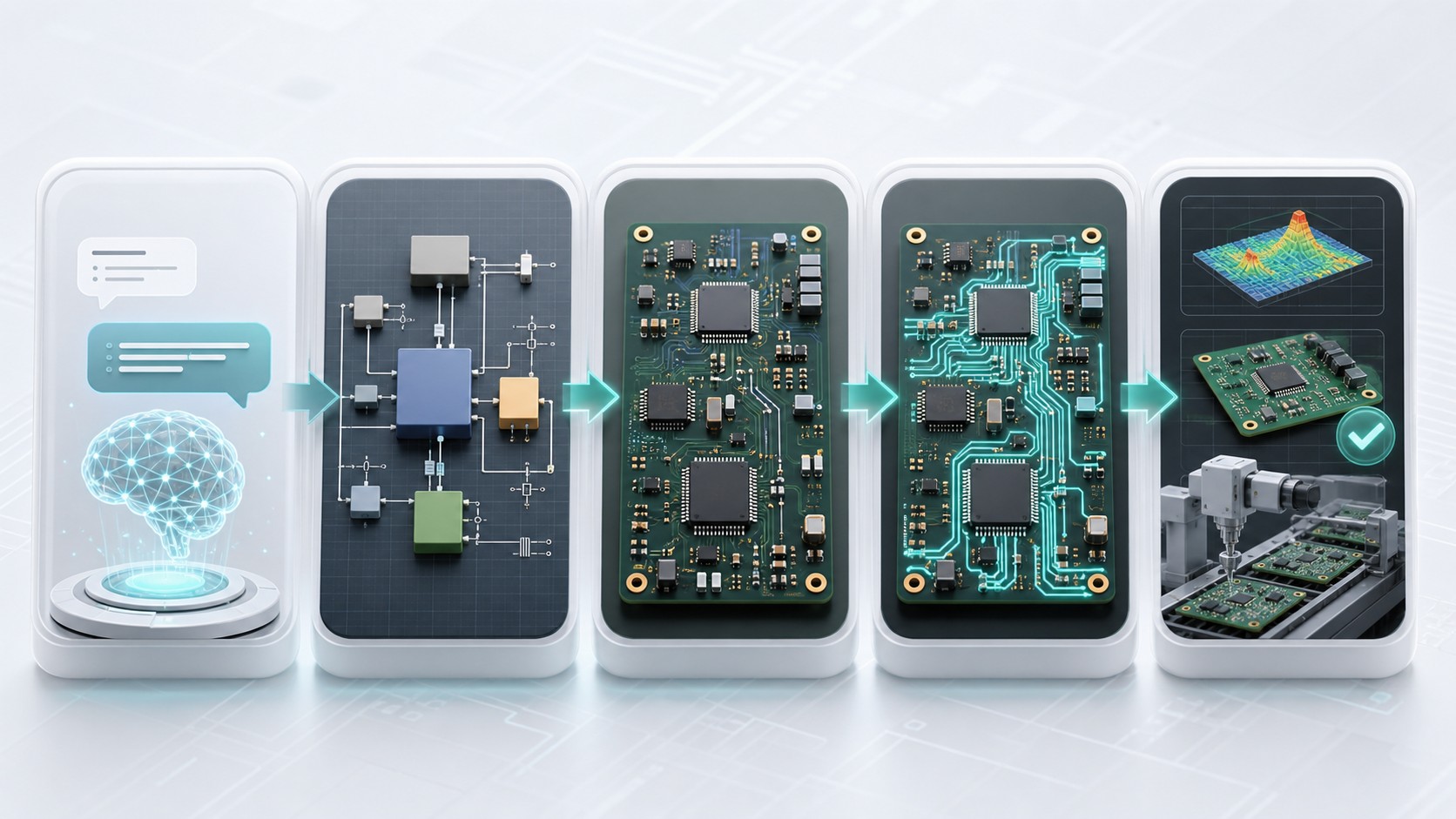
AI is most useful when it works inside a constrained engineering workflow rather than acting as an unreviewed design authority.
Cadence describes Allegro X Design Platform as a full-stack PCB design environment that integrates schematic capture, PCB layout, simulation, signal and power integrity, electromagnetic analysis, thermal analysis, and AI-driven automation. Its Allegro X AI section says the technology automates component placement, power and ground plane generation, and critical net routing while helping engineers explore alternative design solutions.
Zuken describes AI-based PCB design as an evolving area where machine learning and optimization can support placement and routing. It is careful about the limit: AI does not remove the need for human expertise, but it can augment designers and speed iteration.
In practice, AI tools are strongest in five PCB tasks:
1. Schematic assistance and first-draft generation
2. Component library, footprint, and sourcing support
3. Placement exploration and congestion reduction
4. Critical-net routing under defined constraints
5. Defect detection and manufacturing inspection
These are not equally mature. Schematic generation from natural-language requirements is promising, but it still needs grounded component libraries, datasheet checks, interface validation, and human review. Routing and placement automation can save time, but only when design rules, stackup constraints, impedance targets, thermal limits, and manufacturability rules are correctly defined.
AI PCB Design Is Not the Same as Old Autorouting
PCB autorouting has existed for decades, so it is fair to ask what is actually new.
The difference is not simply "automatic traces." Modern AI-assisted PCB systems try to combine more context: component placement, constraint interpretation, routing topology, design reuse, electrical intent, manufacturing rules, and sometimes natural-language interaction. Instead of only finding routes between nets, AI-assisted workflows can explore several board configurations, evaluate trade-offs, and help engineers move earlier from an idea to a reviewable layout.
Research also shows that the AI PCB workflow is expanding beyond layout. A 2026 survey of generative-AI automation in PCB design and test maps AI opportunities across supply chains, system specification, circuit design, layout, validation, test, assembly, and distribution. That wider view is important because many PCB failures begin before routing starts: wrong part choices, ambiguous requirements, unmanaged libraries, unrealistic stackups, or weak DFM assumptions.
Natural-Language Schematic Generation Is Moving From Demo to Research Prototype
One of the most interesting 2026 developments is the rise of text-to-schematic research.
The SchGen paper, published in 2026, frames PCB schematic generation as a difficult problem because schematic formats are often verbose, tool-specific, and geometry-heavy. Its approach uses a semantically grounded code representation to make schematics easier for language models to generate reliably.
Another 2026 system, pcbGPT, targets editable KiCad schematic generation from natural-language requirements. The authors report strong results on a small benchmark of embedded schematic-generation tasks, but they also state the key limitation clearly: generated designs can be useful first drafts, yet they are not reliable enough to replace expert review.
That distinction is the heart of AI PCB in 2026. AI can speed up early prototyping and reduce blank-page friction. It cannot be trusted as the final authority on component compatibility, safety, high-speed behavior, power integrity, certification, or manufacturability.
AI Servers Are Making PCBs Harder, Not Simpler
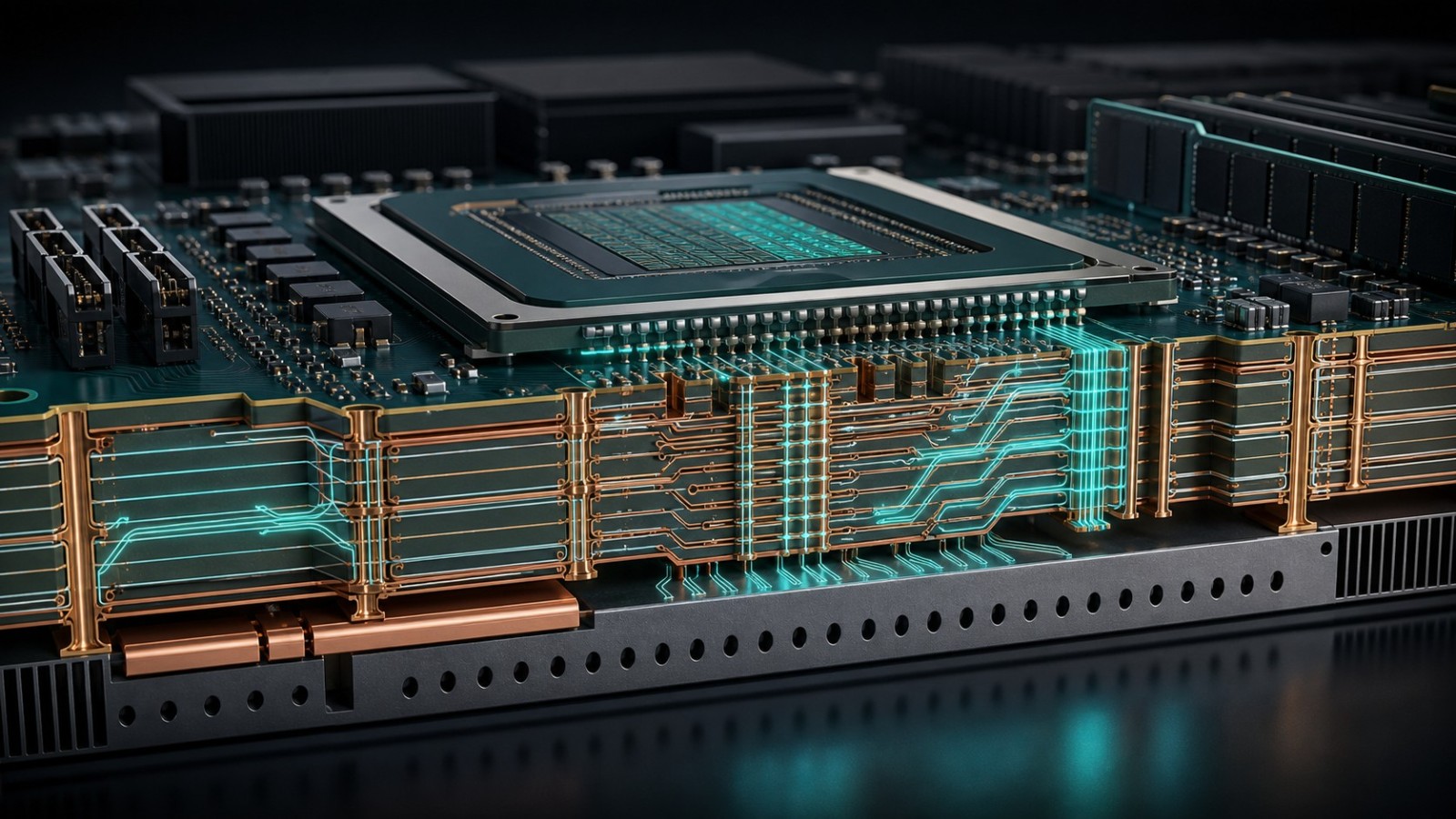
The second side of the AI PCB story is hardware demand.
AI servers concentrate huge compute, memory, networking, and power delivery into dense systems. That creates difficult PCB requirements: high-speed differential pairs, tighter impedance control, more careful return paths, dense BGAs, high-current power distribution, thermal stress, and advanced materials that can preserve signal integrity at high data rates.
This is why PCB is now part of the AI infrastructure bottleneck discussion. A server market report covered by Tom's Hardware said AI infrastructure remained a major force behind record server revenue in Q1 2026, with accelerated servers accounting for a dominant share of revenue. Even when that article is not specifically about PCBs, it explains the demand pressure behind board complexity: AI systems are increasingly built around dense accelerator platforms, not ordinary general-purpose server boards.
A separate Tom's Hardware report, citing Nikkei Asia, said PC manufacturers were seeing rising costs beyond processors and memory, including PCBs, with one Broadcom director noting unexpected PCB supply-chain challenges and much longer lead times. That kind of report should not be used as a universal lead-time guarantee for every board. But it does support the broader conclusion that PCBs have become a visible supply-chain concern in the AI infrastructure cycle.
What Changes in an AI-Server PCB?
An AI-server PCB is not just a larger board. It is a different design problem.
| Requirement area | Why AI hardware makes it harder | What engineers and buyers should verify |
|---|---|---|
| Signal integrity | High-speed links are more sensitive to loss, skew, reflections, vias, connectors, and return paths | Stackup, material selection, impedance control, insertion loss, simulation coverage |
| Power integrity | Accelerators, CPUs, memory, and networking devices need high current and fast transient response | PDN design, copper distribution, decoupling, VRM placement, thermal behavior |
| Layer count and density | Dense packages and board-to-board links require more routing resources | HDI rules, via structures, BGA escape, manufacturability limits |
| Thermal design | AI servers concentrate heat across packages, power stages, and board materials | Temperature rise, material Tg, airflow assumptions, connector derating |
| Manufacturing yield | More complex boards can increase fabrication and assembly risk | DFM/DFT review, AOI strategy, X-ray needs, supplier capability, process windows |
For sourcing teams, the lesson is simple: do not evaluate AI-server PCBs only by layer count or board size. The real question is whether the supplier can repeatedly manufacture the required stackup, materials, impedance targets, via structures, and inspection process at the needed quality level.
AI in PCB Manufacturing and Inspection
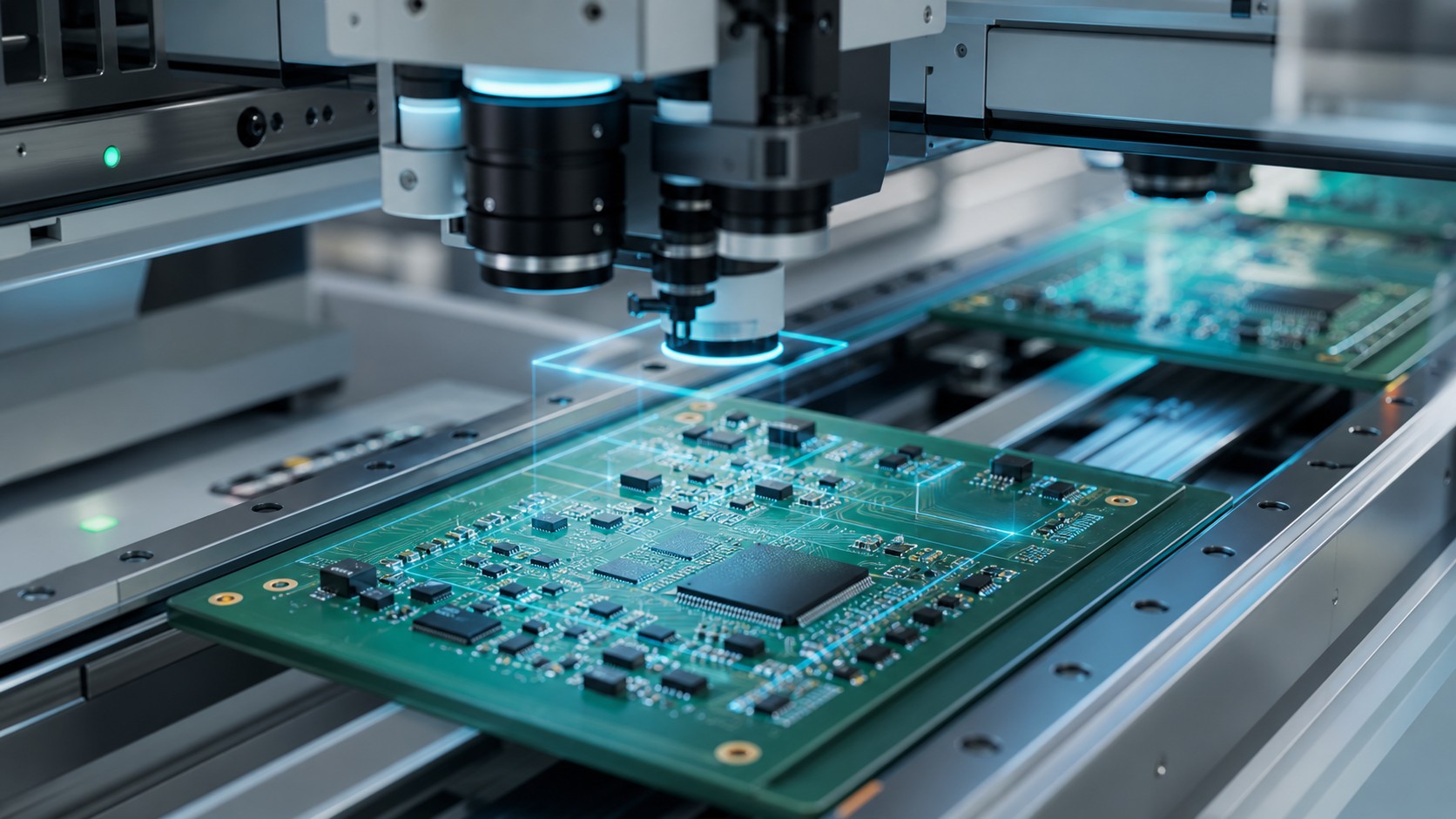
AI is also moving into PCB manufacturing and inspection.
Traditional automated optical inspection can catch many issues, but dense boards create subtle defect patterns: tiny opens and shorts, solder anomalies, missing or misaligned components, contamination, scratches, and defects that are hard to interpret from full-board images. Recent research shows why this is not a solved problem.
The 2026 UniPCB benchmark argues that general multimodal large language models still struggle with complex PCB inspection because boards contain dense components, intricate wiring, and subtle defects that require domain expertise. Another 2026 paper on high-resolution PCB defect detection shows that small defects can disappear when full-board images are resized, and that tile-based inference can recover detail if overlap and merging are handled carefully.
For manufacturers, this means AI inspection should be treated as a process improvement tool, not a magic replacement for process engineering. It can help prioritize defects, reduce false calls, and improve coverage, but it still depends on data quality, camera setup, lighting, defect taxonomy, model validation, and operator feedback.
The Hidden Risk: AI Can Make Bad PCB Decisions Faster
AI can reduce repetitive work, but it can also accelerate mistakes.
The risk is not that an AI tool draws a trace. The risk is that it produces a plausible-looking board while hiding assumptions about impedance, return path, creepage, derating, thermal limits, sourcing availability, footprint correctness, or manufacturing process capability.
That is why every AI PCB workflow needs guardrails:
| Guardrail | Why it matters |
|---|---|
| Clear design constraints | AI cannot optimize what the engineer has not defined |
| Governed component libraries | Wrong footprints and symbols can ruin otherwise good automation |
| Human review checkpoints | Safety, compliance, and high-speed behavior require expert judgment |
| Simulation and DRC/DFM checks | AI output must pass conventional engineering verification |
| Supplier feedback | Fabrication limits should shape the design before release |
| Change traceability | Teams need to know what the AI changed and why |
The winning workflow is not "AI designs the board." It is "AI explores options, the engineer defines constraints, and verification decides what survives."
Will AI Replace PCB Designers?
No, not in the parts of the job that matter most.
AI can reduce manual placement work, suggest routing patterns, generate first-draft schematics, summarize datasheets, assist with library work, and improve inspection workflows. Those are meaningful changes. But PCB engineering is still a system-level discipline involving physics, materials, manufacturing, cost, compliance, reliability, and trade-offs between electrical, mechanical, thermal, and supply-chain constraints.
Zuken's own framing is useful here: AI may not take the wheel entirely, but it can share the driving. Cadence's product language also positions AI as a way to compress cycle time and improve exploration, not as a reason to remove engineering review.
The future role of PCB designers is likely to shift toward constraint definition, architecture choices, review, simulation, DFM communication, and system-level trade-off management.
How to Evaluate AI PCB Tools in 2026
For teams comparing AI PCB design tools, the most important question is not which demo looks impressive. It is whether the tool improves a real workflow without creating hidden risk.
Use this evaluation checklist:
| Evaluation question | Why it matters |
|---|---|
| Which stage does the AI actually help with: schematic, placement, routing, DFM, inspection, or sourcing? | "AI PCB" can mean very different things |
| Does the tool preserve constraints and design intent? | Automation without constraints can create unbuildable boards |
| Can it use governed libraries and approved components? | Library errors are expensive and hard to catch late |
| Does it expose why a change was made? | Engineers need reviewable decisions, not opaque outputs |
| Does it integrate with existing EDA and manufacturing flows? | Isolated AI tools can create data handoff problems |
| Can it handle high-speed, power, thermal, and manufacturing rules? | AI-server boards are not simple hobby layouts |
| What must still be verified manually? | The answer defines the real productivity gain |
For buyers, a similar logic applies to PCB suppliers. Ask not only about capacity, but also about material capability, impedance control, HDI process limits, inspection strategy, yield history, and experience with high-speed server or accelerator boards.
What AI and PCB Mean for 2026 Electronics Teams
The AI-PCB intersection is becoming a strategic issue for three groups.
For design teams, AI can shorten early design loops and reduce repetitive layout work, but only if constraints, libraries, simulation, and review are disciplined.
For manufacturers, AI can improve inspection and process control, but only when the data pipeline is strong enough to represent real defects and real production variation.
For procurement teams, AI infrastructure demand can make high-end PCB capacity, materials, lead times, and supplier capability more important than before.
That makes PCB a more visible part of the AI hardware stack. In the past, boards often appeared late in the story, after chips and systems had already been discussed. In 2026, they belong much earlier in the planning conversation.
FAQ
What is AI PCB?
AI PCB usually means either AI-assisted PCB design and manufacturing, or PCB technology built for AI hardware such as servers, accelerators, and edge AI devices.
Can AI design a PCB from text?
Research systems and some commercial tools can generate first-draft circuits, schematics, or layouts from prompts or constraints, but expert review is still required. Natural-language hardware design remains difficult because parts, footprints, datasheets, electrical constraints, and manufacturability all need grounding.
Is AI PCB design reliable enough for production?
AI-assisted outputs can be useful, but production release still requires normal engineering verification: ERC, DRC, DFM, SI/PI analysis, thermal review, BOM review, supplier checks, and design review.
Why are AI servers important for PCB demand?
AI servers combine accelerators, CPUs, memory, networking, and high-current power delivery in dense systems. That increases the need for advanced boards, better materials, tighter impedance control, more careful power design, and stronger manufacturing quality control.
What should buyers check before sourcing AI-server PCBs?
Buyers should verify stackup capability, HDI process limits, material availability, impedance control, via reliability, inspection methods, lead time, yield history, and whether the supplier has experience with high-speed server or accelerator boards.
Sources and references used for this guide
Cadence Allegro X Design Platform
Source type: Official vendor product documentation.
Used for: Current examples of AI-driven PCB design, integrated analysis, automated placement, plane generation, and critical-net routing in an enterprise PCB platform.
Caution: Vendor pages describe product capabilities and positioning; they do not independently prove market-wide adoption or superiority.Zuken, Exploring the Future of AI-Based PCB Design Solutions
Source type: Official vendor technical blog.
Used for: A balanced description of AI-based place-and-route, limitations of replacing human expertise, and the idea of AI augmenting PCB designers.
Caution: Vendor perspective should be used for workflow framing, not neutral ranking claims.Tom's Hardware, Arm servers capture over 45% of data center market revenue
Source type: Professional technology media reporting on IDC data.
Used for: Current context on accelerated server revenue and AI infrastructure demand pressure in Q1 2026.
Caution: The article supports server-demand context, not PCB-specific design specifications.Tom's Hardware, PC makers report surging prices across different components
Source type: Professional technology media citing Nikkei Asia and industry comments.
Used for: Evidence that PCBs became visible in broader 2026 component cost and lead-time discussions.
Caution: Reported lead times and pricing pressures should not be generalized to every PCB supplier, region, or board type.Surveying GenAI-based Automation in Printed Circuit Board Design and Test
Source type: Research survey.
Used for: Taxonomy of GenAI applications across PCB design, test, assembly, distribution, and related workflow stages.
Caution: Survey papers map research directions and challenges; they do not prove production readiness for a specific commercial tool.SchGen: PCB Schematic Generation with Semantic-Grounded Code Representations
Source type: Research paper.
Used for: Natural-language-to-schematic research context and the challenge of representing PCB schematics for LLM generation.
Caution: Research prototype results should not be treated as production tool performance.pcbGPT: Automatic PCB Schematic Synthesis from Natural Language Requirements
Source type: Research paper.
Used for: Evidence that text-to-PCB schematic generation is progressing but still needs expert review.
Caution: The benchmark is limited; results do not imply fully autonomous production-ready PCB design.UniPCB: A Unified Vision-Language Benchmark for Open-Ended PCB Quality Inspection
Source type: Research paper.
Used for: PCB inspection challenges involving dense components, wiring structures, and subtle defects.
Caution: Benchmark performance is research evidence, not a guarantee for a specific factory inspection line.From Full Boards to Tiny Defects: Scale-Aware Tile Inference with Topology-Aware Merging for High-Resolution PCB Defect Detection
Source type: Research paper.
Used for: Explanation of why high-resolution PCB defect detection is difficult and why tile-based inference can preserve small defects.
Caution: Dataset results and methods need validation against each manufacturer's camera setup, defect taxonomy, and production process.
 UTMEL
UTMEL
We are the professional distributor of electronic components, providing a large variety of products to save you a lot of time, effort, and cost with our efficient self-customized service. careful order preparation fast delivery service
 Power Semiconductor Procurement After the Nexperia Shake-Up—NXP for Stability, ON for Technology, or Nexperia for Value?UTMEL04 November 20254880
The recent supply chain turmoil surrounding Netherlands-based Nexperia has sent shockwaves through the global semiconductor industry, forcing procurement professionals to re-evaluate their sourcing strategies.
Read More AI Computing Power Gap: How Token Consumption is Reshaping Server Component SourcingUTMEL23 June 2026955
As global token consumption drives the transition to high-density 100kW+ AI data centers, power delivery networks require advanced Wide-Bandgap semiconductors (SiC/GaN) and high-capacitance MLCCs. This shift has triggered a component procurement crisis with lead times exceeding 24 weeks. To bypass shortages, hardware buyers must abandon just-in-time manufacturing and leverage independent global distributor networks to secure critical power and passive components.
Read More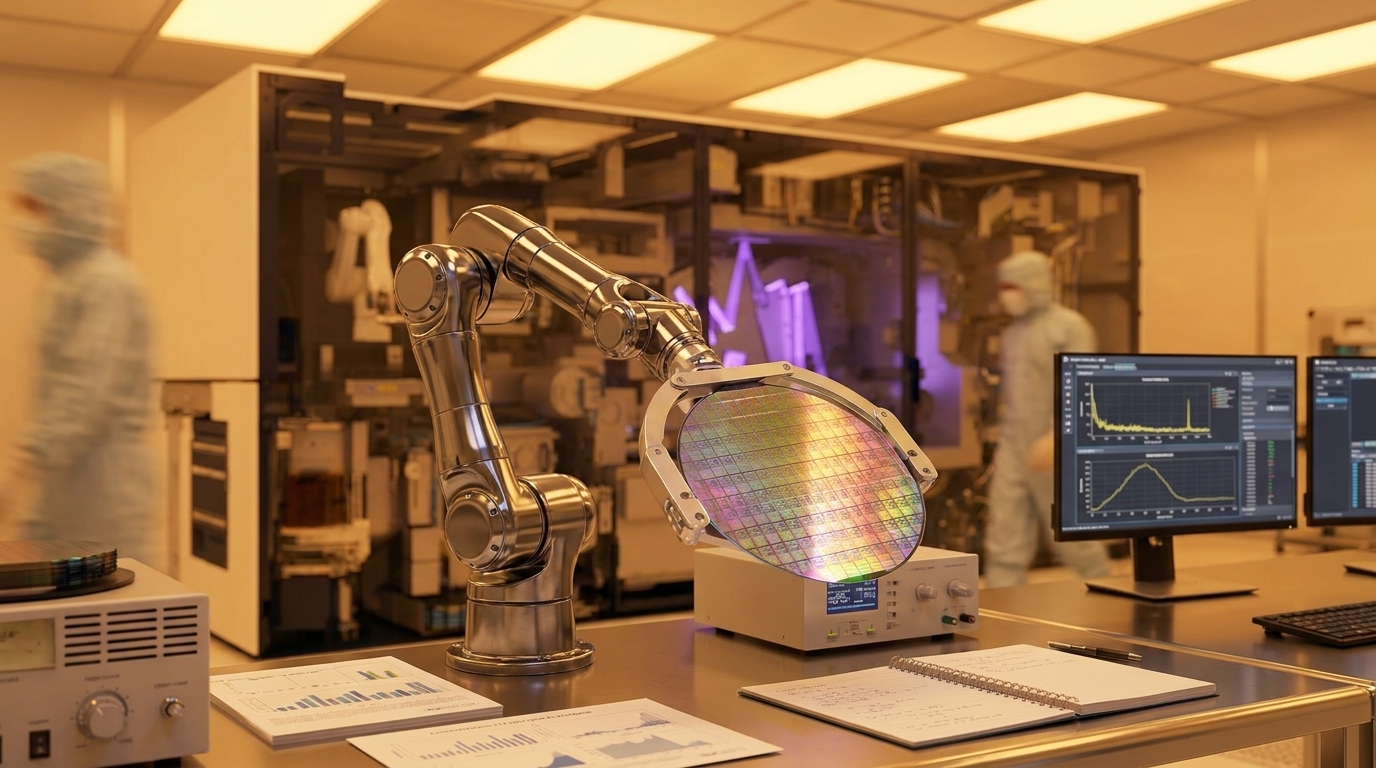 The BSPDN Revolution: Overcoming IR Drop in Sub-2nm GAAFET Nodes with Backside Power DeliveryUTMEL25 June 2026933
As semiconductor manufacturing enters the sub-2nm era, Backside Power Delivery Networks (BSPDN) are replacing traditional front-side routing to overcome critical IR drop bottlenecks. By separating power and signal delivery, chipmakers like Intel and TSMC drastically improve performance and density in GAAFET designs. However, this radical shift introduces manufacturing complexities, thermal challenges, and demands advanced packaging and power management solutions.
Read More Power Management ICs Trends 2026: AI Demand, Supply Risks, and Sourcing StrategiesUTMEL06 July 20261433
As AI server racks surpass 100kW by 2026, data centers are shifting toward wide-bandgap semiconductors like SiC and GaN. However, this demand has triggered a critical shortage of mature-node Power Management ICs (PMICs). To prevent production halts, sourcing teams must abandon 'just-in-time' models, implement proactive 'just-in-case' strategies, and rapidly qualify pin-to-pin alternative components to secure their supply chains.
Read More onsemi Synaptics Acquisition Impact: BOM Risk Checklist and Second-Source Strategy for Edge AI DesignsUTMEL27 July 2026345
The onsemi acquisition of Synaptics provides hardware program managers a 12-to-18-month window before potential product cancellations occur in mid-2027. This guide outlines how to audit BOM exposure across overlap and non-core product lines, calculate Last-Time-Buy volumes including hidden storage costs, establish proactive second-sourcing triggers, and implement supply chain monitoring to prevent line-down events.
Read More
Subscribe to Utmel !
![0201N120J500CT]() 0201N120J500CT
0201N120J500CTWalsin Technology Corporation
![04M030050HNDIN34814]() 04M030050HNDIN34814
04M030050HNDIN34814Essentra Components
![04M050080HNDIN34814]() 04M050080HNDIN34814
04M050080HNDIN34814Essentra Components
![0603B224K6R3CT]() 0603B224K6R3CT
0603B224K6R3CTWalsin Technology Corporation
![0825020TNA]() 0825020TNA
0825020TNAEssentra Components
![0525020SCN]() 0525020SCN
0525020SCNEssentra Components
![BLM18PG221SN1D]() BLM18PG221SN1D
BLM18PG221SN1DMurata Electronics
![BLM18AG121SN1D]() BLM18AG121SN1D
BLM18AG121SN1DMurata Electronics
![BLM21AG102SN1D]() BLM21AG102SN1D
BLM21AG102SN1DMurata Electronics
![BLM18SG221TN1D]() BLM18SG221TN1D
BLM18SG221TN1DMurata Electronics


