Product
 Brand
Brand Articles
 Tools
Tools
Semiconductor Veteran Kevin Conley Takes Helm as CEO of Applied Brain Research
Applied Brain Research (ABR), a leading developer of AI solutions, has announced the appointment of Kevin Conley, a seasoned semiconductor industry veteran, as its new Chief Executive Officer. As ABR embarks on a transformative phase of growth and innovation, Conley's extensive experience and vision are expected to be invaluable. Conley has held executive leadership roles at global semiconductor giants such as SanDisk, Corsair Components, and Everspin Technologies. His consistent track record in driving innovation, advancing technology, and delivering value to customers aligns with ABR's goals. His deep understanding of the AI chip landscape, combined with his expertise in semiconductor and product development, make him an ideal fit for leading ABR's future endeavors. 'I am thrilled to join ABR as CEO and embark on this exciting journey,' said Conley. 'ABR stands at the forefront of AI solution innovation, and I am committed to bringing its game-changing technology to the Artificial Intelligence of Things (AIoT) chip market. With our leadership in Time Series Processing, we are uniquely positioned to redefine industry standards and elevate ABR to new heights of excellence.' ABR's co-founder and interim CEO, Dr. Chris Eliasmith, has transitioned to the role of CTO. Eliasmith expressed confidence in Conley's ability to drive product development and market expansion, aligning with ABR's commitment to deliver breakthrough solutions. 'ABR has consistently challenged industry norms and set new benchmarks in AI. As Kevin assumes the role of CEO, ABR is poised to reinforce its competitive advantage and foster an era of unparalleled innovation bringing its technology to the broad opportunity in the AIoT,' said Eliasmith. Founded by alumni of the Computational Neuroscience Research Group at the University of Waterloo, ABR is a pioneer in Artificial Intelligence technology. The company is leading a new wave of product development targeting ultra-low power Edge AI, enabling a new level of capability in low-power critical applications. ABR's revolutionary time-series AI processor uses 100x less-power than other high-functionality edge AI hardware, and supports AI models up to 10-100x larger than other low-power edge AI hardware.
 UTMEL
UTMEL
We are the professional distributor of electronic components, providing a large variety of products to save you a lot of time, effort, and cost with our efficient self-customized service. careful order preparation fast delivery service
 Power Semiconductor Procurement After the Nexperia Shake-Up—NXP for Stability, ON for Technology, or Nexperia for Value?UTMEL04 November 20254832
The recent supply chain turmoil surrounding Netherlands-based Nexperia has sent shockwaves through the global semiconductor industry, forcing procurement professionals to re-evaluate their sourcing strategies.
Read More AI Computing Power Gap: How Token Consumption is Reshaping Server Component SourcingUTMEL23 June 2026900
As global token consumption drives the transition to high-density 100kW+ AI data centers, power delivery networks require advanced Wide-Bandgap semiconductors (SiC/GaN) and high-capacitance MLCCs. This shift has triggered a component procurement crisis with lead times exceeding 24 weeks. To bypass shortages, hardware buyers must abandon just-in-time manufacturing and leverage independent global distributor networks to secure critical power and passive components.
Read More The BSPDN Revolution: Overcoming IR Drop in Sub-2nm GAAFET Nodes with Backside Power DeliveryUTMEL25 June 2026825
As semiconductor manufacturing enters the sub-2nm era, Backside Power Delivery Networks (BSPDN) are replacing traditional front-side routing to overcome critical IR drop bottlenecks. By separating power and signal delivery, chipmakers like Intel and TSMC drastically improve performance and density in GAAFET designs. However, this radical shift introduces manufacturing complexities, thermal challenges, and demands advanced packaging and power management solutions.
Read More Power Management ICs Trends 2026: AI Demand, Supply Risks, and Sourcing StrategiesUTMEL06 July 20261314
As AI server racks surpass 100kW by 2026, data centers are shifting toward wide-bandgap semiconductors like SiC and GaN. However, this demand has triggered a critical shortage of mature-node Power Management ICs (PMICs). To prevent production halts, sourcing teams must abandon 'just-in-time' models, implement proactive 'just-in-case' strategies, and rapidly qualify pin-to-pin alternative components to secure their supply chains.
Read More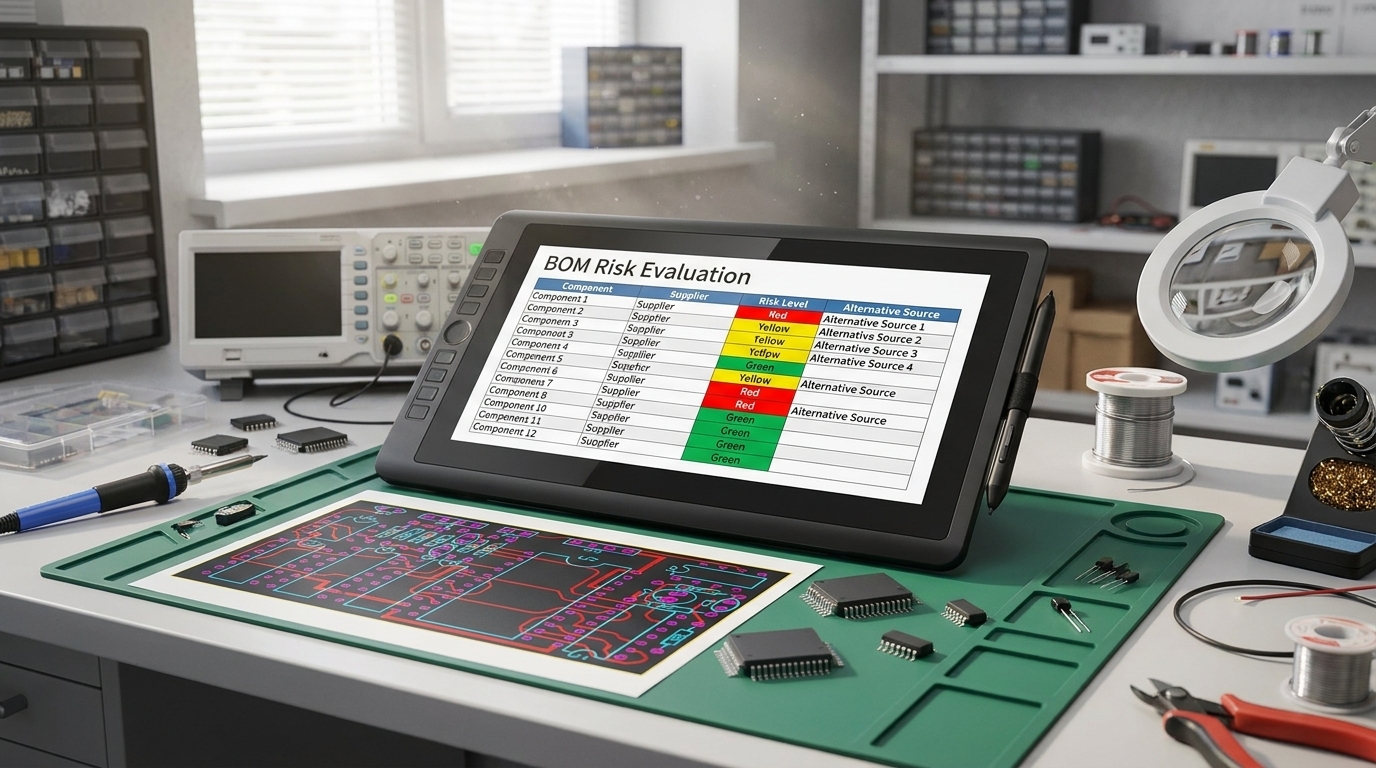 onsemi Synaptics Acquisition Impact: BOM Risk Checklist and Second-Source Strategy for Edge AI DesignsUTMEL27 July 2026300
The onsemi acquisition of Synaptics provides hardware program managers a 12-to-18-month window before potential product cancellations occur in mid-2027. This guide outlines how to audit BOM exposure across overlap and non-core product lines, calculate Last-Time-Buy volumes including hidden storage costs, establish proactive second-sourcing triggers, and implement supply chain monitoring to prevent line-down events.
Read More
Subscribe to Utmel !
![AD8313ARMZ]() AD8313ARMZ
AD8313ARMZAnalog Devices Inc.
![BLM03BC330SN1D]() BLM03BC330SN1D
BLM03BC330SN1DMurata Electronics
![AD8319ACPZ-R7]() AD8319ACPZ-R7
AD8319ACPZ-R7Analog Devices Inc.
![BK0603HS601-T]() BK0603HS601-T
BK0603HS601-TTaiyo Yuden
![AD8361ARMZ-REEL7]() AD8361ARMZ-REEL7
AD8361ARMZ-REEL7Analog Devices Inc.
![ADAU1761BCPZ-R7]() ADAU1761BCPZ-R7
ADAU1761BCPZ-R7Analog Devices Inc.
![BLM03HD102SN1D]() BLM03HD102SN1D
BLM03HD102SN1DMurata Electronics
![NFM21PC475B1A3D]() NFM21PC475B1A3D
NFM21PC475B1A3DMurata Electronics
![BLM03BB750SN1D]() BLM03BB750SN1D
BLM03BB750SN1DMurata Electronics
![T1233QNL]() T1233QNL
T1233QNLPulse Electronics Network