

 Product
 Brand
Brand Articles
 Tools
Tools
AD7891AP-1REEL IC DAS: Feature, Circuit,Specification

Tape & Reel (TR) Obsolete 12 b b 500k k Special Purpose ADCs/DACs Serial, Parallel 5V V 44-LCC (J-Lead) Surface Mount 44-PLCC (16.59x16.59)


Tape & Reel (TR) Obsolete 12 b b 500k k Special Purpose ADCs/DACs Serial, Parallel 5V V 44-LCC (J-Lead) Surface Mount 44-PLCC (16.59x16.59)
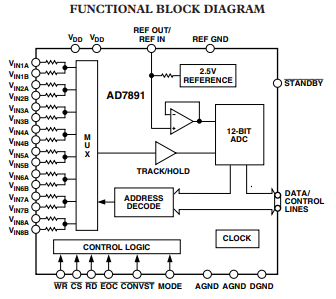
The AD7891AP-1REEL is an 8-channel, 12-bit data acquisition system with a choice of either parallel or serial interface structure. The part contains an input multiplexer, an on-chip track/hold amplifier, a high-speed 12-bit ADC, a 2.5V reference, and a high-speed interface.
AD7891AP-1REEL Feature
Fast 12-Bit ADC with 1.6s Conversion Time
8 Single-Ended Analog Input Channels
Overvoltage Protection on Each Channel
Selection of Input Ranges: 10V for 2.5V for AD7891-2
Parallel and Serial Interface
On-Chip Track/Hold Amplifier
On-Chip Reference Single-Supply, Low Power Operation (100 mW Max)
AD7891AP-1REEL Advantage
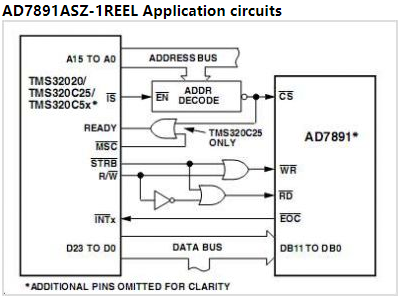
The AD7891 provides the option of either a parallel or serial interface structure determined by the MODE pin. The part has standard control inputs and fast data access times for both the serial and parallel interfaces, ensuring easy interfacing to modern microprocessors, microcontrollers, and digital signal processors.
In addition to the traditional dc accuracy specifications, such as linearity, full-scale and offset errors, the part is also specified for dynamic performance parameters, including harmonic distortion and signal-to-noise ratio.
Power dissipation in normal mode is 82 mW typical; in the standby mode, this is reduced to 75 mW typ. The part is available in a 44-terminal MQFP and a 44-lead PLCC.
Specifications
- TypeParameter
- Mounting Type
The "Mounting Type" in electronic components refers to the method used to attach or connect a component to a circuit board or other substrate, such as through-hole, surface-mount, or panel mount.
Surface Mount - Package / Case
refers to the protective housing that encases an electronic component, providing mechanical support, electrical connections, and thermal management.
44-LCC (J-Lead) - Number of Pins44
- Supplier Device Package
The parameter "Supplier Device Package" in electronic components refers to the physical packaging or housing of the component as provided by the supplier. It specifies the form factor, dimensions, and layout of the component, which are crucial for compatibility and integration into electronic circuits and systems. The supplier device package information typically includes details such as the package type (e.g., DIP, SOP, QFN), number of pins, pitch, and overall size, allowing engineers and designers to select the appropriate component for their specific application requirements. Understanding the supplier device package is essential for proper component selection, placement, and soldering during the manufacturing process to ensure optimal performance and reliability of the electronic system.
44-PLCC (16.59x16.59) - Number of Elements1
- Operating Temperature
The operating temperature is the range of ambient temperature within which a power supply, or any other electrical equipment, operate in. This ranges from a minimum operating temperature, to a peak or maximum operating temperature, outside which, the power supply may fail.
-40°C~85°C - Packaging
Semiconductor package is a carrier / shell used to contain and cover one or more semiconductor components or integrated circuits. The material of the shell can be metal, plastic, glass or ceramic.
Tape & Reel (TR) - Part Status
Parts can have many statuses as they progress through the configuration, analysis, review, and approval stages.
Obsolete - Moisture Sensitivity Level (MSL)
Moisture Sensitivity Level (MSL) is a standardized rating that indicates the susceptibility of electronic components, particularly semiconductors, to moisture-induced damage during storage and the soldering process, defining the allowable exposure time to ambient conditions before they require special handling or baking to prevent failures
3 (168 Hours) - TypeData Acquisition System (DAS)
- Max Operating Temperature
The Maximum Operating Temperature is the maximum body temperature at which the thermistor is designed to operate for extended periods of time with acceptable stability of its electrical characteristics.
105°C - Min Operating Temperature
The "Min Operating Temperature" parameter in electronic components refers to the lowest temperature at which the component is designed to operate effectively and reliably. This parameter is crucial for ensuring the proper functioning and longevity of the component, as operating below this temperature may lead to performance issues or even damage. Manufacturers specify the minimum operating temperature to provide guidance to users on the environmental conditions in which the component can safely operate. It is important to adhere to this parameter to prevent malfunctions and ensure the overall reliability of the electronic system.
-40°C - Max Power Dissipation
The maximum power that the MOSFET can dissipate continuously under the specified thermal conditions.
100mW - Voltage - Supply
Voltage - Supply refers to the range of voltage levels that an electronic component or circuit is designed to operate with. It indicates the minimum and maximum supply voltage that can be applied for the device to function properly. Providing supply voltages outside this range can lead to malfunction, damage, or reduced performance. This parameter is critical for ensuring compatibility between different components in a circuit.
5V - Base Part Number
The "Base Part Number" (BPN) in electronic components serves a similar purpose to the "Base Product Number." It refers to the primary identifier for a component that captures the essential characteristics shared by a group of similar components. The BPN provides a fundamental way to reference a family or series of components without specifying all the variations and specific details.
AD7891 - Output Type
The "Output Type" parameter in electronic components refers to the type of signal or data that is produced by the component as an output. This parameter specifies the nature of the output signal, such as analog or digital, and can also include details about the voltage levels, current levels, frequency, and other characteristics of the output signal. Understanding the output type of a component is crucial for ensuring compatibility with other components in a circuit or system, as well as for determining how the output signal can be utilized or processed further. In summary, the output type parameter provides essential information about the nature of the signal that is generated by the electronic component as its output.
TTL - Operating Supply Voltage
The voltage level by which an electrical system is designated and to which certain operating characteristics of the system are related.
5V - Polarity
In electronic components, polarity refers to the orientation or direction in which the component must be connected in a circuit to function properly. Components such as diodes, capacitors, and LEDs have polarity markings to indicate which terminal should be connected to the positive or negative side of the circuit. Connecting a component with incorrect polarity can lead to malfunction or damage. It is important to pay attention to polarity markings and follow the manufacturer's instructions to ensure proper operation of electronic components.
Bipolar - Number of Channels8
- Interface
In electronic components, the term "Interface" refers to the point at which two different systems, devices, or components connect and interact with each other. It can involve physical connections such as ports, connectors, or cables, as well as communication protocols and standards that facilitate the exchange of data or signals between the connected entities. The interface serves as a bridge that enables seamless communication and interoperability between different parts of a system or between different systems altogether. Designing a reliable and efficient interface is crucial in ensuring proper functionality and performance of electronic components and systems.
Parallel, Serial - Max Supply Voltage
In general, the absolute maximum common-mode voltage is VEE-0.3V and VCC+0.3V, but for products without a protection element at the VCC side, voltages up to the absolute maximum rated supply voltage (i.e. VEE+36V) can be supplied, regardless of supply voltage.
5.25V - Min Supply Voltage
The minimum supply voltage (V min ) is explored for sequential logic circuits by statistically simulating the impact of within-die process variations and gate-dielectric soft breakdown on data retention and hold time.
4.75V - Power Dissipation
the process by which an electronic or electrical device produces heat (energy loss or waste) as an undesirable derivative of its primary action.
100mW - Number of Bits12
- Min Input Voltage
The parameter "Min Input Voltage" in electronic components refers to the minimum voltage level that must be applied to the component for it to operate within its specified parameters. This value is crucial as providing a voltage below this minimum threshold may result in the component malfunctioning or not functioning at all. It is important to adhere to the specified minimum input voltage to ensure the proper operation and longevity of the electronic component. Failure to meet this requirement may lead to potential damage to the component or the overall system in which it is used.
2.375V - Max Input Voltage
Max Input Voltage refers to the maximum voltage level that an electronic component can safely handle without getting damaged. This parameter is crucial for ensuring the proper functioning and longevity of the component. Exceeding the specified maximum input voltage can lead to overheating, electrical breakdown, or permanent damage to the component. It is important to carefully adhere to the manufacturer's guidelines regarding the maximum input voltage to prevent any potential issues and maintain the reliability of the electronic device.
2.625V - Supply Type
Supply Type in electronic components refers to the classification of power sources used to operate the component. It indicates whether the component requires DC or AC power, and if DC, specifies the voltage levels such as low, medium, or high. Different supply types can affect the performance, compatibility, and application of the component in electronic circuits. Understanding the supply type is crucial for proper component selection and integration into electronic designs.
Single - Data Interface
A Data Interface in EDQ is a template of a set of attributes representing a given entity, used to create processes that read from, or write to, interfaces rather than directly from or to sources or targets of data.
Serial, Parallel - Sampling Rate
often described in the context of signal processing as the number of samples per time.
500 ksps - Sampling Rate (Per Second)
The sampling rate (per second) in electronic components refers to the frequency at which an analog signal is measured or sampled to convert it into a digital signal. It is typically expressed in Hertz (Hz) and indicates how many times per second the analog signal is sampled. A higher sampling rate allows for better representation of the original signal, capturing more detail and reducing distortion during the conversion process. In audio applications, for example, common sampling rates include 44.1 kHz for CD-quality audio and 48 kHz for video production.
500k - Power Consumption
Power consumption is the amount of input energy (measured in watts) required for an electrical appliance to function. This is opposed to power output which is a measure of the level of performance, of a heat pump for example.
82mW - Integral Nonlinearity (INL)
Integral Nonlinearity (INL) is a measure of the deviation of a transfer function from a straight line when considering the entire output range of a device, such as a digital-to-analog converter or an analog-to-digital converter. It is quantified as the maximum deviation of the actual output from the ideal output across the entire input range, expressed as a percentage of the full-scale output. INL indicates how closely the output follows a linear model, influencing the accuracy of the signal representation in electronic components. A lower INL value signifies better linearity and higher precision in signal processing applications.
1 LSB - Number of A/D Converters1
- Number of Converters1
- Voltage Supply Source
A voltage source is a two-terminal device which can maintain a fixed voltage. An ideal voltage source can maintain the fixed voltage independent of the load resistance or the output current. However, a real-world voltage source cannot supply unlimited current. A voltage source is the dual of a current source.
Single Supply - Signal to Noise Ratio (SNR)
Signal to Noise Ratio (SNR) is a measure used in electronics to quantify the ratio of the strength of a desired signal to the strength of background noise. It is commonly expressed in decibels (dB) and is used to evaluate the quality of a signal transmission or processing system. A higher SNR indicates a stronger, clearer signal relative to the background noise, resulting in better performance and accuracy in electronic components such as amplifiers, receivers, and communication systems. SNR is crucial in ensuring reliable and efficient operation of electronic devices by minimizing the impact of unwanted noise on the signal quality.
70 dB - Differential Nonlinearity
Differential Nonlinearity (DNL) is a parameter used to measure the deviation of the actual step size between two adjacent digital output codes in an analog-to-digital converter (ADC) or digital-to-analog converter (DAC) from the ideal step size. It quantifies the accuracy of the converter in maintaining consistent step sizes across the entire range of digital codes. DNL is typically expressed in terms of least significant bits (LSBs) and is an important factor in determining the overall performance and linearity of the converter. A lower DNL value indicates better linearity and accuracy in the conversion process, while a higher DNL value suggests potential errors and nonlinearity in the output signal.
1 LSB - Resolution (Bits)
Resolution (Bits) in electronic components refers to the number of bits used to represent the analog signal in digital form. It indicates the level of detail or precision with which the analog signal can be converted into digital data. A higher resolution means more bits are used, allowing for finer distinctions to be made between different signal levels. For example, an 8-bit resolution can represent 256 different levels, while a 16-bit resolution can represent 65,536 levels. In general, a higher resolution leads to better accuracy and fidelity in the digital representation of the original analog signal.
12 b - Number of Analog Inputs8
- Radiation Hardening
Radiation hardening is the process of making electronic components and circuits resistant to damage or malfunction caused by high levels of ionizing radiation, especially for environments in outer space (especially beyond the low Earth orbit), around nuclear reactors and particle accelerators, or during nuclear accidents or nuclear warfare.
No - RoHS Status
RoHS means “Restriction of Certain Hazardous Substances” in the “Hazardous Substances Directive” in electrical and electronic equipment.
Non-RoHS Compliant - Lead Free
Lead Free is a term used to describe electronic components that do not contain lead as part of their composition. Lead is a toxic material that can have harmful effects on human health and the environment, so the electronics industry has been moving towards lead-free components to reduce these risks. Lead-free components are typically made using alternative materials such as silver, copper, and tin. Manufacturers must comply with regulations such as the Restriction of Hazardous Substances (RoHS) directive to ensure that their products are lead-free and environmentally friendly.
Contains Lead
AD7891AP-1REEL Functional Block Diagram
AD7891AP-1REEL Circuit
Parts with Similar Specs
- ImagePart NumberManufacturerPackage / CaseNumber of PinsNumber of BitsSampling RatePolarityInterfaceIntegral Nonlinearity (INL)Differential NonlinearityNumber of A/D ConvertersNumber of ConvertersMin Supply VoltageView Compare
![AD7891AP-1REEL]()
AD7891AP-1REEL
44-LCC (J-Lead)
44
12
500 ksps
Bipolar
Parallel, Serial
1 LSB
1 LSB
1
1
4.75 V
![AD7891APZ-1REEL]()
44-LCC (J-Lead)
44
12
500 ksps
Bipolar
Parallel, Serial
1 LSB
1 LSB
-
-
-
![ADC12048CIV]()
44-LCC (J-Lead)
44
12
278 ksps
Unipolar
-
1 LSB
1 LSB
-
-
4.5 V
![AD7891BPZ-1]()
44-LCC (J-Lead)
44
12
500 ksps
Bipolar
Parallel, Serial
0.75 LSB
1 LSB
-
-
-
![AD7891BP-2]()
44-LCC (J-Lead)
44
12
500 ksps
Bipolar, Unipolar
Parallel, Serial
0.75 LSB
1 LSB
1
-
-


AD7891AP-1REEL Manufacturer
Analog Devices (NASDAQ: ADI) is a world leader in the design, manufacture, and marketing of a broad portfolio of high performance analog, mixed-signal, and digital signal processing (DSP) integrated circuits (ICs) used in virtually all types of electronic equipment. Since our inception in 1965, we have focused on solving the engineering challenges associated with signal processing in electronic equipment. Used by over 100,000 customers worldwide, our signal processing products play a fundamental role in converting, conditioning, and processing real-world phenomena such as temperature, pressure, sound, light, speed, and motion into electrical signals to be used in a wide array of electronic devices.
Datasheet PDF
- PCN Obsolescence/ EOL :
- Datasheets :
- ConflictMineralStatement :
1.What are the highlights of AD7891?
The AD7891 is a complete monolithic 12-bit data acquisition system that combines an 8-channel multiplexer, 12-bit ADC, 2.5 V reference, and track/hold amplifier on a single chip. The AD7891-2 features a conversion time of 1.6 ms and an acquisition time of 0.4 ms. This allows a sample rate of 500 kSPS when sampling one channel and 62.5 kSPS when channel hopping. These sample rates can be achieved using either a software or hardware convert start. The AD7891-1 has an acquisition time of 0.6 ms when using a hardware convert start and an acquisition time of 0.7 ms when using a software convert start. These acquisition times allow sample rates of 454.5 kSPS and 435 kSPS, respectively, for hardware and software convert start. Each channel on the AD7891 has overvoltage protection. This means an overvoltage on an unselected channel does not affect the conversion on a selected channel. The AD7891-1 can withstand overvoltages of ±17 V.
2.What is the interface information of AD7891?
The AD7891 provides two interface options, a 12-bit parallel interface and a high speed serial interface. The required interface mode is selected via the MODE pin. The two interface modes are discussed in the following sections.
3.How does an integrated circuit work?
Integrated circuits are a combination of diodes, microprocessors, and transistors in a minimized form on a wafer made of silicon. ... Transistors – These components are used to store voltages or circuit stabilizer. They can be utilized to amplify the given signal and used as switches working in digital circuits.
4.What are the uses of integrated circuit?
An integrated circuit, or IC, is small chip that can function as an amplifier, oscillator, timer, microprocessor, or even computer memory. An IC is a small wafer, usually made of silicon, that can hold anywhere from hundreds to millions of transistors, resistors, and capacitors.
5.What is the symbol of integrated circuit?
Usually, an integrated circuit is represented by a rectangle, with pins extending out of the sides. Each pin should be labeled with both a number, and a function.
 TDA1517P Power Amplifier: Circuit, Replacement and Pinout
20 August 202121418
![Difference Between BS170 N-Channel MOSFET vs. 2N7000 N-Channel MOSFET [Video&FAQ]](https://res.utmel.com/Images/Article/991b840d-d62d-4cd0-b756-4ec2fa6e357e.jpg) Difference Between BS170 N-Channel MOSFET vs. 2N7000 N-Channel MOSFET [Video&FAQ]
Difference Between BS170 N-Channel MOSFET vs. 2N7000 N-Channel MOSFET [Video&FAQ]11 April 202211648
 S9013 NPN Silicon Transistors: Datasheet, Pinout and Equivalents
13 April 202225188
 2N7002V N-Channel MOSFET: Pinout, Datasheet and Application
09 July 2021615
![LR41 Battery, LR41 Battery Equivalent, LR41 and SR41 Cell Battery [FAQ]](https://res.utmel.com/Images/Article/edaf2000-e788-42b0-b239-6f7d52115528.jpg) LR41 Battery, LR41 Battery Equivalent, LR41 and SR41 Cell Battery [FAQ]
LR41 Battery, LR41 Battery Equivalent, LR41 and SR41 Cell Battery [FAQ]20 December 202133638
 ATMEGA328P-MU AVR 8-bit Microcontrollers - MCU 32KB In-system: Datasheet, Pinout, and Equivalents
24 February 20223759
 LMR16006YDDCR: PWM DC/DC, Step-Down, Datasheet
22 February 20222045
 RF101 Diode: Datasheet, Features, Dimensions
21 July 2021875
 Chip Filters, Piezoelectric Materials and the Piezoelectric Effect
27 September 20227010
 What is FIR Filter?
24 September 202018413
 2026 ADAS Sensors: Supply Outlook and Alternative Sourcing
18 July 2026436
 Tech Giants Accelerate In-House Semiconductor Design, Threatening Fabless Chipmakers
27 September 20233388
 MLCC: Applications and Future Development
20 December 202110115
 The Reason for the Leakage Current of MOS Tube
26 March 20229335
 An Overview of Development Board
18 December 202515539
 Getting Started with Raspberry Pi: A Beginner's Guide
23 August 20235102
Analog Devices Inc.
In Stock
United States
China
Canada
Japan
Russia
Germany
United Kingdom
Singapore
Italy
Hong Kong(China)
Taiwan(China)
France
Korea
Mexico
Netherlands
Malaysia
Austria
Spain
Switzerland
Poland
Thailand
Vietnam
India
United Arab Emirates
Afghanistan
Åland Islands
Albania
Algeria
American Samoa
Andorra
Angola
Anguilla
Antigua & Barbuda
Argentina
Armenia
Aruba
Australia
Azerbaijan
Bahamas
Bahrain
Bangladesh
Barbados
Belarus
Belgium
Belize
Benin
Bermuda
Bhutan
Bolivia
Bonaire, Sint Eustatius and Saba
Bosnia & Herzegovina
Botswana
Brazil
British Indian Ocean Territory
British Virgin Islands
Brunei
Bulgaria
Burkina Faso
Burundi
Cabo Verde
Cambodia
Cameroon
Cayman Islands
Central African Republic
Chad
Chile
Christmas Island
Cocos (Keeling) Islands
Colombia
Comoros
Congo
Congo (DRC)
Cook Islands
Costa Rica
Côte d’Ivoire
Croatia
Cuba
Curaçao
Cyprus
Czechia
Denmark
Djibouti
Dominica
Dominican Republic
Ecuador
Egypt
El Salvador
Equatorial Guinea
Eritrea
Estonia
Eswatini
Ethiopia
Falkland Islands
Faroe Islands
Fiji
Finland
French Guiana
French Polynesia
Gabon
Gambia
Georgia
Ghana
Gibraltar
Greece
Greenland
Grenada
Guadeloupe
Guam
Guatemala
Guernsey
Guinea
Guinea-Bissau
Guyana
Haiti
Honduras
Hungary
Iceland
Indonesia
Iran
Iraq
Ireland
Isle of Man
Israel
Jamaica
Jersey
Jordan
Kazakhstan
Kenya
Kiribati
Kosovo
Kuwait
Kyrgyzstan
Laos
Latvia
Lebanon
Lesotho
Liberia
Libya
Liechtenstein
Lithuania
Luxembourg
Macao(China)
Madagascar
Malawi
Maldives
Mali
Malta
Marshall Islands
Martinique
Mauritania
Mauritius
Mayotte
Micronesia
Moldova
Monaco
Mongolia
Montenegro
Montserrat
Morocco
Mozambique
Myanmar
Namibia
Nauru
Nepal
New Caledonia
New Zealand
Nicaragua
Niger
Nigeria
Niue
Norfolk Island
North Korea
North Macedonia
Northern Mariana Islands
Norway
Oman
Pakistan
Palau
Palestinian Authority
Panama
Papua New Guinea
Paraguay
Peru
Philippines
Pitcairn Islands
Portugal
Puerto Rico
Qatar
Réunion
Romania
Rwanda
Samoa
San Marino
São Tomé & Príncipe
Saudi Arabia
Senegal
Serbia
Seychelles
Sierra Leone
Sint Maarten
Slovakia
Slovenia
Solomon Islands
Somalia
South Africa
South Sudan
Sri Lanka
St Helena, Ascension, Tristan da Cunha
St. Barthélemy
St. Kitts & Nevis
St. Lucia
St. Martin
St. Pierre & Miquelon
St. Vincent & Grenadines
Sudan
Suriname
Svalbard & Jan Mayen
Sweden
Syria
Tajikistan
Tanzania
Timor-Leste
Togo
Tokelau
Tonga
Trinidad & Tobago
Tunisia
Turkey
Turkmenistan
Turks & Caicos Islands
Tuvalu
U.S. Outlying Islands
U.S. Virgin Islands
Uganda
Ukraine
Uruguay
Uzbekistan
Vanuatu
Vatican City
Venezuela
Wallis & Futuna
Yemen
Zambia
Zimbabwe
![AD7606BSTZ]() AD7606BSTZ
AD7606BSTZAnalog Devices Inc.
![AD2S1200WSTZ]() AD2S1200WSTZ
AD2S1200WSTZAnalog Devices Inc.
![AD421BRZRL]() AD421BRZRL
AD421BRZRLAnalog Devices Inc.
![AD7147PACPZ-500R7]() AD7147PACPZ-500R7
AD7147PACPZ-500R7Analog Devices Inc.
![AD1954YSTZ]() AD1954YSTZ
AD1954YSTZAnalog Devices Inc.
![AD5592RBRUZ]() AD5592RBRUZ
AD5592RBRUZAnalog Devices Inc.
![AD7147WPACPZ-1500R]() AD7147WPACPZ-1500R
AD7147WPACPZ-1500RAnalog Devices Inc.
![AD7606BSTZ-RL]() AD7606BSTZ-RL
AD7606BSTZ-RLAnalog Devices Inc.
![AD7606BSTZ-4]() AD7606BSTZ-4
AD7606BSTZ-4Analog Devices Inc.
![AD7891ASZ-1]() AD7891ASZ-1
AD7891ASZ-1Analog Devices Inc.


