

 Product
 Brand
Brand Articles
 Tools
Tools
Difference Between TDA7293 vs. TDA7294 Audio Amplifier [Video&FAQ]

20 kHz kHz Audio Amplifiers 10.7mm mm 5mm mm 50W W 15 pins Multiwatt-15 (Vertical, Bent and Staggered Leads)


20 kHz kHz Audio Amplifiers 10.7mm mm 5mm mm 50W W 15 pins Multiwatt-15 (Vertical, Bent and Staggered Leads)
Both audio chips feature DMOS output stages, which stand for double-diffused metal–oxide–semiconductor. The maximum supply rails for the TDA7293 and TDA7294 are respectively +/-60V DC and +/-50V DC. AC supply rails range from 32V-0-32V to 35V-0-35V for transformers, with 32V-0-32V being recommended for 8-ohm operation. But what is the distinction between the two? This article will answer your questions and show you how they are similar and different, as well as how they can be used interchangeably.

tda7294 vs tda7293 amplifier circuit connection | Electro Bhai |
- What is a TDA7293 Audio Amplifier?
- What is a TDA7294 Audio Amplifier?
- TDA7293 vs TDA7294 Features Comparison
- TDA7293 vs TDA7294 Applications
- TDA7293 vs TDA7294 Where to use?
- TDA7293 vs TDA7294 Schematic Diagram Monolithic Power Amplifier
- TDA7293 vs TDA7294 As a Circuit
- TDA7293 vs TDA7294 P.C.B. and Components Layout
- TDA7293 vs TDA7294 Application Circuit
- TDA7293 vs TDA7294 High-efficiency Application Circuit
- TDA7293 VS TDA7294 Specifications Comparison
- TDA7293 vs TDA7294 Equivalents
- TDA7293 vs TDA7294 Package
- TDA7293 vs TDA7294 Interchangeability
- Product Datasheet
What is a TDA7293 Audio Amplifier?
The TDA7293 Pinout is shown as follows.
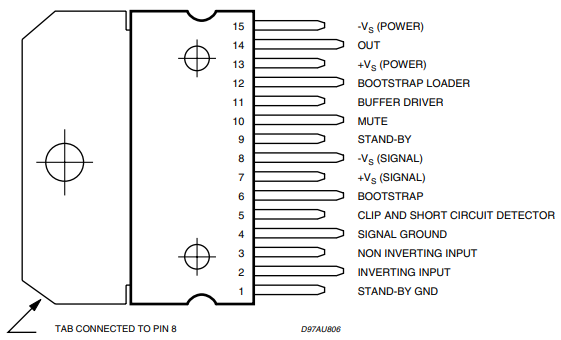
TDA7293 Pinout
The TDA7293 is a monolithic integrated circuit in a Multiwatt15 package designed for use as an audio class AB amplifier in Hi-Fi applications such as home stereo, self-powered loudspeakers, and Topclass TV. It can supply the most power into both 4-Ω and 8-Ω loads because of its wide voltage range and strong output current capability.
The remote operation is simplified by the built-in muting function with turn-on delay, which eliminates on-off switching noises.
By connecting numerous devices and using pin11, the parallel mode can be achieved. High output power can be given to loads with very low impedance, reducing the system's heat dissipation.
What is a TDA7294 Audio Amplifier?
The TDA7294 Pinout is given below.

TDA7294 Pinout
The TDA7294 is a monolithic integrated circuit that comes in a Multiwatt15 package and is designed to be used as an audio class AB amplifier in Hi-Fi field applications (Home Stereo, self-powered loudspeakers, Top class TV). It can supply the most power into both 4W and 8W loads due to its wide voltage range and high out current capability, even in the presence of poor supply regulation and high Supply Voltage Rejection. The remote operation is simplified by the built-in muting function with turn-on delay, which eliminates switching on-off noises.
The TDA7294 is a monolithic MOS power amplifier that can operate at 80V supply voltage (100V without a signal) and deliver up to ±10 A of output current. Internally, the TDA7294's metal tab is attached to the -Vs pin.
TDA7293 vs TDA7294 Features Comparison
TDA7293 Features
• Multipower BCD Technology
• Very High Operating Voltage Range (±50 V)
• DMOS Power Stage
• High Output Power (100 W into 8 Ω @ THD =10%, with VS = ±40 V)
• Muting and Stand-by Functions
• No Switch On/Off Noise
• Very Low Distortion
• Very Low Noise
• Short-circuit Protected (With No Input Signal Applied)
• Thermal Shutdown
• Clip Detector
• Modularity (Several Devices Can Easily be Connected in Parallel to Drive Very Low Impedances)
TDA7294 Features
• Very High Operating Voltage Range of ±40V
• DMOS Power Stage
• High Output Power (Up To 100W Music Power)
• Muting/Stand-By Functions
• No Switch On/Off Noise
• No Boucherot Cells
• Very Low Distortion
• Very Low Noise
• Short Circuit Protection
• Thermal Shutdown
TDA7293 vs TDA7294 Applications
• HI-FI
• CAR-RADIO
• Bridge Application Circuit
• An Audio Class AB Amplifier
• Stereos System
• Subwoofer
TDA7293 vs TDA7294 Where to use?
TDA7293 and TDA7294 can be utilized in amplification circuits that require a lot of power and efficiency.
TDA7293 vs TDA7294 Schematic Diagram Monolithic Power Amplifier
The following shows TDA7293 vs TDA7294 Schematic Diagram Monolithic Power Amplifier.

TDA7293 vs TDA7294 Schematic Diagram Monolithic Power Amplifier
| Component List Resistor R1=22K R2=22K R3=680R R4=10K R5=22K R6=1K | Capacitor C1=1N C2=22uF/50V C3=22uF/50V C4=22uF/50V C5=22uF C6=22uF C7=100N C8=100N C9=1000uF/50V C10=1000uF/50V | LED D1=RED LED Clip Detector for TDA7293 |
| Connector J1=Audio Input J2=Output Speaker J3=Power Supply 1:+25VDC 2:GND 3:-25VDC | Integrated Circuit IC1= TDA7294 / TDA7293 |
TDA7293 vs TDA7294 As a Circuit
TDA7293 As a Circuit

TDA7293 Circuit
Because all additional internal functions are unused, the circuit is conventional and very simple. The All connections can be hardwired or established with plugs and sockets. I predict hard wiring to be the most prevalent method in most circumstances, as connections are difficult to wire and add unneeded cost as well as reduce reliability.
The TDA7293's specifications suggest that it can work with supply voltages of up to ±50V. It might work with no input signal (and hence no output), but if 4 ohm loads are expected, I wouldn't recommend anything higher than ±35V, while ±42V will suffice if you can supply adequate heatsinking. Naturally, the 42V supplies (obtained from a 30+30V transformer) are preferable if you can afford to lose a few ICs to experimentation.
The Project 87 balanced transmitter board can also be used to bridge this amp. A ±35V supply should deliver around 150W into 8 ohms. Because the effective impedance of each amplifier is too low, it cannot be bridged into 4 ohms.
The speaker return should be made directly to the centre-tap of the power supply filter capacitors, despite the fact that the PCB has a ground pad for the speaker. The pad on the PCB is a 'convenience' that allows PCB connectors to be used (as shown in the photo above). These should only be used if the connection to the power supply is very short (less than 100mm).
TDA7294 As a Circuit
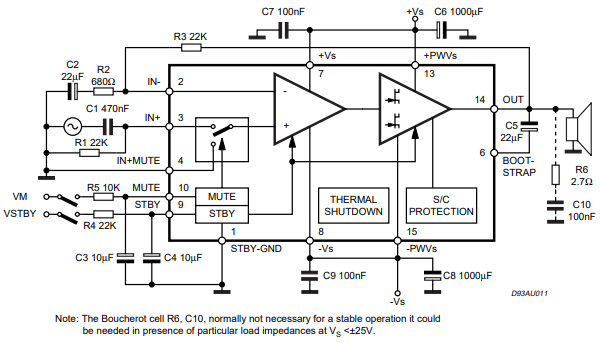
TDA7294 Circuit
R1 is the input resistance, and a value of 22kΩ is ideal. The loop gain of the amplifier is determined by R2=680Ω and R3=22kΩ. The standby ON/OFF time duration is determined by R4=22kΩ and C4=10µF. The silence time constant is determined by the R5=10kΩ and C3=10µF values. C1=0.47µF is the input DC Decoupling utilized. The feedback DC is C2=22mF. Bootstrapping with C5=22mF. For supply voltage bypass, C6 , C8=1000mF and C7 , C9 0.1mF are employed.
TDA7293 vs TDA7294 P.C.B. and Components Layout
TDA7293 P.C.B. and Components Layout

TDA7294 P.C.B. and Components Layout
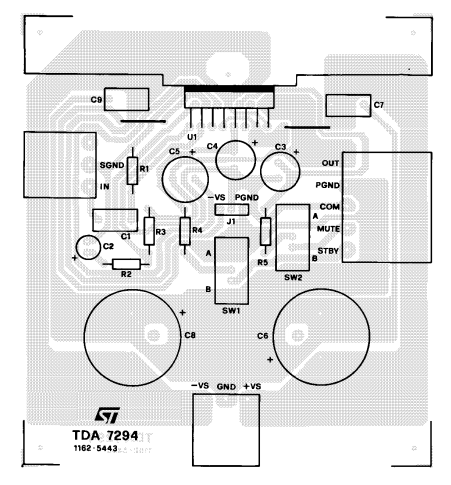
TDA7293 vs TDA7294 Application Circuit
TDA7293 Application Circuit

TDA7294 Application Circuit
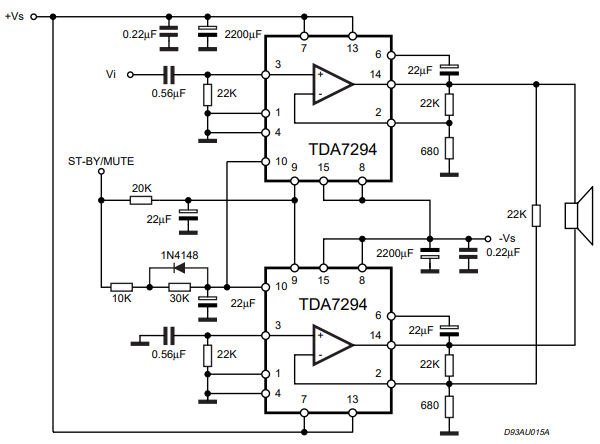
TDA7293 vs TDA7294 High-efficiency Application Circuit
TDA7293 High-efficiency Application Circuit
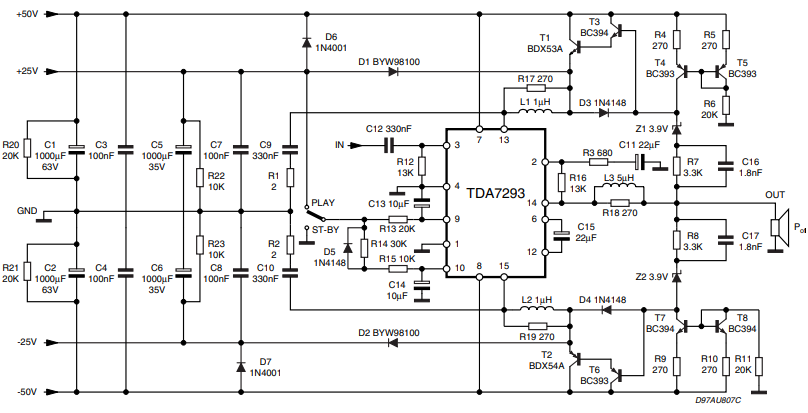
TDA7294 High-efficiency Application Circuit

TDA7293 VS TDA7294 Specifications Comparison
| TDA7293 | TDA7294 |
| • Multipower BCD technology • Very high operating voltage range (±50 V) • DMOS power stage • High output power (100 W into 8 Ω @ THD =10%, with VS = ±40 V) • Muting and stand-by functions • No switch on/off noise • Very low distortion • Very low noise • Short-circuit protected (with no input signal applied) • Thermal shutdown • Clip detector • Modularity (several devices can easily be connected in parallel to drive very low impedances) | • Very High Operating Voltage Range (±40V) • DMOS Power Stage High Output Power up to 100W Music Power • Muting/Standby Functions • No Switch ON/OFF Noise • No Boucherot Cells • Very Low Distortion • Very Low Noise • Short Circuit Protection • Thermal Shutdown |
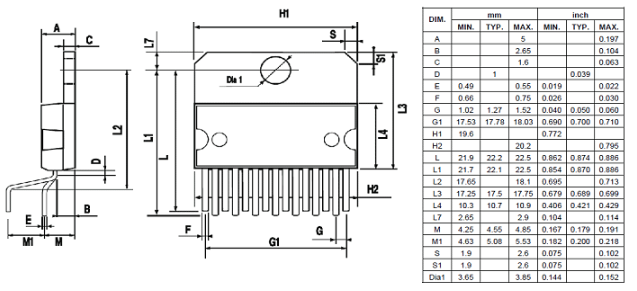
TDA7293 vs TDA7294 Package
TDA7293 Package
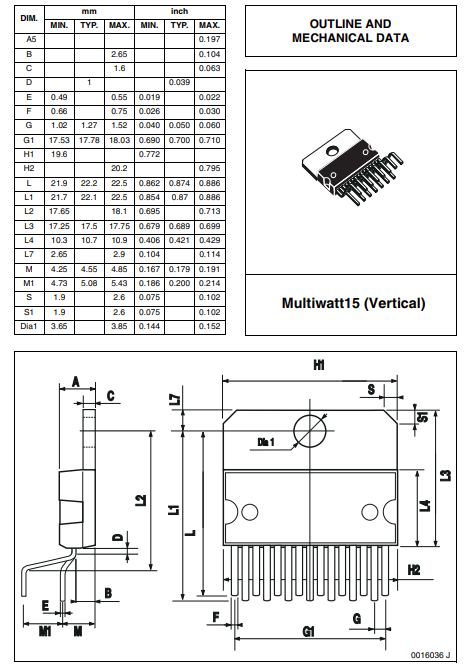
TDA7294 Package
TDA7293 vs TDA7294 Interchangeability
DMOS, or double-diffused metal–oxide–semiconductor, output stages are used in both of these audio chips. The TDA7293 and TDA7294 have maximum supply rails of +/-60V DC and +/-50V DC, respectively. Transformer supply rails are AC 32V-0-32V to 35V-0-35V, with 32V-0-32V being recommended for 8-ohm operation.
TDA7293 has the same conversion rate as TDA7294, but it has a wider voltage supply range and the highest available dual 50V DC power supply, giving it a larger dynamic range and higher output power. At an 8-ohm load, a twin 40V DC power supply may produce an average output power of 100W. Of course, if the voltage is doubled to 50V, or if the load is reduced to 4 ohms, the output power will increase, according to TDA7293's characteristics. A dual 28V AC voltage can be selected when choosing a transformer, resulting in a voltage of around 40V after rectification and filtering. Of course, the voltage can be raised. Given the variability in grid voltage, it is preferable to be less than the maximum voltage of 50V, allowing the circuit to operate in a more stable state.
Product Datasheet
What is a TDA7294?
The TDA7294 is a monolithic integrated circuit in the Multiwatt15 package, intended for use as an audio class AB amplifier in Hi-Fi field applications (Home Stereo, self-powered loudspeakers, Topclass TV).
TDA7293 vs LM3886?
The TDA7293 is a monolithic integrated circuit in a Multiwatt15 package designed for use as an audio class AB amplifier in Hi-Fi applications such as home stereo, self-powered loudspeakers, and Topclass TV. It can offer the most power into both 4- and 8-loads because of its wide voltage range and strong output current capacity. However, The LM3886 is one of the most highly regarded audio chip amplifiers in the DIY community. The reason for its popularity is due to its very low distortion, minimal external components, and low cost. With the right layout and component selection, you can build an excellent sounding Hi-Fi audio amplifier that will rival high-end amps retailing for several thousand dollars or more.
The TDA7293 is a monolithic integrated circuit in what package?
Multiwatt15.
Why is the TDA7293 a monolithic integrated circuit?
Wide voltage range and strong output current capability.
The remote operation is simplified by the built-in muting function with what?
Turn-on delay.
What can be given to loads with very low impedance?
High output power.
What package does the TDA7294 come in?
Multiwatt15.
What eliminates switching on-off noises?
Turn-on delay.
The TDA7294 can operate at what voltage?
80V supply voltage (100V without a signal).
What is attached to the -Vs pin?
Metal tab.
 SI5351 Clock Generator: Datasheet, Pinout and Applications
31 August 20217344
 MSP430: Detailed Datasheet, Pinout, and Alternatives Guide
22 January 2026467
 AMD Kintex-7 XC7K480T FPGA: Technical Analysis and Design Guide
14 January 20261454
 SST25VF020 2 Mbit SPI Serial Flash: Pinout, Equivalent and Datasheet
24 March 2022990
 TPS1H200AQDGNRQ1 High-Side Switch: Diagram, Pinout, and Datasheet
30 March 20222912
 TPS54824RNVR: 18-VFQFN, Step-Down, Pinout, Datasheet
26 February 20221497
 MIC2042 High-side MOSFET Switch: Pinout, Equivalent and Datasheet
01 April 2022699
 LM74700QDBVRQ1 Diode Controller: 12V, Pinout, Datasheet
07 March 20224770
 What is Metaverse?
09 October 20212920
 General PCB Layout Design Guidelines for RF and Digital-to-Analog Circuits
20 January 202214852
 SiC MOSFET Shortage 2026: Supply, Lead Times & Alternatives
02 July 20261555
 The Future of Automated and Additive Manufacturing for Power Electronics
24 May 20233568
 Detecting Wafer Patterns using Semi-Supervised Learning
21 October 20221447
 Differential Amplifier vs Current Sense Amplifier
07 April 20227751
 Norton's Theorem: Working Principle, Circuit Design, and Modern Applications
27 May 2026993
 Challenges and Issues in Smart Grid Infrastructure
11 May 20234558
STMicroelectronics
In Stock: 990
United States
China
Canada
Japan
Russia
Germany
United Kingdom
Singapore
Italy
Hong Kong(China)
Taiwan(China)
France
Korea
Mexico
Netherlands
Malaysia
Austria
Spain
Switzerland
Poland
Thailand
Vietnam
India
United Arab Emirates
Afghanistan
Åland Islands
Albania
Algeria
American Samoa
Andorra
Angola
Anguilla
Antigua & Barbuda
Argentina
Armenia
Aruba
Australia
Azerbaijan
Bahamas
Bahrain
Bangladesh
Barbados
Belarus
Belgium
Belize
Benin
Bermuda
Bhutan
Bolivia
Bonaire, Sint Eustatius and Saba
Bosnia & Herzegovina
Botswana
Brazil
British Indian Ocean Territory
British Virgin Islands
Brunei
Bulgaria
Burkina Faso
Burundi
Cabo Verde
Cambodia
Cameroon
Cayman Islands
Central African Republic
Chad
Chile
Christmas Island
Cocos (Keeling) Islands
Colombia
Comoros
Congo
Congo (DRC)
Cook Islands
Costa Rica
Côte d’Ivoire
Croatia
Cuba
Curaçao
Cyprus
Czechia
Denmark
Djibouti
Dominica
Dominican Republic
Ecuador
Egypt
El Salvador
Equatorial Guinea
Eritrea
Estonia
Eswatini
Ethiopia
Falkland Islands
Faroe Islands
Fiji
Finland
French Guiana
French Polynesia
Gabon
Gambia
Georgia
Ghana
Gibraltar
Greece
Greenland
Grenada
Guadeloupe
Guam
Guatemala
Guernsey
Guinea
Guinea-Bissau
Guyana
Haiti
Honduras
Hungary
Iceland
Indonesia
Iran
Iraq
Ireland
Isle of Man
Israel
Jamaica
Jersey
Jordan
Kazakhstan
Kenya
Kiribati
Kosovo
Kuwait
Kyrgyzstan
Laos
Latvia
Lebanon
Lesotho
Liberia
Libya
Liechtenstein
Lithuania
Luxembourg
Macao(China)
Madagascar
Malawi
Maldives
Mali
Malta
Marshall Islands
Martinique
Mauritania
Mauritius
Mayotte
Micronesia
Moldova
Monaco
Mongolia
Montenegro
Montserrat
Morocco
Mozambique
Myanmar
Namibia
Nauru
Nepal
New Caledonia
New Zealand
Nicaragua
Niger
Nigeria
Niue
Norfolk Island
North Korea
North Macedonia
Northern Mariana Islands
Norway
Oman
Pakistan
Palau
Palestinian Authority
Panama
Papua New Guinea
Paraguay
Peru
Philippines
Pitcairn Islands
Portugal
Puerto Rico
Qatar
Réunion
Romania
Rwanda
Samoa
San Marino
São Tomé & Príncipe
Saudi Arabia
Senegal
Serbia
Seychelles
Sierra Leone
Sint Maarten
Slovakia
Slovenia
Solomon Islands
Somalia
South Africa
South Sudan
Sri Lanka
St Helena, Ascension, Tristan da Cunha
St. Barthélemy
St. Kitts & Nevis
St. Lucia
St. Martin
St. Pierre & Miquelon
St. Vincent & Grenadines
Sudan
Suriname
Svalbard & Jan Mayen
Sweden
Syria
Tajikistan
Tanzania
Timor-Leste
Togo
Tokelau
Tonga
Trinidad & Tobago
Tunisia
Turkey
Turkmenistan
Turks & Caicos Islands
Tuvalu
U.S. Outlying Islands
U.S. Virgin Islands
Uganda
Ukraine
Uruguay
Uzbekistan
Vanuatu
Vatican City
Venezuela
Wallis & Futuna
Yemen
Zambia
Zimbabwe


