

 Product
 Brand
Brand Articles
 Tools
Tools
Hex Inverter 74LS04: Datasheet, Specifications, and Pinout

74LS04N datasheet pdf and Unclassified product details from RAYTHEON SEMICONDUCTOR stock available at Utmel


74LS04 Hex Inverter is a member of the 74XXYY IC series. In today's article, we'll have a detailed introduction to the 74LS04 Hex Inverter, after reading this article, you will learn what is 74LS04, what's its features, in which country it is the most popular, and what's the difference between 74HC04.

74LS04 Inverter(NOT) Gate IC
74LS04 Description
74LS04 Hex Inverter is a member of the 74XXYY IC series. The 74-series are digital logic integrated circuits, It includes six independent inverse HEX gates. Each gate consists of an input and an output. The reverse-phase is one of its main functions. The 74LS04 IC has a wide range of working voltage, a wide range of working conditions, and directly interfaces with CMOS, NMOS, and TTL.
74LS04 Pinout and Configurations
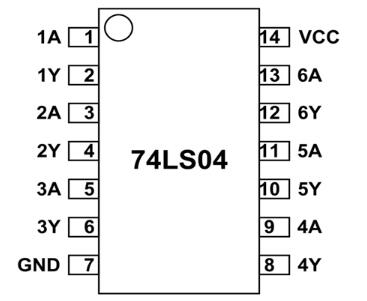
| Pin Number | Description |
| INPUT OF INVERTING GATES | |
| 1 | 1A-INPUT of GATE 1 |
| 3 | 2A-INPUT of GATE 2 |
| 5 | 3A-INPUT of GATE 3 |
| 9 | 4A-INPUT of GATE 4 |
| 11 | 5A-INPUT of GATE 5 |
| 13 | 6A-INPUT of GATE 6 |
| SHARED TERMINALS | |
| 7 | GND- Should be connected to ground |
| 14 | VCC-Should be connected to a positive voltage |
| OUTPUT OF INVERTING GATES | |
| 2 | 1Y-OUTPUT of GATE 1 |
| 4 | 2Y-OUTPUT of GATE 2 |
| 6 | 3Y-OUTPUT of GATE 3 |
| 8 | 4Y-OUTPUT of GATE 4 |
| 10 | 5Y-OUTPUT of GATE 5 |
| 12 | 6Y-OUTPUT of GATE 6 |
74LS04 Features
Supply voltage range: +4.75V to +5.25V
Maximum supply voltage: +7V
Maximum current allowed to draw through each gate output: 8mA
Totally lead-free
TTL outputs
Maximum Rise Time: 15ns
Maximum Fall Time: 15ns
Operating temperature:0°C to 70 °C
74LS04 CAD Models
Symbol

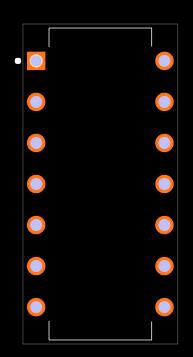
Footprint
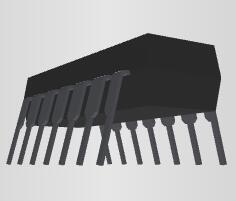
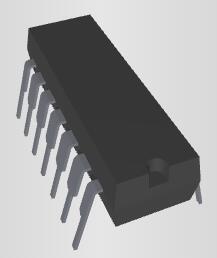
3D
Specifications
- TypeParameter
- JESD-609 Code
The "JESD-609 Code" in electronic components refers to a standardized marking code that indicates the lead-free solder composition and finish of electronic components for compliance with environmental regulations.
e0 - Terminal Finish
Terminal Finish refers to the surface treatment applied to the terminals or leads of electronic components to enhance their performance and longevity. It can improve solderability, corrosion resistance, and overall reliability of the connection in electronic assemblies. Common finishes include nickel, gold, and tin, each possessing distinct properties suitable for various applications. The choice of terminal finish can significantly impact the durability and effectiveness of electronic devices.
Tin/Lead (Sn/Pb) - Peak Reflow Temperature (Cel)
Peak Reflow Temperature (Cel) is a parameter that specifies the maximum temperature at which an electronic component can be exposed during the reflow soldering process. Reflow soldering is a common method used to attach electronic components to a circuit board. The Peak Reflow Temperature is crucial because it ensures that the component is not damaged or degraded during the soldering process. Exceeding the specified Peak Reflow Temperature can lead to issues such as component failure, reduced performance, or even permanent damage to the component. It is important for manufacturers and assemblers to adhere to the recommended Peak Reflow Temperature to ensure the reliability and functionality of the electronic components.
NOT SPECIFIED - Time@Peak Reflow Temperature-Max (s)
Time@Peak Reflow Temperature-Max (s) refers to the maximum duration that an electronic component can be exposed to the peak reflow temperature during the soldering process, which is crucial for ensuring reliable solder joint formation without damaging the component.
NOT SPECIFIED - RoHS Status
RoHS means “Restriction of Certain Hazardous Substances” in the “Hazardous Substances Directive” in electrical and electronic equipment.
Non-RoHS Compliant
74LS04 Applications
There are many applications for this device. It has very important in inversion circuits. A few of its applications are explained here and discussed.
It is a Universal use logic instrument used in the different logic circuit.
It is used on different servers.
It is used in different storage modules to store data.
This module is also used in different personal computers and notebooks as a storing device.
It is also used in different digital reluctance circuits and instruments.
This module is used in different networking systems.
It is also used in different Digital instruments and networks.
74LS04 Circuit Diagram

74LS04 Equivalents
CD7404, 74LS14, A single transistor can be configured to form a NOT gate.
74LS04 Manufacturer
Raytheon Technologies Corporation is an American multinational aerospace and defense conglomerate headquartered in Waltham, Massachusetts. It is one of the largest aerospace, intelligence services providers, and defense manufacturers in the world by revenue and market capitalization. Raytheon Technologies (RTX) researches, develops and manufactures advanced technology products in the aerospace and defense industry, including aircraft engines, avionics, aerostructures, cybersecurity, guided missiles, air defense systems, satellites, and drones. The company is also a large military contractor, getting a significant portion of its revenue from the U.S. government.
Where to use 74LS04
Here are a few cases where 74LS04 is used.
1. The chip is basically used where a logic inverter is needed. Inverter Gates in this chip provides an output that is negated logic input. The chip has six gates that do NOT operate.
2. When you want TTL outputs. The gates in this chip provide TTL logic outputs which are a must in some applications.
3. 74LS04 is a low-cost chip available in the market and so it is used when application cost is low.
How to use 74LS04
As mentioned earlier 74LS04 has six INVERTING GATES which can be used individually. The internal connection of gates can be given as below.

Now let us take a single gate of the six and connect it as shown in the circuit diagram.

For understanding the working of NOT gate, let’s redraw it in a more simplified version.

As shown in the diagram, we have a transistor forming a NOT gate. Input here is 1A which is connected to the button. Output 1Y is connected to LED through a resistor. The LED is connected to know the output status.
In the circuit,
When the button is not pressed:
The current through the base of the transistor will be zero. Because the base current is zero the transistor will be in an OFF state. Under the OFF state, the total supply voltage appears across the transistor. Under such a case, the output 1Y here will be HIGH, since the output is nothing but voltage across the transistor. Hence when a button is not pressed INPUT 1A = LOW and OUTPUT 1Y = HIGH.
When a button is pressed:
Voltage appears at the base of the transistor and current flows through it. Because the base current is present the transistor will turn ON. Under the ON state, the total supply voltage appears across the resistor and the voltage across the transistor will be zero. Under such a case, the output 1Y here will also be LOW since the output is nothing but voltage across the transistor. Hence when a button is pressed INPUT 1A = HIGH and OUTPUT 1Y = LOW.
If we draw a truth table based on the above cases, we will have.
| Input 1A | Output 1Y |
| LOW | HIGH |
| HIGH | LOW |
By truth table, you can understand that OUTPUT for NOT gate is negation or inversion of INPUT. We can write the output function as, Y = A.
We have six of these gates in the 74LS04 chip. We can use one or all six of these gates depending on the requirement.
74LS04 Package


74LS04 vs 74HC04


74LS04 Pinout 74HC04 Pinout
74LS04 contains six independent gates each of which performs the logic INVERT function. The output signals of the six inverters are opposite to the input signals. The inverter can reverse the phase of the input signal by 180 degrees. This circuit is used in analog circuits, such as audio amplifiers, clock oscillators, etc.
74HC04 is a hex inverter of a CMOS circuit, and the working voltage is 2V-6V. Both 74LS04 and 74HC04 are inverters, but LS stands for low-power Schottky and HC is high-speed COMS. LS is slightly faster than HC. LS adopts TTL level. HC is CMOS level. 74HC04 is easy to understand. Input low level, output high level. Input high level, output low level.
Trend Analysis
Parts with Similar Specs
What is a NOT gate?
A NOT gate is a digital logic gate that inverts the input digital signal. A NOT gate always has high or logic level 1 output when its input is low or at logic level 0. On the other hand, a logical NOT gate always has low or logic level 0 output when input is high or at logic level 1.
What is the function of ic 74ls04?
74LS04 Hex NOT Gate IC. 74LS04 is a 2-input quadruple 8-bit NOT gate IC. Inverter in logic converters is an electronics device whose basic functions are to invert the incoming logic whether it is HIGH or LOW. They are also known as NOT gates.
What is 74LS04?
74LS04 is a member of the 74XXYY IC series. The 74-series are digital logic integrated circuits. 74LS04 IC has six NOT gates. These NOT gates perform Inverting function. Hence name HEX INVERTING GATES.
What is a hex inverter?
A hex inverter is a type of integrated circuit that contains six inverters. Many sophisticated digital devices use inverters, including multiplexers, decoders, and state machines. An inverter circuit's main function is to output the voltage representing the opposite level to its input.
Why is NOT gate called an inverter?
A NOT gate often called an inverter, is a nice digital logic gate to start with because it has only a single input with simple behavior. A NOT gate performs logical negation on its input. In other words, if the input is true, then the output will be false.
 MCF532x ColdFire® Microprocessor Datasheet Overview
29 February 2024161
 MJ15003 NPN Transistor: Datasheet, Pinout, and Equivalent
05 November 20219704
 BAS416 Diode: NXP BAS416, 75V, SOD 323, Datasheet PDF
17 February 20221948
 PIC16F1776ISS Microcontroller Datasheet Overview
29 February 2024234
 SAM-M8Q:u-blox M8 GNSS antenna module
09 March 20221946
![L293D Motor Driver IC: Pinout, Datasheet and Specification [Video]](https://res.utmel.com/Images/Article/e66f6222-c865-4d7a-afe1-33e0cbb859ff.png) L293D Motor Driver IC: Pinout, Datasheet and Specification [Video]
L293D Motor Driver IC: Pinout, Datasheet and Specification [Video]10 May 202113379
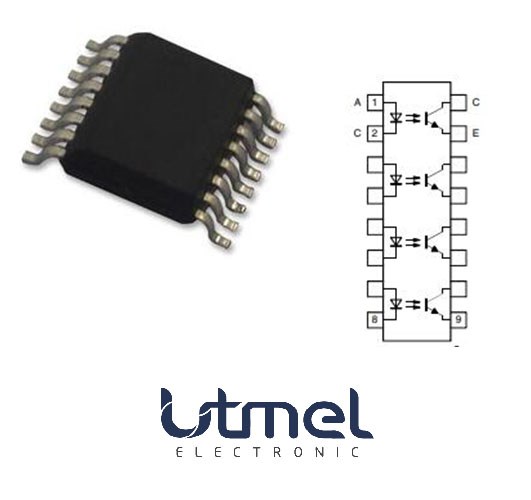 tcmt4100 Transistor Output Optocouplers: Datasheet, Pinout, and Package
17 March 20221096
 A Comprehensive Guide to LTC6603CUF#TRPBF Active Filter
06 March 2024155
 Intel Launches Industry's First Stackable, Shareable and Transferable One-Year Semiconductor Technician Certificate Program
26 September 20233139
 Flyback Diode Relay Selection: How to Choose the Right Diode for a Relay Coil
11 June 20261782
 Electrical Symbols & Electronic Symbols: A Practical Guide to Reading Circuit Diagrams
17 June 2026436
 What Makes Time Delay Relays Essential in Automation
10 July 20251967
 Introduction to buck, boost, and buck-boost converters
28 September 202124856
 What Is a Shunt (Resistor)? How Current Sensing Works and How to Choose
17 July 20268293
 Step-by-Step Guide to 2.2 k Ohm Resistor Color Code in 2025
20 August 20254316
 Towards an Optoelectronic Chip That Mimics the Human Brain
20 April 2022999
RAYTHEON SEMICONDUCTOR
In Stock
United States
China
Canada
Japan
Russia
Germany
United Kingdom
Singapore
Italy
Hong Kong(China)
Taiwan(China)
France
Korea
Mexico
Netherlands
Malaysia
Austria
Spain
Switzerland
Poland
Thailand
Vietnam
India
United Arab Emirates
Afghanistan
Åland Islands
Albania
Algeria
American Samoa
Andorra
Angola
Anguilla
Antigua & Barbuda
Argentina
Armenia
Aruba
Australia
Azerbaijan
Bahamas
Bahrain
Bangladesh
Barbados
Belarus
Belgium
Belize
Benin
Bermuda
Bhutan
Bolivia
Bonaire, Sint Eustatius and Saba
Bosnia & Herzegovina
Botswana
Brazil
British Indian Ocean Territory
British Virgin Islands
Brunei
Bulgaria
Burkina Faso
Burundi
Cabo Verde
Cambodia
Cameroon
Cayman Islands
Central African Republic
Chad
Chile
Christmas Island
Cocos (Keeling) Islands
Colombia
Comoros
Congo
Congo (DRC)
Cook Islands
Costa Rica
Côte d’Ivoire
Croatia
Cuba
Curaçao
Cyprus
Czechia
Denmark
Djibouti
Dominica
Dominican Republic
Ecuador
Egypt
El Salvador
Equatorial Guinea
Eritrea
Estonia
Eswatini
Ethiopia
Falkland Islands
Faroe Islands
Fiji
Finland
French Guiana
French Polynesia
Gabon
Gambia
Georgia
Ghana
Gibraltar
Greece
Greenland
Grenada
Guadeloupe
Guam
Guatemala
Guernsey
Guinea
Guinea-Bissau
Guyana
Haiti
Honduras
Hungary
Iceland
Indonesia
Iran
Iraq
Ireland
Isle of Man
Israel
Jamaica
Jersey
Jordan
Kazakhstan
Kenya
Kiribati
Kosovo
Kuwait
Kyrgyzstan
Laos
Latvia
Lebanon
Lesotho
Liberia
Libya
Liechtenstein
Lithuania
Luxembourg
Macao(China)
Madagascar
Malawi
Maldives
Mali
Malta
Marshall Islands
Martinique
Mauritania
Mauritius
Mayotte
Micronesia
Moldova
Monaco
Mongolia
Montenegro
Montserrat
Morocco
Mozambique
Myanmar
Namibia
Nauru
Nepal
New Caledonia
New Zealand
Nicaragua
Niger
Nigeria
Niue
Norfolk Island
North Korea
North Macedonia
Northern Mariana Islands
Norway
Oman
Pakistan
Palau
Palestinian Authority
Panama
Papua New Guinea
Paraguay
Peru
Philippines
Pitcairn Islands
Portugal
Puerto Rico
Qatar
Réunion
Romania
Rwanda
Samoa
San Marino
São Tomé & Príncipe
Saudi Arabia
Senegal
Serbia
Seychelles
Sierra Leone
Sint Maarten
Slovakia
Slovenia
Solomon Islands
Somalia
South Africa
South Sudan
Sri Lanka
St Helena, Ascension, Tristan da Cunha
St. Barthélemy
St. Kitts & Nevis
St. Lucia
St. Martin
St. Pierre & Miquelon
St. Vincent & Grenadines
Sudan
Suriname
Svalbard & Jan Mayen
Sweden
Syria
Tajikistan
Tanzania
Timor-Leste
Togo
Tokelau
Tonga
Trinidad & Tobago
Tunisia
Turkey
Turkmenistan
Turks & Caicos Islands
Tuvalu
U.S. Outlying Islands
U.S. Virgin Islands
Uganda
Ukraine
Uruguay
Uzbekistan
Vanuatu
Vatican City
Venezuela
Wallis & Futuna
Yemen
Zambia
Zimbabwe