

 Product
 Brand
Brand Articles
 Tools
Tools
L9110S 2-Channel Motor driver: Circuit, Pinout, and How to work [Video&FAQ]

L9110S datasheet pdf and Unclassified product details from Wuxi I-core Elec stock available at Utmel


The L9110S 2-Channel motor driver module is a tiny board for controlling small robots. This article mainly introduces Circuit, Pinout, How to work and other detailed information about 2-Channel Motor driver L9110S.
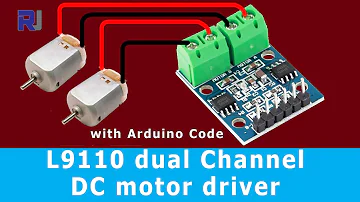
How to control 2 DC motors using L9110s motor driver module with Arduino code
L9110S Description
The L9110S 2-Channel motor driver module is a tiny board for controlling small robots. This module contains two motor driver chips, each capable of driving up to 800mA of continuous current. The boards may function between 2.5 and 12 volts, allowing this module to work with both 3.3 and 5-volt microcontrollers.
This module is connected to a microcontroller through a set of female header pins. Two sets of screw terminals are used to connect the motors.
A PWM (Pulse Width Modulation) signal is used to control a motor's speed, while a digital output is utilized to modify its direction. A single four-line two-phase stepper motor can also be driven with this module. This board has four holes that make it simple to attach to your robot or other projects.
• Two independent L9110S motor driver chips
• 800mA continuous current per channel
• Can drive two bidirectional DC motors or a four-line two-phase stepper motor
• Four mounting holes
L9110S Pin Configuration
The following shows L9110S Pin Configuration.

Pin Configuration
| Pin Number | Pin Name | Description |
| 1 | B-IA | Motor B Input A |
| 2 | B-IB | Motor B Input B |
| 3 | GND | ground |
| 4 | VCC | 2.5V-12V DC |
| 5 | A-IA | Motor A Input A |
| 6 | A-IB | Motor B Input B |
More detailed information is given below.


Pinout
L9110S Features
Motor driver modules are frequently used to control the speed and direction of motors nowadays. One of them is the L9110S dual-channel module. Two DC motors and one stepper motor can be controlled using this module. It is based on the L9110 integrated circuit. The following are the main characteristics:
• The allowable continuous current for each channel: 800 mA
• The maximum allowable current: 1.5 A
• Power supply: 2.5V to 12V
• Low quiescent current
• 800mA continuous current output capability per channel
• Lower saturation voltage
• TTL / CMOS output level compatible, and can be directly connected to the CPU
• Output built-in clamp diodes for inductive load
• Integrated control and drive into a monolithic IC
• With pin high-voltage protection function
• Operating temperature: 0 ℃ -80 ℃
L9110S Specs
• Motor Voltage: 2.5 ~12V
• Number of Channels: 2
• Max Continuous Current per Channel: 800mA
• Dimensions: 31mm x 22mm x 12mm
Specifications
- TypeParameter
- Package / Case
refers to the protective housing that encases an electronic component, providing mechanical support, electrical connections, and thermal management.
SOP-8_150mil - Packaging
Semiconductor package is a carrier / shell used to contain and cover one or more semiconductor components or integrated circuits. The material of the shell can be metal, plastic, glass or ceramic.
Tube-packed - RoHS Status
RoHS means “Restriction of Certain Hazardous Substances” in the “Hazardous Substances Directive” in electrical and electronic equipment.
RoHS Compliant
Interfacing L9110S Dual-Channel Driver Module with Arduino
The diagram below shows how to link Arduino to these modules. Connect the wires in the proper order.

Diagram
L9110S Schematic Diagram
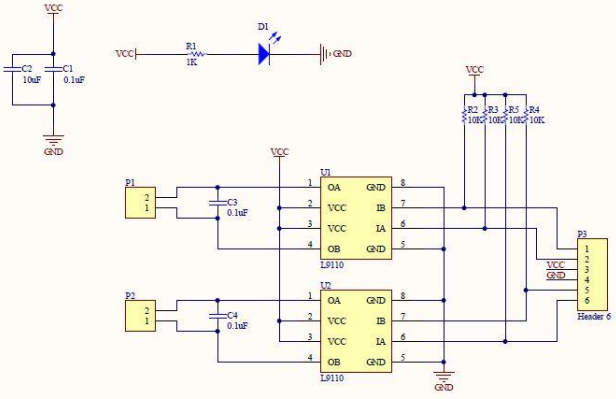
L9110S Sample Sketch
L9110S Sample Sketch
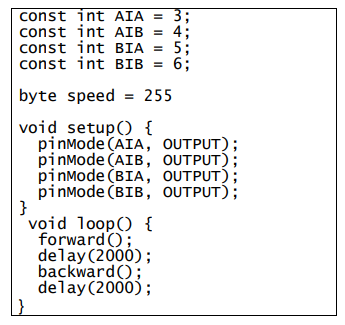

Sample Sketch
How to Test
The components to be used are:
• Microcontroller (any compatible arduino)
• L9110 2-channel motor driver
• Pin connectors
• DC motors
• 2.5V-12V DC external power supply
1. Use pin connectors to connect the components. The VCC pin is connected to a 2.5V12V DC external power source capable of handling 800mA, the GND pin to the GND, and the A-IA, A-IB , B-IA, and B-IB pins to the digital I/O ports. The pin number will be determined by the program code.
2. After the hardware is connected, open the Arduino IDE and load the sample sketch.
3. Connect the microcontroller's ports to the PC with a USB connection.
4. Put the application on the computer.
L9110S Testing Results
The two motors should travel forward and backward every two seconds, according to the program. Depending on the wire connections, the orientation may change.
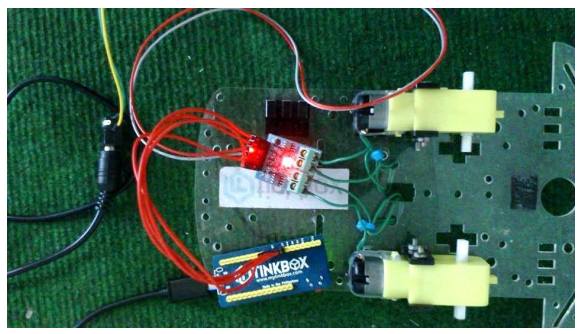
Program
L9110S Dimension

What is L9110S motor driver?
The L9110S 2-Channel motor driver module is a compact board that can be used to drive small robots. This module has two independent motor driver chips which can each drive up to 800mA of continuous current. The boards can be operated from 2.5V to 12V enabling this module to be used with both 3.3V and 5V microcontrollers.
What is a motor driver IC?
A motor driver IC is an integrated circuit chip that is usually used to control motors in autonomous robots. Motor driver ICs act as an interface between microprocessors in robots and the motors in the robot.
What is a tiny board for controlling small robots?
L9110S 2-Channel motor driver module.
How many motor driver chips does the L9110S 2-Channel module contain?
Two.
How many volts can the L9110S 2-Channel motor driver chips function?
2.5 and 12 volts.
How is the L9110S 2-Channel motor driver module connected to a microcontroller?
Through a set of female header pins.
How many screw terminals are used to connect the motors?
Two sets of screw terminals.
What signal is used to control a motors speed?
PWM (Pulse Width Modulation).
What type of motor can be driven with the L9110S 2-Channel motor driver module?
Four-line two-phase stepper motor.
How many holes does the L9110S 2-Channel motor driver module have?
Four holes.
How many mounting holes does the L9110S 2-Channel motor driver module have?
Four mounting holes.
 W25Q32JVSSIQ: Overview, Features, and Applications
07 November 20234708
 AD8302 2.7 GHz RF Gain and Phase Detector: Datasheet, Pinout, and Performance Review
25 February 20262237
 A Comprehensive Guide to LTC7810ILXE#PBF Dual Switching Controller
06 March 2024372
 1SMA5929BT3G Zener Diode: Pinout, Equivalent and Datasheet
05 May 20222052
 XC2S200-5PQG208C and XC2S200-5PQ208C A Detailed Comparison
06 June 2025279
 OnSemi MBR0540T1G Schottky Diode: 40V 500mA Fast Switching Review
27 August 2025505
 1N5399 Rectifier Diode: Pinout, Datasheet, and Specifications
17 August 202124927
 LM3S9000 Series Microcontroller: A Technical Overview
29 February 2024344
 Does the Terminal Resistance of the CAN Bus Have to be 120Ω?
19 April 202237520
 HIKSEMI Authorized Distributor | UTMEL Electronics
15 November 20234305
 Top 10 OSAT (Outsourced Semiconductor Assembly and Test) Companies
26 August 202680506
 4680 Battery - Upgrade of Battery Technology
17 December 20217101
 Semiconductor Inspection System Market Expected to Reach US$ 8,380.01 Million By 2030
15 September 20233867
 Beginner’s Handbook for Choosing Circular Connectors
14 July 20254345
 What is a Multimeter?
20 December 20217120
 Understanding of Carbon Film Resistors
17 October 202526606
Wuxi I-core Elec
In Stock: 52192
United States
China
Canada
Japan
Russia
Germany
United Kingdom
Singapore
Italy
Hong Kong(China)
Taiwan(China)
France
Korea
Mexico
Netherlands
Malaysia
Austria
Spain
Switzerland
Poland
Thailand
Vietnam
India
United Arab Emirates
Afghanistan
Åland Islands
Albania
Algeria
American Samoa
Andorra
Angola
Anguilla
Antigua & Barbuda
Argentina
Armenia
Aruba
Australia
Azerbaijan
Bahamas
Bahrain
Bangladesh
Barbados
Belarus
Belgium
Belize
Benin
Bermuda
Bhutan
Bolivia
Bonaire, Sint Eustatius and Saba
Bosnia & Herzegovina
Botswana
Brazil
British Indian Ocean Territory
British Virgin Islands
Brunei
Bulgaria
Burkina Faso
Burundi
Cabo Verde
Cambodia
Cameroon
Cayman Islands
Central African Republic
Chad
Chile
Christmas Island
Cocos (Keeling) Islands
Colombia
Comoros
Congo
Congo (DRC)
Cook Islands
Costa Rica
Côte d’Ivoire
Croatia
Cuba
Curaçao
Cyprus
Czechia
Denmark
Djibouti
Dominica
Dominican Republic
Ecuador
Egypt
El Salvador
Equatorial Guinea
Eritrea
Estonia
Eswatini
Ethiopia
Falkland Islands
Faroe Islands
Fiji
Finland
French Guiana
French Polynesia
Gabon
Gambia
Georgia
Ghana
Gibraltar
Greece
Greenland
Grenada
Guadeloupe
Guam
Guatemala
Guernsey
Guinea
Guinea-Bissau
Guyana
Haiti
Honduras
Hungary
Iceland
Indonesia
Iran
Iraq
Ireland
Isle of Man
Israel
Jamaica
Jersey
Jordan
Kazakhstan
Kenya
Kiribati
Kosovo
Kuwait
Kyrgyzstan
Laos
Latvia
Lebanon
Lesotho
Liberia
Libya
Liechtenstein
Lithuania
Luxembourg
Macao(China)
Madagascar
Malawi
Maldives
Mali
Malta
Marshall Islands
Martinique
Mauritania
Mauritius
Mayotte
Micronesia
Moldova
Monaco
Mongolia
Montenegro
Montserrat
Morocco
Mozambique
Myanmar
Namibia
Nauru
Nepal
New Caledonia
New Zealand
Nicaragua
Niger
Nigeria
Niue
Norfolk Island
North Korea
North Macedonia
Northern Mariana Islands
Norway
Oman
Pakistan
Palau
Palestinian Authority
Panama
Papua New Guinea
Paraguay
Peru
Philippines
Pitcairn Islands
Portugal
Puerto Rico
Qatar
Réunion
Romania
Rwanda
Samoa
San Marino
São Tomé & Príncipe
Saudi Arabia
Senegal
Serbia
Seychelles
Sierra Leone
Sint Maarten
Slovakia
Slovenia
Solomon Islands
Somalia
South Africa
South Sudan
Sri Lanka
St Helena, Ascension, Tristan da Cunha
St. Barthélemy
St. Kitts & Nevis
St. Lucia
St. Martin
St. Pierre & Miquelon
St. Vincent & Grenadines
Sudan
Suriname
Svalbard & Jan Mayen
Sweden
Syria
Tajikistan
Tanzania
Timor-Leste
Togo
Tokelau
Tonga
Trinidad & Tobago
Tunisia
Turkey
Turkmenistan
Turks & Caicos Islands
Tuvalu
U.S. Outlying Islands
U.S. Virgin Islands
Uganda
Ukraine
Uruguay
Uzbekistan
Vanuatu
Vatican City
Venezuela
Wallis & Futuna
Yemen
Zambia
Zimbabwe