

 Product
 Brand
Brand Articles
 Tools
Tools
LPC1768FBD100: Overview, Features, and Applications


512KB Flash Microcontroller 100 Pin 100 MHz
ARM Cortex-M3 based microcontrollers with low power consumption and high integration for embedded applications are the LPC1769/68/67/66/65/64/63.
LPC1768FBD100 Description
ARM Cortex-M3 based microcontrollers with low power consumption and high integration for embedded applications are the LPC1769/68/67/66/65/64/63. The Arm Cortex-M3 is a next-generation core that provides improved support block integration and greater debug tools, among other system upgrades.
The CPU frequencies of the LPC1768/67/66/65/64/63 can go up to 100 MHz. Up to 120 MHz of CPU frequency are supported by the LPC1769. The Harvard design of the Arm Cortex-M3 CPU has a three-stage pipeline, independent local instruction and data buses, and a third bus for peripherals. Additionally, an inbuilt prefetch unit supporting speculative branching is a feature of the Arm Cortex-M3 CPU.
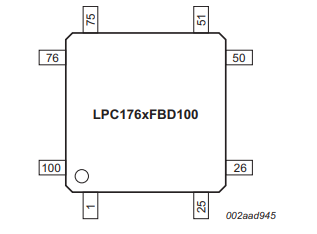
LPC1768FBD100 Pinout
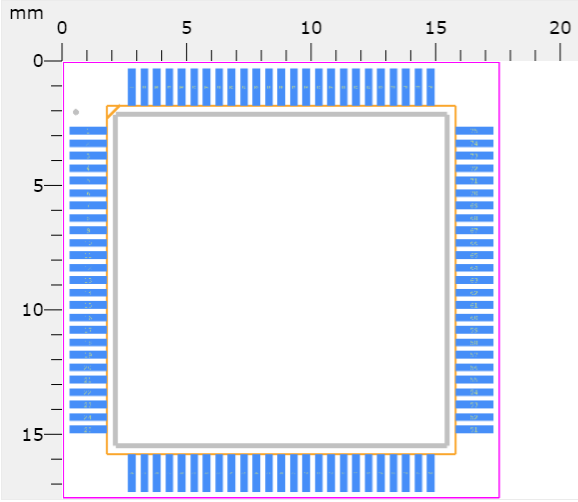
LPC1768FBD100 CAD Model
Footprint
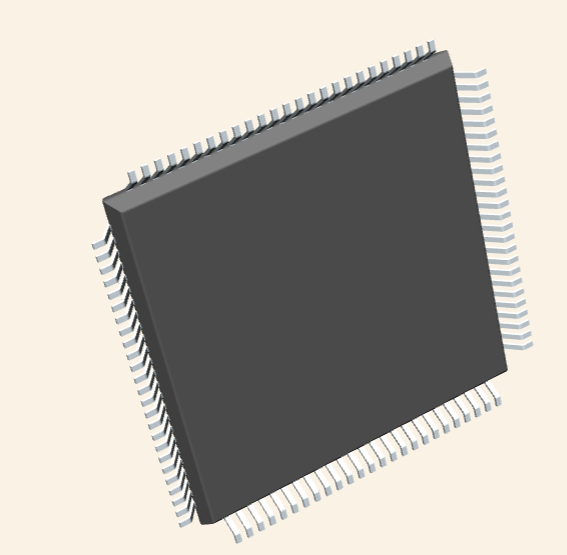
3D Model
LPC1768FBD100 Features
Nested Vectored Interrupt Controller (NVIC) incorporated into Arm Cortex-M3.
On-chip flash programming memory of up to 512 kB. An improved flash memory accelerator allows for zero wait states and fast operation at 120 MHz.
On-chip bootloader software allows for both In-System Programming (ISP) and In-Application Programming (IAP).
Specifications
- TypeParameter
- Surface Mount
having leads that are designed to be soldered on the side of a circuit board that the body of the component is mounted on.
YES - Number of Pins100
- Number of Terminals100
- Watchdog1
- I2S1
- I2C3
- UART4
- USART0
- DAC Resolution (bit)10
- Number of DAC'sSingle
- ADC Resolution (bit)12
- Number of ADCsSingle
- No. of Timers4
- Number of I/Os70
- Interface TypeCAN/Ethernet/I2C/I2S/SPI/SSP/UART/USB
- ProgrammabilityYes
- Maximum Expanded Memory Size1GB
- Data Bus Width (bit)32
- Maximum Clock Rate (MHz)100
- Maximum CPU Frequency (MHz)100
- Instruction Set ArchitectureRISC
- Family NameLPC1700
- ECCN (US)EAR99
- Parallel Master PortNo
- Real Time ClockNo
- Special FeaturesCAN Controller
- Minimum Operating Supply Voltage (V)2.4
- Typical Operating Supply Voltage (V)3.3
- Maximum Operating Supply Voltage (V)3.6
- Maximum Power Dissipation (mW)1500
- Minimum Operating Temperature (°C)-40
- Maximum Operating Temperature (°C)85
- CECC QualifiedNo
- Standard Package NameQFP
- Supplier PackageLQFP
- MountingSurface Mount
- Package Height1.45(Max)
- Package Length14.1(Max)
- Package Width14.1(Max)
- PCB changed100
- Lead ShapeGull-wing
- RoHSCompliant
- Package DescriptionLFQFP, QFP100,.63SQ,20
- Package StyleFLATPACK, LOW PROFILE, FINE PITCH
- Moisture Sensitivity Levels3
- Package Body MaterialPLASTIC/EPOXY
- Package Equivalence CodeQFP100,.63SQ,20
- Operating Temperature-Min-40 °C
- Supply Voltage-Nom3.3 V
- Reflow Temperature-Max (s)30
- Supply Voltage-Min2.4 V
- Operating Temperature-Max85 °C
- Rohs CodeYes
- Manufacturer Part NumberLPC1768FBD100
- RAM(byte)65536
- Clock Frequency-Max25 MHz
- Package CodeLFQFP
- Package ShapeSQUARE
- ManufacturerNXP Semiconductors
- ROM(word)131072
- Part Life Cycle CodeActive
- Number of I/O Lines70
- Samacsys Description32-BIT, FLASH, 100 MHz, RISC MICROCONTROLLER, PQFP100
- Ihs ManufacturerNXP SEMICONDUCTORS
- Supply Voltage-Max3.6 V
- Risk Rank1.97
- Part Package CodeQFP
- JESD-609 Code
The "JESD-609 Code" in electronic components refers to a standardized marking code that indicates the lead-free solder composition and finish of electronic components for compliance with environmental regulations.
e3 - Pbfree Code
The "Pbfree Code" parameter in electronic components refers to the code or marking used to indicate that the component is lead-free. Lead (Pb) is a toxic substance that has been widely used in electronic components for many years, but due to environmental concerns, there has been a shift towards lead-free alternatives. The Pbfree Code helps manufacturers and users easily identify components that do not contain lead, ensuring compliance with regulations and promoting environmentally friendly practices. It is important to pay attention to the Pbfree Code when selecting electronic components to ensure they meet the necessary requirements for lead-free applications.
Yes - Part Status
Parts can have many statuses as they progress through the configuration, analysis, review, and approval stages.
Active - Termination
Termination in electronic components refers to the practice of matching the impedance of a circuit to prevent signal reflections and ensure maximum power transfer. It involves the use of resistors or other components at the end of transmission lines or connections. Proper termination is crucial in high-frequency applications to maintain signal integrity and reduce noise.
SMD/SMT - Terminal Finish
Terminal Finish refers to the surface treatment applied to the terminals or leads of electronic components to enhance their performance and longevity. It can improve solderability, corrosion resistance, and overall reliability of the connection in electronic assemblies. Common finishes include nickel, gold, and tin, each possessing distinct properties suitable for various applications. The choice of terminal finish can significantly impact the durability and effectiveness of electronic devices.
Tin (Sn) - Max Operating Temperature
The Maximum Operating Temperature is the maximum body temperature at which the thermistor is designed to operate for extended periods of time with acceptable stability of its electrical characteristics.
85 °C - Min Operating Temperature
The "Min Operating Temperature" parameter in electronic components refers to the lowest temperature at which the component is designed to operate effectively and reliably. This parameter is crucial for ensuring the proper functioning and longevity of the component, as operating below this temperature may lead to performance issues or even damage. Manufacturers specify the minimum operating temperature to provide guidance to users on the environmental conditions in which the component can safely operate. It is important to adhere to this parameter to prevent malfunctions and ensure the overall reliability of the electronic system.
-40 °C - HTS Code
HTS (Harmonized Tariff Schedule) codes are product classification codes between 8-1 digits. The first six digits are an HS code, and the countries of import assign the subsequent digits to provide additional classification. U.S. HTS codes are 1 digits and are administered by the U.S. International Trade Commission.
8542.31.00.01 - SubcategoryMicrocontrollers
- Technology
In the context of electronic components, the parameter "Technology" refers to the specific manufacturing process and materials used to create the component. This includes the design, construction, and materials used in the production of the component. The technology used can greatly impact the performance, efficiency, and reliability of the electronic component. Different technologies may be used for different types of components, such as integrated circuits, resistors, capacitors, and more. Understanding the technology behind electronic components is important for selecting the right components for a particular application and ensuring optimal performance.
CMOS - Terminal Position
In electronic components, the term "Terminal Position" refers to the physical location of the connection points on the component where external electrical connections can be made. These connection points, known as terminals, are typically used to attach wires, leads, or other components to the main body of the electronic component. The terminal position is important for ensuring proper connectivity and functionality of the component within a circuit. It is often specified in technical datasheets or component specifications to help designers and engineers understand how to properly integrate the component into their circuit designs.
QUAD - Terminal Form
Occurring at or forming the end of a series, succession, or the like; closing; concluding.
GULL WING - Peak Reflow Temperature (Cel)
Peak Reflow Temperature (Cel) is a parameter that specifies the maximum temperature at which an electronic component can be exposed during the reflow soldering process. Reflow soldering is a common method used to attach electronic components to a circuit board. The Peak Reflow Temperature is crucial because it ensures that the component is not damaged or degraded during the soldering process. Exceeding the specified Peak Reflow Temperature can lead to issues such as component failure, reduced performance, or even permanent damage to the component. It is important for manufacturers and assemblers to adhere to the recommended Peak Reflow Temperature to ensure the reliability and functionality of the electronic components.
260 - Terminal Pitch
The center distance from one pole to the next.
0.5 mm - Reach Compliance Code
Reach Compliance Code refers to a designation indicating that electronic components meet the requirements set by the Registration, Evaluation, Authorization, and Restriction of Chemicals (REACH) regulation in the European Union. It signifies that the manufacturer has assessed and managed the chemical substances within the components to ensure safety and environmental protection. This code is vital for compliance with regulations aimed at minimizing risks associated with hazardous substances in electronic products.
compliant - Frequency
In electronic components, the parameter "Frequency" refers to the rate at which a signal oscillates or cycles within a given period of time. It is typically measured in Hertz (Hz) and represents how many times a signal completes a full cycle in one second. Frequency is a crucial aspect in electronic components as it determines the behavior and performance of various devices such as oscillators, filters, and communication systems. Understanding the frequency characteristics of components is essential for designing and analyzing electronic circuits to ensure proper functionality and compatibility with other components in a system.
100 MHz - Pin Count
a count of all of the component leads (or pins)
100 - JESD-30 Code
JESD-30 Code refers to a standardized descriptive designation system established by JEDEC for semiconductor-device packages. This system provides a systematic method for generating designators that convey essential information about the package's physical characteristics, such as size and shape, which aids in component identification and selection. By using JESD-30 codes, manufacturers and engineers can ensure consistency and clarity in the specification of semiconductor packages across various applications and industries.
S-PQFP-G100 - Qualification Status
An indicator of formal certification of qualifications.
Not Qualified - Power Supplies
an electronic circuit that converts the voltage of an alternating current (AC) into a direct current (DC) voltage.?
2.5/3.3 V - Temperature Grade
Temperature grades represent a tire's resistance to heat and its ability to dissipate heat when tested under controlled laboratory test conditions.
INDUSTRIAL - Interface
In electronic components, the term "Interface" refers to the point at which two different systems, devices, or components connect and interact with each other. It can involve physical connections such as ports, connectors, or cables, as well as communication protocols and standards that facilitate the exchange of data or signals between the connected entities. The interface serves as a bridge that enables seamless communication and interoperability between different parts of a system or between different systems altogether. Designing a reliable and efficient interface is crucial in ensuring proper functionality and performance of electronic components and systems.
CAN, I2C, SPI, SSP, UART - Max Supply Voltage
In general, the absolute maximum common-mode voltage is VEE-0.3V and VCC+0.3V, but for products without a protection element at the VCC side, voltages up to the absolute maximum rated supply voltage (i.e. VEE+36V) can be supplied, regardless of supply voltage.
3.6 V - Min Supply Voltage
The minimum supply voltage (V min ) is explored for sequential logic circuits by statistically simulating the impact of within-die process variations and gate-dielectric soft breakdown on data retention and hold time.
2.4 V - Memory Size
The memory capacity is the amount of data a device can store at any given time in its memory.
512 kB - Speed
In electronic components, "Speed" typically refers to the rate at which data can be processed or transferred within the component. It is a measure of how quickly the component can perform its functions, such as executing instructions or transmitting signals. Speed is often specified in terms of frequency, such as clock speed in processors or data transfer rate in memory modules. Higher speed components can perform tasks more quickly, leading to improved overall performance in electronic devices. It is an important parameter to consider when designing or selecting electronic components for specific applications.
100 MHz - RAM Size
RAM size refers to the amount of random access memory (RAM) available in an electronic component, such as a computer or smartphone. RAM is a type of volatile memory that stores data and instructions that are actively being used by the device's processor. The RAM size is typically measured in gigabytes (GB) and determines how much data the device can store and access quickly for processing. A larger RAM size allows for smoother multitasking, faster loading times, and better overall performance of the electronic component. It is an important factor to consider when choosing a device, especially for tasks that require a lot of memory, such as gaming, video editing, or running multiple applications simultaneously.
64KB - uPs/uCs/Peripheral ICs Type
The parameter "uPs/uCs/Peripheral ICs Type" refers to the classification of various integrated circuits used in electronic devices. It encompasses microprocessors (uPs), microcontrollers (uCs), and peripheral integrated circuits that provide additional functionalities. This classification helps in identifying the specific type of chip used for processing tasks, controlling hardware, or interfacing with other components in a system. Understanding this parameter is essential for selecting the appropriate electronic components for a given application.
MICROCONTROLLER, RISC - Peripherals
In the context of electronic components, "Peripherals" refer to devices or components that are connected to a main system or device to enhance its functionality or provide additional features. These peripherals can include input devices such as keyboards, mice, and touchscreens, as well as output devices like monitors, printers, and speakers. Other examples of peripherals include external storage devices, network adapters, and cameras. Essentially, peripherals are external devices that expand the capabilities of a main electronic system or device.
DMA - Program Memory Type
Program memory typically refers to flash memory when it is used to hold the program (instructions). Program memory may also refer to a hard drive or solid state drive (SSD). Contrast with data memory.
Flash - Program Memory Size
Program Memory Size refers to the amount of memory available in an electronic component, such as a microcontroller or microprocessor, that is used to store program instructions. This memory is non-volatile, meaning that the data stored in it is retained even when the power is turned off. The program memory size determines the maximum amount of code that can be stored and executed by the electronic component. It is an important parameter to consider when selecting a component for a specific application, as insufficient program memory size may limit the functionality or performance of the device.
512KB - Bit Size
In electronic components, "Bit Size" refers to the number of bits that can be processed or stored by a particular component. A bit is the smallest unit of data in computing and can have a value of either 0 or 1. The Bit Size parameter is commonly used to describe the capacity or performance of components such as microprocessors, memory modules, and data buses. A larger Bit Size generally indicates a higher processing capability or storage capacity, allowing for more complex operations and larger amounts of data to be handled efficiently. It is an important specification to consider when selecting electronic components for specific applications that require certain levels of performance and data processing capabilities.
32 - Has ADC
Has ADC refers to the presence of an Analog-to-Digital Converter (ADC) in an electronic component. An ADC is a crucial component in many electronic devices as it converts analog signals, such as voltage or current, into digital data that can be processed by a digital system. Having an ADC allows the electronic component to interface with analog signals and convert them into a format that can be manipulated and analyzed digitally. This parameter is important for applications where analog signals need to be converted into digital form for further processing or control.
YES - DMA Channels
DMA (Direct Memory Access) Channels are a feature found in electronic components such as microcontrollers, microprocessors, and peripheral devices. DMA Channels allow data to be transferred directly between peripherals and memory without involving the CPU, thereby reducing the burden on the CPU and improving overall system performance. Each DMA Channel is typically assigned to a specific peripheral device or memory region, enabling efficient data transfer operations. The number of DMA Channels available in a system determines the concurrent data transfer capabilities and can vary depending on the specific hardware design. Overall, DMA Channels play a crucial role in optimizing data transfer efficiency and system performance in electronic devices.
YES - PWM Channels
PWM Channels, or Pulse Width Modulation Channels, refer to the number of independent PWM outputs available in an electronic component, such as a microcontroller or a motor driver. PWM is a technique used to generate analog-like signals by varying the duty cycle of a square wave signal. Each PWM channel can control the output of a specific device or component by adjusting the pulse width of the signal. Having multiple PWM channels allows for precise control of multiple devices simultaneously, making it a valuable feature in applications such as motor control, LED dimming, and audio signal generation. The number of PWM channels available in a component determines the flexibility and complexity of the system it can control.
YES - DAC Channels
DAC Channels refer to the number of independent analog output channels available in a digital-to-analog converter (DAC) electronic component. Each channel can convert a digital input signal into an analog output voltage or current. The number of DAC channels determines how many separate analog signals can be generated simultaneously by the DAC. For example, a DAC with two channels can output two different analog signals at the same time, while a DAC with only one channel can only output a single analog signal. The number of DAC channels is an important specification to consider when selecting a DAC for applications requiring multiple analog outputs.
1 - Seated Height-Max
Seated Height-Max in electronic components refers to the maximum height at which a component can be comfortably installed or operated when a user is seated. It is particularly relevant in designs involving ergonomic considerations, where the placement of controls, displays, or other interfaces must accommodate users in seated positions. This parameter ensures accessibility and usability, preventing strain or discomfort during operation.
1.6 mm - Number of Timers/Counters4
- Density
In electronic components, "Density" refers to the mass or weight of a material per unit volume. It is a physical property that indicates how tightly packed the atoms or molecules are within the material. The density of a component can affect its performance and characteristics, such as its strength, thermal conductivity, and electrical properties. Understanding the density of electronic components is important for designing and manufacturing processes to ensure optimal performance and reliability.
4 Mb - Core Architecture
In electronic components, the term "Core Architecture" refers to the fundamental design and structure of the component's internal circuitry. It encompasses the arrangement of key components, such as processors, memory units, and input/output interfaces, within the device. The core architecture plays a crucial role in determining the component's performance, power efficiency, and overall capabilities. Different core architectures are optimized for specific applications and requirements, such as high-speed processing, low power consumption, or specialized functions. Understanding the core architecture of electronic components is essential for engineers and designers to select the most suitable components for their projects.
ARM - CPU Family
CPU Family refers to a classification of microprocessors that share a common architecture and design traits. It signifies a group of processors that are typically produced by the same manufacturer and have similar functionality and features. The CPU Family can encompass various models that may differ in performance, power consumption, and specific capabilities but retain a unified core design, allowing for compatibility with software and hardware. This classification helps users and developers to understand the performance characteristics and upgrade pathways of different CPU models within the same family.
ARM7 - Number of UART Channels4
- Number of ADC Channels8
- Ethernet
Ethernet is a widely used networking technology that allows devices to communicate with each other over a local area network (LAN). It is a set of standards that define how data is transmitted over a physical medium, typically using twisted-pair cables or fiber optics. Ethernet specifies the protocols for data transmission, addressing, and error detection, ensuring reliable and efficient communication between devices. It is commonly used in homes, businesses, and data centers to connect computers, printers, routers, and other networked devices. Ethernet has evolved over the years to support faster speeds and improved performance, making it a fundamental component of modern networking infrastructure.
1 - Min Supply Voltage (DC)
The parameter "Min Supply Voltage (DC)" in electronic components refers to the minimum voltage level required for the component to operate properly. It indicates the lowest voltage that can be safely applied to the component without causing damage or malfunction. This parameter is crucial for ensuring the reliable and stable operation of the component within its specified operating range. It is important for designers and engineers to adhere to the specified minimum supply voltage to prevent potential issues such as erratic behavior, reduced performance, or permanent damage to the component.
2.4 V - USB
USB stands for Universal Serial Bus, which is a common interface used for connecting various electronic devices to a computer or other host device. It allows for the transfer of data, power, and communication between devices. USB ports are found on a wide range of devices such as computers, smartphones, printers, cameras, and more. The USB standard has evolved over the years to include different versions with varying data transfer speeds and power delivery capabilities. Overall, USB has become a widely adopted and versatile standard for connecting and interacting with electronic components.
1 - ROM Programmability
ROM Programmability refers to the ability of a Read-Only Memory (ROM) electronic component to be programmed or written with data or instructions during the manufacturing process. Unlike Random-Access Memory (RAM), ROM is non-volatile memory, meaning that the data stored in it is retained even when the power is turned off. ROM programmability allows manufacturers to pre-load specific data or instructions onto the ROM chip before it is integrated into a device, ensuring that the necessary information is readily available for the device's operation. This feature is commonly used in devices such as microcontrollers, embedded systems, and other electronic devices where specific data needs to be permanently stored and accessed.
FLASH - Number of PWM Channels6
- Number of GPIO70
- SPI
SPI stands for Serial Peripheral Interface. It is a synchronous serial communication protocol used for short-distance communication between microcontrollers and peripheral devices. SPI uses a master-slave architecture, allowing a single master to control multiple slave devices. It features separate lines for data transmission, clock signals, and chip selection, enabling high-speed data exchange and simple hardware connections.
1 - CAN2
- PWM
PWM stands for Pulse Width Modulation. It is a method used in electronic devices to control the amount of power delivered to a load by varying the width of the pulse signal. In PWM, the signal is turned on and off at a specific frequency, with the ratio of the on-time (duty cycle) to the off-time determining the average power delivered to the load. This technique is commonly used in applications such as motor speed control, LED dimming, and power regulation in electronic circuits. PWM allows for efficient control of power output and is widely used in various electronic components and systems.
1 - ADC Channels8
- Device Core
Used in casting and moulding processes to produce internal cavities and reentrant angles (an interior angle that is greater than 18°).
ARM Cortex M3 - Width14 mm
- Length14 mm
- RoHS Status
RoHS means “Restriction of Certain Hazardous Substances” in the “Hazardous Substances Directive” in electrical and electronic equipment.
RoHS Compliant - REACH SVHC
The parameter "REACH SVHC" in electronic components refers to the compliance with the Registration, Evaluation, Authorization, and Restriction of Chemicals (REACH) regulation regarding Substances of Very High Concern (SVHC). SVHCs are substances that may have serious effects on human health or the environment, and their use is regulated under REACH to ensure their safe handling and minimize their impact.Manufacturers of electronic components need to declare if their products contain any SVHCs above a certain threshold concentration and provide information on the safe use of these substances. This information allows customers to make informed decisions about the potential risks associated with using the components and take appropriate measures to mitigate any hazards.Ensuring compliance with REACH SVHC requirements is essential for electronics manufacturers to meet regulatory standards, protect human health and the environment, and maintain transparency in their supply chain. It also demonstrates a commitment to sustainability and responsible manufacturing practices in the electronics industry.
No SVHC
LPC1768FBD100 Applications
eMetering
Security systems Lighting
White goods
Business networking
motor function
LPC1768FBD100 Package
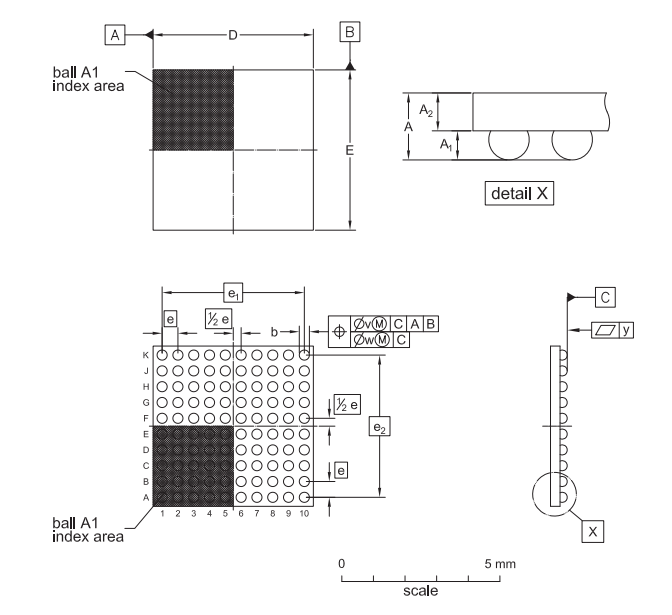
Datasheet PDF
- datasheets :
What are the key features of the LPC1768FBD100 microcontroller?
The LPC1768FBD100 microcontroller offers several key features, including a 100 MHz CPU clock speed, 512 KB of flash memory, 64 KB of RAM, multiple UART, SPI, and I2C interfaces, USB 2.0 Full-Speed device/host/OTG, Ethernet MAC, PWM channels, ADC, and more.
How can I program the LPC1768FBD100 microcontroller?
To program the LPC1768FBD100 microcontroller, you typically use an integrated development environment (IDE) such as Keil MDK-ARM or the LPCXpresso IDE. These IDEs offer features like code editor, compiler, debugger, and flash programming tools to develop and deploy your code on the microcontroller.
 Intel EP1K30TI144-2N FPGA: Features, Pricing, and Selection Guide
07 June 2025150
 HEF4094BT Shift Register: Pinout, Datasheet, Functional Diagram
16 February 20226399
 How to use ATTINY88 Microcontroller?
25 March 20222990
 AD780 3 ppm/°C Voltage Reference: Datasheet, Specs, and Design Analysis
11 April 2026149
 MPSA56 Transistor: MPSA56, Equivalent, Datasheet
07 January 20229812
 TL064 Operational Amplifier: Features, Pinout and Datasheet
16 July 20214231
 74LS32 Quad-2-Input OR Gate: Datasheet pdf, Pinout and Circuit
22 November 202117734
 2N5306 Transistor: NPN Darlington Transistor, Datasheet, Pinout
21 December 20211963
 What is PWM "Dead Band"?
21 April 20227685
 Exploring an Advanced Approach to Thermal Design for Dual-Sided Cooling of Power Semiconductor Modules in Electric and Hybrid Vehicles
07 September 2023926
 Introduction to Synchronous Counter and Asynchronous Counter
31 March 202518375
 What is a Memory Controller?
12 August 202034485
 What is a Decoder?
15 June 202622941
 Ceramic Capacitors Explained: Dielectric Classes, MLCC Construction, and the Parameters That Actually Matter
24 June 20266353
 How are Integrated Circuits produced?
20 October 202526172
 DeepMind Building AI That Thinks Like a Baby May Help Build Computer Models With Human Minds
18 July 20222582
NXP Semiconductors
In Stock: 16038
United States
China
Canada
Japan
Russia
Germany
United Kingdom
Singapore
Italy
Hong Kong(China)
Taiwan(China)
France
Korea
Mexico
Netherlands
Malaysia
Austria
Spain
Switzerland
Poland
Thailand
Vietnam
India
United Arab Emirates
Afghanistan
Åland Islands
Albania
Algeria
American Samoa
Andorra
Angola
Anguilla
Antigua & Barbuda
Argentina
Armenia
Aruba
Australia
Azerbaijan
Bahamas
Bahrain
Bangladesh
Barbados
Belarus
Belgium
Belize
Benin
Bermuda
Bhutan
Bolivia
Bonaire, Sint Eustatius and Saba
Bosnia & Herzegovina
Botswana
Brazil
British Indian Ocean Territory
British Virgin Islands
Brunei
Bulgaria
Burkina Faso
Burundi
Cabo Verde
Cambodia
Cameroon
Cayman Islands
Central African Republic
Chad
Chile
Christmas Island
Cocos (Keeling) Islands
Colombia
Comoros
Congo
Congo (DRC)
Cook Islands
Costa Rica
Côte d’Ivoire
Croatia
Cuba
Curaçao
Cyprus
Czechia
Denmark
Djibouti
Dominica
Dominican Republic
Ecuador
Egypt
El Salvador
Equatorial Guinea
Eritrea
Estonia
Eswatini
Ethiopia
Falkland Islands
Faroe Islands
Fiji
Finland
French Guiana
French Polynesia
Gabon
Gambia
Georgia
Ghana
Gibraltar
Greece
Greenland
Grenada
Guadeloupe
Guam
Guatemala
Guernsey
Guinea
Guinea-Bissau
Guyana
Haiti
Honduras
Hungary
Iceland
Indonesia
Iran
Iraq
Ireland
Isle of Man
Israel
Jamaica
Jersey
Jordan
Kazakhstan
Kenya
Kiribati
Kosovo
Kuwait
Kyrgyzstan
Laos
Latvia
Lebanon
Lesotho
Liberia
Libya
Liechtenstein
Lithuania
Luxembourg
Macao(China)
Madagascar
Malawi
Maldives
Mali
Malta
Marshall Islands
Martinique
Mauritania
Mauritius
Mayotte
Micronesia
Moldova
Monaco
Mongolia
Montenegro
Montserrat
Morocco
Mozambique
Myanmar
Namibia
Nauru
Nepal
New Caledonia
New Zealand
Nicaragua
Niger
Nigeria
Niue
Norfolk Island
North Korea
North Macedonia
Northern Mariana Islands
Norway
Oman
Pakistan
Palau
Palestinian Authority
Panama
Papua New Guinea
Paraguay
Peru
Philippines
Pitcairn Islands
Portugal
Puerto Rico
Qatar
Réunion
Romania
Rwanda
Samoa
San Marino
São Tomé & Príncipe
Saudi Arabia
Senegal
Serbia
Seychelles
Sierra Leone
Sint Maarten
Slovakia
Slovenia
Solomon Islands
Somalia
South Africa
South Sudan
Sri Lanka
St Helena, Ascension, Tristan da Cunha
St. Barthélemy
St. Kitts & Nevis
St. Lucia
St. Martin
St. Pierre & Miquelon
St. Vincent & Grenadines
Sudan
Suriname
Svalbard & Jan Mayen
Sweden
Syria
Tajikistan
Tanzania
Timor-Leste
Togo
Tokelau
Tonga
Trinidad & Tobago
Tunisia
Turkey
Turkmenistan
Turks & Caicos Islands
Tuvalu
U.S. Outlying Islands
U.S. Virgin Islands
Uganda
Ukraine
Uruguay
Uzbekistan
Vanuatu
Vatican City
Venezuela
Wallis & Futuna
Yemen
Zambia
Zimbabwe
![MC9S12A128CPVE]() MC9S12A128CPVE
MC9S12A128CPVENXP USA Inc.
![DSP56F807PY80E]() DSP56F807PY80E
DSP56F807PY80ENXP USA Inc.
![MC908AZ32ACFUE]() MC908AZ32ACFUE
MC908AZ32ACFUENXP USA Inc.
![MK60FN1M0VLQ12]() MK60FN1M0VLQ12
MK60FN1M0VLQ12NXP USA Inc.
![MK66FX1M0VLQ18]() MK66FX1M0VLQ18
MK66FX1M0VLQ18NXP USA Inc.
![MC56F8037VLH]() MC56F8037VLH
MC56F8037VLHNXP USA Inc.
![MKL03Z32VFG4]() MKL03Z32VFG4
MKL03Z32VFG4NXP USA Inc.
![MC9S12A256CPVE]() MC9S12A256CPVE
MC9S12A256CPVENXP USA Inc.
![MKL25Z128VLK4]() MKL25Z128VLK4
MKL25Z128VLK4NXP USA Inc.
![MK60DN512VLL10]() MK60DN512VLL10
MK60DN512VLL10NXP USA Inc.


