

 Product
 Brand
Brand Articles
 Tools
Tools
PAM8403 Audio Amplifier: Datasheet, Price and Pinout


20 kHz kHz Audio Amplifiers 1.55mm mm 4mm mm 16 pins 16-SOIC (0.154, 3.90mm Width)
PAM8403 is a filterless 3w class-d stereo audio amplifier. This article mainly introduce its datasheet, price, circuit and pther detailed information about Diodes Incorporated PAM8403.
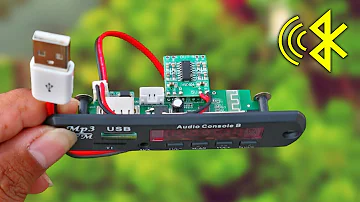
Mini Super Bass Amplifier Using PAM8403 Board With MP3 Bluetooth
PAM8403 Description
The PAM8403 is a 3W, class-D audio amplifier which can be powered using simple 5V input and could drive two 3W + 3W stereo speakers. It is an excellent choice, who wants a Class-D stereo audio amplifier in small board space. It offers low THD+N, allowing it to achieve high-quality sound reproduction. The new filterless architecture allows the device to drive the speaker directly, requiring no low-pass output filters, thus saving system cost and PCB area. With the same numbers of external components, the efficiency of the PAM8403 is much better than that of Class-AB cousins. It can extend the battery life, which makes it well-suited for portable applications.
PAM8403 Pinout
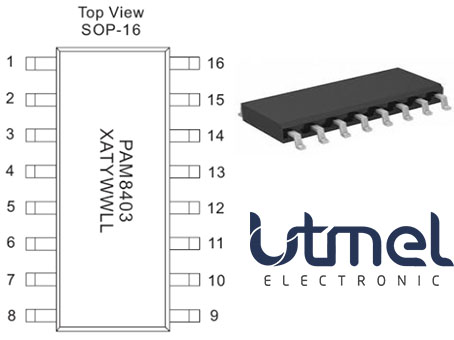

PAM8403 CAD Model
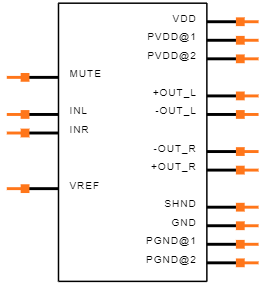
Symbol
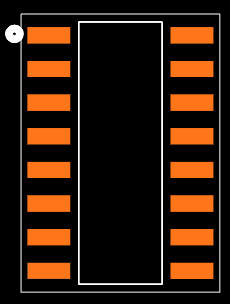
Footprint
3D Model
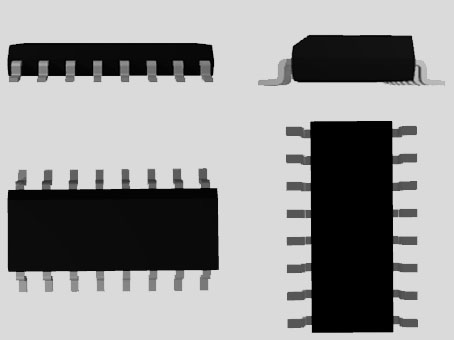
PAM8403 Features
★Operating Voltage: Wide power supply ranges from 2.5V to 5.5V DC
★Dual-channel stereo with high output power (3W Output at 10% THD with a 4Ω Load and 5V Power Supply )
★Max Gain 24 dB.
★Filterless architecture
★Operating Temperature: -40 to +85°C
★Superior Low Noise
★Dimensions (LxWxH) in cm 2.1 x 1.8 x .3
★Filterless, Low Quiescent Current and Low EMI
★Low THD+N
★Superior Low Noise
★Efficiency up to 90%
★Short Circuit Protection
★Thermal Shutdown
★Few External Components to Save the Space and Cost
★Pb-Free Package
Specifications
- TypeParameter
- Factory Lead Time19 Weeks
- Mount
In electronic components, the term "Mount" typically refers to the method or process of physically attaching or fixing a component onto a circuit board or other electronic device. This can involve soldering, adhesive bonding, or other techniques to secure the component in place. The mounting process is crucial for ensuring proper electrical connections and mechanical stability within the electronic system. Different components may have specific mounting requirements based on their size, shape, and function, and manufacturers provide guidelines for proper mounting procedures to ensure optimal performance and reliability of the electronic device.
Surface Mount - Mounting Type
The "Mounting Type" in electronic components refers to the method used to attach or connect a component to a circuit board or other substrate, such as through-hole, surface-mount, or panel mount.
Surface Mount - Package / Case
refers to the protective housing that encases an electronic component, providing mechanical support, electrical connections, and thermal management.
16-SOIC (0.154, 3.90mm Width) - Number of Pins16
- Weight6.39999g
- Power - Output (Max)3W
- Usage LevelIndustrial grade
- Operating Temperature
The operating temperature is the range of ambient temperature within which a power supply, or any other electrical equipment, operate in. This ranges from a minimum operating temperature, to a peak or maximum operating temperature, outside which, the power supply may fail.
-40°C~85°C TA - Packaging
Semiconductor package is a carrier / shell used to contain and cover one or more semiconductor components or integrated circuits. The material of the shell can be metal, plastic, glass or ceramic.
Tape & Reel (TR) - Published2012
- JESD-609 Code
The "JESD-609 Code" in electronic components refers to a standardized marking code that indicates the lead-free solder composition and finish of electronic components for compliance with environmental regulations.
e3 - Part Status
Parts can have many statuses as they progress through the configuration, analysis, review, and approval stages.
Active - Moisture Sensitivity Level (MSL)
Moisture Sensitivity Level (MSL) is a standardized rating that indicates the susceptibility of electronic components, particularly semiconductors, to moisture-induced damage during storage and the soldering process, defining the allowable exposure time to ambient conditions before they require special handling or baking to prevent failures
3 (168 Hours) - Number of Terminations16
- ECCN Code
An ECCN (Export Control Classification Number) is an alphanumeric code used by the U.S. Bureau of Industry and Security to identify and categorize electronic components and other dual-use items that may require an export license based on their technical characteristics and potential for military use.
EAR99 - TypeClass D
- Terminal Finish
Terminal Finish refers to the surface treatment applied to the terminals or leads of electronic components to enhance their performance and longevity. It can improve solderability, corrosion resistance, and overall reliability of the connection in electronic assemblies. Common finishes include nickel, gold, and tin, each possessing distinct properties suitable for various applications. The choice of terminal finish can significantly impact the durability and effectiveness of electronic devices.
Matte Tin (Sn) - Voltage - Supply
Voltage - Supply refers to the range of voltage levels that an electronic component or circuit is designed to operate with. It indicates the minimum and maximum supply voltage that can be applied for the device to function properly. Providing supply voltages outside this range can lead to malfunction, damage, or reduced performance. This parameter is critical for ensuring compatibility between different components in a circuit.
2.8V~5.5V - Terminal Position
In electronic components, the term "Terminal Position" refers to the physical location of the connection points on the component where external electrical connections can be made. These connection points, known as terminals, are typically used to attach wires, leads, or other components to the main body of the electronic component. The terminal position is important for ensuring proper connectivity and functionality of the component within a circuit. It is often specified in technical datasheets or component specifications to help designers and engineers understand how to properly integrate the component into their circuit designs.
DUAL - Terminal Form
Occurring at or forming the end of a series, succession, or the like; closing; concluding.
GULL WING - Number of Functions1
- Base Part Number
The "Base Part Number" (BPN) in electronic components serves a similar purpose to the "Base Product Number." It refers to the primary identifier for a component that captures the essential characteristics shared by a group of similar components. The BPN provides a fundamental way to reference a family or series of components without specifying all the variations and specific details.
PAM8403 - Output Type
The "Output Type" parameter in electronic components refers to the type of signal or data that is produced by the component as an output. This parameter specifies the nature of the output signal, such as analog or digital, and can also include details about the voltage levels, current levels, frequency, and other characteristics of the output signal. Understanding the output type of a component is crucial for ensuring compatibility with other components in a circuit or system, as well as for determining how the output signal can be utilized or processed further. In summary, the output type parameter provides essential information about the nature of the signal that is generated by the electronic component as its output.
2-Channel (Stereo) - Power Supplies
an electronic circuit that converts the voltage of an alternating current (AC) into a direct current (DC) voltage.?
5V - Number of Channels2
- Operating Supply Current
Operating Supply Current, also known as supply current or quiescent current, is a crucial parameter in electronic components that indicates the amount of current required for the device to operate under normal conditions. It represents the current drawn by the component from the power supply while it is functioning. This parameter is important for determining the power consumption of the component and is typically specified in datasheets to help designers calculate the overall power requirements of their circuits. Understanding the operating supply current is essential for ensuring proper functionality and efficiency of electronic systems.
16mA - Output Power
That power available at a specified output of a device under specified conditions of operation.
3W - Bandwidth
In electronic components, "Bandwidth" refers to the range of frequencies over which the component can effectively operate or pass signals without significant loss or distortion. It is a crucial parameter for devices like amplifiers, filters, and communication systems. The bandwidth is typically defined as the difference between the upper and lower frequencies at which the component's performance meets specified criteria, such as a certain level of signal attenuation or distortion. A wider bandwidth indicates that the component can handle a broader range of frequencies, making it more versatile for various applications. Understanding the bandwidth of electronic components is essential for designing and optimizing circuits to ensure proper signal transmission and reception within the desired frequency range.
20 kHz - Voltage Gain
Voltage gain is a measure of how much an electronic component or circuit amplifies an input voltage signal to produce an output voltage signal. It is typically expressed as a ratio or in decibels (dB). A higher voltage gain indicates a greater amplification of the input signal. Voltage gain is an important parameter in amplifiers, where it determines the level of amplification provided by the circuit. It is calculated by dividing the output voltage by the input voltage and is a key factor in determining the overall performance and functionality of electronic devices.
24dB - Power Supply Rejection Ratio (PSRR)
Power Supply Rejection Ratio (PSRR) is a measure of how well an electronic component, such as an operational amplifier or voltage regulator, can reject changes in its supply voltage. It indicates the ability of the component to maintain a stable output voltage despite fluctuations in the input supply voltage. A higher PSRR value signifies better performance in rejecting noise and variations from the power supply, leading to improved signal integrity and more reliable operation in electronic circuits. PSRR is typically expressed in decibels (dB).
-59dB - Max Output Power x Channels @ Load
Max Output Power x Channels @ Load is a specification that describes the maximum power output that an electronic component, such as an amplifier or audio device, can deliver across a certain number of channels at a specific load impedance. This parameter is important for understanding the capability of the component to drive speakers or other devices effectively. The value is typically expressed in watts and can vary depending on the number of channels being used and the impedance of the load. It helps users determine the compatibility of the component with their audio setup and ensures that the component can provide sufficient power for optimal performance.
3W x 1 @ 4 Ω - Voltage - Supply (Max)
Voltage - Supply (Max) is a parameter in electronic components that specifies the maximum voltage that can be safely applied to the component for proper operation. This parameter is crucial for ensuring the component's longevity and preventing damage due to overvoltage conditions. Exceeding the maximum supply voltage can lead to component failure, reduced performance, or even permanent damage. Designers must carefully consider this parameter when selecting components and designing circuits to ensure reliable and safe operation within the specified voltage limits.
5.5V - Harmonic Distortion
Harmonic distortion is a common parameter used to describe the quality of audio or electronic signals. It refers to the presence of unwanted harmonics or additional frequencies in the output signal that were not present in the input signal. These harmonics are typically multiples of the original signal frequency and can distort the waveform, affecting the overall sound quality or performance of the electronic component. Lower harmonic distortion values indicate a cleaner and more accurate output signal, while higher distortion levels can result in a more distorted or altered sound. Manufacturers often specify harmonic distortion levels in percentage or decibels to help users understand the quality of the component's output.
10% - Features
In the context of electronic components, the term "Features" typically refers to the specific characteristics or functionalities that a particular component offers. These features can vary depending on the type of component and its intended use. For example, a microcontroller may have features such as built-in memory, analog-to-digital converters, and communication interfaces like UART or SPI.When evaluating electronic components, understanding their features is crucial in determining whether they meet the requirements of a particular project or application. Engineers and designers often look at features such as operating voltage, speed, power consumption, and communication protocols to ensure compatibility and optimal performance.In summary, the "Features" parameter in electronic components describes the unique attributes and capabilities that differentiate one component from another, helping users make informed decisions when selecting components for their electronic designs.
Depop, Short-Circuit and Thermal Protection - Height1.55mm
- Length10mm
- Width4mm
- Radiation Hardening
Radiation hardening is the process of making electronic components and circuits resistant to damage or malfunction caused by high levels of ionizing radiation, especially for environments in outer space (especially beyond the low Earth orbit), around nuclear reactors and particle accelerators, or during nuclear accidents or nuclear warfare.
No - RoHS Status
RoHS means “Restriction of Certain Hazardous Substances” in the “Hazardous Substances Directive” in electrical and electronic equipment.
ROHS3 Compliant - Lead Free
Lead Free is a term used to describe electronic components that do not contain lead as part of their composition. Lead is a toxic material that can have harmful effects on human health and the environment, so the electronics industry has been moving towards lead-free components to reduce these risks. Lead-free components are typically made using alternative materials such as silver, copper, and tin. Manufacturers must comply with regulations such as the Restriction of Hazardous Substances (RoHS) directive to ensure that their products are lead-free and environmentally friendly.
Lead Free
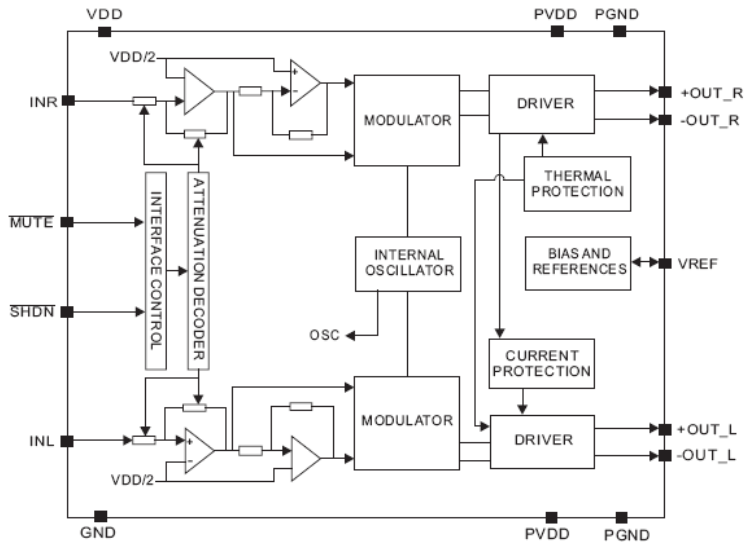
PAM8403 Functional Block Diagram
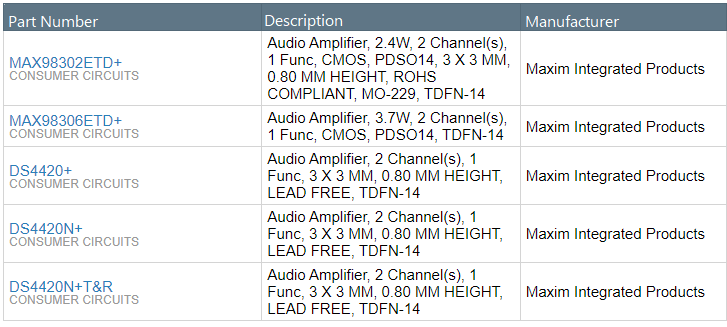
PAM8403 Alternatives
PAM8403 Applications
★Speaker output in LCD Monitors / TV Projectors
★Speaker output amplifier in Notebook Computers
★Can be used for Portable Speakers, Portable DVD Players, Game Machines
★Any possible amplifier-based project where small space and 5V output is available.
★Cellular Phones/Speaker Phones
PAM8403 Package

PAM8403 Manufacturer
Diodes Incorporated is the world's leading manufacturer and supplier, providing high-quality dedicated standard products for a wide range of discrete, logic, analog and mixed-signal semiconductor markets. Diodes serves the consumer electronics, computing, communications, industrial and automotive markets.
Trend Analysis
Datasheet PDF
- Environmental Information :
- Datasheets :
1.How to adjust the gain of PAM8403? I want to connect the microphone of a dynamic microphone as input. If I input it directly, I can hardly hear the sound, right?
That's absolute. The dynamic microphone input is only a few mV, so add a microphone amplifier alone or use a conference microphone.
2.How to solve the noise of class d current of PAM8403 digital power amplifier chip?
Causes of noise:
(1) There is discharge phenomenon on the board (cleaning, drying).
(2)Tail plug leakage (cleaning, drying).
(3)The receiver paper tray is damaged or of poor quality.
(4)The soft cable is short-circuited and leaks electricity.
(5)Welding leakage of audio peripheral components.
3.PAM8002 and PAM8403 which is better?
8403 is 3W better than 8002(2w), the tone of 8403 is mach better than 8002.
4.Can PAM8403 be connected to a tweeter and woofer?
Class D amplifier chip with output power of only 3 watts. The thrust is too small. Unless it is connected to a small speaker or headphones. A larger speaker cannot be pushed. So although it can be connected, it will not produce any good results.
5.Can CM8602B and PAM8403 be used in common?
No, they can not.
6.Which is better, PAM8403 or MIX3001?
PAM8403 is designed by a US-funded design company with companies in the United States and Shanghai. The operating cost is relatively high. Because its products are cast in TSMC, the cost is relatively high. MIX3001 is a cheaper IC designed to absorb the advantages of PAM8403. The main feature is FM without interference, and the others are no different from PAM8403.
 PC817 Photocoupler : Application, Pinout and Datasheet
30 July 202117348
 1N4006 Diode: Pinout, Datasheet, and 1N4006 vs 1N4007
31 August 20215223
 NRF24L01P Transceiver: Datasheet, Pinout and Applications
14 August 20214443
 TIP41C Transistor: Datasheet, Pinout, and Test Circuits
09 July 202143415
 74HC157 Quad 2-input Multiplexer: Pinout, Datasheet and Circuit
08 November 202111352
 STM3240G-EVAL Complete Setup and Development Guide
04 June 2025321
 MPX5010DP Transducer: Pinout, Specifications and Datasheet
18 October 20218784
 MC1455 Timer: MC1455 Datasheet, Pinout, MC1455 vs. 555
17 December 20216292
 Crystal Oscillators Explained: How They Work and How to Specify One
14 July 202615567
 What Makes a CPU?
30 March 20221910
 What is Time Delay Relay?
18 December 202517385
 Trends in the Semiconductor Industry in 2022
14 February 20222855
 What are TPMS Sensors?
21 November 20205975
 What is a Printed Circuit Board?
22 April 20218196
 Spiral wrap choices that keep hoses damage free
15 July 20251594
 C1815 vs C945 Key Features and Application Guide
01 September 20254508
Diodes Incorporated
In Stock
United States
China
Canada
Japan
Russia
Germany
United Kingdom
Singapore
Italy
Hong Kong(China)
Taiwan(China)
France
Korea
Mexico
Netherlands
Malaysia
Austria
Spain
Switzerland
Poland
Thailand
Vietnam
India
United Arab Emirates
Afghanistan
Åland Islands
Albania
Algeria
American Samoa
Andorra
Angola
Anguilla
Antigua & Barbuda
Argentina
Armenia
Aruba
Australia
Azerbaijan
Bahamas
Bahrain
Bangladesh
Barbados
Belarus
Belgium
Belize
Benin
Bermuda
Bhutan
Bolivia
Bonaire, Sint Eustatius and Saba
Bosnia & Herzegovina
Botswana
Brazil
British Indian Ocean Territory
British Virgin Islands
Brunei
Bulgaria
Burkina Faso
Burundi
Cabo Verde
Cambodia
Cameroon
Cayman Islands
Central African Republic
Chad
Chile
Christmas Island
Cocos (Keeling) Islands
Colombia
Comoros
Congo
Congo (DRC)
Cook Islands
Costa Rica
Côte d’Ivoire
Croatia
Cuba
Curaçao
Cyprus
Czechia
Denmark
Djibouti
Dominica
Dominican Republic
Ecuador
Egypt
El Salvador
Equatorial Guinea
Eritrea
Estonia
Eswatini
Ethiopia
Falkland Islands
Faroe Islands
Fiji
Finland
French Guiana
French Polynesia
Gabon
Gambia
Georgia
Ghana
Gibraltar
Greece
Greenland
Grenada
Guadeloupe
Guam
Guatemala
Guernsey
Guinea
Guinea-Bissau
Guyana
Haiti
Honduras
Hungary
Iceland
Indonesia
Iran
Iraq
Ireland
Isle of Man
Israel
Jamaica
Jersey
Jordan
Kazakhstan
Kenya
Kiribati
Kosovo
Kuwait
Kyrgyzstan
Laos
Latvia
Lebanon
Lesotho
Liberia
Libya
Liechtenstein
Lithuania
Luxembourg
Macao(China)
Madagascar
Malawi
Maldives
Mali
Malta
Marshall Islands
Martinique
Mauritania
Mauritius
Mayotte
Micronesia
Moldova
Monaco
Mongolia
Montenegro
Montserrat
Morocco
Mozambique
Myanmar
Namibia
Nauru
Nepal
New Caledonia
New Zealand
Nicaragua
Niger
Nigeria
Niue
Norfolk Island
North Korea
North Macedonia
Northern Mariana Islands
Norway
Oman
Pakistan
Palau
Palestinian Authority
Panama
Papua New Guinea
Paraguay
Peru
Philippines
Pitcairn Islands
Portugal
Puerto Rico
Qatar
Réunion
Romania
Rwanda
Samoa
San Marino
São Tomé & Príncipe
Saudi Arabia
Senegal
Serbia
Seychelles
Sierra Leone
Sint Maarten
Slovakia
Slovenia
Solomon Islands
Somalia
South Africa
South Sudan
Sri Lanka
St Helena, Ascension, Tristan da Cunha
St. Barthélemy
St. Kitts & Nevis
St. Lucia
St. Martin
St. Pierre & Miquelon
St. Vincent & Grenadines
Sudan
Suriname
Svalbard & Jan Mayen
Sweden
Syria
Tajikistan
Tanzania
Timor-Leste
Togo
Tokelau
Tonga
Trinidad & Tobago
Tunisia
Turkey
Turkmenistan
Turks & Caicos Islands
Tuvalu
U.S. Outlying Islands
U.S. Virgin Islands
Uganda
Ukraine
Uruguay
Uzbekistan
Vanuatu
Vatican City
Venezuela
Wallis & Futuna
Yemen
Zambia
Zimbabwe
![PAM8003DR]() PAM8003DR
PAM8003DRDiodes Incorporated
![PAM8304ASR]() PAM8304ASR
PAM8304ASRDiodes Incorporated
![PAM8302AASCR]() PAM8302AASCR
PAM8302AASCRDiodes Incorporated
![PAM8403DR-H]() PAM8403DR-H
PAM8403DR-HDiodes Incorporated
![PAM8302AADCR]() PAM8302AADCR
PAM8302AADCRDiodes Incorporated
![PAM8303DBSC]() PAM8303DBSC
PAM8303DBSCDiodes Incorporated
![PAM8304AYR]() PAM8304AYR
PAM8304AYRDiodes Incorporated
![PAM8404ZER]() PAM8404ZER
PAM8404ZERDiodes Incorporated
![PAM8009KGR]() PAM8009KGR
PAM8009KGRDiodes Incorporated


