

 Product
 Brand
Brand Articles
 Tools
Tools
PT2399 Delay Echo Processor IC: Datasheet, Schematic and Circuit

PT2399 datasheet pdf and Unclassified product details from PTC(Princeton Tech) stock available at Utmel


PT2399 is a digital delay echo audio processor. This article mainly covers pinout, datasheet, applications, circuit, and other details about PT2399 delay. Furthermore, there is a huge range of semiconductors, capacitors, resistors, and ICs in stock. Welcome your RFQ!

PT2399 Delay Pedals - How do they work?
What is PT2399 Delay?
The PT2399 is a CMOS single-chip echo processor IC. A high sample rate ADC converts the analog data into a bitstream, which is then stored in internal 44Kbit RAM. After processing, the bitstream is de-modulated by DAC and lowpass filter. The internal VCO clock frequency determines the overall delay duration, and the user can easily modify the VCO frequency by changing the external resistance.

PT2399 Pinout

PT2399 Pinout
| Pin Number | Pin Name | Description |
| 1 | VCC | Supply Voltage Input |
| 2 | REF | Analog Reference Voltage Input |
| 3,4 | AGND, DGND | Analog Ground and Digital Ground |
| 5 | CLK_O | Clock Signal Output |
| 6 | VCO | Frequency adjust input pin |
| 7,8 | CC1,CC0 | Current control 1 and Current control 0 |
| 9,10 | OP1-OUT, OP1-IN | 1st Op-amp Output and input pin |
| 11,12 | OP2-IN, OP2-OUT | 2nd Op-amp Input and Output pin |
| 13,14 | LPF2-IN, LPF2-OUT | 2nd Low pass filter input and output pin |
| 15,16 | LPF1-OUT, LPF-IN | 1st Low pass filter output and input pin |
PT2399 CAD Model
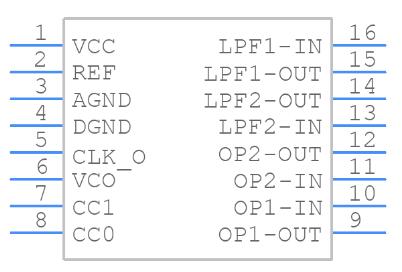
PT2399 Symbol
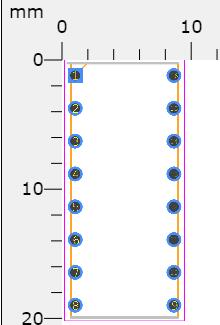
PT2399 Footprint
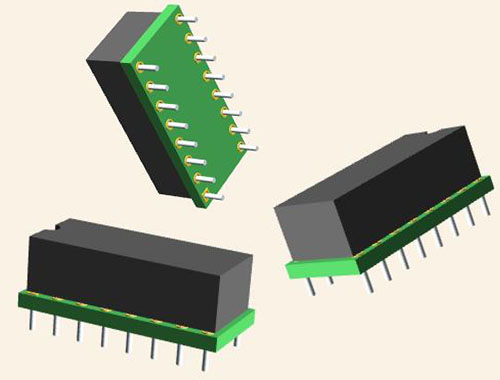
PT2399 3D Model
PT2399 Block Diagram

PT2399 Block Diagram
PT2399 Features
CMOS technology
Least external components
Auto-reset Function prevent POP noise
Low noise, SNR better than 90dB (typical)
Low distortion, THD= 0.5 %( typical)
User-adjustable VCO clock frequency
PT2399 Applications
KARAOKE Mixer
CD/DVD Player/Recorder
Multimedia TV
Car Entertainment System
Music Instrument effecter
Electronics Toy
PT2399 Application Circuit Schematics
The Delay/Echo circuit described in the datasheet is the most common use for the PT2399; these fundamental circuits are quite similar and serve as the foundations for many additional guitar pedals:

Echo

Delay
Alternative for PT2399
BU9253
PT2399 Power
PT2399 Input Stage
Three op-amps make up the Input Stage. The designer cannot use two of them (2 and 3) because they are always employed as part of the Sigma-Delta ADC circuit. The first op-amp can be used in a variety of ways, but the most typical application is as a filter/adder in a Multi-Feedback topology:
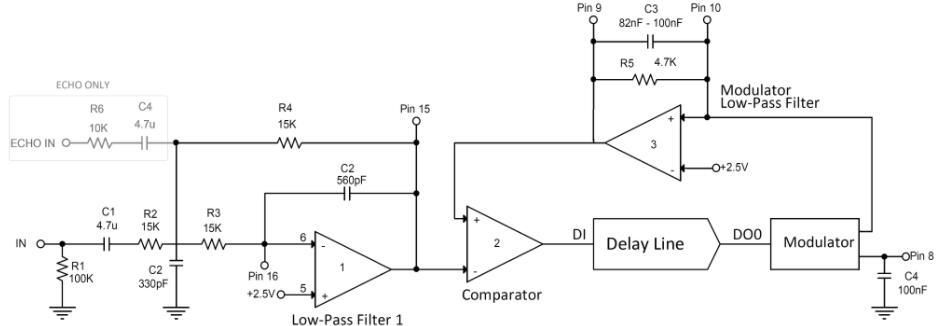
PT2399 Input
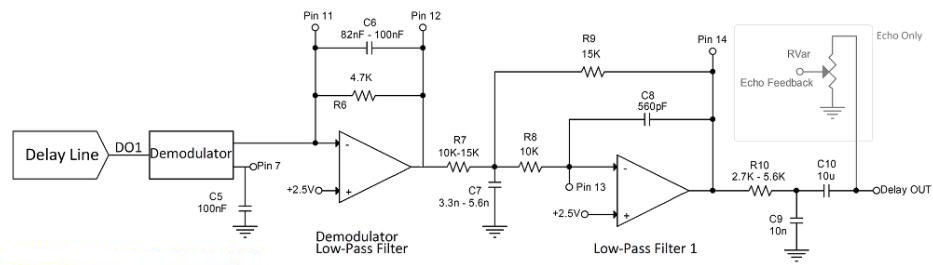
PT2399 Output Stage
Two op-amps make up the output stage. The first has limited usefulness and is used after the Demodulator as a low pass filter (Anti-Aliasing Filter). The second op-amp is unrestricted and is typically used in a Multi-Feedback op-amp filter.
PT2399 Output
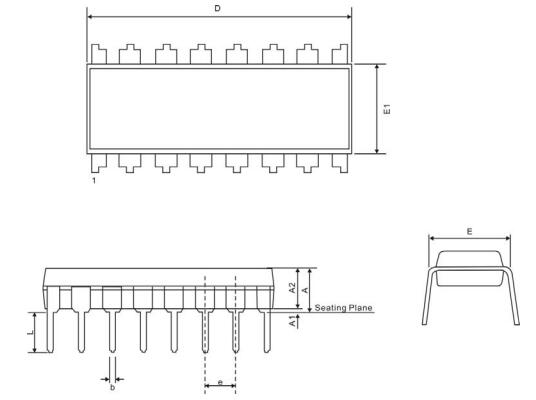
PT2399 Package Dimensions
PT2399 Package Dimensions
PT2399 Manufacturer
PTC (Princeton Tech) was established in 1986 and was initially deeply involved in the consumer IC field. It has become a leading manufacturer of consumer IC design in Taiwan. Since then, it has entered the automotive IC market and obtained certification and adoption by many well-known manufacturers in the world, which proves that the superior quality of PTC(Princeton Tech) products has been deeply recognized and trusted by customers. PTC(Princeton Tech) has developed mass-produced products, including various display driver ICs, multimedia voice ICs, motor driver ICs, radio frequency ICs, codec ICs, remote control ICs and customized ICs, etc.
What do pin 15 and 16 do in a pt2399 circuit?
Pin 15 and pin 16 to form a capacitance by changing the external resistance to change the input frequency response of the inverting amplifier, as the signal input.
What is the use of PT2399?
The PT2399 is a single chip echo processor IC utilizing CMOS technology. Which accept analog audio input signal, a high sample rate ADC transfer the analog signal into a bitstream then storage to internal 44Kbit RAM, after processing the bitstream will de-modulate by DAC and low pass filter.
How does a PT2399 work?
In the PT2399, digitization is only used to delay the signal, nothing else! The small DSP in the PT2399 stores only a sample of the sound in memory for a few milliseconds. Then it plays it back later without any sound processing added. Then, all the sound processing is done with a 100% analog circuit.
 Panasonic ERJ-2RKF1002X vs Yageo 0402 Resistors
19 September 2025367
 LPC1768FBD100: Overview, Features, and Applications
12 December 20231028
 CA3130EZ BiMOS Operational Amplifier: Schematic, Pinout, and Datasheet
14 February 20222505
 ADG202AKNZ Analog Switch: Feature, Specification, Datasheet
22 May 2021650
![The Guide to PIC16F1503 8-bit Microcontroller [FAQ]](https://res.utmel.com/Images/Article/ada937dc-8d7f-4372-a00a-b40f9463079c.jpg) The Guide to PIC16F1503 8-bit Microcontroller [FAQ]
The Guide to PIC16F1503 8-bit Microcontroller [FAQ]24 April 20225208
 TL074ID OP-AMP: Pinout, Specification, and Datasheet
11 June 20214240
 1N34A Diode: Datasheet, Circuit and Alternatives
27 August 202111076
 TPS2556DRBR Switch: 8-VDFN 5V, Pinout and Datasheet
10 February 20221053
 Introduction to Flyback Transformer
29 January 202111811
 Detailed Introduction of the Chip Design Process
21 December 202118041
 The 2026 Engineer’s Guide: Choosing the Right MCU for Your Next IoT & New Energy Project
30 April 2026795
 What is FIR Filter?
24 September 202018323
 Essential Tips for Picking the Best Gas Sensor
15 July 20252932
 What are the Applications of Filters?
17 January 202616885
 How to Use an External Hard Drive?
24 June 20219181
 What Is a Decoupling Capacitor? Function, Placement, and Selection Guide
04 July 202613378
PTC(Princeton Tech)
In Stock: 6115
United States
China
Canada
Japan
Russia
Germany
United Kingdom
Singapore
Italy
Hong Kong(China)
Taiwan(China)
France
Korea
Mexico
Netherlands
Malaysia
Austria
Spain
Switzerland
Poland
Thailand
Vietnam
India
United Arab Emirates
Afghanistan
Åland Islands
Albania
Algeria
American Samoa
Andorra
Angola
Anguilla
Antigua & Barbuda
Argentina
Armenia
Aruba
Australia
Azerbaijan
Bahamas
Bahrain
Bangladesh
Barbados
Belarus
Belgium
Belize
Benin
Bermuda
Bhutan
Bolivia
Bonaire, Sint Eustatius and Saba
Bosnia & Herzegovina
Botswana
Brazil
British Indian Ocean Territory
British Virgin Islands
Brunei
Bulgaria
Burkina Faso
Burundi
Cabo Verde
Cambodia
Cameroon
Cayman Islands
Central African Republic
Chad
Chile
Christmas Island
Cocos (Keeling) Islands
Colombia
Comoros
Congo
Congo (DRC)
Cook Islands
Costa Rica
Côte d’Ivoire
Croatia
Cuba
Curaçao
Cyprus
Czechia
Denmark
Djibouti
Dominica
Dominican Republic
Ecuador
Egypt
El Salvador
Equatorial Guinea
Eritrea
Estonia
Eswatini
Ethiopia
Falkland Islands
Faroe Islands
Fiji
Finland
French Guiana
French Polynesia
Gabon
Gambia
Georgia
Ghana
Gibraltar
Greece
Greenland
Grenada
Guadeloupe
Guam
Guatemala
Guernsey
Guinea
Guinea-Bissau
Guyana
Haiti
Honduras
Hungary
Iceland
Indonesia
Iran
Iraq
Ireland
Isle of Man
Israel
Jamaica
Jersey
Jordan
Kazakhstan
Kenya
Kiribati
Kosovo
Kuwait
Kyrgyzstan
Laos
Latvia
Lebanon
Lesotho
Liberia
Libya
Liechtenstein
Lithuania
Luxembourg
Macao(China)
Madagascar
Malawi
Maldives
Mali
Malta
Marshall Islands
Martinique
Mauritania
Mauritius
Mayotte
Micronesia
Moldova
Monaco
Mongolia
Montenegro
Montserrat
Morocco
Mozambique
Myanmar
Namibia
Nauru
Nepal
New Caledonia
New Zealand
Nicaragua
Niger
Nigeria
Niue
Norfolk Island
North Korea
North Macedonia
Northern Mariana Islands
Norway
Oman
Pakistan
Palau
Palestinian Authority
Panama
Papua New Guinea
Paraguay
Peru
Philippines
Pitcairn Islands
Portugal
Puerto Rico
Qatar
Réunion
Romania
Rwanda
Samoa
San Marino
São Tomé & Príncipe
Saudi Arabia
Senegal
Serbia
Seychelles
Sierra Leone
Sint Maarten
Slovakia
Slovenia
Solomon Islands
Somalia
South Africa
South Sudan
Sri Lanka
St Helena, Ascension, Tristan da Cunha
St. Barthélemy
St. Kitts & Nevis
St. Lucia
St. Martin
St. Pierre & Miquelon
St. Vincent & Grenadines
Sudan
Suriname
Svalbard & Jan Mayen
Sweden
Syria
Tajikistan
Tanzania
Timor-Leste
Togo
Tokelau
Tonga
Trinidad & Tobago
Tunisia
Turkey
Turkmenistan
Turks & Caicos Islands
Tuvalu
U.S. Outlying Islands
U.S. Virgin Islands
Uganda
Ukraine
Uruguay
Uzbekistan
Vanuatu
Vatican City
Venezuela
Wallis & Futuna
Yemen
Zambia
Zimbabwe