

 Product
 Brand
Brand Articles
 Tools
Tools
TDA7560 Amplifier: Circuits, Pinout, and Datasheet [Video&FAQ]


20 kHz kHz Audio Amplifiers 80W W 25 pins 25-Flexiwatt (Formed Leads)
The TDA7560 is a 4 x 51 W quad bridge car radio amplifier. This article mainly introduces circuits, pinout, datasheet and other detailed information about STMicroelectronics TDA7560.

Assembling a 320W audio amplifier with 14.4V with IC TDA7560
TDA7560 Description
The TDA7560 is a class AB audio power amplifier using groundbreaking BCD (Bipolar/CMOS/DMOS) technology in a Flexiwatt 25 compact developed for high-power vehicle radio.
The fully complementary P-Channel/N-Channel output structure allows for a rail-to-rail output voltage swing, which, when paired with high output current and minimal saturation losses, establishes new power standards in the car-radio market, with unrivaled distortion performance.
TDA7560 Pinout

TDA7560 CAD Model
The followings are the Symbol, Footprint, 3D Model of TDA7560.
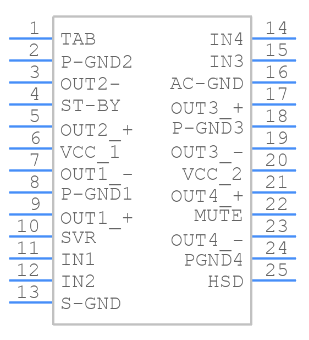
Symbol
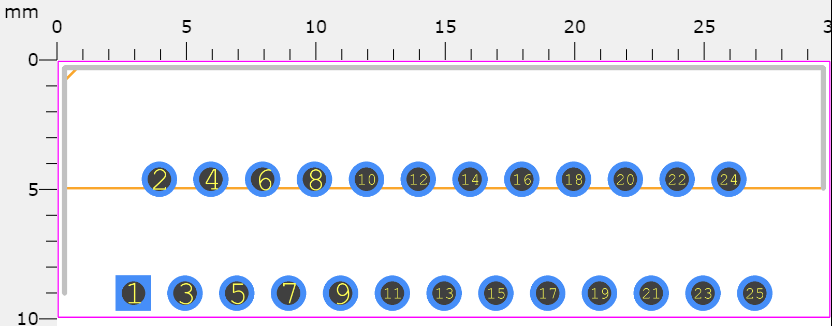
Footprint

3D Model
TDA7560 Features
• Superior output power capability:
– 4 x 51 W/4 Ω max.
– 4 x 45 W/4 Ω EIAJ
– 4 x 30 W/4 Ω @ 14.4 V, 1 kHz, 10 %
– 4 x 80 W/2 Ω max.
– 4 x 77 W/2 Ω EIAJ
– 4 x 55 W/2 Ω @ 14.4 V, 1 kHz, 10 %
• Multipower BCD technology
• MOSFET output power stage
• Excellent 2 W driving capability
• Hi-Fi class distortion
• Low output noise
• Standby function
• Mute function
• Automute at min. supply voltage detection
• Low external component count:
– Internally fixed gain (26 dB)
– No external compensation
– No bootstrap capacitors
• On board 0.35 A high side driver
• Protections:
– Output short circuit to GND, to VS, across the load
– Very inductive loads
– Overrating chip temperature with soft thermal limiter
– Output DC offset detection
– Load dump voltage
– Fortuitous open GND
– Reversed battery
– ESD
Specifications
- TypeParameter
- Lifecycle Status
Lifecycle Status refers to the current stage of an electronic component in its product life cycle, indicating whether it is active, obsolete, or transitioning between these states. An active status means the component is in production and available for purchase. An obsolete status indicates that the component is no longer being manufactured or supported, and manufacturers typically provide a limited time frame for support. Understanding the lifecycle status is crucial for design engineers to ensure continuity and reliability in their projects.
ACTIVE (Last Updated: 7 months ago) - Mount
In electronic components, the term "Mount" typically refers to the method or process of physically attaching or fixing a component onto a circuit board or other electronic device. This can involve soldering, adhesive bonding, or other techniques to secure the component in place. The mounting process is crucial for ensuring proper electrical connections and mechanical stability within the electronic system. Different components may have specific mounting requirements based on their size, shape, and function, and manufacturers provide guidelines for proper mounting procedures to ensure optimal performance and reliability of the electronic device.
Through Hole - Mounting Type
The "Mounting Type" in electronic components refers to the method used to attach or connect a component to a circuit board or other substrate, such as through-hole, surface-mount, or panel mount.
Through Hole - Package / Case
refers to the protective housing that encases an electronic component, providing mechanical support, electrical connections, and thermal management.
25-Flexiwatt (Formed Leads) - Number of Pins25
- Power - Output (Max)80W
- Packaging
Semiconductor package is a carrier / shell used to contain and cover one or more semiconductor components or integrated circuits. The material of the shell can be metal, plastic, glass or ceramic.
Tube - Part Status
Parts can have many statuses as they progress through the configuration, analysis, review, and approval stages.
Obsolete - Moisture Sensitivity Level (MSL)
Moisture Sensitivity Level (MSL) is a standardized rating that indicates the susceptibility of electronic components, particularly semiconductors, to moisture-induced damage during storage and the soldering process, defining the allowable exposure time to ambient conditions before they require special handling or baking to prevent failures
1 (Unlimited) - Number of Terminations25
- ECCN Code
An ECCN (Export Control Classification Number) is an alphanumeric code used by the U.S. Bureau of Industry and Security to identify and categorize electronic components and other dual-use items that may require an export license based on their technical characteristics and potential for military use.
EAR99 - TypeClass AB
- Max Operating Temperature
The Maximum Operating Temperature is the maximum body temperature at which the thermistor is designed to operate for extended periods of time with acceptable stability of its electrical characteristics.
150°C - HTS Code
HTS (Harmonized Tariff Schedule) codes are product classification codes between 8-1 digits. The first six digits are an HS code, and the countries of import assign the subsequent digits to provide additional classification. U.S. HTS codes are 1 digits and are administered by the U.S. International Trade Commission.
8542.33.00.01 - Max Power Dissipation
The maximum power that the MOSFET can dissipate continuously under the specified thermal conditions.
80W - Voltage - Supply
Voltage - Supply refers to the range of voltage levels that an electronic component or circuit is designed to operate with. It indicates the minimum and maximum supply voltage that can be applied for the device to function properly. Providing supply voltages outside this range can lead to malfunction, damage, or reduced performance. This parameter is critical for ensuring compatibility between different components in a circuit.
8V~18V - Terminal Position
In electronic components, the term "Terminal Position" refers to the physical location of the connection points on the component where external electrical connections can be made. These connection points, known as terminals, are typically used to attach wires, leads, or other components to the main body of the electronic component. The terminal position is important for ensuring proper connectivity and functionality of the component within a circuit. It is often specified in technical datasheets or component specifications to help designers and engineers understand how to properly integrate the component into their circuit designs.
ZIG-ZAG - Number of Functions1
- Terminal Pitch
The center distance from one pole to the next.
1mm - Base Part Number
The "Base Part Number" (BPN) in electronic components serves a similar purpose to the "Base Product Number." It refers to the primary identifier for a component that captures the essential characteristics shared by a group of similar components. The BPN provides a fundamental way to reference a family or series of components without specifying all the variations and specific details.
TDA7560 - Pin Count
a count of all of the component leads (or pins)
25 - Output Type
The "Output Type" parameter in electronic components refers to the type of signal or data that is produced by the component as an output. This parameter specifies the nature of the output signal, such as analog or digital, and can also include details about the voltage levels, current levels, frequency, and other characteristics of the output signal. Understanding the output type of a component is crucial for ensuring compatibility with other components in a circuit or system, as well as for determining how the output signal can be utilized or processed further. In summary, the output type parameter provides essential information about the nature of the signal that is generated by the electronic component as its output.
4-Channel (Quad) - Power Supplies
an electronic circuit that converts the voltage of an alternating current (AC) into a direct current (DC) voltage.?
13.2V - Number of Channels4
- Power Dissipation
the process by which an electronic or electrical device produces heat (energy loss or waste) as an undesirable derivative of its primary action.
80W - Quiescent Current
The quiescent current is defined as the current level in the amplifier when it is producing an output of zero.
200mA - Supply Current-Max
Supply Current-Max refers to the maximum amount of current that an electronic component or circuit can draw from its power supply under specified operating conditions. It is a critical parameter that determines the power consumption and thermal performance of the device. Exceeding this limit can lead to overheating, potential damage, or failure of the component. Knowing the Supply Current-Max helps in designing circuits that ensure proper operation and reliability.
320mA - Output Power
That power available at a specified output of a device under specified conditions of operation.
43W - Supply Type
Supply Type in electronic components refers to the classification of power sources used to operate the component. It indicates whether the component requires DC or AC power, and if DC, specifies the voltage levels such as low, medium, or high. Different supply types can affect the performance, compatibility, and application of the component in electronic circuits. Understanding the supply type is crucial for proper component selection and integration into electronic designs.
Single - Bandwidth
In electronic components, "Bandwidth" refers to the range of frequencies over which the component can effectively operate or pass signals without significant loss or distortion. It is a crucial parameter for devices like amplifiers, filters, and communication systems. The bandwidth is typically defined as the difference between the upper and lower frequencies at which the component's performance meets specified criteria, such as a certain level of signal attenuation or distortion. A wider bandwidth indicates that the component can handle a broader range of frequencies, making it more versatile for various applications. Understanding the bandwidth of electronic components is essential for designing and optimizing circuits to ensure proper signal transmission and reception within the desired frequency range.
20 kHz - Voltage Gain
Voltage gain is a measure of how much an electronic component or circuit amplifies an input voltage signal to produce an output voltage signal. It is typically expressed as a ratio or in decibels (dB). A higher voltage gain indicates a greater amplification of the input signal. Voltage gain is an important parameter in amplifiers, where it determines the level of amplification provided by the circuit. It is calculated by dividing the output voltage by the input voltage and is a key factor in determining the overall performance and functionality of electronic devices.
26dB - Gain
In electronic components, "Gain" refers to the ratio of the output signal amplitude to the input signal amplitude. It is a measure of the amplification provided by the component, such as a transistor or operational amplifier. Gain is typically expressed in decibels (dB) or as a numerical value, indicating how much the signal is amplified by the component.A higher gain value indicates a greater amplification of the input signal, while a lower gain value indicates less amplification. Gain is an important parameter in designing and analyzing electronic circuits, as it determines the overall performance and functionality of the system. Different components have different gain characteristics, and understanding the gain of a component is crucial for achieving the desired signal processing or amplification in electronic systems.
26 dB - Max Output Power x Channels @ Load
Max Output Power x Channels @ Load is a specification that describes the maximum power output that an electronic component, such as an amplifier or audio device, can deliver across a certain number of channels at a specific load impedance. This parameter is important for understanding the capability of the component to drive speakers or other devices effectively. The value is typically expressed in watts and can vary depending on the number of channels being used and the impedance of the load. It helps users determine the compatibility of the component with their audio setup and ensures that the component can provide sufficient power for optimal performance.
80W x 4 @ 2 Ω - Voltage - Supply (Max)
Voltage - Supply (Max) is a parameter in electronic components that specifies the maximum voltage that can be safely applied to the component for proper operation. This parameter is crucial for ensuring the component's longevity and preventing damage due to overvoltage conditions. Exceeding the maximum supply voltage can lead to component failure, reduced performance, or even permanent damage. Designers must carefully consider this parameter when selecting components and designing circuits to ensure reliable and safe operation within the specified voltage limits.
13.2V - Voltage - Supply (Min)
Voltage - Supply (Min) is a parameter in electronic components that specifies the minimum voltage required for the component to operate within its specified performance range. This parameter indicates the lowest voltage level that can be safely applied to the component without causing malfunctions or damage. It is crucial to ensure that the supply voltage provided to the component is equal to or higher than the specified minimum voltage to guarantee proper functionality and reliability. Failure to meet this requirement may result in erratic behavior, reduced performance, or even permanent damage to the component.
13.2V - Harmonic Distortion
Harmonic distortion is a common parameter used to describe the quality of audio or electronic signals. It refers to the presence of unwanted harmonics or additional frequencies in the output signal that were not present in the input signal. These harmonics are typically multiples of the original signal frequency and can distort the waveform, affecting the overall sound quality or performance of the electronic component. Lower harmonic distortion values indicate a cleaner and more accurate output signal, while higher distortion levels can result in a more distorted or altered sound. Manufacturers often specify harmonic distortion levels in percentage or decibels to help users understand the quality of the component's output.
10% - Features
In the context of electronic components, the term "Features" typically refers to the specific characteristics or functionalities that a particular component offers. These features can vary depending on the type of component and its intended use. For example, a microcontroller may have features such as built-in memory, analog-to-digital converters, and communication interfaces like UART or SPI.When evaluating electronic components, understanding their features is crucial in determining whether they meet the requirements of a particular project or application. Engineers and designers often look at features such as operating voltage, speed, power consumption, and communication protocols to ensure compatibility and optimal performance.In summary, the "Features" parameter in electronic components describes the unique attributes and capabilities that differentiate one component from another, helping users make informed decisions when selecting components for their electronic designs.
Mute, Short-Circuit and Thermal Protection, Standby - Radiation Hardening
Radiation hardening is the process of making electronic components and circuits resistant to damage or malfunction caused by high levels of ionizing radiation, especially for environments in outer space (especially beyond the low Earth orbit), around nuclear reactors and particle accelerators, or during nuclear accidents or nuclear warfare.
No - RoHS Status
RoHS means “Restriction of Certain Hazardous Substances” in the “Hazardous Substances Directive” in electrical and electronic equipment.
ROHS3 Compliant
TDA7560 Functional Block Diagram
TDA7560 Functional Block Diagram is shown as follows.
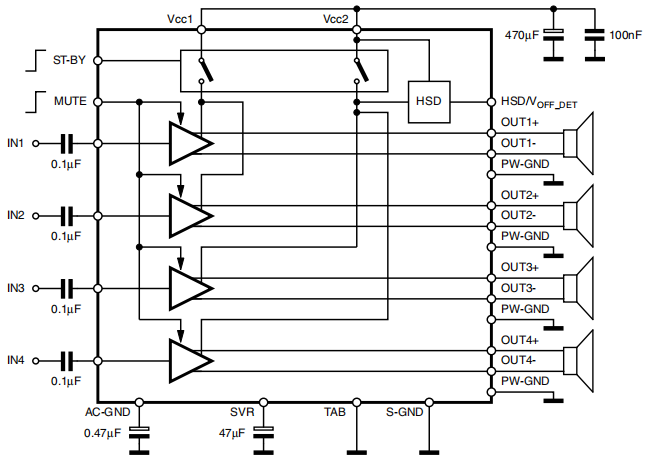
Functional Block Diagram
TDA7560 Car Amp Circuit Diagram
The following figure shows the TDA7560 Car Amp Circuit.

4 x 50 Watts TDA7560 Car Amp Circuit
TDA7560 Standard Test and Application Circuit, and PCB Layout
The TDA7560 Standard Test and Application Circuit is shown as follows.

Standard Test and Application Circuit
PCB and component layout of the Application Circuit

Components and Top Copper Layer

Bottom Copper Layer
TDA7560 Alternatives
| Part Number | Description | Manufacturer |
| TDA7850CONSUMER CIRCUITS | 4 x 50 W MOSFET quad bridge power amplifier | STMicroelectronics |
TDA7560 Application
• High Power Car Radio
TDA7560 Package
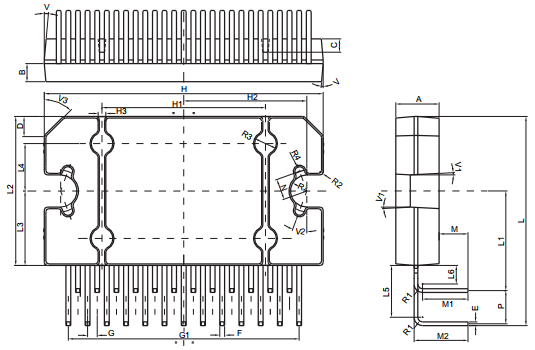

TDA7560 Manufacturer
STMicroelectronics is a leading global independent semiconductor firm that develops and delivers semiconductor solutions for a wide range of microelectronics applications. The Company is at the forefront of System-on-Chip (SoC) technology, and its products play a major role in supporting today's convergence trends, thanks to an unparalleled mix of silicon and system expertise, manufacturing capabilities, Intellectual Property (IP) portfolio, and strategic partners.
Datasheet PDF
- Datasheets :
Which is better TDA7560 or 7850?
1. TDA7850: 4*50W MOSFET Quad-Bridge Power Amplifier with HSD
2. TDA7560: 4*45W QUAD Bridge Car Radio Amplifier PLUS HSD
Both of them have HSD, which is the difference in power, and the difference is only 5W.
Car amplifier TDA7560 original with 4 ohm speakers: Question 1. Now a certain channel directly adds a treble (4 ohms), and 4 ohms and 4 ohms become 2 ohms. Will the output power change? (That is, the total volume of this road is larger than the other). Question 2. Before connecting a treble, connect an extra 2 divider. Is the output change the same as that of question 1?
The tweeter cannot be directly connected in parallel with the original speaker. It is not only the impedance problem and the power change, but the power marked by the tweeter is the power that can be tolerated at high frequencies. If it can also withstand the bass, it will not work at all. The output power of the power amplifier is mainly in the bass part, the treble power is very small, and the speaker impedance changes with the frequency. Big, the volume is slightly louder and hangs up. Although an LC divider is not necessary, a capacitor should be connected to divide the frequency at most. For example, a non-polar capacitor between 2.2 and 5.6uf will basically not change the output power of the entire power amplifier after it is connected, and the volume will basically remain unchanged. The tone should be more delicate and translucent.
What kind of integrated block is TDA7560? What's the use?
TDA7560 is a car power amplifier block, its main function is to improve the sound of the car and ensure the quality of the sound.
Can I replace D7388 with TDA7560 for car audio? Do I need to replace the capacitor?
The pin function is the same as the arrangement, and it can be replaced completely.
Just after the replacement, if the power cannot reach or the sound quality is not good, it belongs to the power supply voltage does not meet the requirements of the new block. There is no need to change capacitors.
Is it feasible to replace TDA7388 with TDA7560 power amplifier block?
The parameters of the two are not much different (the power of 7560 is slightly larger), and the pins are the same, which can be directly replaced.
What is the TDA7560 a class AB audio power amplifier using?
BCD (Bipolar/CMOS/DMOS) technology.
What type of output structure allows for a rail-to-rail output voltage swing?
P-Channel/N-Channel output structure.
 OnSemi MBR0540T1G Schottky Diode: 40V 500mA Fast Switching Review
27 August 2025498
 LPC824 Microcontroller: Datasheet, Pinout, NXP LPC824
23 August 20212541
 HMC462LP5 Low Noise Amplifier: Datasheet, Pinout, Price
20 December 2021452
 LM7805CT Voltage Regulator: Feature, Specification, and Datasheet
16 June 20215417
 The Comprehensive Introduction to Si53306
16 June 20221645
 M93C66-W 4-Kbit MICROWIRE™ Serial EEPROM: Pinout, Equivalent and Datasheet
08 March 20221422
 OP07 Operational Amplifier: Pinout, Datasheet, OP07 VS LM308
15 December 202111431
 EPM240T100C5 Altera: Specifications, Features and Applications
10 April 2025824
 Introduction to Pi Filter
19 February 202116132
 Sourcing for Embodied AI: How Large Action Models (LAMs) are Driving the Edge AI Chip Explosion
22 July 2026354
 Rectangular Connectors vs Circular Connectors: Which fits your Project Best
04 July 20252952
 MCU Crystal Selection & Startup Verification: Load Capacitance, ESR, and Oscillation Margin Guide
29 September 2026351
 How to Pick the Perfect Boost Converter for Your Needs
07 June 20251664
 What is a Capacitive Sensor?
31 October 202511353
 4680 Battery - Upgrade of Battery Technology
17 December 20217094
 Introduction to Silicon Controlled Rectifier
25 September 20209727
STMicroelectronics
In Stock: 1
United States
China
Canada
Japan
Russia
Germany
United Kingdom
Singapore
Italy
Hong Kong(China)
Taiwan(China)
France
Korea
Mexico
Netherlands
Malaysia
Austria
Spain
Switzerland
Poland
Thailand
Vietnam
India
United Arab Emirates
Afghanistan
Åland Islands
Albania
Algeria
American Samoa
Andorra
Angola
Anguilla
Antigua & Barbuda
Argentina
Armenia
Aruba
Australia
Azerbaijan
Bahamas
Bahrain
Bangladesh
Barbados
Belarus
Belgium
Belize
Benin
Bermuda
Bhutan
Bolivia
Bonaire, Sint Eustatius and Saba
Bosnia & Herzegovina
Botswana
Brazil
British Indian Ocean Territory
British Virgin Islands
Brunei
Bulgaria
Burkina Faso
Burundi
Cabo Verde
Cambodia
Cameroon
Cayman Islands
Central African Republic
Chad
Chile
Christmas Island
Cocos (Keeling) Islands
Colombia
Comoros
Congo
Congo (DRC)
Cook Islands
Costa Rica
Côte d’Ivoire
Croatia
Cuba
Curaçao
Cyprus
Czechia
Denmark
Djibouti
Dominica
Dominican Republic
Ecuador
Egypt
El Salvador
Equatorial Guinea
Eritrea
Estonia
Eswatini
Ethiopia
Falkland Islands
Faroe Islands
Fiji
Finland
French Guiana
French Polynesia
Gabon
Gambia
Georgia
Ghana
Gibraltar
Greece
Greenland
Grenada
Guadeloupe
Guam
Guatemala
Guernsey
Guinea
Guinea-Bissau
Guyana
Haiti
Honduras
Hungary
Iceland
Indonesia
Iran
Iraq
Ireland
Isle of Man
Israel
Jamaica
Jersey
Jordan
Kazakhstan
Kenya
Kiribati
Kosovo
Kuwait
Kyrgyzstan
Laos
Latvia
Lebanon
Lesotho
Liberia
Libya
Liechtenstein
Lithuania
Luxembourg
Macao(China)
Madagascar
Malawi
Maldives
Mali
Malta
Marshall Islands
Martinique
Mauritania
Mauritius
Mayotte
Micronesia
Moldova
Monaco
Mongolia
Montenegro
Montserrat
Morocco
Mozambique
Myanmar
Namibia
Nauru
Nepal
New Caledonia
New Zealand
Nicaragua
Niger
Nigeria
Niue
Norfolk Island
North Korea
North Macedonia
Northern Mariana Islands
Norway
Oman
Pakistan
Palau
Palestinian Authority
Panama
Papua New Guinea
Paraguay
Peru
Philippines
Pitcairn Islands
Portugal
Puerto Rico
Qatar
Réunion
Romania
Rwanda
Samoa
San Marino
São Tomé & Príncipe
Saudi Arabia
Senegal
Serbia
Seychelles
Sierra Leone
Sint Maarten
Slovakia
Slovenia
Solomon Islands
Somalia
South Africa
South Sudan
Sri Lanka
St Helena, Ascension, Tristan da Cunha
St. Barthélemy
St. Kitts & Nevis
St. Lucia
St. Martin
St. Pierre & Miquelon
St. Vincent & Grenadines
Sudan
Suriname
Svalbard & Jan Mayen
Sweden
Syria
Tajikistan
Tanzania
Timor-Leste
Togo
Tokelau
Tonga
Trinidad & Tobago
Tunisia
Turkey
Turkmenistan
Turks & Caicos Islands
Tuvalu
U.S. Outlying Islands
U.S. Virgin Islands
Uganda
Ukraine
Uruguay
Uzbekistan
Vanuatu
Vatican City
Venezuela
Wallis & Futuna
Yemen
Zambia
Zimbabwe


