Product
 Brand
Brand Articles
 Tools
Tools
What's the Difference between the BMP280 and the BME280 Atmospheric Sensors?


Pressure, Temperature and Humidity Sensor Digital Output 1.8V 8-Pin LGA T/R
In terms of BMP280 vs. BME280, When purchasing BME280 on eBay, there is a good chance you may receive BMP280 instead. Many sellers do not distinguish between the two. In this article, we will explain the features and specs of each so that you can distinguish between the two. Aside from their differences, we'll run a tutorial to see how well they interface with other libraries. When completing a complex project, you will know which choice is superior.

What's the difference between the BMP280 and the BME280 atmospheric sensors
What is BMP280 ?
BMP280 is a barometric pressure sensor that measures air pressure and temperature. In contrast to the BME280, which monitors air pressure, temperature, and humidity, the BMP280 just measures air pressure and temperature. The unit's low power consumption and small size enable the implementation of battery-powered devices such as watches, GPS devices, and mobile phones. MBP280 additionally supports SPI and I2C connection and functions as a precision altimeter.
What is BME280 ?
BME280 is a precision environmental sensor that measures humidity, temperatures, and barometric pressures. The device syndicates high exactitude and linearity and is impeccably practical for high EMC sturdiness and long-term stability.
BMP280 vs BME280 Pinout
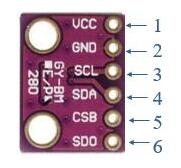
BMP280 Pinout
| Pin No. | Pin Name | Pin Description |
| 1 | VCC | This is the power pin. Connect 3.3V DC supply at this pin. |
| 2 | GND | Ground pin |
| 3 | SCL | This is the serial clock pin for the I2C interface. |
| 4 | SDA | This is the serial data pin for the I2C interface. |
| 5 | CSB | The chip select pin selects the I2C or SPI interface. It selects the SPI interface when provided with a low signal or grounded. On applying a HIGH signal of 3.3V, this pin will select the I2C interface. |
| 6 | SDO | It is the serial data output pin that sends out the output value. |
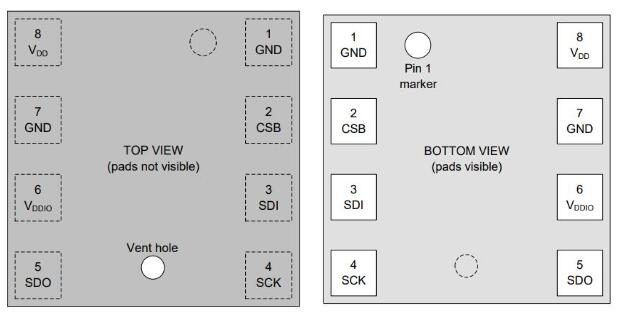
BME280 Pinout
| Pin Number | Pin Name | Pin Description |
| 1 | GND | Ground |
| 2 | CSB | Chip Select |
| 3 | SDI | Serial Data Interface |
| 4 | SCK | Serial Clock Interface |
| 5 | SDO | Serial Data Output |
| 6 | VDDIO | Digital/Interface Supply |
| 7 | GND | Ground |
| 8 | VDD | Analog Supply |
BMP280 vs BME280 Specifications
| BME280 | BMP280 | |
| Measures | air pressure temperature humidity | air pressure temperature |
| Supply voltage | 1.7 to 3.6V (for the chip) 3.3 to 5V for the board | 1.7 to 3.6V (for the chip) 3.3 to 5V for the board |
| Temperature range | -40 to 85ºC | -40 to 85ºC |
| Weight G.W | 10g | 3g |
| Accuracy of Air Pressure | ±1.0 hPa | ±1.0 hPa |
| Range of Air pressure | 300 – 1100 hPa | 300 – 1100 hPa |
| Dimensions | 40mm x20mm x15mm | 20mm x 40mm |
| Current Consumption | 0.4 mA | 0.6 mA |
| Accuracy of Temperature | ±1 | ±1 |
BMP280 vs BME280Applications
BMP280 Applications
You may be wondering where the BMP280 sensor comes in handy. Because of its characteristics and capabilities, such as SPI and I2C compatibility, the BMP280 sensor is ideal for weather and environmental sensing. Some of the BMP280's applications are listed below.
Monitoring of fitness
Control of home automation
Forecast of weather
Indoor navigation (elevator detection, floor detection)
Outdoor navigation (sports and leisure applications)
Indicating vertical velocity
GPS navigation enhancement (dead-reckoning, detection of slopes, etc)
Applications relating to health care i.e. spirometry
All other projects requiring the appropriate reading of the atmospheric pressure
BME280 Applications
You might be wondering where the BME280 sensor can be used. Because of its characteristics and capabilities, such as SPI and I2C compatibility, the BME280 sensor is ideal for weather and environmental sensing. Some of the BME280's uses are listed below.
Monitoring of fitness
Control of home automation
Forecast of weather
Indoor or outdoor navigation
GPS navigation enhancement
All other projects requiring the appropriate reading of the atmospheric pressure
BMP280 & BME280 Manufacturer
Bosch Sensortec GmbH is a fully owned subsidiary of Robert Bosch GmbH dedicated to the world of consumer electronics; offering a complete portfolio of micro-electro-mechanical systems (MEMS) based sensors and solutions that enable mobile devices to feel and sense the world around them. Bosch Sensortec develops and markets a broad portfolio of MEMS sensors, solutions, and systems for applications in smartphones, tablets, wearable devices, and various products within the IoT (Internet of Things).
BMP28 vs BME280 PCB

Looking at the rear of the PCB, it seems the purple PCB may be the “genuine” and the blue PCB a “clone” – notice the poor printing by comparison and the M which became I1. Regardless, it seems the PCB was designed for BME280 and BMP280 – the black dot on the left module on the P text indicates it’s a BMP280. This was, however, confusing to the seller who insisted this meant it was a BME280 as the E was showing. The purple module on the right didn’t have any marks.
BME280 use with Arduino
You can use the environmental sensor Grove-BME280 with different microcontrollers such as Arduino, LinkIt ONE, and Beaglebone. You can achieve this through SPI or I2C. For our example today, we will be explaining to you how to connect your Grove environmental sensor BM280 to the Arduino.
Step by Step Guide
Step One: Connect the BME280 sensor to touch the Grove Base Shield V2 I2C port. After that, plug or insert it into Seeeduino. However, if you lack a Grove Base Shield, the module can be connected directly to the Seeeduino.
Step Two: Using a USB cable, connect Seeeduino to the PC
Step Three: Here is the software aspect of the tutorial. First of all, visit Github to download the example and library code.
Step Four: Create a brand new sketch for the Arduino and then paste some codes to it. You can also get access to the code directly just by following this path: File – Example – Barometer_Sensor – Barometer_Sensor.
Step Five: This step requires that you upload this code gotten in step five into your Arduino
Step Six: Open the serial monitor in order to receive the data of the sensor, which includes humidity, altitude, the value of barometric pressure, and temperature.
BMP28 vs BME280 Package
Finally, you can know the difference between bmp280 vs bme280 just by inspecting the package visually. If you check the datasheet of the BME280, you will see the markings for devices requiring mass production. This marking has to have ??? U? format. Here, the U signifies BME280. Now, the last ? you are seeing here just a P, while the final two characters are supposed to be UP.
Compared with the datasheet of BMP280, the format ought to be ??? K?. Here, the final “?” should be either W, N, U, or P. Therefore, KW, KN, KU, and KP are all devices of BMP280.
BME280 Equivalents
BME180, BMP280, HTU21D
BMP28 vs BME280 Datasheet
Conclusion
If you try to buy a Bosch Sensortec BME280 module on eBay, there’s a good chance you will get the lesser BMP280 instead. The reason seems to be sellers that don’t know what they are selling, a supply chain that doesn’t understand the difference between a BME280 and the BMP280, and a PCB break-out design that is shared between the two types of sensors. As a result, buying these sensors can get quite frustrating, as the sellers often get away with them.
If you want to be sure you get what you ordered, you’ll probably have to spend quite a bit more for a proper module from the likes of Adafruit, where everything is clearly labeled and controlled.
What is BMP280?
The BMP280 is an absolute barometric pressure sensor, which is especially feasible for mobile applications. Its small dimensions and its low power consumption allow for the implementation in battery-powered devices such as mobile phones, GPS modules, or watches.
What is bme280?
The BME280 is a humidity sensor specially developed for mobile applications and wearables where size and low power consumption are key design parameters. The unit combines high linearity and high accuracy sensors and is perfectly feasible for low current consumption, long-term stability, and high EMC robustness.
How does bme280 work?
The BME280 sensor module reads barometric pressure, temperature, and humidity. Because pressure changes with altitude, you can also estimate altitude. There are several versions of this sensor module. The BME280 sensor uses I2C or SPI communication protocol to exchange data with a microcontroller.
What are i2c sensors?
The I2C bus is a simple and flexible way to transfer digital data between two electronic devices which may be physically separate or contained on the same printed circuit board (PCB).
How Does a Barometric Sensor Work? How Do I Connect My BMP180 to Arduino?
An aneroid barometer consists of an aneroid cell inside. The aneroid cell expands/contracts when there are small changes to atmospheric pressure. This movement from the aneroid cell causes mechanical levers to amplify, resulting in display pointers triggering and registering as readings on the front display.
 4N25 Phototransistor Optocoupler IC
30 June 20227152
 A Comprehensive Guide to DIABLO16 Microcontroller by 4D Systems Pty Ltd
07 March 2024617
 BD437 Transistor: BD437 Pinout, Datasheet, Equivalent
06 April 20224180
 AT45DB081E 8-Mbit DataFlash: Pinout, Features and Datasheet
30 March 20221491
 MAX232ACSE Driver/Receiver: Features, Pinout, and Datasheet
17 April 2025929
 Z8 Encore! XP® Z8F0823 Series Microcontrollers: Technical Overview and Specifications
29 February 2024286
 TIP31C Power Transistor: Pinout, Datasheet, and Specification
03 July 20219122
 LM358 Dual Op-Amp vs LM393 Dual Comparator
12 August 20228444
 Huang Renxun: Nvidia Is No Longer a GPU Company
06 April 20222811
 Introduction to Flyback Transformer
29 January 202112125
 VRLA Battery: Working Principle, Capacity and Maintenance
12 March 202110972
 Analysis and Solutions of Common Causes of Serial Port Lost Data
15 August 20225331
 Power Transformer Basics and Operation Cautions
16 October 20206047
 Leading Fiber Optic Connectors Every Installer Should Know
17 July 20253285
 What Sensors are Used in Industrial Robots?
09 November 20217280
 How to Select the Most Accurate Shunt Resistor for Your Circuit
06 June 20254903
Bosch Sensortec
In Stock: 1521
United States
China
Canada
Japan
Russia
Germany
United Kingdom
Singapore
Italy
Hong Kong(China)
Taiwan(China)
France
Korea
Mexico
Netherlands
Malaysia
Austria
Spain
Switzerland
Poland
Thailand
Vietnam
India
United Arab Emirates
Afghanistan
Åland Islands
Albania
Algeria
American Samoa
Andorra
Angola
Anguilla
Antigua & Barbuda
Argentina
Armenia
Aruba
Australia
Azerbaijan
Bahamas
Bahrain
Bangladesh
Barbados
Belarus
Belgium
Belize
Benin
Bermuda
Bhutan
Bolivia
Bonaire, Sint Eustatius and Saba
Bosnia & Herzegovina
Botswana
Brazil
British Indian Ocean Territory
British Virgin Islands
Brunei
Bulgaria
Burkina Faso
Burundi
Cabo Verde
Cambodia
Cameroon
Cayman Islands
Central African Republic
Chad
Chile
Christmas Island
Cocos (Keeling) Islands
Colombia
Comoros
Congo
Congo (DRC)
Cook Islands
Costa Rica
Côte d’Ivoire
Croatia
Cuba
Curaçao
Cyprus
Czechia
Denmark
Djibouti
Dominica
Dominican Republic
Ecuador
Egypt
El Salvador
Equatorial Guinea
Eritrea
Estonia
Eswatini
Ethiopia
Falkland Islands
Faroe Islands
Fiji
Finland
French Guiana
French Polynesia
Gabon
Gambia
Georgia
Ghana
Gibraltar
Greece
Greenland
Grenada
Guadeloupe
Guam
Guatemala
Guernsey
Guinea
Guinea-Bissau
Guyana
Haiti
Honduras
Hungary
Iceland
Indonesia
Iran
Iraq
Ireland
Isle of Man
Israel
Jamaica
Jersey
Jordan
Kazakhstan
Kenya
Kiribati
Kosovo
Kuwait
Kyrgyzstan
Laos
Latvia
Lebanon
Lesotho
Liberia
Libya
Liechtenstein
Lithuania
Luxembourg
Macao(China)
Madagascar
Malawi
Maldives
Mali
Malta
Marshall Islands
Martinique
Mauritania
Mauritius
Mayotte
Micronesia
Moldova
Monaco
Mongolia
Montenegro
Montserrat
Morocco
Mozambique
Myanmar
Namibia
Nauru
Nepal
New Caledonia
New Zealand
Nicaragua
Niger
Nigeria
Niue
Norfolk Island
North Korea
North Macedonia
Northern Mariana Islands
Norway
Oman
Pakistan
Palau
Palestinian Authority
Panama
Papua New Guinea
Paraguay
Peru
Philippines
Pitcairn Islands
Portugal
Puerto Rico
Qatar
Réunion
Romania
Rwanda
Samoa
San Marino
São Tomé & Príncipe
Saudi Arabia
Senegal
Serbia
Seychelles
Sierra Leone
Sint Maarten
Slovakia
Slovenia
Solomon Islands
Somalia
South Africa
South Sudan
Sri Lanka
St Helena, Ascension, Tristan da Cunha
St. Barthélemy
St. Kitts & Nevis
St. Lucia
St. Martin
St. Pierre & Miquelon
St. Vincent & Grenadines
Sudan
Suriname
Svalbard & Jan Mayen
Sweden
Syria
Tajikistan
Tanzania
Timor-Leste
Togo
Tokelau
Tonga
Trinidad & Tobago
Tunisia
Turkey
Turkmenistan
Turks & Caicos Islands
Tuvalu
U.S. Outlying Islands
U.S. Virgin Islands
Uganda
Ukraine
Uruguay
Uzbekistan
Vanuatu
Vatican City
Venezuela
Wallis & Futuna
Yemen
Zambia
Zimbabwe