

 Product
 Brand
Brand Articles
 Tools
Tools
Yageo RC0402FR-0710KL SMD Resistor: Complete Guide to 0402 Thick Film Resistors


RES SMD 10K OHM 1% 1/16W 0402
Yageo RC0402FR-0710KL is a thick film SMD resistor valued for compact size, reliability, and use in consumer, industrial, and automotive electronics.
Product Introduction
The Yageo RC0402FR-0710KL stands as a thick film SMD resistor that helps control current and voltage in electronic circuits. Many engineers choose SMD resistors like this one for their small size and efficiency. The global SMD market has grown to $1.5 billion in 2024, driven by compact devices and new technology in Asia-Pacific regions. While the Yageo RC0402FR-0710KL sits quietly on circuit boards, its role remains critical. People often overlook SMD resistors, but they keep modern electronics running smoothly.
What Are SMD Resistors?
SMD Basics
SMD resistors play a key role in almost every electronic device. SMD stands for surface mount device. These resistors attach directly to the surface of a printed circuit board. Engineers use SMD resistors because they save space and allow for smaller, lighter products. The small size of each chip makes it possible to fit many components on one board.
SMD resistors have a simple but strong construction. Each resistor uses a ceramic base called a substrate. This base gives electrical insulation and helps with heat flow. On top of the substrate, a resistive film covers the surface. Several protective layers shield the resistor from moisture and damage. The ends of the resistor, called terminations, use metals like copper or silver. These metals get a nickel and tin coating to help with soldering.
SMD resistors offer many benefits:
Small size for compact designs
Good accuracy and stability
Lower parasitic inductance, which helps in high-frequency circuits
The table below shows how thick film and thin film SMD resistors compare:
| Feature | Thick Film Resistors | Thin Film Resistors |
|---|---|---|
| Material Deposition | Screen-printed paste with conductive particles | Vacuum-deposited or sputtered conductive film |
| Film Thickness | Micrometers (thicker) | Nanometers (very thin) |
| Resistance Tolerance | Wider (±1% to ±5%) | Tighter (±0.1% to ±1%) |
| Temperature Coefficient (TCR) | Higher (less stable with temperature) | Lower (more stable with temperature) |
| Noise | Slightly higher noise levels | Lower noise characteristics |
| Cost | Lower cost | Higher cost due to complexity |
| Applications | General purpose where high precision is not essential | Precision applications like instrumentation, medical, audio |
Thick Film Technology
Thick film technology shapes most SMD resistors found in electronics today. Manufacturers create thick film resistors by screen printing a special paste onto a ceramic base. This paste contains metal oxides and glass frit. The process forms a thick layer, measured in micrometers, across the surface. After printing, the resistor gets fired at high temperatures to harden the film.
Thick film SMD resistors cost less than thin film types. They work well for general use where high precision is not needed. The temperature coefficient in thick film resistors is higher, so resistance can change more with temperature. Still, these resistors remain stable enough for most consumer and industrial uses.
Thick film SMD resistors:
Use a screen-printed resistive film
Offer a wide range of resistance values
Provide good durability and moisture resistance
Suit applications like current limiting, voltage division, and signal conditioning
Thin film SMD resistors use a different process. They get a very thin, vacuum-deposited film. This method gives better precision and stability but costs more. Thick film SMD resistors remain the top choice for most everyday electronics because they balance cost, size, and performance.
Yageo RC0402FR-0710KL Features
Specifications
The Yageo RC0402FR-0710KL stands out as a compact and reliable component in the world of smd resistors. This resistor uses thick film technology, which gives it a balance of cost and performance. Engineers often choose this resistor for its small size and stable electrical properties. The 0402 package measures only 1.0 mm by 0.5 mm, making it one of the smallest smd resistors available. This tiny footprint allows designers to fit more components on a printed circuit board, which is important for modern electronics like smartphones and wearables.
The following table shows the main electrical specifications for the Yageo RC0402FR-0710KL:
| Specification | Value |
|---|---|
| Resistance | 10 kΩ |
| Tolerance | ±1% |
| Rated Power | 0.063 W |
| Temperature Coefficient | ±100 ppm/°C |
| Maximum Working Voltage | 50 V |
| Maximum Overload Voltage | 100 V |
| Dielectric Withstanding Voltage | 100 V |
| Operating Temperature Range | -55°C to +155°C |
| Technology | Thick Film |
| Case Size | 0402 (1005 Metric) |
| Mounting Method | Surface Mount |
The 10 kΩ resistance value makes this resistor useful for many circuit functions, such as voltage dividers and current limiters. The ±1% tolerance means the actual resistance stays close to the marked value, which helps circuits work as designed. The rated power of 0.063 W fits well with low-power signal lines in mobile devices.
When comparing the 0402 package to other common smd resistor sizes, the space savings become clear. The table below highlights the differences:
| SMD Size | Typical Power Rating | Recommended Use |
|---|---|---|
| 0402 | 0.063W | Mobile devices, signal lines |
| 0603 | 0.10W | Consumer electronics, sensors |
| 0805 | 0.125–0.25W | Power circuits, motor drivers |
| 1206 | 0.25–0.50W | Industrial, automotive systems |
The 0402 size allows for higher component density and more compact circuit layouts. This is especially important in devices where every millimeter counts.
The physical dimensions of smd resistors also show how much space the 0402 package saves:
| Package Size | Dimensions (mm) | Dimensions (inch) |
|---|---|---|
| 0402 | 1.0 x 0.5 | 0.04 x 0.02 |
| 0603 | 1.5 x 0.8 | 0.06 x 0.03 |
| 0805 | 2.0 x 1.3 | 0.08 x 0.05 |
| 1206 | 3.0 x 1.5 | 0.12 x 0.06 |
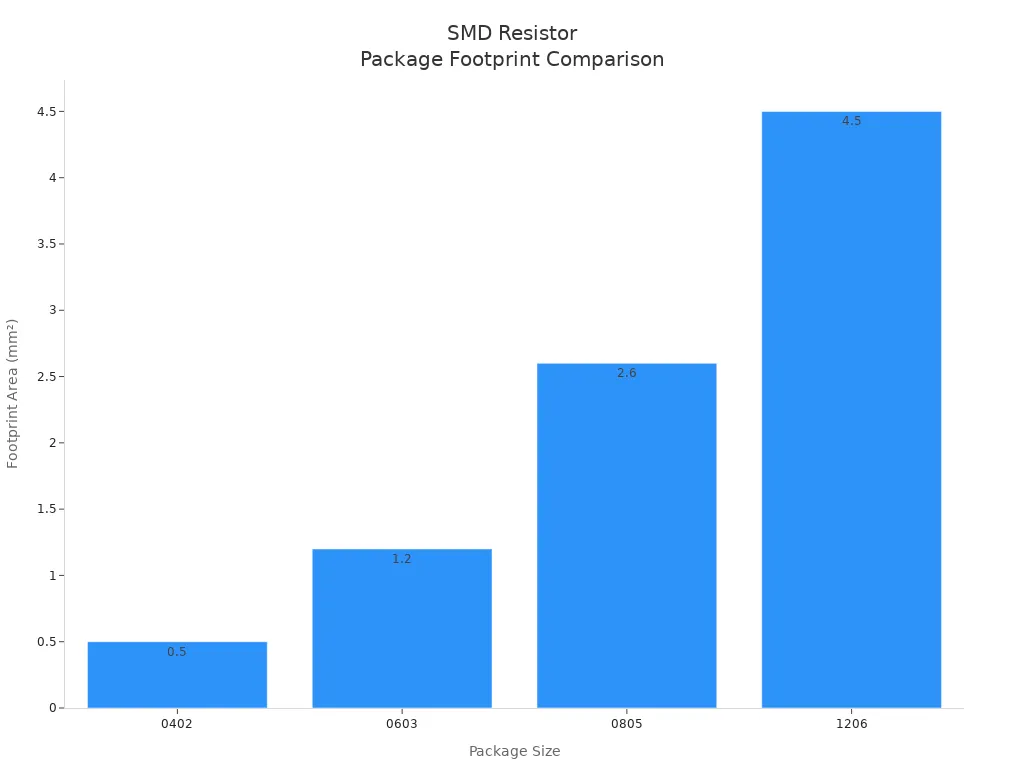
The chart above shows that the 0402 package takes up much less space than larger smd resistors. This makes the Yageo RC0402FR-0710KL a top choice for engineers who need to save space on their boards.
Reliability and Compliance
The Yageo RC0402FR-0710KL offers more than just small size and stable performance. This smd resistor meets strict environmental and safety standards. It is lead-free and fully RoHS compliant. These certifications mean the resistor does not contain hazardous substances, making it safe for both users and the environment.
This resistor also shows strong reliability in harsh conditions. The thick film construction gives it good durability and moisture resistance. The RC_L series, which includes the Yageo RC0402FR-0710KL, performs well in extreme temperatures and high humidity. The operating range from -55°C to +155°C allows it to work in many different environments.
Note: Proper storage helps maintain the resistor’s quality. Keep it in a dry, temperature-controlled place with humidity below 60% RH. Avoid direct sunlight and physical stress to prevent damage. Use anti-static packaging to protect against static electricity.
Key reliability features include:
Moisture resistance for use in humid environments
Wide operating temperature range for harsh conditions
Thick film technology for stable performance
Compatibility with automated SMT assembly for efficient manufacturing
The Yageo RC0402FR-0710KL fits well in automated production lines. Its surface mount design allows for fast and accurate placement by machines. This makes it a reliable choice for high-volume manufacturing of modern electronics.
SMD Applications
SMD resistors play a vital role in many electronic applications. Their small size and reliable performance make them a top choice for engineers. These components appear in almost every modern device. The following sections explore how smd resistors support both consumer electronics and industrial or automotive systems.
Consumer Electronics
People rely on smartphones, tablets, and laptops every day. Inside these devices, smd resistors help control current and voltage. Their compact design allows engineers to fit more features into smaller spaces. SMD resistors support high-density circuit layouts, which are essential for modern gadgets.
SMD resistors appear in many consumer applications:
Smartphones
Tablets
Laptops
Wearable devices
Televisions
Game consoles
These resistors help protect sensitive parts by limiting current. They also divide voltage to create reference signals for sensors and chips. Their small size makes them perfect for devices where space is limited. SMD resistors also work well with automated assembly machines, which speeds up production and improves quality.
SMD resistors keep electronic devices safe and reliable. They help prevent damage from too much current and make sure each part gets the right voltage.
SMD resistors also support miniaturization. Smaller resistors save space on printed circuit boards. This allows designers to add more functions or shrink the device. Their short connections improve signal quality, which is important for fast and powerful electronics.
Industrial and Automotive
Industrial and automotive applications demand high reliability. SMD resistors like the Yageo RC0402FR-0710KL meet these needs. They work well in harsh environments, such as factories or vehicles, where temperature and moisture can change quickly.
The table below shows how the Yageo RC0402FR-0710KL fits industrial and automotive applications:
| Feature | Yageo RC0402FR-0710KL SMD Resistor |
|---|---|
| Power Rating | 62.5 mW (1/16 W) |
| Moisture Resistance | Yes |
| Technology | Thick Film |
| Operating Temperature | -55°C to +155°C |
| Case Size | 0402 (1.0 mm x 0.5 mm) |
| Mounting Style | PCB Mount |
| Application | High Reliability, Industrial Use |
| Features | Space-saving design, moisture resistant, high reliability |
Factories use smd resistors in control panels, sensors, and power supplies. Cars rely on these resistors for engine control units, lighting systems, and safety features. The wide temperature range and moisture resistance help smd resistors survive tough conditions. Their stable performance ensures that machines and vehicles operate safely.
SMD resistors support many circuit roles in both consumer and industrial applications:
Voltage divider: Sets precise voltage levels for sensors and chips.
Current limiter: Protects LEDs and other parts from too much current.
Pull-up or pull-down: Keeps signals at the correct logic level.
Signal conditioning: Reduces noise and improves data quality.
Engineers select smd resistors based on power rating, tolerance, and temperature needs. These choices help ensure that circuits work well and last a long time. SMD resistors use less power and provide accurate signals, which is important for sensitive and low-power devices.
SMD resistors enable the miniaturization of electronics. They allow more complex circuits in smaller packages, making advanced technology possible in both homes and industries.
Advantages and Limits
Benefits
SMD resistors like the Yageo RC0402FR-0710KL offer many advantages for modern electronics. Engineers choose these components for their stability and reliability in a wide range of applications. The compact 0402 package allows designers to fit more parts on high-density boards. This makes smd resistors ideal for smartphones, tablets, and other small devices.
Key benefits include:
High accuracy with precise resistance values for stable circuit operation
Low tolerance of 1% for consistent performance in demanding applications
Heat resistance supports long-term use in harsh environments
Stable resistance values under different temperatures and humidity
Vibration resistance for automotive and industrial applications
Compliance with industry standards ensures quality and reliability
SMD resistors also help lower manufacturing costs. The table below compares smd resistors to traditional through-hole types:
| Feature/Aspect | Through-Hole Resistors | Surface Mount (SMD) Resistors |
|---|---|---|
| Typical Use | Prototyping, hobbyist projects, small-scale production | Mass manufacturing, automated assembly |
| Assembly Method | Manual insertion or specialized insertion machines | Automated pick-and-place machines |
| Unit Cost | Generally higher per unit | Generally lower per unit, especially in bulk |
| Size | Larger, with leads for insertion | Smaller, flat package |
| Board Space | Requires more board space | More space-efficient |
| Cost Impact of Volume | Less benefit from bulk discounts | Significant cost reduction with bulk purchasing |
Bulk orders can reduce the unit price of smd resistors by up to 80%. This cost efficiency supports large-scale production.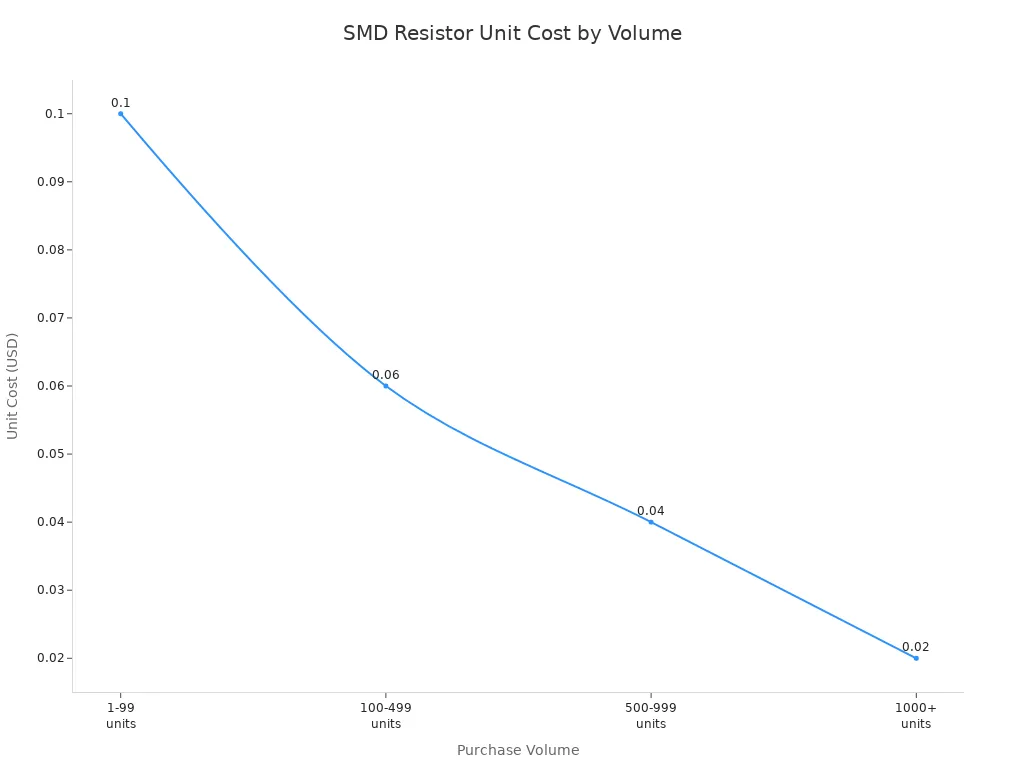
SMD resistors also produce low noise in most general applications. Their design supports reliable signal processing in many circuits.
Drawbacks
Despite many strengths, thick film smd resistors have some limits. Their power handling is lower than some other types. Most smd resistors in the 0402 size can only handle up to 0.063 watts. This restricts their use in high-power applications.
Thick film resistors also have higher tolerance and temperature coefficients than thin film types. This means their resistance can change more with temperature. For critical applications, thin film resistors offer better precision and lower noise. Thick film resistors may show more excess noise and less linearity, which can affect sensitive audio or measurement circuits.
The table below highlights some limits of thick film smd resistors:
| Characteristic | Thick Film SMD Resistors |
|---|---|
| Tolerance | ±1% to ±5% (less precise) |
| Temperature Coefficient (TCR) | 50 to 200 ppm/°C (higher variation with temperature) |
| Power Rating | 1/16 to 1/4 watt (lower power handling) |
| Stability (1000 hours at rated power) | ±1% to ±3% resistance change (lower stability) |
SMD resistors can also fail if exposed to too much heat, humidity, or mechanical stress. Proper design and protection help prevent these issues in demanding applications.
Note: For high-precision or high-power applications, engineers often select thin film or metal film resistors instead of thick film smd types.
The Yageo RC0402FR-0710KL shows how a small component can make a big difference in electronics. SMD resistors appear in almost every advanced device, where they control current and protect circuits from damage. Their compact size and strong coatings help them last longer, even in tough conditions. Manufacturers trust these smd resistors for reliable, automated assembly. People often overlook their value, but these parts keep technology running smoothly every day.
FAQ
What does the 0402 size mean for SMD resistors?
The 0402 size shows the resistor’s length and width in inches. It measures 0.04 inches long and 0.02 inches wide. This small size helps engineers design compact electronic devices.
How does the Yageo RC0402FR-0710KL handle moisture?
This resistor uses thick film technology. It resists moisture and works well in humid environments. The design helps prevent damage from water and keeps circuits safe.
Why is a chip resistor guide important for beginners?
A chip resistor guide helps new engineers choose the right resistor. It explains sizes, values, and uses. This guide makes learning about SMD resistors easier and faster.
What is the best way to perform testing on SMD resistors?
Engineers use a digital multimeter for testing. They measure resistance to check if the value matches the label. Proper testing ensures the resistor works as expected in the circuit.
Can the Yageo RC0402FR-0710KL be used in automotive circuits?
Yes, this resistor fits automotive circuits. It handles wide temperature ranges and vibration. Many car systems use it for stable and reliable performance.
Specifications
- TypeParameter
- Factory Lead Time33 Weeks
- Mounting Type
The "Mounting Type" in electronic components refers to the method used to attach or connect a component to a circuit board or other substrate, such as through-hole, surface-mount, or panel mount.
Surface Mount - Package / Case
refers to the protective housing that encases an electronic component, providing mechanical support, electrical connections, and thermal management.
0402 (1005 Metric) - Terminal Shape
Terminal Shape in electronic components refers to the physical design of the connection points on the component that allow for electrical connections to be made. These terminals can come in various shapes such as pins, leads, pads, or terminals with specific configurations like surface mount or through-hole. The terminal shape is important as it determines how the component can be mounted on a circuit board or connected to other components. Different terminal shapes are used based on the specific requirements of the electronic circuit design and manufacturing process.
WRAPAROUND - Voltage Rated
RATED voltage is the voltage on the nameplate - the "design point" for maximum power throughput and safe thermal operation.
50V - Voltage - Rated (DC)50V
- Operating Temperature
The operating temperature is the range of ambient temperature within which a power supply, or any other electrical equipment, operate in. This ranges from a minimum operating temperature, to a peak or maximum operating temperature, outside which, the power supply may fail.
-55°C~155°C - Packaging
Semiconductor package is a carrier / shell used to contain and cover one or more semiconductor components or integrated circuits. The material of the shell can be metal, plastic, glass or ceramic.
Tape & Reel (TR) - Series
In electronic components, the "Series" refers to a group of products that share similar characteristics, designs, or functionalities, often produced by the same manufacturer. These components within a series typically have common specifications but may vary in terms of voltage, power, or packaging to meet different application needs. The series name helps identify and differentiate between various product lines within a manufacturer's catalog.
RC - Published2008
- Size / Dimension
In electronic components, the parameter "Size / Dimension" refers to the physical dimensions of the component, such as its length, width, and height. These dimensions are crucial for determining how the component will fit into a circuit or system, as well as for ensuring compatibility with other components and the overall design requirements. The size of a component can also impact its performance characteristics, thermal properties, and overall functionality within a given application. Engineers and designers must carefully consider the size and dimensions of electronic components to ensure proper integration and functionality within their designs.
0.039Lx0.020W 1.00mmx0.50mm - Tolerance
In electronic components, "tolerance" refers to the acceptable deviation or variation from the specified or ideal value of a particular parameter, such as resistance, capacitance, or voltage. It indicates the range within which the actual value of the component can fluctuate while still being considered acceptable for use in a circuit. Tolerance is typically expressed as a percentage or a specific value and is important for ensuring the accuracy and reliability of electronic devices. Components with tighter tolerances are more precise but may also be more expensive. It is crucial to consider tolerance when selecting components to ensure proper functionality and performance of the circuit.
±1% - JESD-609 Code
The "JESD-609 Code" in electronic components refers to a standardized marking code that indicates the lead-free solder composition and finish of electronic components for compliance with environmental regulations.
e3 - Pbfree Code
The "Pbfree Code" parameter in electronic components refers to the code or marking used to indicate that the component is lead-free. Lead (Pb) is a toxic substance that has been widely used in electronic components for many years, but due to environmental concerns, there has been a shift towards lead-free alternatives. The Pbfree Code helps manufacturers and users easily identify components that do not contain lead, ensuring compliance with regulations and promoting environmentally friendly practices. It is important to pay attention to the Pbfree Code when selecting electronic components to ensure they meet the necessary requirements for lead-free applications.
yes - Part Status
Parts can have many statuses as they progress through the configuration, analysis, review, and approval stages.
Active - Moisture Sensitivity Level (MSL)
Moisture Sensitivity Level (MSL) is a standardized rating that indicates the susceptibility of electronic components, particularly semiconductors, to moisture-induced damage during storage and the soldering process, defining the allowable exposure time to ambient conditions before they require special handling or baking to prevent failures
1 (Unlimited) - Number of Terminations2
- Termination
Termination in electronic components refers to the practice of matching the impedance of a circuit to prevent signal reflections and ensure maximum power transfer. It involves the use of resistors or other components at the end of transmission lines or connections. Proper termination is crucial in high-frequency applications to maintain signal integrity and reduce noise.
SMD/SMT - Temperature Coefficient
The resistance-change factor per degree Celsius of temperature change is called the temperature coefficient of resistance. This factor is represented by the Greek lower-case letter “alpha” (α). A positive coefficient for a material means that its resistance increases with an increase in temperature.
±100ppm/°C - Resistance
Resistance is a fundamental property of electronic components that measures their opposition to the flow of electric current. It is denoted by the symbol "R" and is measured in ohms (Ω). Resistance is caused by the collisions of electrons with atoms in a material, which generates heat and reduces the flow of current. Components with higher resistance will impede the flow of current more than those with lower resistance. Resistance plays a crucial role in determining the behavior and functionality of electronic circuits, such as limiting current flow, voltage division, and controlling power dissipation.
10kOhm - Terminal Finish
Terminal Finish refers to the surface treatment applied to the terminals or leads of electronic components to enhance their performance and longevity. It can improve solderability, corrosion resistance, and overall reliability of the connection in electronic assemblies. Common finishes include nickel, gold, and tin, each possessing distinct properties suitable for various applications. The choice of terminal finish can significantly impact the durability and effectiveness of electronic devices.
Matte Tin (Sn) - with Nickel (Ni) barrier - Composition
Parameter "Composition" in electronic components refers to the specific materials and substances used in the construction of the component. It encompasses the chemical and physical elements that make up the component, influencing its electrical, thermal, and mechanical properties. The composition can affect the performance, reliability, and durability of the component in various applications. Understanding the composition is essential for optimizing the design and functionality of electronic devices.
Thick Film - Power (Watts)
The parameter "Power (Watts)" in electronic components refers to the amount of electrical energy consumed or dissipated by the component. It is a measure of how much energy the component can handle or generate. Power is typically measured in watts, which is a unit of power that indicates the rate at which energy is transferred. Understanding the power rating of electronic components is crucial for ensuring they operate within their specified limits to prevent overheating and potential damage. It is important to consider power requirements when designing circuits or selecting components to ensure proper functionality and reliability.
0.063W 1/16W - Depth
In electronic components, "Depth" typically refers to the measurement of the distance from the front to the back of the component. It is an important parameter to consider when designing or selecting components for a project, as it determines how much space the component will occupy within a circuit or device. The depth of a component can impact the overall size and layout of the circuit board or enclosure in which it will be installed. It is usually specified in millimeters or inches and is crucial for ensuring proper fit and functionality within the intended application.
500μm - Construction
Construction in electronic components refers to the design and materials used in the manufacturing of the components. It encompasses the physical structure, arrangement, and integration of various parts like substrates, conductors, and insulators. The construction impacts the performance, reliability, and thermal properties of the component, influencing how it interacts with electrical signals and other components in a circuit. Different construction techniques can also affect the size, weight, and cost of the electronic component.
Rectangular - Resistor Type
The parameter "Resistor Type" in electronic components refers to the specific material and construction of a resistor that determines its electrical properties and performance characteristics. There are various types of resistors available, such as carbon film, metal film, wirewound, and thick film resistors, each with its own advantages and applications. The resistor type affects factors like tolerance, temperature coefficient, power rating, and stability, which are important considerations when selecting a resistor for a particular circuit. Choosing the right resistor type is crucial for ensuring proper functionality and reliability of electronic devices and circuits.
FIXED RESISTOR - Military Standard
Military Standard in electronic components refers to a set of guidelines and specifications established by the military for the design, manufacturing, and testing of electronic devices used in military applications. These standards ensure that the components meet specific requirements for reliability, durability, performance, and environmental conditions. Components that meet military standards are often more rugged and capable of withstanding harsh operating conditions such as extreme temperatures, vibrations, and electromagnetic interference. Adhering to military standards helps to ensure the quality and consistency of electronic components used in critical military systems and applications.
Not - Case Code (Imperial)
The term "Case Code (Imperial)" in electronic components refers to a standardized system used to specify the physical dimensions and package types of components, particularly capacitors and resistors. This code helps manufacturers and engineers identify the size and form factor of the component, ensuring compatibility with circuit designs and PCB layouts. In the context of electronic components, the Case Code (Imperial) typically follows a numerical format that indicates the length and width of the component in inches. For example, a Case Code of 1206 signifies a component that measures 0.12 inches by 0.06 inches. This coding system is essential for selecting the correct components for specific applications, as it provides a quick reference to the physical characteristics of the part, including its footprint and mounting style.
0402 - Lead Pitch
Lead pitch in electronic components refers to the distance between the center of one lead (or pin) of a component to the center of the adjacent lead. It is an important parameter to consider when designing and assembling electronic circuits, as it determines the spacing required on a circuit board for proper placement and soldering of the component. Lead pitch is typically specified in millimeters or inches and can vary depending on the type of component, such as integrated circuits, resistors, capacitors, and connectors. Choosing the correct lead pitch ensures proper alignment and connection of components on a circuit board, ultimately affecting the functionality and reliability of the electronic device.
200μm - Working Voltage
The "Working Voltage" parameter in electronic components refers to the maximum voltage that the component can safely handle while operating within its specified parameters. It is a crucial specification to consider when designing or selecting components for a circuit to prevent damage or failure. Exceeding the working voltage can lead to breakdown or insulation failure, potentially causing the component to malfunction or even become permanently damaged. It is important to always operate electronic components within their specified working voltage range to ensure reliable and safe operation of the circuit.
50V - Features
In the context of electronic components, the term "Features" typically refers to the specific characteristics or functionalities that a particular component offers. These features can vary depending on the type of component and its intended use. For example, a microcontroller may have features such as built-in memory, analog-to-digital converters, and communication interfaces like UART or SPI.When evaluating electronic components, understanding their features is crucial in determining whether they meet the requirements of a particular project or application. Engineers and designers often look at features such as operating voltage, speed, power consumption, and communication protocols to ensure compatibility and optimal performance.In summary, the "Features" parameter in electronic components describes the unique attributes and capabilities that differentiate one component from another, helping users make informed decisions when selecting components for their electronic designs.
Moisture Resistant - Height400μm
- Height Seated (Max)
Height Seated (Max) is a parameter in electronic components that refers to the maximum allowable height of the component when it is properly seated or installed on a circuit board or within an enclosure. This specification is crucial for ensuring proper fit and alignment within the overall system design. Exceeding the maximum seated height can lead to mechanical interference, electrical shorts, or other issues that may impact the performance and reliability of the electronic device. Manufacturers provide this information to help designers and engineers select components that will fit within the designated space and function correctly in the intended application.
0.016 0.40mm - REACH SVHC
The parameter "REACH SVHC" in electronic components refers to the compliance with the Registration, Evaluation, Authorization, and Restriction of Chemicals (REACH) regulation regarding Substances of Very High Concern (SVHC). SVHCs are substances that may have serious effects on human health or the environment, and their use is regulated under REACH to ensure their safe handling and minimize their impact.Manufacturers of electronic components need to declare if their products contain any SVHCs above a certain threshold concentration and provide information on the safe use of these substances. This information allows customers to make informed decisions about the potential risks associated with using the components and take appropriate measures to mitigate any hazards.Ensuring compliance with REACH SVHC requirements is essential for electronics manufacturers to meet regulatory standards, protect human health and the environment, and maintain transparency in their supply chain. It also demonstrates a commitment to sustainability and responsible manufacturing practices in the electronics industry.
No SVHC - RoHS Status
RoHS means “Restriction of Certain Hazardous Substances” in the “Hazardous Substances Directive” in electrical and electronic equipment.
ROHS3 Compliant - Lead Free
Lead Free is a term used to describe electronic components that do not contain lead as part of their composition. Lead is a toxic material that can have harmful effects on human health and the environment, so the electronics industry has been moving towards lead-free components to reduce these risks. Lead-free components are typically made using alternative materials such as silver, copper, and tin. Manufacturers must comply with regulations such as the Restriction of Hazardous Substances (RoHS) directive to ensure that their products are lead-free and environmentally friendly.
Lead Free
Parts with Similar Specs
- ImagePart NumberManufacturerTolerancePower (Watts)CompositionPackage / CaseContact PlatingView Compare
![RC0402FR-0710KL]()
RC0402FR-0710KL
±1%
0.063W, 1/16W
Thick Film
0402 (1005 Metric)
-
![RN73H1ETTP1300F25]()
±1%
0.063W, 1/16W
Thick Film
0402 (1005 Metric)
-
![RN73R1ETTP3050F50]()
±1%
0.063W, 1/16W
Metal Film
0402 (1005 Metric)
-
![RN731ETTP1450F25]()
±1%
0.063W, 1/16W
Thin Film
0402 (1005 Metric)
-
![RN731ETTP2770F50]()
±1%
0.063W, 1/16W
Thin Film
0402 (1005 Metric)
-



Datasheet PDF
- Datasheets :
- RohsStatement :
 AD825 125 V/µs High-Speed JFET Op-Amp: Performance Analysis, Pinout, and Audio Design Guide
17 March 2026214
 BC338 NPN Transistor: Pinout, Datasheet, and Equivalents
25 August 20217461
![MJE3055T Bipolar (BJT) Transistor NPN 60 V 10 A[Video]: Datasheet, Pinout, and Features](https://res.utmel.com/Images/Article/9450e3cd-4f81-4ab1-a1bd-de2561ca7ecf.png) MJE3055T Bipolar (BJT) Transistor NPN 60 V 10 A[Video]: Datasheet, Pinout, and Features
MJE3055T Bipolar (BJT) Transistor NPN 60 V 10 A[Video]: Datasheet, Pinout, and Features06 April 20223751
 LM1458 Dual Op-Amp : Pinout, Applications and Datasheet
10 August 20214252
 Footprint of STM8S103K3T6C Microcontroller
24 July 2025413
 DS3231M RTC: Pinout, Application, Circuit
16 August 20215236
 BD679 Transistor: Pinout, Equivalent and Datasheet
31 August 20217564
 AV101KE Through Hole Resistor: Datasheet, Application, Features
30 July 2021997
 Emerging Trends in Complex Programmable Logic Devices Market 2025
16 June 20251055
 Hydrogen Fuel Cell: Features, Working and Applications
21 June 20216909
 AC/DC, DC/DC Converter Fundamental Guide
04 June 202615392
 Commonly Used Circuit Protection Components: How to Match the Right Device to Each Threat
14 July 20267019
 15 Key Elements of Diode Selection
26 November 202119459
 Arduino and Bluetooth Based Home Automation
29 August 20239412
 What is ToF Technology?
22 January 20213751
 What is Safety Relay?
12 April 202526292
Yageo
In Stock: 660013
United States
China
Canada
Japan
Russia
Germany
United Kingdom
Singapore
Italy
Hong Kong(China)
Taiwan(China)
France
Korea
Mexico
Netherlands
Malaysia
Austria
Spain
Switzerland
Poland
Thailand
Vietnam
India
United Arab Emirates
Afghanistan
Åland Islands
Albania
Algeria
American Samoa
Andorra
Angola
Anguilla
Antigua & Barbuda
Argentina
Armenia
Aruba
Australia
Azerbaijan
Bahamas
Bahrain
Bangladesh
Barbados
Belarus
Belgium
Belize
Benin
Bermuda
Bhutan
Bolivia
Bonaire, Sint Eustatius and Saba
Bosnia & Herzegovina
Botswana
Brazil
British Indian Ocean Territory
British Virgin Islands
Brunei
Bulgaria
Burkina Faso
Burundi
Cabo Verde
Cambodia
Cameroon
Cayman Islands
Central African Republic
Chad
Chile
Christmas Island
Cocos (Keeling) Islands
Colombia
Comoros
Congo
Congo (DRC)
Cook Islands
Costa Rica
Côte d’Ivoire
Croatia
Cuba
Curaçao
Cyprus
Czechia
Denmark
Djibouti
Dominica
Dominican Republic
Ecuador
Egypt
El Salvador
Equatorial Guinea
Eritrea
Estonia
Eswatini
Ethiopia
Falkland Islands
Faroe Islands
Fiji
Finland
French Guiana
French Polynesia
Gabon
Gambia
Georgia
Ghana
Gibraltar
Greece
Greenland
Grenada
Guadeloupe
Guam
Guatemala
Guernsey
Guinea
Guinea-Bissau
Guyana
Haiti
Honduras
Hungary
Iceland
Indonesia
Iran
Iraq
Ireland
Isle of Man
Israel
Jamaica
Jersey
Jordan
Kazakhstan
Kenya
Kiribati
Kosovo
Kuwait
Kyrgyzstan
Laos
Latvia
Lebanon
Lesotho
Liberia
Libya
Liechtenstein
Lithuania
Luxembourg
Macao(China)
Madagascar
Malawi
Maldives
Mali
Malta
Marshall Islands
Martinique
Mauritania
Mauritius
Mayotte
Micronesia
Moldova
Monaco
Mongolia
Montenegro
Montserrat
Morocco
Mozambique
Myanmar
Namibia
Nauru
Nepal
New Caledonia
New Zealand
Nicaragua
Niger
Nigeria
Niue
Norfolk Island
North Korea
North Macedonia
Northern Mariana Islands
Norway
Oman
Pakistan
Palau
Palestinian Authority
Panama
Papua New Guinea
Paraguay
Peru
Philippines
Pitcairn Islands
Portugal
Puerto Rico
Qatar
Réunion
Romania
Rwanda
Samoa
San Marino
São Tomé & Príncipe
Saudi Arabia
Senegal
Serbia
Seychelles
Sierra Leone
Sint Maarten
Slovakia
Slovenia
Solomon Islands
Somalia
South Africa
South Sudan
Sri Lanka
St Helena, Ascension, Tristan da Cunha
St. Barthélemy
St. Kitts & Nevis
St. Lucia
St. Martin
St. Pierre & Miquelon
St. Vincent & Grenadines
Sudan
Suriname
Svalbard & Jan Mayen
Sweden
Syria
Tajikistan
Tanzania
Timor-Leste
Togo
Tokelau
Tonga
Trinidad & Tobago
Tunisia
Turkey
Turkmenistan
Turks & Caicos Islands
Tuvalu
U.S. Outlying Islands
U.S. Virgin Islands
Uganda
Ukraine
Uruguay
Uzbekistan
Vanuatu
Vatican City
Venezuela
Wallis & Futuna
Yemen
Zambia
Zimbabwe
![RT0603BRD071ML]() RT0603BRD071ML
RT0603BRD071MLYageo
![RT1206DRE072K61L]() RT1206DRE072K61L
RT1206DRE072K61LYageo
![RT0603BRE07750RL]() RT0603BRE07750RL
RT0603BRE07750RLYageo
![RE0402DRE0762KL]() RE0402DRE0762KL
RE0402DRE0762KLYageo
![RE0402DRE0736KL]() RE0402DRE0736KL
RE0402DRE0736KLYageo
![RT0603DRE0725K2L]() RT0603DRE0725K2L
RT0603DRE0725K2LYageo
![RT0805FRD07200KL]() RT0805FRD07200KL
RT0805FRD07200KLYageo
![AC2512FK-07619RL]() AC2512FK-07619RL
AC2512FK-07619RLYageo
![RT2512BKE07210KL]() RT2512BKE07210KL
RT2512BKE07210KLYageo
![RC0201DR-0710RL]() RC0201DR-0710RL
RC0201DR-0710RLYageo


