Product
 Brand
Brand Articles
 Tools
Tools
Quick Answer: What Is RF Technology?
RF technology, or radio frequency technology, uses electromagnetic waves to transmit, receive, sense, identify, or control information wirelessly. In practical engineering, RF usually refers to radio-frequency signals from the kilohertz range up to microwave and millimeter-wave frequencies. It powers everyday systems such as Wi-Fi, Bluetooth, cellular networks, GPS, RFID, remote controls, and satellite links, but it is also essential in radar, aerospace, medical equipment, industrial automation, test systems, and RF components such as switches, filters, amplifiers, connectors, and antennas.
The most important RF specifications are frequency range, bandwidth, output power, receiver sensitivity, gain, noise figure, insertion loss, isolation, impedance, VSWR or return loss, modulation type, linearity, power handling, and regulatory compliance. Choosing RF technology is not only about selecting the highest frequency or strongest signal. A good RF design balances range, data rate, antenna size, power consumption, interference, environment, cost, and legal spectrum limits.
Why RF Technology Matters
RF technology is the invisible infrastructure behind modern wireless systems. Every time a phone connects to a cellular tower, a Bluetooth headset pairs with a laptop, a warehouse scanner reads an RFID tag, or a radar system detects an object, RF engineering is involved.
However, RF is not a single product category. It can refer to:
A frequency range in the electromagnetic spectrum
A wireless communication method
A signal chain made of antennas, filters, switches, amplifiers, mixers, and receivers
A component category used in RF circuits
A sensing or identification method such as radar, RFID, or RF sensing
A compliance and testing domain for wireless products
This is why many RF articles feel incomplete. Some explain only radio waves, while others focus only on RF components or wireless protocols. A useful RF technology guide should connect the physics, specifications, components, applications, and selection logic in one place.
How RF Technology Works
At a basic level, an RF system converts information into an electromagnetic signal, sends it through space or along a transmission path, and then converts it back into useful information.
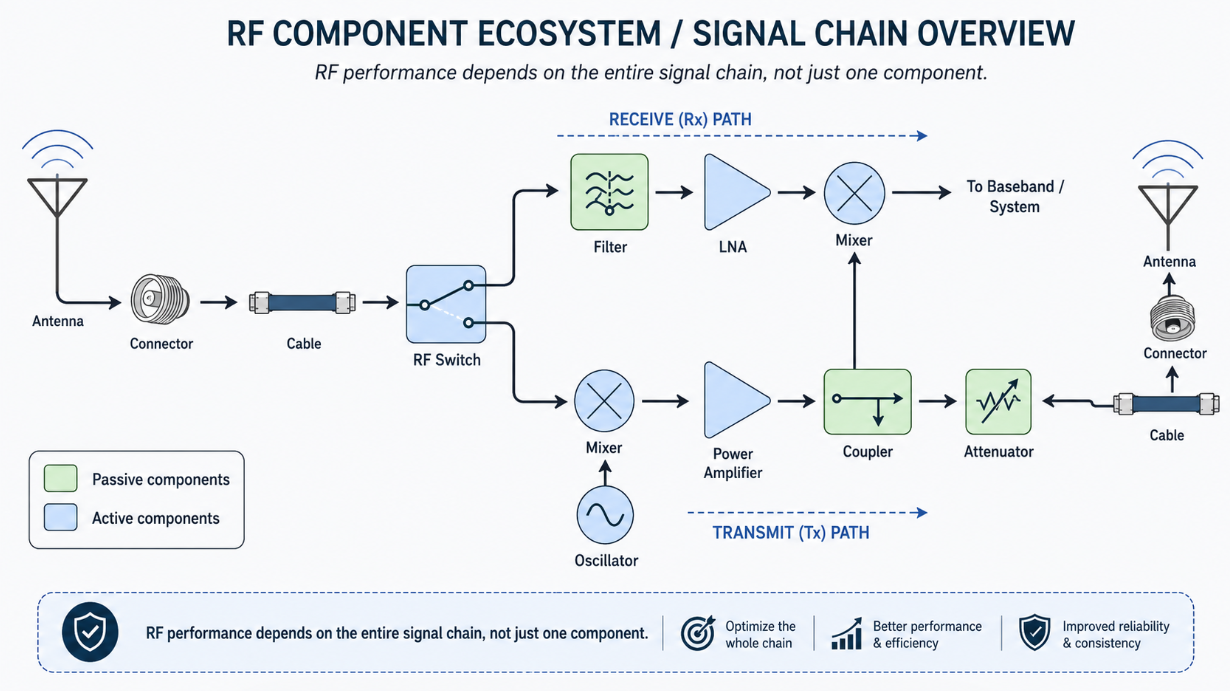
A typical RF communication chain includes:
Baseband or data source – The original information, such as audio, sensor data, video, or digital packets.
Modulator – Converts information into a signal format suitable for RF transmission.
Frequency source or oscillator – Generates the carrier frequency.
Mixer or upconverter – Moves the signal to the desired RF frequency.
Power amplifier – Increases signal strength before transmission.
Filter – Removes unwanted frequencies and reduces interference.
Antenna or transmission line – Radiates the signal into space or carries it through coaxial cable.
Propagation path – Air, space, cable, or another medium.
Receiver antenna or RF input – Captures the signal.
Low-noise amplifier and filters – Improve weak received signals while controlling noise.
Downconverter and demodulator – Recover the original information.
Processor or application system – Uses the data for communication, control, measurement, identification, or sensing.

RF Frequency Bands and What They Are Used For
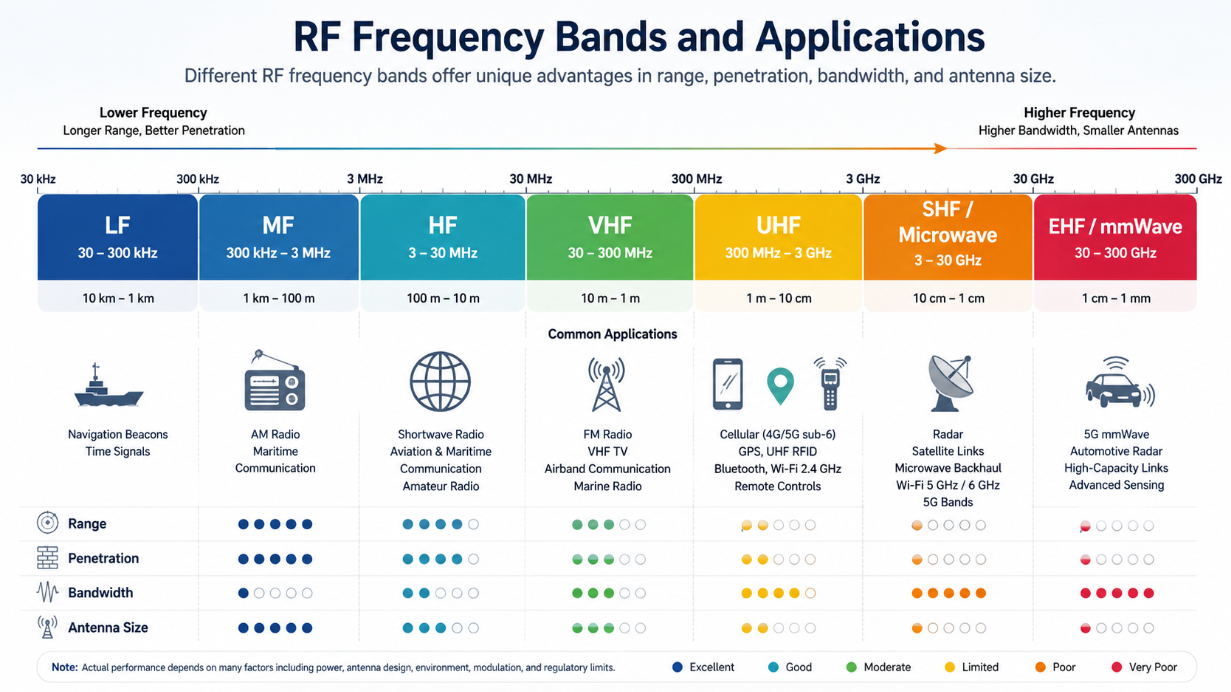
Frequency is the first decision point in RF technology. Lower frequencies generally travel farther and penetrate obstacles better, but they offer less bandwidth and often require larger antennas. Higher frequencies can support wider bandwidth, smaller antennas, and high data rates, but they are more sensitive to blockage, path loss, and design complexity.
| Frequency Band | Approximate Range | Typical Characteristics | Common Applications |
|---|---|---|---|
| LF | 30–300 kHz | Long wavelength, low data capacity, strong propagation characteristics | Navigation, time signals, some low-frequency identification systems |
| MF | 300 kHz–3 MHz | Medium range, ground-wave propagation possible | AM broadcasting, maritime communication |
| HF | 3–30 MHz | Long-distance skywave propagation under suitable conditions | Shortwave radio, amateur radio, aviation and maritime communication |
| VHF | 30–300 MHz | Good balance of range and antenna size | FM radio, VHF TV, airband communication, marine radio |
| UHF | 300 MHz–3 GHz | Common for mobile and short-range wireless systems | Cellular, GPS, UHF RFID, Bluetooth, Wi-Fi 2.4 GHz, remote controls |
| SHF / Microwave | 3–30 GHz | Higher bandwidth, smaller antennas, more line-of-sight behavior | Radar, satellite links, microwave backhaul, Wi-Fi 5 GHz/6 GHz, 5G bands |
| EHF / mmWave | 30–300 GHz | Very wide bandwidth, short range, high path loss, precise beamforming often needed | 5G mmWave, automotive radar, high-capacity point-to-point links, advanced sensing |
A frequency band does not automatically define performance. The final result depends on output power, antenna design, modulation, receiver sensitivity, bandwidth, regulatory limits, installation environment, and interference.
Core RF Specifications Explained
RF specifications are not just datasheet numbers. Each one describes a design trade-off. The most important specs are listed below.
| RF Specification | What It Means | Why It Matters |
|---|---|---|
| Frequency range | The operating frequency or supported band | Determines compatibility with protocols, antennas, filters, and regulations |
| Bandwidth | The width of spectrum used by the signal | Affects data rate, resolution, and channel planning |
| Output power | Transmit power, often in watts or dBm | Influences range but is limited by regulation, heat, and battery life |
| EIRP | Effective isotropic radiated power | Combines transmitter output and antenna gain for regulatory and coverage analysis |
| Receiver sensitivity | Weakest signal the receiver can detect reliably | Affects real-world range and link reliability |
| Noise figure | Noise added by the receiver or amplifier | Lower noise figure helps weak-signal performance |
| Gain | Signal amplification or antenna directivity | Useful for coverage, but too much gain can create distortion or regulatory issues |
| Insertion loss | Signal loss caused by inserting a component | Critical for switches, filters, cables, adapters, and connectors |
| Isolation | How well a switch, filter, or path blocks unwanted signals | Important for RF switches, duplexers, and multi-path systems |
| Return loss / VSWR | How well impedance is matched | Poor matching reflects energy and reduces performance |
| Impedance | RF system resistance to AC signal flow, commonly standardized in RF systems | Mismatched impedance causes reflections and power loss |
| Modulation | How data is encoded onto the RF carrier | Determines data rate, robustness, and receiver complexity |
| Phase noise | Frequency stability and spectral purity of an oscillator | Important in radar, high-speed communication, and precision systems |
| Linearity / IP3 / P1dB | How well components handle strong signals without distortion | Critical in crowded RF environments |
| Switching time | Time needed for an RF switch to change states | Important in test systems, beamforming, and multi-band radios |
| Power handling | Maximum RF power a component can tolerate | Prevents overheating, compression, or failure |
| Temperature range | Environmental operating limits | Important for automotive, industrial, aerospace, and outdoor applications |
| Compliance | Conformity with spectrum, EMC, exposure, or product rules | Required before many wireless products can be sold or deployed |
The Most Common RF Specification Mistake
The biggest mistake is treating one strong number as proof of good performance. A high-gain antenna, low-noise amplifier, or wide-band RF switch may still be unsuitable if the impedance, frequency range, power handling, linearity, isolation, connector type, or environmental rating does not match the system.
Main RF Components in a Wireless System
RF systems are built from active and passive components. The exact signal chain depends on whether the design is a transmitter, receiver, transceiver, radar system, RFID reader, satellite terminal, test setup, or IoT device.
Antennas
Antennas convert electrical RF signals into electromagnetic waves and vice versa. Antenna type, gain, polarization, size, placement, and surrounding materials strongly affect real-world performance. A well-designed RF circuit can perform poorly if the antenna is blocked, detuned, or installed in the wrong environment.
Filters
RF filters pass desired frequency ranges and reject unwanted signals. They are used to reduce interference, meet spectral requirements, and protect receivers from out-of-band energy.
Low-Noise Amplifiers
Low-noise amplifiers, or LNAs, boost weak received signals while adding as little noise as possible. They are especially important in receivers, GPS systems, satellite links, radar front ends, and long-range wireless systems.
Power Amplifiers
Power amplifiers increase transmit signal strength. Their selection depends on output power, efficiency, linearity, frequency range, thermal performance, and modulation type.
RF Switches
RF switches route signals between different paths, antennas, bands, or test ports. Key RF switch specifications include insertion loss, isolation, switching speed, power handling, frequency range, and control voltage.
Mixers and Oscillators
Mixers translate signals between frequencies, while oscillators generate stable RF carrier signals. Their phase noise and frequency stability can strongly affect high-performance communication and radar systems.
Couplers, Splitters, and Attenuators
These components sample, divide, combine, or reduce RF signals. They are common in RF test systems, distributed antenna systems, power monitoring, and calibration setups.
RF Connectors, Cables, and Adapters
Cables and connectors can quietly destroy RF performance if their frequency rating, impedance, connector gender, cable loss, shielding, or mechanical quality is wrong. At microwave and millimeter-wave frequencies, connector quality and cable length become especially important.
RF Technology Applications by Industry
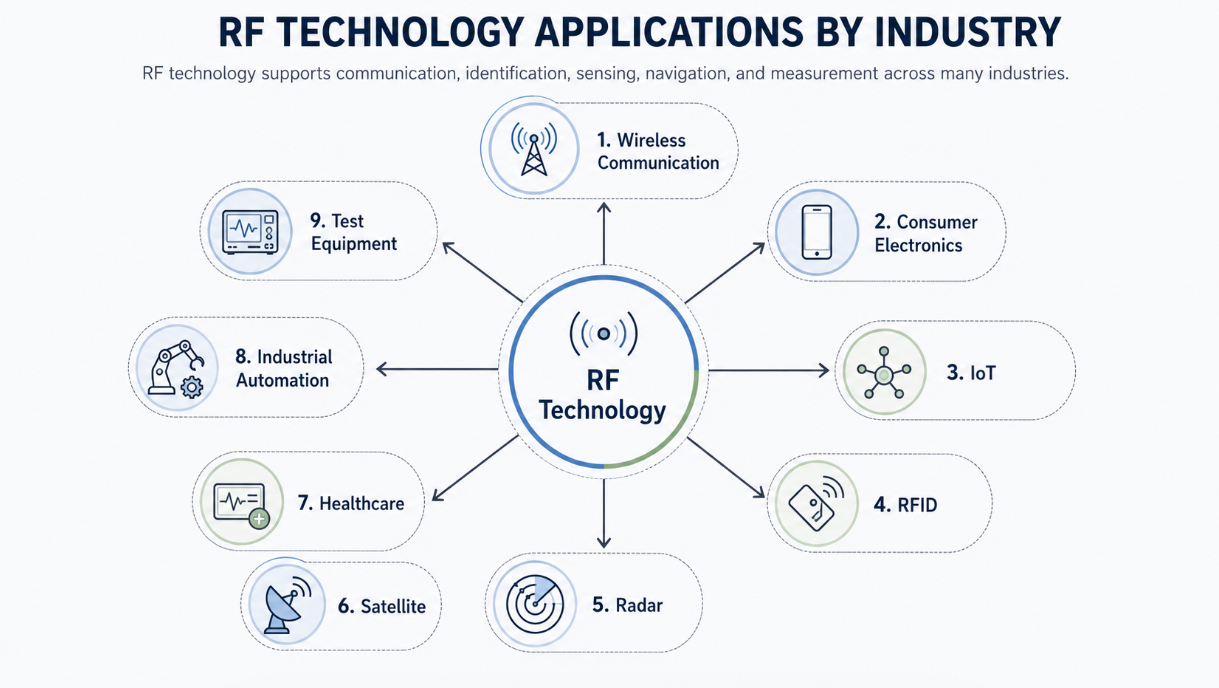
RF technology is used wherever signals need to travel without direct wires, where objects need to be identified, or where electromagnetic waves can sense distance, motion, position, or material behavior.
Wireless Communication
RF is the foundation of cellular networks, Wi-Fi, Bluetooth, radio broadcasting, satellite communication, microwave backhaul, and private wireless systems. Each application uses different frequency bands, modulation techniques, power levels, and antenna architectures.
Consumer Electronics
Smartphones, wireless earbuds, smartwatches, remote controls, smart TVs, routers, gaming accessories, and smart-home devices all depend on RF links. In consumer products, RF design must balance performance, size, battery life, cost, and regulatory certification.
IoT and Industrial Automation
IoT systems use RF for sensor networks, smart meters, asset tracking, industrial monitoring, agriculture, building automation, and logistics. Some systems prioritize long range and low power, while others prioritize low latency, high throughput, or dense device support.
RFID and Contactless Identification
RFID uses radio waves to identify tagged objects or credentials. It is widely used in inventory control, access cards, logistics, retail, manufacturing, libraries, and supply chains. RFID performance depends on tag type, reader power, antenna orientation, frequency band, material environment, and interference.
Radar and Navigation
Radar uses RF energy to detect objects, measure distance, estimate speed, and support navigation. It is used in aviation, weather monitoring, automotive safety systems, defense, marine systems, and industrial sensing.
Aerospace and Satellite Systems
Satellite communication, telemetry, GPS, remote sensing, and aviation systems rely on RF links that must work across long distances and harsh environments. These systems often require precise antennas, stable oscillators, high reliability, and strict compliance.
Healthcare and Scientific Equipment
RF is used in medical imaging, RF ablation, wireless medical devices, laboratory instruments, and research systems. Medical and scientific RF applications require careful design, safety evaluation, shielding, and regulatory review.
Test and Measurement
RF test equipment includes spectrum analyzers, vector network analyzers, signal generators, power meters, oscilloscopes, and RF chambers. Engineers use these tools to measure frequency response, power, noise, modulation quality, impedance matching, emissions, and receiver performance.
How to Choose the Right RF Technology or Component
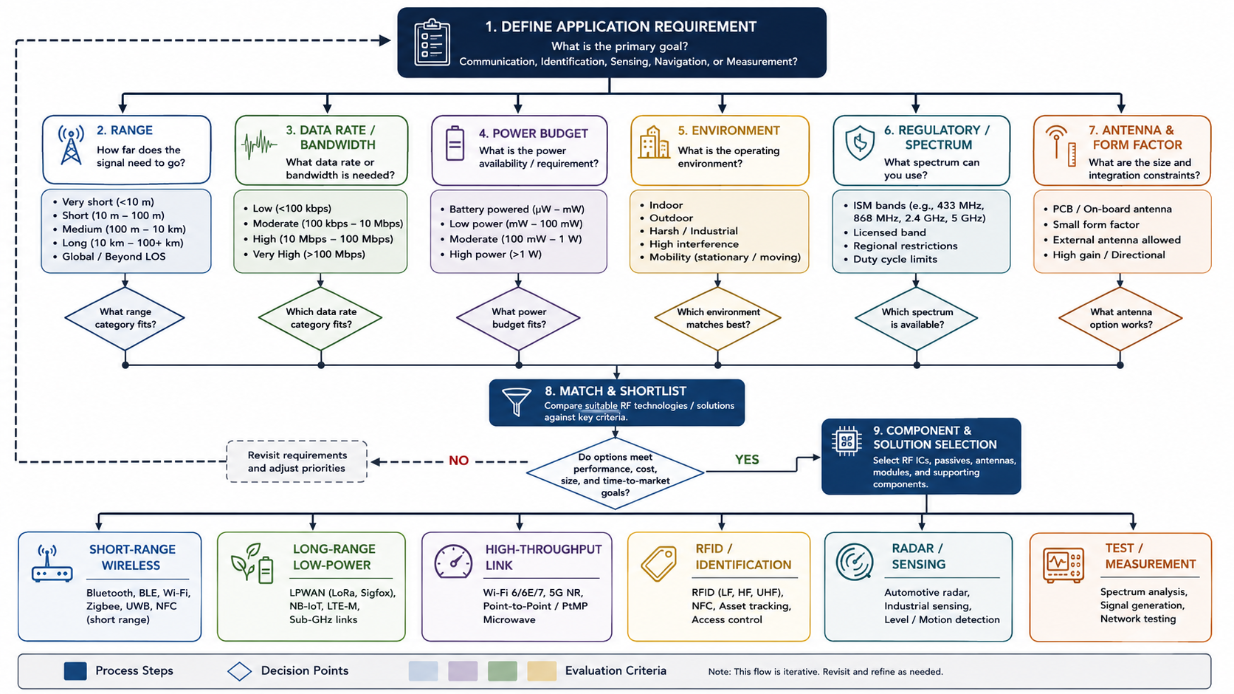
Before selecting an RF module, antenna, switch, connector, transceiver, or wireless protocol, define the system requirement first. The right choice depends on the application, not on the most impressive datasheet headline.
| Selection Question | Why It Matters | What to Check |
|---|---|---|
| What distance must the system cover? | Range affects frequency, power, antenna, and receiver design | Link budget, antenna gain, sensitivity, path loss, environment |
| How much data must be transmitted? | Higher data rates usually need more bandwidth and better signal quality | Bandwidth, modulation, SNR, protocol limits |
| Is the device battery-powered? | Low-power systems may need different protocols and duty cycles | Sleep current, transmit current, protocol overhead, power amplifier efficiency |
| Is the environment crowded or noisy? | Interference can reduce reliability | Frequency planning, filtering, selectivity, coexistence strategy |
| Does the signal need to pass through walls, water, metal, or people? | Materials affect RF propagation differently by frequency | Penetration, multipath, antenna placement, enclosure material |
| Is the spectrum licensed or unlicensed? | Legal use depends on region and frequency allocation | Local rules, certification, permitted power, duty cycle |
| What antenna size is acceptable? | Lower frequencies often require larger antennas | Wavelength, form factor, matching network |
| Is the system mobile or fixed? | Movement changes fading, Doppler, orientation, and coverage | Antenna diversity, protocol robustness, handoff behavior |
| What components must be replaced or sourced? | RF parts are rarely interchangeable by name alone | Frequency range, impedance, package, connector, power, insertion loss, isolation |
| What tests are required before release? | Wireless products often need RF, EMC, and regulatory testing | Pre-compliance scans, conducted/radiated tests, exposure assessment |
Practical Decision Framework
Choose lower frequency when range, penetration, and simpler coverage matter more than bandwidth.
Choose higher frequency when bandwidth, smaller antennas, or directional links matter more than penetration.
Choose licensed spectrum when reliability, interference control, and carrier-grade operation matter.
Choose unlicensed spectrum when cost, flexibility, and fast deployment matter, while accepting interference risk.
Choose narrowband RF when low power and long range matter more than throughput.
Choose wideband RF when high data rates, precise positioning, or high-resolution sensing matter.
Choose components by system-level fit, not by isolated specs.
Common RF Design and Buying Mistakes
Mistake 1: Assuming More Power Always Means Better Range
More transmit power can improve range, but it can also increase heat, battery drain, interference, distortion, and regulatory risk. Receiver sensitivity, antenna design, noise, line-of-sight conditions, and link budget often matter just as much.
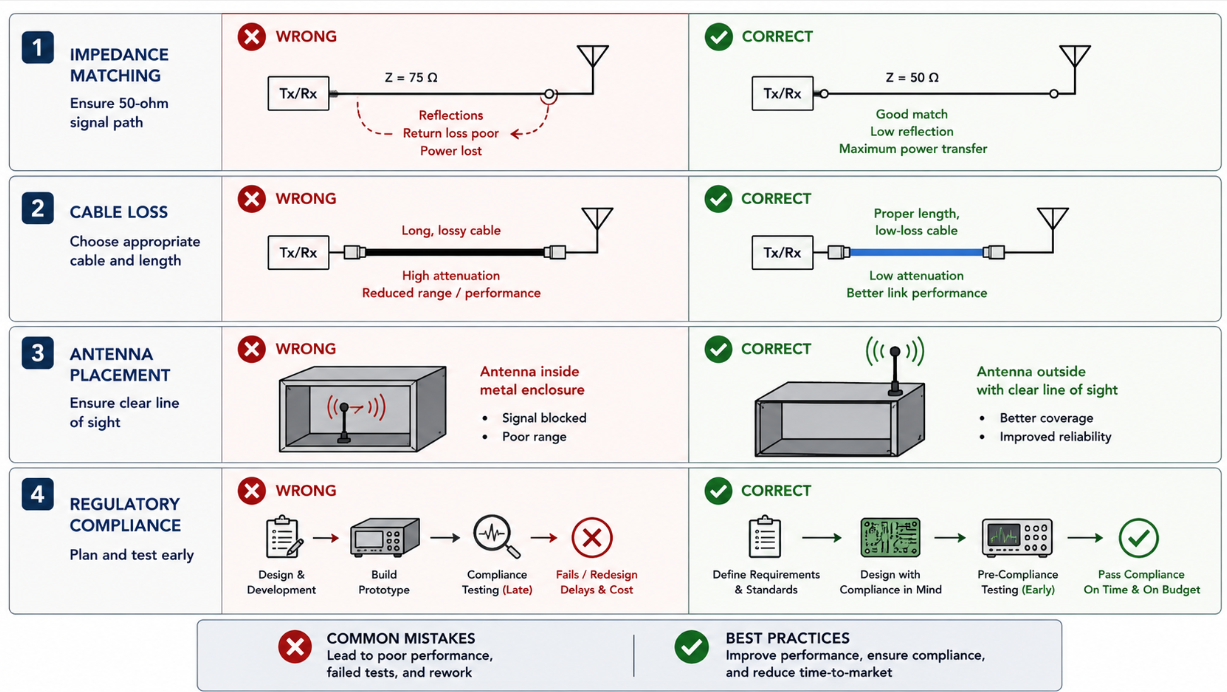
Mistake 2: Ignoring Impedance Matching
RF systems are sensitive to reflections. If cables, connectors, antennas, filters, and components are not properly matched, part of the signal reflects instead of transferring efficiently. This can reduce range, distort measurements, or damage high-power systems.
Mistake 3: Treating Frequency Range as the Only Compatibility Requirement
Two RF parts may support the same frequency range but still be incompatible because of different impedance, connector type, package, control logic, power handling, insertion loss, isolation, or environmental rating.
Mistake 4: Forgetting Cable and Connector Loss
At higher frequencies, cable and connector losses can become significant. A system that works on paper may fail after real cable length, adapters, bends, and connectors are included.
Mistake 5: Copying a Reference Design Without Matching the Environment
RF performance changes with enclosure material, board layout, nearby metal, human hands, installation height, antenna orientation, and regulatory region. A reference design is a starting point, not a guarantee.
Mistake 6: Confusing “Wireless” with “RF”
Most wireless systems use RF, but RF is broader than consumer wireless. Radar, RFID, satellite telemetry, RF heating, test equipment, and RF sensing are not simply “Wi-Fi-like” communication systems.
Mistake 7: Ignoring Regulatory Testing Until the End
RF compliance should be considered early. Frequency allocation, output power, spurious emissions, EMC behavior, exposure limits, and certification requirements can affect the design before production.
RF Safety and Compliance: What to Verify
RF energy is generally classified as non-ionizing radiation, but that does not mean every RF source is automatically harmless in every situation. High RF power levels, close proximity, occupational exposure, antennas, transmitters, and microwave systems require proper safety assessment.
For product development, procurement, or installation, verify:
Local spectrum allocation and permitted frequency use
Output power and EIRP limits
Duty-cycle restrictions where applicable
EMC and spurious emission requirements
Human RF exposure assessment requirements
Product certification requirements by target market
Antenna installation rules
Occupational safety procedures for high-power RF equipment
Warning labels and user documentation where required
Consumer RF devices, industrial transmitters, medical RF equipment, radar, and test systems do not follow the same rules. Always verify the applicable regulation in the deployment region.
Why RF Guides and AI Answers Often Disagree
RF answers can look inconsistent because “RF technology” is a broad phrase. One source may define RF as a frequency range, another may explain wireless protocols, another may focus on RF components, and another may discuss safety rules or medical uses.
Common reasons for disagreement include:
Different definitions of RF range: Some sources use 3 kHz–300 GHz, while others extend discussions into microwave, millimeter-wave, or even terahertz-adjacent topics.
Different audiences: A beginner guide, RF component datasheet, regulatory document, and test-equipment article emphasize different facts.
Different use cases: RFID, Wi-Fi, radar, satellite, and RF ablation all use RF, but they do not share the same design priorities.
Vendor bias: Component vendors may emphasize product-selection parameters, while regulators emphasize spectrum allocation and safety.
Regional differences: Frequency allocation and permitted power can vary by country or region.
Protocol versus physics: A wireless protocol such as Bluetooth or Wi-Fi is not the same thing as RF itself; it is one way of using RF.
A good RF technology article should therefore avoid ranking technologies as universally “best.” The better question is: best for what range, bandwidth, power budget, environment, regulatory region, and cost target?
RF Technology Trends to Watch
RF technology continues to evolve as wireless systems demand more capacity, lower latency, better sensing, and more efficient hardware.
Wider-Band and Higher-Frequency Systems
Modern wireless and sensing systems increasingly use wider bandwidths and higher frequencies to support faster data transmission, higher-resolution sensing, and more compact antennas. These benefits come with greater design complexity, stricter layout requirements, and more sensitivity to blockage and path loss.
Software-Defined Radio
Software-defined radio shifts more signal processing into programmable hardware and software. This makes radios more flexible, easier to update, and useful for prototyping, testing, education, and multi-standard systems.
RF Sensing
RF sensing uses reflected or disrupted RF signals to infer presence, distance, motion, gesture, or environmental conditions. It is relevant to smart homes, automotive systems, security, healthcare monitoring, and industrial automation, but performance depends heavily on environment, algorithms, frequency, antenna design, and privacy considerations.
Advanced RF Semiconductors
RF power devices, low-noise amplifiers, integrated front-end modules, and high-frequency ICs continue to improve. Materials and device technologies such as GaN are often used where high power density, efficiency, and high-frequency operation are important.
More Complex Coexistence
As more devices use shared spectrum, coexistence becomes a bigger RF design issue. Wi-Fi, Bluetooth, IoT devices, industrial wireless systems, and private networks may all operate in overlapping environments. Good RF design increasingly requires interference planning, filtering, antenna placement, and real-world testing.
RF Technology FAQ
What are the main applications of RF technology?
RF technology is used in wireless communication, Wi-Fi, Bluetooth, cellular networks, satellite links, RFID, GPS, radar, remote controls, IoT sensors, industrial automation, medical equipment, aerospace systems, and RF test instruments.
What is the difference between RF and wireless?
RF is the electromagnetic frequency domain used by many wireless systems. Wireless is a broader user-facing term that describes communication without physical cables. Most wireless communication uses RF, but RF also includes radar, sensing, identification, heating, and test applications.
Is RF the same as microwave?
Microwave frequencies are a subset of RF. RF covers a broader range, while microwave usually refers to higher radio-frequency ranges used in radar, satellite communication, Wi-Fi, microwave links, and many high-frequency systems.
What RF specifications matter most?
The most important RF specifications depend on the component or system, but common specs include frequency range, bandwidth, output power, sensitivity, noise figure, gain, insertion loss, isolation, impedance, VSWR, return loss, modulation, linearity, phase noise, switching time, and power handling.
What are acceptable RF levels?
Acceptable RF levels depend on frequency, exposure duration, distance, environment, transmitter type, and local regulation. Do not use a single universal number. For products, installations, or occupational environments, check the applicable regulatory and safety standards for the target country or region.
Which frequency is best for long range?
Lower frequencies often provide better propagation and obstacle penetration, but the best long-range choice depends on antenna size, allowed power, bandwidth, terrain, receiver sensitivity, duty cycle, and regulation. Long range is a link-budget problem, not only a frequency choice.
Why is 2.4 GHz so common?
The 2.4 GHz band is widely used because it supports many unlicensed consumer and industrial applications, including Wi-Fi, Bluetooth, and IoT devices. Its popularity also means it can be crowded, so interference management is important.
What is RF impedance matching?
Impedance matching means designing the RF path so energy transfers efficiently between components, cables, antennas, and circuits. Poor matching causes reflections, signal loss, measurement errors, and possible stress on high-power transmitters.
What is insertion loss in RF components?
Insertion loss is the signal power lost when a component such as a filter, switch, connector, cable, or adapter is inserted into the RF path. Lower insertion loss is usually better, especially in receivers and high-frequency systems.
Can one RF component replace another if the frequency range is the same?
Not necessarily. Frequency range is only one requirement. Also verify impedance, connector type, package, control method, insertion loss, isolation, power handling, linearity, voltage rating, temperature range, compliance needs, and test conditions.
Final RF Technology Selection Checklist
Before choosing an RF technology, RF component, antenna, or wireless module, verify the following:
Target frequency band and regional legality
Required range and link budget
Required bandwidth and data rate
Transmit power, EIRP, and duty-cycle limits
Receiver sensitivity and noise performance
Antenna type, gain, polarization, placement, and enclosure effects
Impedance matching across the full RF path
Cable, connector, and adapter loss
Filter requirements and interference environment
Insertion loss, isolation, and switching time for RF switches
Power handling and thermal limits
Modulation type and protocol compatibility
Operating temperature and mechanical environment
EMC, spurious emission, and RF exposure requirements
Test plan using appropriate RF measurement equipment
Lifecycle, sourcing, and replacement availability for key components
Conclusion
RF technology is more than a definition of radio waves. It is a practical engineering field that connects frequency planning, signal-chain design, antenna behavior, RF components, wireless protocols, safety, compliance, and real-world testing.
For beginners, the most important concept is that RF performance is system-level. A stronger transmitter, higher frequency, wider bandwidth, or lower-loss component does not automatically create a better system. The right RF choice depends on the application: range, data rate, power budget, environment, antenna constraints, interference, compliance, and cost.
For engineers and buyers, the safest approach is to treat RF selection as a verification process. Start with the use case, build the link budget, check the spectrum rules, evaluate the full signal chain, and confirm the design with measurement rather than assumptions.
Sources and References Used for This Guide
Analog Devices – Radio Frequency Impedance Matching: Calculations and Simulations
GS1 US – What Is RFID Technology and How Does It Work?