

 Product
 Brand
Brand Articles
 Tools
Tools
1N4001 Diodes: Pinout, Datasheet and Alternatives

Standard Diode Rectifier Standard Recovery >500ns, > 200mA (Io) 1.1V @ 1A -55°C~175°C 5μA @ 50V Tape & Reel (TR) DO-204AL, DO-41, Axial Through Hole
Unit Price: $0.116490
Ext Price: $0.12


Standard Diode Rectifier Standard Recovery >500ns, > 200mA (Io) 1.1V @ 1A -55°C~175°C 5μA @ 50V Tape & Reel (TR) DO-204AL, DO-41, Axial Through Hole
1N4001 is a rectifier diode with an operating and storage temperature of -65~175°C. This blog mainly introduces features, CAD model and other detailed information of 1N4001.

Full wave bridge rectifier. LEDs and 1N4001 diodes. Rectifier component shown
1N4001 Description
1N4001 is a device that allows current flow through only one direction. That is the current should always flow from the Anode to the cathode. The cathode terminal can be identified by using a grey bar as shown in the picture above.
For 1N4001 Diode, the maximum current carrying capacity is 1A it withstands peaks up to 30A. Hence we can use this in circuits that are designed for less than 1A. The reverse current is 5uA which is negligible. It can withstand a reverse voltage peak up to 50V.
1N4001 Pinout

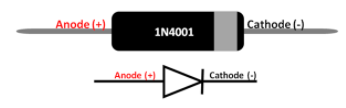
1N4001 Pinout

1N4001 Features
Average forward current is 1A
Non-repetitive Peak current is 30A
Reverse current is 5uA.
RMS reverse voltage is 35V
Peak repetitive Reverse voltage is 50V
Available in DO-41 Package
1N4001 CAD Model
Symbol

Footprint

3D Model

Specifications
- TypeParameter
- Contact Plating
Contact plating (finish) provides corrosion protection for base metals and optimizes the mechanical and electrical properties of the contact interfaces.
Tin - Mount
In electronic components, the term "Mount" typically refers to the method or process of physically attaching or fixing a component onto a circuit board or other electronic device. This can involve soldering, adhesive bonding, or other techniques to secure the component in place. The mounting process is crucial for ensuring proper electrical connections and mechanical stability within the electronic system. Different components may have specific mounting requirements based on their size, shape, and function, and manufacturers provide guidelines for proper mounting procedures to ensure optimal performance and reliability of the electronic device.
Through Hole - Mounting Type
The "Mounting Type" in electronic components refers to the method used to attach or connect a component to a circuit board or other substrate, such as through-hole, surface-mount, or panel mount.
Through Hole - Package / Case
refers to the protective housing that encases an electronic component, providing mechanical support, electrical connections, and thermal management.
DO-204AL, DO-41, Axial - Number of Pins2
- Supplier Device Package
The parameter "Supplier Device Package" in electronic components refers to the physical packaging or housing of the component as provided by the supplier. It specifies the form factor, dimensions, and layout of the component, which are crucial for compatibility and integration into electronic circuits and systems. The supplier device package information typically includes details such as the package type (e.g., DIP, SOP, QFN), number of pins, pitch, and overall size, allowing engineers and designers to select the appropriate component for their specific application requirements. Understanding the supplier device package is essential for proper component selection, placement, and soldering during the manufacturing process to ensure optimal performance and reliability of the electronic system.
DO-204AL (DO-41) - Weight245mg
- Operating Temperature (Max)
The parameter "Operating Temperature (Max)" in electronic components refers to the maximum temperature at which the component can safely operate without experiencing damage or performance degradation. This specification is crucial for ensuring the reliability and longevity of the component in various operating conditions. Exceeding the maximum operating temperature can lead to thermal stress, reduced efficiency, and ultimately failure of the component. It is important for designers and engineers to consider this parameter when selecting and using electronic components to ensure proper functionality and prevent potential issues related to overheating.
175°C - Operating Temperature (Min)
The parameter "Operating Temperature (Min)" in electronic components refers to the minimum temperature at which the component is designed to operate effectively and reliably. This specification indicates the lowest temperature at which the component can function within its specified performance limits. Operating below this minimum temperature may result in reduced efficiency, slower response times, or even complete failure of the component. It is important to consider the operating temperature range of electronic components to ensure proper functionality and longevity in various environmental conditions.
-55°C - Packaging
Semiconductor package is a carrier / shell used to contain and cover one or more semiconductor components or integrated circuits. The material of the shell can be metal, plastic, glass or ceramic.
Tape & Reel (TR) - Published1998
- Part Status
Parts can have many statuses as they progress through the configuration, analysis, review, and approval stages.
LAST SHIPMENTS (Last Updated: 2 days ago) - Moisture Sensitivity Level (MSL)
Moisture Sensitivity Level (MSL) is a standardized rating that indicates the susceptibility of electronic components, particularly semiconductors, to moisture-induced damage during storage and the soldering process, defining the allowable exposure time to ambient conditions before they require special handling or baking to prevent failures
1 (Unlimited) - Capacitance
Capacitance is a fundamental electrical property of electronic components that describes their ability to store electrical energy in the form of an electric field. It is measured in farads (F) and represents the ratio of the amount of electric charge stored on a component to the voltage across it. Capacitors are passive components that exhibit capacitance and are commonly used in electronic circuits for various purposes such as filtering, energy storage, timing, and coupling. Capacitance plays a crucial role in determining the behavior and performance of electronic systems by influencing factors like signal propagation, frequency response, and power consumption.
15pF - Voltage - Rated DC
Voltage - Rated DC is a parameter that specifies the maximum direct current (DC) voltage that an electronic component can safely handle without being damaged. This rating is crucial for ensuring the proper functioning and longevity of the component in a circuit. Exceeding the rated DC voltage can lead to overheating, breakdown, or even permanent damage to the component. It is important to carefully consider this parameter when designing or selecting components for a circuit to prevent any potential issues related to voltage overload.
50V - Current Rating
Current rating is the maximum current that a fuse will carry for an indefinite period without too much deterioration of the fuse element.
1A - Base Part Number
The "Base Part Number" (BPN) in electronic components serves a similar purpose to the "Base Product Number." It refers to the primary identifier for a component that captures the essential characteristics shared by a group of similar components. The BPN provides a fundamental way to reference a family or series of components without specifying all the variations and specific details.
1N4001 - Polarity
In electronic components, polarity refers to the orientation or direction in which the component must be connected in a circuit to function properly. Components such as diodes, capacitors, and LEDs have polarity markings to indicate which terminal should be connected to the positive or negative side of the circuit. Connecting a component with incorrect polarity can lead to malfunction or damage. It is important to pay attention to polarity markings and follow the manufacturer's instructions to ensure proper operation of electronic components.
Standard - Element Configuration
The distribution of electrons of an atom or molecule (or other physical structure) in atomic or molecular orbitals.
Single - Speed
In electronic components, "Speed" typically refers to the rate at which data can be processed or transferred within the component. It is a measure of how quickly the component can perform its functions, such as executing instructions or transmitting signals. Speed is often specified in terms of frequency, such as clock speed in processors or data transfer rate in memory modules. Higher speed components can perform tasks more quickly, leading to improved overall performance in electronic devices. It is an important parameter to consider when designing or selecting electronic components for specific applications.
Standard Recovery >500ns, > 200mA (Io) - Diode Type
In electronic components, the parameter "Diode Type" refers to the specific type or configuration of a diode, which is a semiconductor device that allows current to flow in one direction only. There are various types of diodes, each designed for specific applications and functions. Common diode types include rectifier diodes, zener diodes, light-emitting diodes (LEDs), and Schottky diodes, among others. The diode type determines the diode's characteristics, such as forward voltage drop, reverse breakdown voltage, and maximum current rating, making it crucial for selecting the right diode for a particular circuit or application. Understanding the diode type is essential for ensuring proper functionality and performance in electronic circuits.
Standard - Current - Reverse Leakage @ Vr
Current - Reverse Leakage @ Vr is a parameter that describes the amount of current that flows in the reverse direction through a diode or other semiconductor component when a reverse voltage (Vr) is applied across it. This leakage current is typically very small, but it is important to consider in electronic circuits as it can affect the overall performance and reliability of the component. The reverse leakage current is influenced by factors such as the material properties of the semiconductor, temperature, and the magnitude of the reverse voltage applied. Manufacturers provide this parameter in datasheets to help engineers and designers understand the behavior of the component in reverse bias conditions.
5μA @ 50V - Power Dissipation
the process by which an electronic or electrical device produces heat (energy loss or waste) as an undesirable derivative of its primary action.
3W - Voltage - Forward (Vf) (Max) @ If
The parameter "Voltage - Forward (Vf) (Max) @ If" refers to the maximum voltage drop across a diode when it is forward-biased and conducting a specified forward current (If). It indicates the maximum potential difference the diode can withstand while allowing current to flow in the forward direction without breaking down. This value is crucial for designing circuits as it helps determine how much voltage will be lost across the diode during operation. Higher Vf values can lead to reduced efficiency in power applications, making this parameter essential for optimizing circuit performance.
1.1V @ 1A - Current - Output
Current - Output is a parameter in electronic components that refers to the maximum amount of current that can be delivered by the output of the component. It is a crucial specification as it determines the capability of the component to supply power to connected devices or circuits. The current output rating is typically specified in amperes (A) and is important for ensuring that the component can safely and effectively power the load it is connected to without overheating or failing. Designers and engineers must consider the current output rating when selecting components to ensure compatibility and reliable operation of the overall system.
1A - Forward Current
Current which flows upon application of forward voltage.
1A - Operating Temperature - Junction
Operating Temperature - Junction refers to the maximum temperature at which the junction of an electronic component can safely operate without causing damage or performance degradation. This parameter is crucial for determining the reliability and longevity of the component, as excessive heat can lead to thermal stress and failure. Manufacturers specify the operating temperature range to ensure that the component functions within safe limits under normal operating conditions. It is important for designers and engineers to consider the operating temperature - junction when selecting and using electronic components to prevent overheating and ensure optimal performance.
-55°C~175°C - Max Surge Current
Surge current is a peak non repetitive current. Maximum (peak or surge) forward current = IFSM or if(surge), the maximum peak amount of current the diode is able to conduct in forward bias mode.
30A - Voltage - DC Reverse (Vr) (Max)
Voltage - DC Reverse (Vr) (Max) is a parameter in electronic components that specifies the maximum reverse voltage that the component can withstand without breaking down. This parameter is crucial for components like diodes and transistors that are often subjected to reverse voltage during operation. Exceeding the maximum reverse voltage can lead to the component failing or getting damaged. Designers need to consider this parameter when selecting components to ensure the reliability and longevity of their circuits.
50V - Current - Average Rectified (Io)
The parameter "Current - Average Rectified (Io)" in electronic components refers to the average value of the rectified current flowing through the component. This parameter is important in determining the average power dissipation and thermal considerations of the component. It is typically specified in datasheets for diodes, rectifiers, and other components that handle alternating current (AC) and convert it to direct current (DC). Understanding the average rectified current helps in selecting the appropriate component for a given application to ensure reliable operation and prevent overheating.
1A - Forward Voltage
the amount of voltage needed to get current to flow across a diode.
1.1V - Max Reverse Voltage (DC)
Max Reverse Voltage (DC) refers to the maximum voltage that a semiconductor device, such as a diode, can withstand in the reverse bias direction without failing. Exceeding this voltage can lead to breakdown and potential damage to the component. It is a critical parameter in circuit design to ensure reliability and prevent failure when the device is subjected to reverse voltage conditions.
50V - Average Rectified Current
Mainly used to characterize alternating voltage and current. It can be computed by averaging the absolute value of a waveform over one full period of the waveform.
1A - Peak Reverse Current
The maximum voltage that a diode can withstand in the reverse direction without breaking down or avalanching.If this voltage is exceeded the diode may be destroyed. Diodes must have a peak inverse voltage rating that is higher than the maximum voltage that will be applied to them in a given application.
5μA - Max Repetitive Reverse Voltage (Vrrm)
The Max Repetitive Reverse Voltage (Vrrm) is a crucial parameter in electronic components, particularly in diodes and transistors. It refers to the maximum voltage that can be applied across the component in the reverse direction without causing damage. This parameter is important for ensuring the proper functioning and longevity of the component in circuits where reverse voltage may be present. Exceeding the Vrrm rating can lead to breakdown and failure of the component, so it is essential to carefully consider this specification when designing or selecting components for a circuit.
50V - Capacitance @ Vr, F
Capacitance @ Vr, F refers to the capacitance value of a capacitor measured at a specified rated voltage (Vr). It indicates how much electrical charge the capacitor can store per volt when subjected to this voltage. This parameter is essential for understanding the behavior of capacitors in circuits, particularly under different voltage conditions, and ensures that the component operates within its safe limits. The unit of measurement is Farads (F), which quantifies the capacitor's ability to hold an electrical charge.
15pF @ 4V 1MHz - Peak Non-Repetitive Surge Current
Peak Non-Repetitive Surge Current is a specification in electronic components that refers to the maximum current that the component can withstand for a short duration without sustaining damage. This surge current typically occurs as a result of sudden voltage spikes or transient events in the circuit. It is important to consider this parameter when designing or selecting components to ensure they can handle occasional high-current surges without failing. The value of Peak Non-Repetitive Surge Current is usually specified in amperes and is crucial for protecting the component and maintaining the overall reliability of the circuit.
30A - Reverse Voltage
the voltage drop across the diode if the voltage at the cathode is more positive than the voltage at the anode
50V - Max Forward Surge Current (Ifsm)
Max Forward Surge Current (Ifsm) is a parameter used to specify the maximum peak current that a diode or other electronic component can withstand for a short duration during a surge event. Surge currents can occur due to sudden changes in voltage or power supply fluctuations, and the Ifsm rating helps determine the component's ability to handle such transient overloads without being damaged. It is important to consider the Ifsm rating when selecting components for applications where surge currents are expected, such as in power supplies, motor drives, and other high-power circuits. Exceeding the Ifsm rating can lead to overheating, degradation, or failure of the component, so it is crucial to ensure that the chosen component can safely handle the expected surge currents in the circuit.
30A - Diameter
In electronic components, the parameter "Diameter" typically refers to the measurement of the width of a circular component, such as a resistor, capacitor, or inductor. It is a crucial dimension that helps determine the physical size and fit of the component within a circuit or on a circuit board. The diameter is usually measured in millimeters (mm) or inches (in) and is important for ensuring proper placement and soldering of the component during assembly. Understanding the diameter of electronic components is essential for selecting the right size for a specific application and ensuring compatibility with other components and the overall design of the circuit.
2.72mm - Height5.2mm
- Length5.2mm
- Width6.35mm
- REACH SVHC
The parameter "REACH SVHC" in electronic components refers to the compliance with the Registration, Evaluation, Authorization, and Restriction of Chemicals (REACH) regulation regarding Substances of Very High Concern (SVHC). SVHCs are substances that may have serious effects on human health or the environment, and their use is regulated under REACH to ensure their safe handling and minimize their impact.Manufacturers of electronic components need to declare if their products contain any SVHCs above a certain threshold concentration and provide information on the safe use of these substances. This information allows customers to make informed decisions about the potential risks associated with using the components and take appropriate measures to mitigate any hazards.Ensuring compliance with REACH SVHC requirements is essential for electronics manufacturers to meet regulatory standards, protect human health and the environment, and maintain transparency in their supply chain. It also demonstrates a commitment to sustainability and responsible manufacturing practices in the electronics industry.
No SVHC - Radiation Hardening
Radiation hardening is the process of making electronic components and circuits resistant to damage or malfunction caused by high levels of ionizing radiation, especially for environments in outer space (especially beyond the low Earth orbit), around nuclear reactors and particle accelerators, or during nuclear accidents or nuclear warfare.
No - RoHS Status
RoHS means “Restriction of Certain Hazardous Substances” in the “Hazardous Substances Directive” in electrical and electronic equipment.
RoHS Compliant - Lead Free
Lead Free is a term used to describe electronic components that do not contain lead as part of their composition. Lead is a toxic material that can have harmful effects on human health and the environment, so the electronics industry has been moving towards lead-free components to reduce these risks. Lead-free components are typically made using alternative materials such as silver, copper, and tin. Manufacturers must comply with regulations such as the Restriction of Hazardous Substances (RoHS) directive to ensure that their products are lead-free and environmentally friendly.
Lead Free
1N4001 Applications
Can be used to prevent reverse polarity problem
Half Wave and Full Wave rectifiers
Used as a protection device
Current flow regulators
1N4001 Alternatives
1N4148, 1N4733A, 1N5408, 1N5822, Zener Diodes
1N4001 Package Dimensions


1N4001 Mechanical Characteristics
Case: Epoxy, Molded
Weight: 0.4 gram (approximately)
Finish: All External Surfaces Corrosion Resistant and Terminal Leads are Readily Solderable
Lead and Mounting Surface Temperature for Soldering Purposes: 260°C Max. for 10 Seconds, 1/16 in. from case
Polarity: Cathode Indicated by Polarity Band
1N4001 Manufacturer
ON Semiconductor (Nasdaq: ON) is driving energy-efficient innovations, empowering customers to reduce global energy use. The company offers a comprehensive portfolio of energy-efficient power and signal management, logic, discrete and custom solutions to help design engineers solve their unique design challenges in automotive, communications, computing, consumer, industrial, LED lighting, medical, military/aerospace, and power supply applications. ON Semiconductor operates a responsive, reliable, world-class supply chain and quality program, and a network of manufacturing facilities, sales offices, and design centers in key markets throughout North America, Europe, and the Asia Pacific regions.
Datasheet PDF
- PCN Obsolescence/ EOL :
- Datasheets :
- PCN Part Status Change :
- Environmental Information :
What is the difference between 1N4001 and 1N4007?
First, 1N4001 high reverse breakdown voltage is 50V while 1N4007 high reverse breakdown voltage is 1000V. Second, on the basis of meeting the maximum reverse voltage, 4007 can be used instead of 4001-4006.
How many types of packages are available for 1N4001?
Straight plug DO-41, D0-27, (marking: 1N4001);
Patch SOD-323, SOD123, SMA (usually M1)
How to distinguish the positive and negative poles of IN4001?
Find out the positive and negative of the test lead of the multimeter, then adjust the resistance and use the test lead to test the diode. If the two ends of the diode can be connected, the positive electrode of the test lead is connected to the positive electrode of the diode, otherwise if it is open, the negative electrode of the diode is connected.
 74HC244 Driver IC: Pinout, Alterntaive and Price
30 August 20214119
 Overcoming Switched Capacitor Kickback with AD4000: A Precision ADC Deep Dive
23 March 2026276
 TPS54302DDCR: Synchronous Buck Converter, Pinout
25 February 20227116
 MCF532x ColdFire® Microprocessor Datasheet Overview
29 February 2024182
 STM32F410RBT7 Microcontroller: Pinout, Datasheet, and Circuit
30 June 20212400
 DRV5053 Hall Effect Sensor: Datasheet, Pinout and Applications
30 August 20216182
![GRM155R71H104KE14D Ceramic Capacitor X7R 0402 50V[FAQ]: Datasheet, Features, and Equivalents](https://res.utmel.com/Images/Article/64ebdb7d-ee95-4b46-99ce-05f0ac2cb724.jpg) GRM155R71H104KE14D Ceramic Capacitor X7R 0402 50V[FAQ]: Datasheet, Features, and Equivalents
GRM155R71H104KE14D Ceramic Capacitor X7R 0402 50V[FAQ]: Datasheet, Features, and Equivalents14 March 20221581
 KSA992 BJT Transistor: TO-92, KSA992 Pinout, Datasheet, Equivalent
05 May 20225434
 16 Q&A About the Secrets of Operational Amplifiers
27 March 20256731
 Msemitek Authorized Distributor | UTMEL Electronics
21 November 20234006
 Huawei Responded How to Solve the Problem of Chip Supply
29 March 20224322
 What is Digital Signal Processing (DSP)?
17 March 20225285
 How to Pick the Perfect Boost Converter for Your Needs
07 June 20251604
 ON Semiconductor Provides Soft Fourth-Quarter Guidance. The Stock Drops.
13 March 20243130
 Understanding the Flight Sensing Modules of Drones
06 September 20212122
![Basic Introduction to Digital Filter [Video]](https://res.utmel.com/Images/Article/b0245181-c936-414a-8241-51bf13e7c6b3.jpg) Basic Introduction to Digital Filter [Video]
Basic Introduction to Digital Filter [Video]23 October 20205014
ON Semiconductor
In Stock: 3000
Minimum: 1 Multiples: 1
Qty
Unit Price
Ext Price
1
$0.116490
$0.12
500
$0.085654
$42.83
1000
$0.071379
$71.38
2000
$0.065485
$130.97
5000
$0.061201
$306.00
10000
$0.056931
$569.31
15000
$0.055059
$825.88
50000
$0.054139
$2,706.95
Not the price you want? Send RFQ Now and we'll contact you ASAP.
Inquire for More Quantity
![RB521S30T1G]() RB521S30T1G
RB521S30T1GON Semiconductor
![MBRS130T3]() MBRS130T3
MBRS130T3ON Semiconductor
![MBRS3100T3G]() MBRS3100T3G
MBRS3100T3GON Semiconductor
![MMSD4148T1G]() MMSD4148T1G
MMSD4148T1GON Semiconductor
![1N4148WT]() 1N4148WT
1N4148WTON Semiconductor
![1N914BWS]() 1N914BWS
1N914BWSON Semiconductor
![RB751S40T1G]() RB751S40T1G
RB751S40T1GON Semiconductor
![1N4148WS]() 1N4148WS
1N4148WSON Semiconductor
![BAS16HT1G]() BAS16HT1G
BAS16HT1GON Semiconductor
![MBR0520LT1G]() MBR0520LT1G
MBR0520LT1GON Semiconductor


