Product
 Brand
Brand Articles
 Tools
Tools
4N25 Phototransistor Optocoupler IC


OPTOISO 5KV TRANS W/BASE 6DIP
4N25 is a 6-pin phototransistor coupler. This article covers 4N25 pinout, datasheet, equivalent, features, and other information on how to use and where to use this device.
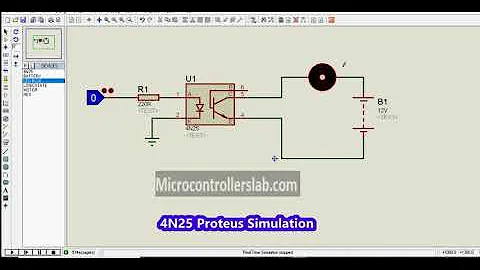
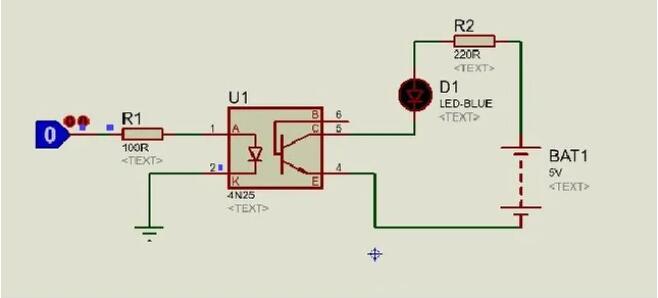
4N25 Phototransistor Optocoupler IC Proteus Simulation
4N25 Description
4N25 belongs to one of the most famous families of optocouplers. Other optocouplers that have almost similar features are 4N26, 4N27, and 4N28. We will discuss all these optoisolators in a single article because they have the same function and pin diagram. All these optocouplers consist of a photodiode and a phototransistor. Gallium arsenide material is used for an infrared light-emitting diode. The phototransistor is made up of a monolithic silicon material. Both photodiode and phototransistor are so coupled that when infrared light of photodiode falls on the base pin of a phototransistor, it turns on by forming an electrical close switch-like connection between collector and emitter pins.
4N25 pinout and Configurations
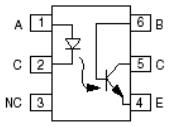
| Pin | Function |
| Anode (1) | Anode terminal of LED |
| Cathode (2) | A cathode terminal of LED |
| NC (3) | No connection / Not used |
| Emitter (4) | Emitter pin of a phototransistor |
| Collector (5) | Collector pin of a phototransistor |
| Base (6) | Base pin of a phototransistor |
4N25 CAD Models
Symbol
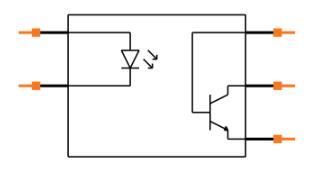
Footprint
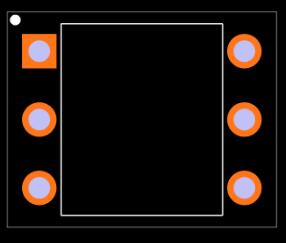
Specifications
- TypeParameter
- Factory Lead Time20 Weeks
- Mount
In electronic components, the term "Mount" typically refers to the method or process of physically attaching or fixing a component onto a circuit board or other electronic device. This can involve soldering, adhesive bonding, or other techniques to secure the component in place. The mounting process is crucial for ensuring proper electrical connections and mechanical stability within the electronic system. Different components may have specific mounting requirements based on their size, shape, and function, and manufacturers provide guidelines for proper mounting procedures to ensure optimal performance and reliability of the electronic device.
Through Hole - Mounting Type
The "Mounting Type" in electronic components refers to the method used to attach or connect a component to a circuit board or other substrate, such as through-hole, surface-mount, or panel mount.
Through Hole - Package / Case
refers to the protective housing that encases an electronic component, providing mechanical support, electrical connections, and thermal management.
6-DIP (0.300, 7.62mm) - Number of Pins6
- Collector-Emitter Breakdown Voltage80V
- Collector-Emitter Saturation Voltage500mV
- Current Transfer Ratio-Min20% @ 10mA
- Power Dissipation (Max)200mW
- Number of Elements1
- Operating Temperature
The operating temperature is the range of ambient temperature within which a power supply, or any other electrical equipment, operate in. This ranges from a minimum operating temperature, to a peak or maximum operating temperature, outside which, the power supply may fail.
-55°C~110°C - Packaging
Semiconductor package is a carrier / shell used to contain and cover one or more semiconductor components or integrated circuits. The material of the shell can be metal, plastic, glass or ceramic.
Tube - Published2008
- Pbfree Code
The "Pbfree Code" parameter in electronic components refers to the code or marking used to indicate that the component is lead-free. Lead (Pb) is a toxic substance that has been widely used in electronic components for many years, but due to environmental concerns, there has been a shift towards lead-free alternatives. The Pbfree Code helps manufacturers and users easily identify components that do not contain lead, ensuring compliance with regulations and promoting environmentally friendly practices. It is important to pay attention to the Pbfree Code when selecting electronic components to ensure they meet the necessary requirements for lead-free applications.
yes - Part Status
Parts can have many statuses as they progress through the configuration, analysis, review, and approval stages.
Active - Moisture Sensitivity Level (MSL)
Moisture Sensitivity Level (MSL) is a standardized rating that indicates the susceptibility of electronic components, particularly semiconductors, to moisture-induced damage during storage and the soldering process, defining the allowable exposure time to ambient conditions before they require special handling or baking to prevent failures
1 (Unlimited) - Additional Feature
Any Feature, including a modified Existing Feature, that is not an Existing Feature.
UL APPROVED - Approval Agency
The parameter "Approval Agency" in electronic components refers to the organization responsible for testing and certifying that a component meets specific safety, quality, and performance standards. These agencies evaluate products to ensure compliance with industry regulations and standards, providing assurance to manufacturers and consumers. Approval from recognized agencies can enhance a component's marketability and acceptance in various applications, particularly in sectors like automotive, aerospace, and healthcare. Common approval agencies include Underwriters Laboratories (UL), International Electrotechnical Commission (IEC), and the American National Standards Institute (ANSI).
CSA, DEMKO, FIMKO, NEMKO, SEMKO, UL, VDE - Voltage - Isolation
Voltage - Isolation is a parameter in electronic components that refers to the maximum voltage that can be safely applied between two isolated points without causing electrical breakdown or leakage. It is a crucial specification for components such as transformers, optocouplers, and capacitors that require isolation to prevent electrical interference or safety hazards. The voltage isolation rating ensures that the component can withstand the specified voltage without compromising its performance or safety. It is typically measured in volts and is an important consideration when designing circuits that require isolation between different parts of the system.
5000Vrms - Output Voltage
Output voltage is a crucial parameter in electronic components that refers to the voltage level produced by the component as a result of its operation. It represents the electrical potential difference between the output terminal of the component and a reference point, typically ground. The output voltage is a key factor in determining the performance and functionality of the component, as it dictates the level of voltage that will be delivered to the connected circuit or load. It is often specified in datasheets and technical specifications to ensure compatibility and proper functioning within a given system.
80V - Output Type
The "Output Type" parameter in electronic components refers to the type of signal or data that is produced by the component as an output. This parameter specifies the nature of the output signal, such as analog or digital, and can also include details about the voltage levels, current levels, frequency, and other characteristics of the output signal. Understanding the output type of a component is crucial for ensuring compatibility with other components in a circuit or system, as well as for determining how the output signal can be utilized or processed further. In summary, the output type parameter provides essential information about the nature of the signal that is generated by the electronic component as its output.
Transistor with Base - Configuration
The parameter "Configuration" in electronic components refers to the specific arrangement or setup of the components within a circuit or system. It encompasses how individual elements are interconnected and their physical layout. Configuration can affect the functionality, performance, and efficiency of the electronic system, and may influence factors such as signal flow, impedance, and power distribution. Understanding the configuration is essential for design, troubleshooting, and optimizing electronic devices.
SINGLE - Number of Channels1
- Voltage - Forward (Vf) (Typ)
The parameter "Voltage - Forward (Vf) (Typ)" in electronic components refers to the typical forward voltage drop across the component when it is conducting current in the forward direction. It is a crucial characteristic of components like diodes and LEDs, indicating the minimum voltage required for the component to start conducting current. The forward voltage drop is typically specified as a typical value because it can vary slightly based on factors such as temperature and manufacturing tolerances. Designers use this parameter to ensure that the component operates within its specified voltage range and to calculate power dissipation in the component.
1.2V - Input Type
Input type in electronic components refers to the classification of the signal or data that a component can accept for processing or conversion. It indicates whether the input is analog, digital, or a specific format such as TTL or CMOS. Understanding input type is crucial for ensuring compatibility between different electronic devices and circuits, as it determines how signals are interpreted and interacted with.
DC - Optoelectronic Device Type
Optoelectronic Device Type refers to the classification of electronic components that can both detect and emit light. These devices convert electrical signals into light or vice versa, making them essential for applications such as optical communication, sensing, and display technologies. Common types of optoelectronic devices include light-emitting diodes (LEDs), photodiodes, phototransistors, and laser diodes. Understanding the optoelectronic device type is crucial for selecting the appropriate component for a specific application based on factors such as wavelength, power output, and sensitivity.
TRANSISTOR OUTPUT OPTOCOUPLER - Max Output Voltage
The maximum output voltage refers to the dynamic area beyond which the output is saturated in the positive or negative direction, and is limited according to the load resistance value.
30V - Collector Emitter Voltage (VCEO)
Collector-Emitter Voltage (VCEO) is a key parameter in electronic components, particularly in transistors. It refers to the maximum voltage that can be applied between the collector and emitter terminals of a transistor while the base terminal is open or not conducting. Exceeding this voltage limit can lead to breakdown and potential damage to the transistor. VCEO is crucial for ensuring the safe and reliable operation of the transistor within its specified limits. Designers must carefully consider VCEO when selecting transistors for a circuit to prevent overvoltage conditions that could compromise the performance and longevity of the component.
500mV - Max Input Current
Max Input Current is a parameter that specifies the maximum amount of electrical current that can safely flow into an electronic component without causing damage. It is an important consideration when designing or using electronic circuits to ensure that the component operates within its specified limits. Exceeding the maximum input current can lead to overheating, component failure, or even pose safety risks. Manufacturers provide this parameter in datasheets to help engineers and users understand the limitations of the component and ensure proper operation within the specified parameters.
50mA - Current - DC Forward (If) (Max)
The parameter "Current - DC Forward (If) (Max)" in electronic components refers to the maximum forward current that can safely pass through the component without causing damage. This parameter is typically specified in datasheets for diodes and LEDs, indicating the maximum current that can flow through the component in the forward direction. Exceeding this maximum current rating can lead to overheating and potentially permanent damage to the component. It is important to ensure that the current flowing through the component does not exceed this specified maximum to maintain proper functionality and reliability.
60mA - Turn On / Turn Off Time (Typ)
Turn On / Turn Off Time (Typ) in electronic components refers to the time it takes for a device to switch from a non-conducting state to a conducting state (Turn On) and vice versa (Turn Off). This parameter is crucial for understanding the speed and responsiveness of the component in switching applications. It typically indicates the average time under specified conditions and is essential for optimizing the performance in circuits where rapid switching is required, such as in power electronics and digital logic devices.
3μs, 3μs - Current Transfer Ratio
Current Transfer Ratio (CTR) is the gain of the optocoupler. It is the ratio of the phototransistor collector current to the IRED forward current. CTR = (IC / IF) * 100 It is expressed as a percentage (%).
20% - Dark Current-Max
Dark Current-Max refers to the maximum amount of current that flows through a photodetector or similar electronic component in the absence of incident light. It is an important parameter that indicates the level of noise in a sensor and is typically measured in terms of amperes or milliamperes. High dark current values can lead to decreased signal-to-noise ratio, affecting the overall sensitivity and performance of the device in low-light conditions. Understanding this parameter is crucial for applications that require precise light detection and measurement.
50nA - RoHS Status
RoHS means “Restriction of Certain Hazardous Substances” in the “Hazardous Substances Directive” in electrical and electronic equipment.
ROHS3 Compliant - Lead Free
Lead Free is a term used to describe electronic components that do not contain lead as part of their composition. Lead is a toxic material that can have harmful effects on human health and the environment, so the electronics industry has been moving towards lead-free components to reduce these risks. Lead-free components are typically made using alternative materials such as silver, copper, and tin. Manufacturers must comply with regulations such as the Restriction of Hazardous Substances (RoHS) directive to ensure that their products are lead-free and environmentally friendly.
Contains Lead
4N25 Features
IR LED Forward Voltage for turning ON: 1.25V-1.5V (Typically 1.3V, 1.5V being the absolute maximum forward voltage)
IR LED Forward Current during ON: 10mA - 60mA (Typically 10mA, 60mA being the absolute maximum forward current)
IR LED Reverse Voltage Maximum: 5V
IR LED Reverse Current Maximum: 100uA
The maximum voltage across COLLECTOR and EMITTER of TRANSISTOR: 70V
Maximum current allowed through TRANSISTOR COLLECTOR: 100mA
Typical Rise Time: 2us
Typical Fall Time: 2us
No additional power needed to be applied to the chip for making it work.
4N25 Applications
DC motor speed control
Lighting systems
PWM applications
AC mains detection
Reed relay driving
Switch-mode power supply feedback
Telephone ring detection
Logic ground isolation
Logic coupling with high-frequency noise rejection
4N25 Equivalents
4N25 OPTOCOUPLER IC has numerous substitutes, including 4N26, 4N27, 4N28, 4N33, MCT2E, and PC817. Before replacing, we must carefully examine the settings and Pin configuration. Replacing without taking voltage, current, and frequency characteristics into consideration may result in irreparable damage.
4N25 Manufacturer
Everlight Electronics Co., Ltd. is a Taiwanese company that manufactures light-emitting diodes (LEDs). It is the world's fifth-largest LED package manufacturer. For a long time, EVERLIGHT has always been dedicated to the constant improvement of products and manufacturing processes through professional R&D efforts, allowing people to live in shining light.
Where to use 4N25
As their name suggests, 4N25 and other equivalent optocouplers such as 4N26, 4N27, and 4N28 can be used to provide electrical isolation between two circuits. In other words, it is used to make an electrical connection between two electrical circuits through photonics signals such as infrared LED and phototransistor. In short, the 4N25 optocoupler is used in applications where to want to isolate electrical circuits from each other. For further information, check the examples that are given in the next section.
Why to Use 4N25 OPTOCOUPLER
For understanding the use of OPTOCOUPLER considers:
Case1: where you want to isolate LOAD CIRCUIT from CONTROL CIRCUIT. Say you want to control the speed of a small DC motor by using MICROCONTROLLER PWM output. This setup is not feasible as the microcontroller is a sensitive device. So for isolating the load circuits and protecting the controller from voltage fluctuations we use OPTOCOUPLER.
Case2: Say you want to trigger a MOSFET circuit which is driving a high power load. The MOSFET trigger voltage typically is 12V. These voltages bursts (+12V) needed for the MOSFET driver to control the high power load cannot be drawn from the controller. As controller puts out +3.3V or +5V bursts. In those cases using the 4N25 OPTOCOUPLER chip is ideal.
Case3: Consider we want to switch a 12V relay which is looping 220V AC fan according to RASPBERRY PI outputs. It is ideal to use 4N25 in this case, as 4N25 draws a negligible amount of power considering a transistor or a MOSFET.
How to use 4N25
This animation depicts a simple example of an optocoupler of any type. However, we use 4N25 in this example. This circuit demonstrates LED controlling with a switch optically. On the input side, the logic signal probe provides a logic high-low signal to a photodiode. The phototransistor turns on and turns off according to the state of the logic switch.
4N25 Package

DIP-6
Trend Analysis
Datasheet PDF
- Datasheets :
Parts with Similar Specs
- ImagePart NumberManufacturerPackage / CaseNumber of PinsNumber of ChannelsVoltage - IsolationCurrent Transfer Ratio (Min)Current Transfer RatioOutput VoltageMax Output VoltageView Compare
![4N25]()
4N25
6-DIP (0.300, 7.62mm)
6
1
5000Vrms
20% @ 10mA
20%
80 V
30 V
![MOC8050300W]()
6-DIP (0.300, 7.62mm)
6
-
5000Vrms
100% @ 10mA
-
70 V
70 V


What is a 4N25?
4n25 is a standard single-channel 6-pin industry-standard phototransistor coupler that contains silicon NPN phototransistor and gallium arsenide infrared LED. It is also known as an optocoupler, photocoupler, or optoisolator.
What is the use of optoisolator?
An optoisolator (also known as an optical coupler, photocoupler, or optocoupler) is a semiconductor device that transfers an electrical signal between isolated circuits using light.
Why do you need an optocoupler?
Optocouplers are often used to reject back EMF, noise, and electrical surges from entering an MCU circuit. Optocouplers create a safe connection between high voltage equipment and microcontrollers with a means of complete electrical insulation.
Why optocoupler is used in SMPS?
Optocouplers are frequently used in isolated switch-mode power supplies (SMPS) for galvanic separation between the primary and secondary sides as well as from the feedback generator.
Why optoisolator is used in PLC?
An optoisolator connects input and output sides with a beam of light modulated by the input current. It transforms a useful input signal into light, sends it across the dielectric channel, captures light on the output side, and transforms it back into an electric signal.
 STM32H743I-EVAL: Specifications, Features and Applications
23 July 2025647
 74HC595D Shift Register: Pinout, Datasheet, and System Diagram
22 July 20214615
 AD8066ARZ-R7 Precision Amplifier: Technical Specifications and Applications
07 June 2025894
 UPD78F0730 MCCAB-AX: Microcontroller Datasheet Overview
29 February 2024225
 BT136-600E 4Q TRIAC: Datasheet, Circuit and Equivalent
18 October 202131942
 NJM4560 Dual OP-AMP: Datasheet, Equivalent and Circuit
03 November 202110500
 CR2016 vs CR2032 Lithium Batteries - What is the Difference?
04 March 20226904
 LD1117V33 Regulator: Pinout, Applications and Datasheet
18 October 20233311
 The Future of Semiconductors: Chiplets and Super NoCs
30 August 20233945
 The Introduction to Common Tools and Using Methods of Fiber Optic
07 January 20227456
 Thermistor: Characteristics, Classification, Symbol and Applications
10 December 202525700
 How to Pick the Perfect Boost Converter for Your Needs
07 June 20251597
 The Through Hole of the PCB Circuit Board Must be Plugged, Why?
14 February 20235301
 Is ON Semiconductor's Stock Overvalued? A Detailed Analysis
28 September 20233833
 Essential Tips for Picking the Best Gas Sensor
15 July 20253108
 The Development Trends in the Field of Electronic Component Applications
28 July 20235188
Everlight Electronics Co Ltd
In Stock: 6500
Minimum: 1 Multiples: 1
Qty
Unit Price
Ext Price
1
$0.230648
$0.23
10
$0.217592
$2.18
100
$0.205276
$20.53
500
$0.193657
$96.83
1000
$0.182695
$182.70
Not the price you want? Send RFQ Now and we'll contact you ASAP.
Inquire for More Quantity
![EL816(S1)(D)(TD)]() EL816(S1)(D)(TD)
EL816(S1)(D)(TD)Everlight Electronics Co Ltd
![ELQ3H7(TA)]() ELQ3H7(TA)
ELQ3H7(TA)Everlight Electronics Co Ltd
![EL3H4(A)(TA)-VG]() EL3H4(A)(TA)-VG
EL3H4(A)(TA)-VGEverlight Electronics Co Ltd
![EL1013(TA)-VG]() EL1013(TA)-VG
EL1013(TA)-VGEverlight Electronics Co Ltd
![EL1019(TA)-VG]() EL1019(TA)-VG
EL1019(TA)-VGEverlight Electronics Co Ltd
![EL3H7(C)(TA)-G]() EL3H7(C)(TA)-G
EL3H7(C)(TA)-GEverlight Electronics Co Ltd
![EL817-G]() EL817-G
EL817-GEverlight Electronics Co Ltd
![EL3H7(A)(TA)-G]() EL3H7(A)(TA)-G
EL3H7(A)(TA)-GEverlight Electronics Co Ltd
![ELM453(TA)-V]() ELM453(TA)-V
ELM453(TA)-VEverlight Electronics Co Ltd
![EL357N-G]() EL357N-G
EL357N-GEverlight Electronics Co Ltd