

 Product
 Brand
Brand Articles
 Tools
Tools
AD260BND-1 Digital Isolators: Pinout, Specification, Datasheet


DGTL ISO 3.5KV GEN PURP 22DIP
The AD260BND-1 is designed using Analog Devices' new IsoLogic circuit architecture to isolate five digital control signals to/ from a microcontroller and its related field I/O components. Six models allow all I/O combinations from five input lines to five output lines, including combinations in between. Every AD260 effectively replaces up to five optoisolators while also providing the 1.5W transformer for a 3.5 kV isolated dc-dc power supply circuit.
AD260BND-1 Description
The AD260BND-1 is designed using Analog Devices new IsoLogic circuit architecture to isolate five digital control signals to/ from a microcontroller and its related field I/O components. Six models allow all I/O combinations from five input lines to five output lines, including combinations in between. Every AD260 effectively replaces up to five optoisolators while also providing the 1.5 W transformer for a 3.5 kV isolated dc-dc power supply circuit.
Each line of the AD260 has a bandwidth of 20 MHz (min) with a propagation delay of only 14 ns, which allows for extremely fast data transmission. Output waveform symmetry is maintained to within ±1 ns of the input so the AD260 can be used to accurately isolate time-based PWM signals.
All field or system output pins of the AD260 can be set to a high resistance three-state level by use of the two enable pins. A field output three-stated offers a convenient method of presetting logic levels at power-up by use of pull-up/down resistors. System side outputs being three-stated allows for easy multiplexing of multiple AD260s.
AD260BND-1 Pinout
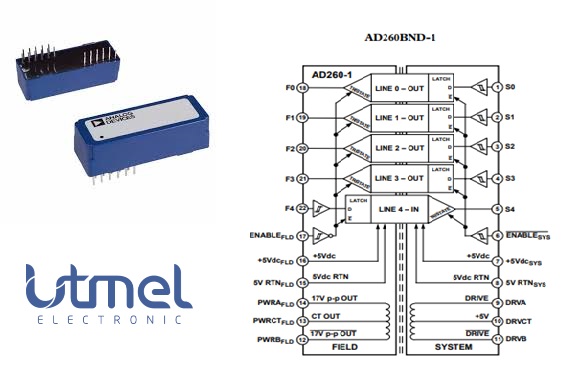
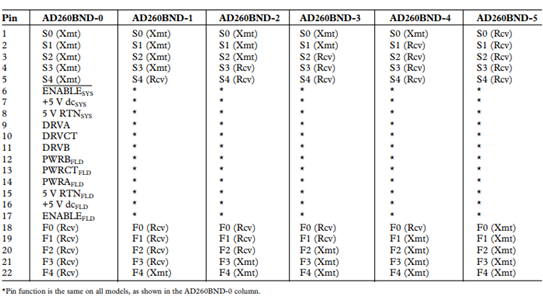
AD260BND-1 CAD Model
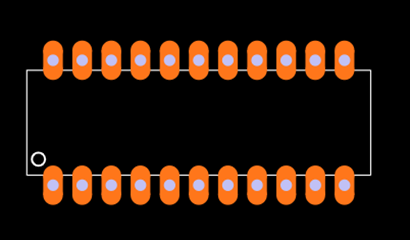
AD260BND-1 Feature
IsoLogic™ Circuit Architecture
Isolation Test Voltage: To 3.5kV rms
Five Isolated Logic Lines: Available in Six I/O Configurations
Logic Signal Bandwidth: 20 MHz (Min), 40 mbps (NRZ)
Isolated Power Transformer: 37 V p-p, 1.5 W Max
CMV Transient Immunity: 10 kV/ms Min
Waveform Edge Transmission Symmetry: 61ns
Field and System Output Enable/Three-State Functions
Performance Rated Over –258C to +858C
UL1950, IEC950, EN60950 Certification, Pending
AD260BND-1 Advantage
Six Isolated Logic Line I/O Configurations Available:
The AD260 is available in six pin-compatible versions of I/O configurations to meet a wide variety of requirements.
Wide Bandwidth with Minimal Edge Error:
The AD260 with IsoLogic affords extremely fast isolation of logic signals due to its 20 MHz bandwidth and 14 ns propagation delay. It maintains a waveform input-to-output edge transition error of typically less than ±1 ns (total) for positive vs. negative transition.
3.5 kV rms Test Voltage Isolation Rating:
The AD260 B Grade is rated to operate at 1.25 kV rms and is 100% production tested at 3.5 kV rms, using a standard ADI test method.
High Transient Immunity:
The AD260 rejects common-mode transients slewing at up to 10 kV/µs without false triggering or damage to the device.
Specifications
- TypeParameter
- Lifecycle Status
Lifecycle Status refers to the current stage of an electronic component in its product life cycle, indicating whether it is active, obsolete, or transitioning between these states. An active status means the component is in production and available for purchase. An obsolete status indicates that the component is no longer being manufactured or supported, and manufacturers typically provide a limited time frame for support. Understanding the lifecycle status is crucial for design engineers to ensure continuity and reliability in their projects.
OBSOLETE (Last Updated: 1 month ago) - Contact Plating
Contact plating (finish) provides corrosion protection for base metals and optimizes the mechanical and electrical properties of the contact interfaces.
Lead, Tin - Mount
In electronic components, the term "Mount" typically refers to the method or process of physically attaching or fixing a component onto a circuit board or other electronic device. This can involve soldering, adhesive bonding, or other techniques to secure the component in place. The mounting process is crucial for ensuring proper electrical connections and mechanical stability within the electronic system. Different components may have specific mounting requirements based on their size, shape, and function, and manufacturers provide guidelines for proper mounting procedures to ensure optimal performance and reliability of the electronic device.
Through Hole - Mounting Type
The "Mounting Type" in electronic components refers to the method used to attach or connect a component to a circuit board or other substrate, such as through-hole, surface-mount, or panel mount.
Through Hole - Package / Case
refers to the protective housing that encases an electronic component, providing mechanical support, electrical connections, and thermal management.
22-DIP Module - Number of Pins22
- Operating Temperature
The operating temperature is the range of ambient temperature within which a power supply, or any other electrical equipment, operate in. This ranges from a minimum operating temperature, to a peak or maximum operating temperature, outside which, the power supply may fail.
-25°C~85°C - Packaging
Semiconductor package is a carrier / shell used to contain and cover one or more semiconductor components or integrated circuits. The material of the shell can be metal, plastic, glass or ceramic.
Tube - Series
In electronic components, the "Series" refers to a group of products that share similar characteristics, designs, or functionalities, often produced by the same manufacturer. These components within a series typically have common specifications but may vary in terms of voltage, power, or packaging to meet different application needs. The series name helps identify and differentiate between various product lines within a manufacturer's catalog.
IsoLogic™ - Pbfree Code
The "Pbfree Code" parameter in electronic components refers to the code or marking used to indicate that the component is lead-free. Lead (Pb) is a toxic substance that has been widely used in electronic components for many years, but due to environmental concerns, there has been a shift towards lead-free alternatives. The Pbfree Code helps manufacturers and users easily identify components that do not contain lead, ensuring compliance with regulations and promoting environmentally friendly practices. It is important to pay attention to the Pbfree Code when selecting electronic components to ensure they meet the necessary requirements for lead-free applications.
no - Part Status
Parts can have many statuses as they progress through the configuration, analysis, review, and approval stages.
Obsolete - Moisture Sensitivity Level (MSL)
Moisture Sensitivity Level (MSL) is a standardized rating that indicates the susceptibility of electronic components, particularly semiconductors, to moisture-induced damage during storage and the soldering process, defining the allowable exposure time to ambient conditions before they require special handling or baking to prevent failures
1 (Unlimited) - Number of Terminations22
- ECCN Code
An ECCN (Export Control Classification Number) is an alphanumeric code used by the U.S. Bureau of Industry and Security to identify and categorize electronic components and other dual-use items that may require an export license based on their technical characteristics and potential for military use.
EAR99 - TypeGeneral Purpose
- Voltage - Supply
Voltage - Supply refers to the range of voltage levels that an electronic component or circuit is designed to operate with. It indicates the minimum and maximum supply voltage that can be applied for the device to function properly. Providing supply voltages outside this range can lead to malfunction, damage, or reduced performance. This parameter is critical for ensuring compatibility between different components in a circuit.
4V~5.75V - Terminal Position
In electronic components, the term "Terminal Position" refers to the physical location of the connection points on the component where external electrical connections can be made. These connection points, known as terminals, are typically used to attach wires, leads, or other components to the main body of the electronic component. The terminal position is important for ensuring proper connectivity and functionality of the component within a circuit. It is often specified in technical datasheets or component specifications to help designers and engineers understand how to properly integrate the component into their circuit designs.
QUAD - Number of Functions1
- Supply Voltage
Supply voltage refers to the electrical potential difference provided to an electronic component or circuit. It is crucial for the proper operation of devices, as it powers their functions and determines performance characteristics. The supply voltage must be within specified limits to ensure reliability and prevent damage to components. Different electronic devices have specific supply voltage requirements, which can vary widely depending on their design and intended application.
5V - Base Part Number
The "Base Part Number" (BPN) in electronic components serves a similar purpose to the "Base Product Number." It refers to the primary identifier for a component that captures the essential characteristics shared by a group of similar components. The BPN provides a fundamental way to reference a family or series of components without specifying all the variations and specific details.
AD260 - Pin Count
a count of all of the component leads (or pins)
22 - Voltage - Isolation
Voltage - Isolation is a parameter in electronic components that refers to the maximum voltage that can be safely applied between two isolated points without causing electrical breakdown or leakage. It is a crucial specification for components such as transformers, optocouplers, and capacitors that require isolation to prevent electrical interference or safety hazards. The voltage isolation rating ensures that the component can withstand the specified voltage without compromising its performance or safety. It is typically measured in volts and is an important consideration when designing circuits that require isolation between different parts of the system.
3500Vrms - Operating Supply Voltage
The voltage level by which an electrical system is designated and to which certain operating characteristics of the system are related.
5V - Number of Channels5
- Operating Supply Current
Operating Supply Current, also known as supply current or quiescent current, is a crucial parameter in electronic components that indicates the amount of current required for the device to operate under normal conditions. It represents the current drawn by the component from the power supply while it is functioning. This parameter is important for determining the power consumption of the component and is typically specified in datasheets to help designers calculate the overall power requirements of their circuits. Understanding the operating supply current is essential for ensuring proper functionality and efficiency of electronic systems.
4mA - Propagation Delay
the flight time of packets over the transmission link and is limited by the speed of light.
25 ns - Channel Type
In electronic components, the parameter "Channel Type" refers to the type of channel through which electrical signals or current flow within the component. This parameter is commonly associated with field-effect transistors (FETs) and other semiconductor devices. The channel type can be categorized as either N-channel or P-channel, depending on the polarity of the majority charge carriers (electrons or holes) that carry the current within the channel. N-channel devices have an electron-conducting channel, while P-channel devices have a hole-conducting channel. Understanding the channel type is crucial for proper circuit design and component selection to ensure compatibility and optimal performance.
Unidirectional - Propagation Delay tpLH / tpHL (Max)
Propagation delay tpLH and tpHL refer to the time it takes for a digital signal to travel through a logic gate or other electronic component. tpLH is the maximum time delay for the output to transition from a low state to a high state, while tpHL is the maximum time delay for the output to transition from a high state to a low state. These parameters are critical for determining the speed and timing performance of digital circuits, as they impact how quickly signals can propagate through the system and affect overall operation.
25ns, 25ns - Common Mode Transient Immunity (Min)
Common Mode Transient Immunity (Min) is a parameter that measures the ability of an electronic component to withstand and reject common mode noise or interference signals. Common mode noise refers to unwanted signals that are present on both input and output lines of a component. The minimum value of Common Mode Transient Immunity indicates the minimum level of noise or interference that the component can tolerate without affecting its performance. A higher Common Mode Transient Immunity value signifies better protection against common mode noise, ensuring reliable operation of the component in noisy environments. It is an important specification to consider when designing circuits that are exposed to external disturbances or electromagnetic interference.
10kV/μs - Supply Voltage1-Nom
Supply Voltage1-Nom is a parameter in electronic components that refers to the nominal or rated voltage level at which the component is designed to operate optimally. This parameter specifies the voltage level that the component requires to function correctly and efficiently. It is important to ensure that the actual supply voltage provided to the component closely matches the specified nominal voltage to prevent damage or malfunction. Deviating significantly from the nominal voltage may result in unreliable performance or even permanent damage to the component. It is crucial to adhere to the specified supply voltage range to ensure the proper functioning and longevity of the electronic component.
5V - Inputs - Side 1/Side 2
The parameter "Inputs - Side 1/Side 2" in electronic components refers to the configuration of input connections on the component. It indicates which side of the component is designated as Side 1 and which side is designated as Side 2 for input connections. This parameter is important for proper installation and connection of the component in a circuit or system. By following the specified input configuration, users can ensure that the component functions correctly and interfaces properly with other components in the circuit.
1/4 - Isolated Power
ISO measures the raw power of a hitter by taking only extra-base hits -- and the type of extra-base hit -- into account.
Yes - Pulse Width Distortion (PWD)
Pulse Width Distortion (PWD) is a term used in electronic components, particularly in digital communication systems. It refers to the distortion or variation in the width of the pulses in a digital signal. In a digital signal, the pulses should ideally have a consistent width to accurately represent the data being transmitted. However, factors such as noise, interference, or imperfections in the transmission medium can cause the pulses to be distorted, leading to errors in data transmission. Monitoring and minimizing pulse width distortion is crucial in ensuring the reliability and accuracy of digital communication systems.
25 ns - Radiation Hardening
Radiation hardening is the process of making electronic components and circuits resistant to damage or malfunction caused by high levels of ionizing radiation, especially for environments in outer space (especially beyond the low Earth orbit), around nuclear reactors and particle accelerators, or during nuclear accidents or nuclear warfare.
No - RoHS Status
RoHS means “Restriction of Certain Hazardous Substances” in the “Hazardous Substances Directive” in electrical and electronic equipment.
Non-RoHS Compliant - Lead Free
Lead Free is a term used to describe electronic components that do not contain lead as part of their composition. Lead is a toxic material that can have harmful effects on human health and the environment, so the electronics industry has been moving towards lead-free components to reduce these risks. Lead-free components are typically made using alternative materials such as silver, copper, and tin. Manufacturers must comply with regulations such as the Restriction of Hazardous Substances (RoHS) directive to ensure that their products are lead-free and environmentally friendly.
Contains Lead
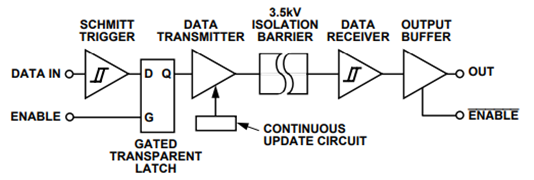
AD260BND-1 Block Diagram
AD260BND-1 Application
PLC/DCS Analog Input and Output Cards
Communications Bus Isolation
General Data Acquisition Applications
IGBT Motor Drive Controls
High Speed Digital I/O Ports
AD260BND-1 Dimension
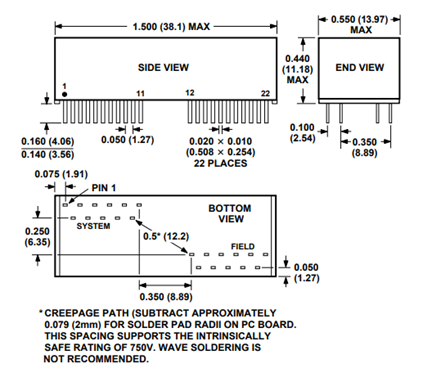
Parts with Similar Specs
- ImagePart NumberManufacturerPackage / CaseNumber of PinsSupply VoltageSupply Voltage1-NomRadiation HardeningMountPackagingPart StatusView Compare
![AD260BND-1]()
AD260BND-1
22-DIP Module
22
5 V
5 V
No
Through Hole
Tube
Obsolete
![AD260AND-2]()
22-DIP Module
22
5 V
5 V
No
Through Hole
Tube
Obsolete
![AD260AND-3]()
22-DIP Module
22
5 V
5 V
No
Through Hole
Tube
Obsolete
![MCP2515-I/P]()
22-DIP Module
22
5 V
5 V
No
Through Hole
Tube
Obsolete
![AD260AND-4]()
18-DIP (0.300, 7.62mm)
18
4.5 V
-
No
Through Hole
Tube
Active


AD260BND-1 Manufacturer
Analog Devices (NASDAQ: ADI) is a world leader in the design, manufacture, and marketing of a broad portfolio of high-performance analog, mixed-signal, and digital signal processing (DSP) integrated circuits (ICs) used in virtually all types of electronic equipment. Since our inception in 1965, we have focused on solving the engineering challenges associated with signal processing in electronic equipment. Used by over 100,000 customers worldwide, our signal processing products play a fundamental role in converting, conditioning, and processing real-world phenomena such as temperature, pressure, sound, light, speed, and motion into electrical signals to be used in a wide array of electronic devices.
Trend Analysis
Datasheet PDF
- Datasheets :
- PCN Obsolescence/ EOL :
- PCN Design/Specification :
- ConflictMineralStatement :
1.What does a single enable pin on either side of the barrier do?
A single enable pin on either side of the barrier causes all outputs on that side to go three-state and all inputs (driven pins) to ignore their inputs and retain their last known state.
2.Why there are six AD260 part configurations?
The five unidirectional logic lines have six possible combinations of “ins” and “outs”, or transmitter/ receiver pairs; hence there are six AD260 part configurations.
3.What does each logic line barrier driver require?
Each logic line barrier driver requires about 160µA per MHz and each receiver 40 µA per MHz plus, of course, 4 mA total idle current (each side).
4.Why the maximum square-wave frequency of operation is 20MHz?
The total capacitance spanning the isolation barrier is about 25 ns. Therefore the maximum square-wave frequency of operation is 20 MHz.
 What is the difference between IRF640 and IRF740: IRF640 vs. IRF740
08 December 20217115
 D44H8 Power Transistor: Pinout, Datasheet, and Applications
21 July 20211354
 STM32F051C6T7 Microcontroller: Datasheet, Pinout, Block Diagram
13 September 20212422
 The Comprehensive Introductions to LMD18200T
14 November 20222792
 PIC16F877A Microcontroller: Datasheet, Pinout and Features
16 May 202337516
 TIP36C Transistor: Equivalent, Datasheet, Test Circuit
29 November 20219887
 XC2331D 16/32-Bit Single-Chip Microcontroller: A Technical Overview
29 February 2024198
 TIP41C Transistor: Datasheet, Pinout, and Test Circuits
09 July 202142788
 Why RFID Technology Matters for Retail Innovation Today
10 July 20252813
 What is a Servo Drive?
16 June 20215853
 MEMS Basics: System Features and Classifications
11 June 20217805
 Silicon Carbide: The Future of Power Electronics
06 March 20233864
 SiC Power Conversion Devices at High Ambient Temperatures
14 March 20232731
 Introduction to Wireless Charger
27 July 20216448
 Smartphone RF Chips Availability Forecast 2026: Lead-Time Risks and Alternatives
14 July 2026316
 Why does a MOSFET with a Small Internal Resistance Heat Up?
09 May 20223967
Analog Devices Inc.
In Stock: 47
United States
China
Canada
Japan
Russia
Germany
United Kingdom
Singapore
Italy
Hong Kong(China)
Taiwan(China)
France
Korea
Mexico
Netherlands
Malaysia
Austria
Spain
Switzerland
Poland
Thailand
Vietnam
India
United Arab Emirates
Afghanistan
Åland Islands
Albania
Algeria
American Samoa
Andorra
Angola
Anguilla
Antigua & Barbuda
Argentina
Armenia
Aruba
Australia
Azerbaijan
Bahamas
Bahrain
Bangladesh
Barbados
Belarus
Belgium
Belize
Benin
Bermuda
Bhutan
Bolivia
Bonaire, Sint Eustatius and Saba
Bosnia & Herzegovina
Botswana
Brazil
British Indian Ocean Territory
British Virgin Islands
Brunei
Bulgaria
Burkina Faso
Burundi
Cabo Verde
Cambodia
Cameroon
Cayman Islands
Central African Republic
Chad
Chile
Christmas Island
Cocos (Keeling) Islands
Colombia
Comoros
Congo
Congo (DRC)
Cook Islands
Costa Rica
Côte d’Ivoire
Croatia
Cuba
Curaçao
Cyprus
Czechia
Denmark
Djibouti
Dominica
Dominican Republic
Ecuador
Egypt
El Salvador
Equatorial Guinea
Eritrea
Estonia
Eswatini
Ethiopia
Falkland Islands
Faroe Islands
Fiji
Finland
French Guiana
French Polynesia
Gabon
Gambia
Georgia
Ghana
Gibraltar
Greece
Greenland
Grenada
Guadeloupe
Guam
Guatemala
Guernsey
Guinea
Guinea-Bissau
Guyana
Haiti
Honduras
Hungary
Iceland
Indonesia
Iran
Iraq
Ireland
Isle of Man
Israel
Jamaica
Jersey
Jordan
Kazakhstan
Kenya
Kiribati
Kosovo
Kuwait
Kyrgyzstan
Laos
Latvia
Lebanon
Lesotho
Liberia
Libya
Liechtenstein
Lithuania
Luxembourg
Macao(China)
Madagascar
Malawi
Maldives
Mali
Malta
Marshall Islands
Martinique
Mauritania
Mauritius
Mayotte
Micronesia
Moldova
Monaco
Mongolia
Montenegro
Montserrat
Morocco
Mozambique
Myanmar
Namibia
Nauru
Nepal
New Caledonia
New Zealand
Nicaragua
Niger
Nigeria
Niue
Norfolk Island
North Korea
North Macedonia
Northern Mariana Islands
Norway
Oman
Pakistan
Palau
Palestinian Authority
Panama
Papua New Guinea
Paraguay
Peru
Philippines
Pitcairn Islands
Portugal
Puerto Rico
Qatar
Réunion
Romania
Rwanda
Samoa
San Marino
São Tomé & Príncipe
Saudi Arabia
Senegal
Serbia
Seychelles
Sierra Leone
Sint Maarten
Slovakia
Slovenia
Solomon Islands
Somalia
South Africa
South Sudan
Sri Lanka
St Helena, Ascension, Tristan da Cunha
St. Barthélemy
St. Kitts & Nevis
St. Lucia
St. Martin
St. Pierre & Miquelon
St. Vincent & Grenadines
Sudan
Suriname
Svalbard & Jan Mayen
Sweden
Syria
Tajikistan
Tanzania
Timor-Leste
Togo
Tokelau
Tonga
Trinidad & Tobago
Tunisia
Turkey
Turkmenistan
Turks & Caicos Islands
Tuvalu
U.S. Outlying Islands
U.S. Virgin Islands
Uganda
Ukraine
Uruguay
Uzbekistan
Vanuatu
Vatican City
Venezuela
Wallis & Futuna
Yemen
Zambia
Zimbabwe
![ADUM1441ARQZ-RL7]() ADUM1441ARQZ-RL7
ADUM1441ARQZ-RL7Analog Devices Inc.
![ADM2587EBRWZ-REEL7]() ADM2587EBRWZ-REEL7
ADM2587EBRWZ-REEL7Analog Devices Inc.
![ADUM1250ARZ]() ADUM1250ARZ
ADUM1250ARZAnalog Devices Inc.
![ADUM1250ARZ-RL7]() ADUM1250ARZ-RL7
ADUM1250ARZ-RL7Analog Devices Inc.
![ADUM121N1BRZ-RL7]() ADUM121N1BRZ-RL7
ADUM121N1BRZ-RL7Analog Devices Inc.
![ADM2582EBRWZ-REEL7]() ADM2582EBRWZ-REEL7
ADM2582EBRWZ-REEL7Analog Devices Inc.
![ADUM1200BRZ-RL7]() ADUM1200BRZ-RL7
ADUM1200BRZ-RL7Analog Devices Inc.
![ADUM4160BRWZ-RL]() ADUM4160BRWZ-RL
ADUM4160BRWZ-RLAnalog Devices Inc.
![ADM2483BRWZ-REEL]() ADM2483BRWZ-REEL
ADM2483BRWZ-REELAnalog Devices Inc.
![ADUM3160BRWZ-RL]() ADUM3160BRWZ-RL
ADUM3160BRWZ-RLAnalog Devices Inc.


