

 Product
 Brand
 Articles
 Tools

CR2016 Battery: Pinout, Equivalents, CR2016 vs. CR2032


BATTERY LITHIUM 3V CR2016
This article will unlock more details about CR2016, a lithium coin cell battery
CR2032 vs CR2016 – What is the Difference Between These Batteries
CR2016 Pinout

CR2016 Pinout
CR2016 Description
The CR2016 is a lithium coin battery commonly used in automotive applications, sensors, medical thermometers, and other electronics applications. It uses a lithium/manganese dioxide (Li/MnO2) chemical system. The nominal voltage for a cell is around 3V. And typical power capacity is approximately 90-100 mAh.
Specifications
- TypeParameter
- Factory Lead Time12 Weeks
- Voltage Rated
RATED voltage is the voltage on the nameplate - the "design point" for maximum power throughput and safe thermal operation.
3V - Size / Dimension
In electronic components, the parameter "Size / Dimension" refers to the physical dimensions of the component, such as its length, width, and height. These dimensions are crucial for determining how the component will fit into a circuit or system, as well as for ensuring compatibility with other components and the overall design requirements. The size of a component can also impact its performance characteristics, thermal properties, and overall functionality within a given application. Engineers and designers must carefully consider the size and dimensions of electronic components to ensure proper integration and functionality within their designs.
0.79Dia x 0.06 H 20.0mmx1.6mm - Part Status
Parts can have many statuses as they progress through the configuration, analysis, review, and approval stages.
Active - Moisture Sensitivity Level (MSL)
Moisture Sensitivity Level (MSL) is a standardized rating that indicates the susceptibility of electronic components, particularly semiconductors, to moisture-induced damage during storage and the soldering process, defining the allowable exposure time to ambient conditions before they require special handling or baking to prevent failures
Not Applicable - Termination Style
"Termination style" in electronic components refers to the method used to connect the component to a circuit board or other electronic devices. It determines how the component's leads or terminals are designed for soldering or mounting onto the circuit board. Common termination styles include through-hole, surface mount, and wire lead terminations.Through-hole components have leads that are inserted through holes in the circuit board and soldered on the other side. Surface mount components have flat terminals that are soldered directly onto the surface of the circuit board. Wire lead terminations involve attaching wires to the component for connection.The choice of termination style depends on factors such as the type of component, the manufacturing process, and the space available on the circuit board. Different termination styles offer various advantages in terms of ease of assembly, reliability, and space efficiency in electronic designs.
Requires Holder - Storage/Refrigeration Temperature
The parameter "Storage/Refrigeration Temperature" in electronic components refers to the recommended temperature range at which the components should be stored to maintain their integrity and functionality. This parameter indicates the temperature limits within which the components can be safely stored without risking damage or degradation. Storage temperature is crucial for preserving the performance and reliability of electronic components over time, especially for sensitive components such as integrated circuits and semiconductors. Refrigeration temperature may be specified for certain components that require lower temperatures to prevent degradation or prolong shelf life. It is important to adhere to the recommended storage/refrigeration temperature guidelines to ensure the longevity and proper functioning of electronic components.
32°F~86°F 0°C~30°C - Battery Chemistry
A battery is a device that stores chemical energy, and converts it to electricity. This is known as electrochemistry and the system that underpins a battery is called an electrochemical cell. A battery can be made up of one or several (like in Volta's original pile) electrochemical cells.
Lithium Manganese Dioxide - Battery Cell Size
The most common lithium-ion cell is the 18650 (the numbers define the physical dimensions and shape as follows: 18mm in diameter, 65mm long and the 0 means it has a round cross-section) which is due to its widespread use in laptop battery packs.
Coin 20.0mm - Capacity
In electronic components, "Capacity" typically refers to the maximum amount of electrical charge that a component can store. It is measured in units called farads (F). Capacitors are the most common components that have a capacity rating. The capacity of a capacitor determines how much energy it can store and release when connected in a circuit. Higher capacity capacitors can store more charge and are often used in applications requiring larger energy storage or filtering capabilities. It is important to select a capacitor with the appropriate capacity to ensure proper functioning of the circuit.
80mAh - RoHS Status
RoHS means “Restriction of Certain Hazardous Substances” in the “Hazardous Substances Directive” in electrical and electronic equipment.
RoHS Compliant
CR2016 Features
●Good pulse and high discharge rate performance
●Wide operating temperature range
●Stable discharge voltage
●No passivation
●Long operating life and shelf life
●Self-discharge rate less than 3% per year at 20°C
●Excellent safety in a hermetically sealed case
●Ability to provide a variety of welded termination tabs for all cell types
CR2016 Applications
Digital watch
Automobile applications (smart key, keyless entry, etc.)
Laser pens
Fitness applications
Medical devices
CR2016 Equivalents
CR2032, CR1220.
How to use CR2016
As per the below circuit diagram, you can power up a 3V DC motor by using a CR2016 battery. These batteries are used in many modules also like the RTC module. The output voltage is 3V so you can also power up your devices, module, electronic equipment which operates on 3V.

How to use CR2016
CR2016 vs. CR2032
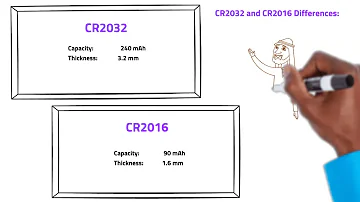
Although CR2032 battery and CR2016 battery share similarities, there are actually differences in battery thickness and battery capacity. Therefore, we cannot simply use the two batteries.
CR2016 and CR2032 may vary in thickness, but they are identical in several ways.
They're both 3-volt versions, and none of them is rechargeable. However, it is important to remember that there are variations inability. CR 2032 has a capacity of 240 mAh, while CR2016 has a capacity of just 90 mAh. The CR2032 can provide 10 hours of use, while you only get about six hours from the CR2016, depending on the power you're using, of course.
Due to their equivalent voltage, there are several cases where CR2016 and CR2032 can be interchanged. However, the fact that they have different capacities and therefore different runtimes can cause problems. You will not get the power from the CR2016 that you will get from the CR2032, and some devices won't function at all.
CR2016 Dimensions

CR2016 Dimensions
CR2016 Manufacturer
ZEUS Battery Products, founded in 2001 and located in the Midwest, emerges as a leading battery manufacturer dedicated to meeting the evolving demands of domestic and global primary and rechargeable battery markets.
Datasheet PDF
- Datasheets :
Can You Use CR2016 instead of CR2032?
No, the CR2016 is thinner and a bit smaller than the CR2032.
What Does CR Mean in Batteries?
CR is the generic designation that is used by the entire batteries maker but lithium batteries are also having chromium. All the batteries that have this chemical substance in their batteries can use this abbreviation CR. On the other DL is the short abbreviation of the battery making company Duracell.
How long do CR2016 batteries last?
10 years.
How do you stack CR2016 batteries?
Remove the two batteries from the remote by sliding batteries out of the battery holder. 4.) Stack the new CR2016 batteries as shown with (+) facing up on both and slide back into the battery holder. Re-attach the cover with the three Phillips screws.
Can you use a 2025 battery in place of a 2016?
2016 is 20mm in diameter and 1.6mm thick. 2025 is 20mm in diameter and 2.5mm thick. The added thickness of 2025 would prevent it from fitting properly in the watches you mention.
 TPS26600PWPT: High Voltage, Pinout, 4.2V to 55V
18 March 2022935
 2N5484 Transistor: 2N5484 Datasheet, Pinout, Equivalent
21 February 20223095
 TM1650 LED Drive Control: Datasheet pdf, Circuit and Pinout
16 November 202119388
 TDA7056B Audio Amplifiers: Schematic, Pinout, and Datasheet [Video&FAQ]
06 January 202214645
 CS4270 Stereo Audio CODEC: CS4270 Datasheet, Pinout, CS4272 VS. CS4270
02 March 20224402
 2N5089 Transistor : Pinout, Equivalent and Datasheet
07 September 20213180
 STM32F302R8T6 Microcontroller: Pinout, Datasheet, and Specification
29 June 20213777
 2N3440 NPN transistor: Datasheet, Equivalent and Pinout
08 November 20214207
 Introduction to Pi Filter
19 February 202116151
 What is 3D XPoint?
09 November 20215682
 Shunt Resistors in Automotive and Power Electronics: A Comprehensive Guide to Selection and Applications
04 August 20257685
 Capacitor Signs: Decoding Symbols & Markings
14 August 202511677
 What is a Servo Drive?
16 June 20215994
 What is PWM "Dead Band"?
21 April 20228420
 Inverter Introduction: Structures, Working Principles and Features
18 February 202238032
 Voltage Follower: Purpose, Working, and Circuits
27 March 202528911
ZEUS Battery Products
In Stock
United States
China
Canada
Japan
Russia
Germany
United Kingdom
Singapore
Italy
Hong Kong(China)
Taiwan(China)
France
Korea
Mexico
Netherlands
Malaysia
Austria
Spain
Switzerland
Poland
Thailand
Vietnam
India
United Arab Emirates
Afghanistan
Åland Islands
Albania
Algeria
American Samoa
Andorra
Angola
Anguilla
Antigua & Barbuda
Argentina
Armenia
Aruba
Australia
Azerbaijan
Bahamas
Bahrain
Bangladesh
Barbados
Belarus
Belgium
Belize
Benin
Bermuda
Bhutan
Bolivia
Bonaire, Sint Eustatius and Saba
Bosnia & Herzegovina
Botswana
Brazil
British Indian Ocean Territory
British Virgin Islands
Brunei
Bulgaria
Burkina Faso
Burundi
Cabo Verde
Cambodia
Cameroon
Cayman Islands
Central African Republic
Chad
Chile
Christmas Island
Cocos (Keeling) Islands
Colombia
Comoros
Congo
Congo (DRC)
Cook Islands
Costa Rica
Côte d’Ivoire
Croatia
Cuba
Curaçao
Cyprus
Czechia
Denmark
Djibouti
Dominica
Dominican Republic
Ecuador
Egypt
El Salvador
Equatorial Guinea
Eritrea
Estonia
Eswatini
Ethiopia
Falkland Islands
Faroe Islands
Fiji
Finland
French Guiana
French Polynesia
Gabon
Gambia
Georgia
Ghana
Gibraltar
Greece
Greenland
Grenada
Guadeloupe
Guam
Guatemala
Guernsey
Guinea
Guinea-Bissau
Guyana
Haiti
Honduras
Hungary
Iceland
Indonesia
Iran
Iraq
Ireland
Isle of Man
Israel
Jamaica
Jersey
Jordan
Kazakhstan
Kenya
Kiribati
Kosovo
Kuwait
Kyrgyzstan
Laos
Latvia
Lebanon
Lesotho
Liberia
Libya
Liechtenstein
Lithuania
Luxembourg
Macao(China)
Madagascar
Malawi
Maldives
Mali
Malta
Marshall Islands
Martinique
Mauritania
Mauritius
Mayotte
Micronesia
Moldova
Monaco
Mongolia
Montenegro
Montserrat
Morocco
Mozambique
Myanmar
Namibia
Nauru
Nepal
New Caledonia
New Zealand
Nicaragua
Niger
Nigeria
Niue
Norfolk Island
North Korea
North Macedonia
Northern Mariana Islands
Norway
Oman
Pakistan
Palau
Palestinian Authority
Panama
Papua New Guinea
Paraguay
Peru
Philippines
Pitcairn Islands
Portugal
Puerto Rico
Qatar
Réunion
Romania
Rwanda
Samoa
San Marino
São Tomé & Príncipe
Saudi Arabia
Senegal
Serbia
Seychelles
Sierra Leone
Sint Maarten
Slovakia
Slovenia
Solomon Islands
Somalia
South Africa
South Sudan
Sri Lanka
St Helena, Ascension, Tristan da Cunha
St. Barthélemy
St. Kitts & Nevis
St. Lucia
St. Martin
St. Pierre & Miquelon
St. Vincent & Grenadines
Sudan
Suriname
Svalbard & Jan Mayen
Sweden
Syria
Tajikistan
Tanzania
Timor-Leste
Togo
Tokelau
Tonga
Trinidad & Tobago
Tunisia
Turkey
Turkmenistan
Turks & Caicos Islands
Tuvalu
U.S. Outlying Islands
U.S. Virgin Islands
Uganda
Ukraine
Uruguay
Uzbekistan
Vanuatu
Vatican City
Venezuela
Wallis & Futuna
Yemen
Zambia
Zimbabwe