

 Product
 Brand
Brand Articles
 Tools
Tools
H11L1 Trigger Photocoupler: Pinout, Datasheet and Circuit


OPTOISO 5KV OPEN COLLECTOR 6DIP
H11L1 is a 6 Pin Dip Schmitt Trigger Photocoupler and available in wide-lead spacing and SMD option. This article mainly convers pinout, datasheet, applications, features and other details of H11L1.

H11L1 Optocoupler based Zero-Crossing Pulse Detector
H11L1 Description
The H11L1 consists of a GaAs infrared emitting diode optically coupled a high speed integrated circuit detector. The output detector incorporates a Schmitt trigger, which provides hysteresis for noise immunity and pulse shaping. H11L1 is in a 6-pin DIP package and available in wide-lead spacing and SMD option.
H11l1 Pinout

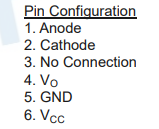
H11L1 CAD Model
Symbol

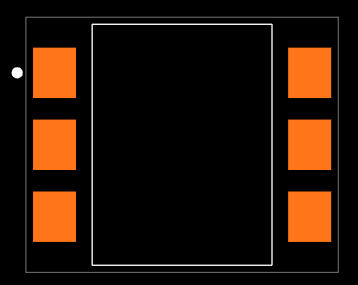
Footprint
Specifications
- TypeParameter
- Factory Lead Time20 Weeks
- Mount
In electronic components, the term "Mount" typically refers to the method or process of physically attaching or fixing a component onto a circuit board or other electronic device. This can involve soldering, adhesive bonding, or other techniques to secure the component in place. The mounting process is crucial for ensuring proper electrical connections and mechanical stability within the electronic system. Different components may have specific mounting requirements based on their size, shape, and function, and manufacturers provide guidelines for proper mounting procedures to ensure optimal performance and reliability of the electronic device.
Through Hole - Mounting Type
The "Mounting Type" in electronic components refers to the method used to attach or connect a component to a circuit board or other substrate, such as through-hole, surface-mount, or panel mount.
Through Hole - Package / Case
refers to the protective housing that encases an electronic component, providing mechanical support, electrical connections, and thermal management.
6-DIP (0.300, 7.62mm) - Number of Pins6
- Number of Elements1
- Operating Temperature
The operating temperature is the range of ambient temperature within which a power supply, or any other electrical equipment, operate in. This ranges from a minimum operating temperature, to a peak or maximum operating temperature, outside which, the power supply may fail.
-55°C~100°C - Packaging
Semiconductor package is a carrier / shell used to contain and cover one or more semiconductor components or integrated circuits. The material of the shell can be metal, plastic, glass or ceramic.
Tube - Published1995
- Pbfree Code
The "Pbfree Code" parameter in electronic components refers to the code or marking used to indicate that the component is lead-free. Lead (Pb) is a toxic substance that has been widely used in electronic components for many years, but due to environmental concerns, there has been a shift towards lead-free alternatives. The Pbfree Code helps manufacturers and users easily identify components that do not contain lead, ensuring compliance with regulations and promoting environmentally friendly practices. It is important to pay attention to the Pbfree Code when selecting electronic components to ensure they meet the necessary requirements for lead-free applications.
yes - Part Status
Parts can have many statuses as they progress through the configuration, analysis, review, and approval stages.
Active - Moisture Sensitivity Level (MSL)
Moisture Sensitivity Level (MSL) is a standardized rating that indicates the susceptibility of electronic components, particularly semiconductors, to moisture-induced damage during storage and the soldering process, defining the allowable exposure time to ambient conditions before they require special handling or baking to prevent failures
1 (Unlimited) - Additional Feature
Any Feature, including a modified Existing Feature, that is not an Existing Feature.
UL APPROVED - Max Power Dissipation
The maximum power that the MOSFET can dissipate continuously under the specified thermal conditions.
120mW - Voltage - Supply
Voltage - Supply refers to the range of voltage levels that an electronic component or circuit is designed to operate with. It indicates the minimum and maximum supply voltage that can be applied for the device to function properly. Providing supply voltages outside this range can lead to malfunction, damage, or reduced performance. This parameter is critical for ensuring compatibility between different components in a circuit.
3V~16V - Voltage - Isolation
Voltage - Isolation is a parameter in electronic components that refers to the maximum voltage that can be safely applied between two isolated points without causing electrical breakdown or leakage. It is a crucial specification for components such as transformers, optocouplers, and capacitors that require isolation to prevent electrical interference or safety hazards. The voltage isolation rating ensures that the component can withstand the specified voltage without compromising its performance or safety. It is typically measured in volts and is an important consideration when designing circuits that require isolation between different parts of the system.
5000Vrms - Output Type
The "Output Type" parameter in electronic components refers to the type of signal or data that is produced by the component as an output. This parameter specifies the nature of the output signal, such as analog or digital, and can also include details about the voltage levels, current levels, frequency, and other characteristics of the output signal. Understanding the output type of a component is crucial for ensuring compatibility with other components in a circuit or system, as well as for determining how the output signal can be utilized or processed further. In summary, the output type parameter provides essential information about the nature of the signal that is generated by the electronic component as its output.
Open Collector - Max Output Current
The maximum current that can be supplied to the load.
50mA - Configuration
The parameter "Configuration" in electronic components refers to the specific arrangement or setup of the components within a circuit or system. It encompasses how individual elements are interconnected and their physical layout. Configuration can affect the functionality, performance, and efficiency of the electronic system, and may influence factors such as signal flow, impedance, and power distribution. Understanding the configuration is essential for design, troubleshooting, and optimizing electronic devices.
SINGLE - Number of Channels1
- Voltage - Forward (Vf) (Typ)
The parameter "Voltage - Forward (Vf) (Typ)" in electronic components refers to the typical forward voltage drop across the component when it is conducting current in the forward direction. It is a crucial characteristic of components like diodes and LEDs, indicating the minimum voltage required for the component to start conducting current. The forward voltage drop is typically specified as a typical value because it can vary slightly based on factors such as temperature and manufacturing tolerances. Designers use this parameter to ensure that the component operates within its specified voltage range and to calculate power dissipation in the component.
1.15V - Propagation Delay
the flight time of packets over the transmission link and is limited by the speed of light.
4 μs - Input Type
Input type in electronic components refers to the classification of the signal or data that a component can accept for processing or conversion. It indicates whether the input is analog, digital, or a specific format such as TTL or CMOS. Understanding input type is crucial for ensuring compatibility between different electronic devices and circuits, as it determines how signals are interpreted and interacted with.
DC - Optoelectronic Device Type
Optoelectronic Device Type refers to the classification of electronic components that can both detect and emit light. These devices convert electrical signals into light or vice versa, making them essential for applications such as optical communication, sensing, and display technologies. Common types of optoelectronic devices include light-emitting diodes (LEDs), photodiodes, phototransistors, and laser diodes. Understanding the optoelectronic device type is crucial for selecting the appropriate component for a specific application based on factors such as wavelength, power output, and sensitivity.
LOGIC IC OUTPUT OPTOCOUPLER - Forward Current
Current which flows upon application of forward voltage.
60mA - Max Output Voltage
The maximum output voltage refers to the dynamic area beyond which the output is saturated in the positive or negative direction, and is limited according to the load resistance value.
15V - Data Rate
Data Rate is defined as the amount of data transmitted during a specified time period over a network. It is the speed at which data is transferred from one device to another or between a peripheral device and the computer. It is generally measured in Mega bits per second(Mbps) or Mega bytes per second(MBps).
1MHz - Direction
In electronic components, the parameter "Direction" refers to the orientation or alignment in which the component is designed to operate effectively. This parameter is particularly important for components such as diodes, transistors, and capacitors, which have specific polarity or orientation requirements for proper functionality. For example, diodes allow current flow in one direction only, so their direction parameter indicates the correct orientation for current flow. Similarly, polarized capacitors have a positive and negative terminal, requiring proper alignment for correct operation. Understanding and adhering to the direction parameter is crucial for ensuring the reliable and efficient performance of electronic components in a circuit.
Unidirectional - Output Current per Channel
Output Current per Channel is a specification commonly found in electronic components such as amplifiers, audio interfaces, and power supplies. It refers to the maximum amount of electrical current that can be delivered by each individual output channel of the component. This parameter is important because it determines the capacity of the component to drive connected devices or loads. A higher output current per channel means the component can deliver more power to connected devices, while a lower output current may limit the performance or functionality of the component in certain applications. It is crucial to consider the output current per channel when selecting electronic components to ensure they can meet the power requirements of the intended system or setup.
50mA - Rise Time
In electronics, when describing a voltage or current step function, rise time is the time taken by a signal to change from a specified low value to a specified high value.
100ns - Fall Time (Typ)
Fall Time (Typ) is a parameter used to describe the time it takes for a signal to transition from a high level to a low level in an electronic component, such as a transistor or an integrated circuit. It is typically measured in nanoseconds or microseconds and is an important characteristic that affects the performance of the component in digital circuits. A shorter fall time indicates faster switching speeds and can result in improved overall circuit performance, such as reduced power consumption and increased data transmission rates. Designers often consider the fall time specification when selecting components for their circuits to ensure proper functionality and efficiency.
100 ns - Rise / Fall Time (Typ)
The parameter "Rise / Fall Time (Typ)" in electronic components refers to the time it takes for a signal to transition from a specified low level to a specified high level (rise time) or from a high level to a low level (fall time). It is typically measured in nanoseconds or picoseconds and is an important characteristic in determining the speed and performance of a component, such as a transistor or integrated circuit. A shorter rise/fall time indicates faster signal switching and can impact the overall speed and efficiency of a circuit. Designers often consider this parameter when selecting components for high-speed applications to ensure proper signal integrity and timing.
100ns 100ns - On-State Current-Max
The parameter "On-State Current-Max" in electronic components refers to the maximum current that can flow through the component when it is in the fully conducting state, also known as the "on-state." This parameter is crucial for determining the maximum load that the component can handle without getting damaged. It is typically specified in the component's datasheet and is important for ensuring the safe and reliable operation of the component within its specified limits. Designers and engineers use this parameter to select components that can handle the required current levels in their circuits without exceeding the maximum ratings.
0.05A - Propagation Delay tpLH / tpHL (Max)
Propagation delay tpLH and tpHL refer to the time it takes for a digital signal to travel through a logic gate or other electronic component. tpLH is the maximum time delay for the output to transition from a low state to a high state, while tpHL is the maximum time delay for the output to transition from a high state to a low state. These parameters are critical for determining the speed and timing performance of digital circuits, as they impact how quickly signals can propagate through the system and affect overall operation.
4μs, 4μs - Inputs - Side 1/Side 2
The parameter "Inputs - Side 1/Side 2" in electronic components refers to the configuration of input connections on the component. It indicates which side of the component is designated as Side 1 and which side is designated as Side 2 for input connections. This parameter is important for proper installation and connection of the component in a circuit or system. By following the specified input configuration, users can ensure that the component functions correctly and interfaces properly with other components in the circuit.
1/0 - Reverse Voltage (DC)
Reverse Voltage (DC) refers to the maximum voltage that an electronic component, typically a semiconductor device like a diode, can withstand in the reverse direction without undergoing breakdown or failure. It indicates the threshold at which the device will start to conduct in reverse, potentially damaging the component. This parameter is crucial for ensuring the reliability and safety of circuits that may experience reverse polarity or unexpected voltage conditions. Exceeding the specified reverse voltage can lead to permanent damage or catastrophic failure of the component.
6V - Radiation Hardening
Radiation hardening is the process of making electronic components and circuits resistant to damage or malfunction caused by high levels of ionizing radiation, especially for environments in outer space (especially beyond the low Earth orbit), around nuclear reactors and particle accelerators, or during nuclear accidents or nuclear warfare.
No - RoHS Status
RoHS means “Restriction of Certain Hazardous Substances” in the “Hazardous Substances Directive” in electrical and electronic equipment.
ROHS3 Compliant - Lead Free
Lead Free is a term used to describe electronic components that do not contain lead as part of their composition. Lead is a toxic material that can have harmful effects on human health and the environment, so the electronics industry has been moving towards lead-free components to reduce these risks. Lead-free components are typically made using alternative materials such as silver, copper, and tin. Manufacturers must comply with regulations such as the Restriction of Hazardous Substances (RoHS) directive to ensure that their products are lead-free and environmentally friendly.
Lead Free
H11L1 Block Diagram
H11L1 Features
• High data rate, 1MHz typical (NRZ)
•Free from latch up and oscillation throughout voltage and temperature ranges.
• Microprocessor compatible drive
• Logic compatible output sinks 16mA at 0.4V maximum
• Guaranteed on/off threshold hysteresis
• Wide supply voltage capability, compatible with all popular logic systems
• High isolation voltage between input and output (Viso=5000 V rms )
• Compact dual-in-line package
• Pb free and RoHS compliant
• UL and cUL approved(No. E214129)
• VDE approved (No. 132249)
• SEMKO approved
• NEMKO approved
• DEMKO approved
• FIMKO approved
H11L1 Schematic

H11L1 Applications
Logic to logic isolator
Programmable current level sensor
Line receiver - eliminate noise and transient problems
AC to TTL conversion - square wave shaping
Digital programming of power supplies
Interfaces computers with peripherals
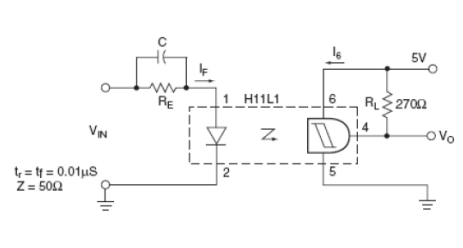
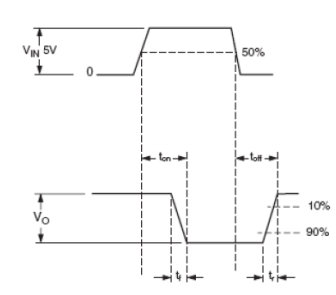
H11L1 Test Circuit
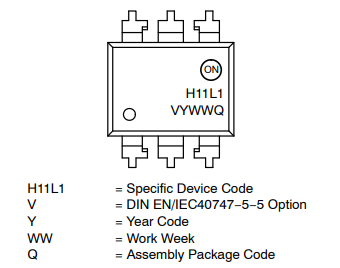
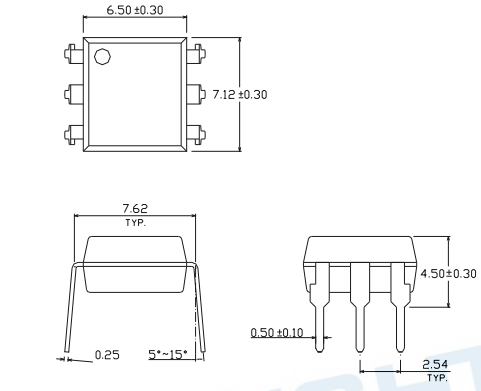
H11L1 Package
H11L1 Manufacturer
Everlight Electronics Co., Ltd. was founded in 1983 in Taipei, Taiwan. Playing a critical role in the formation of the global LED industry, the company is rapidly ascending to become a leading supplier due to its dedication to certification, R&D, production, quality, marketing and global customer service. Everlight provides a diverse product portfolio consisting of High Power LEDs, Lamps, SMD LEDs, LED Lighting Modules, Digital Displays, Optocouplers and Infrared Components for various applications. Today, Everlight is a global company with over 6,400 employees based in China, Hong Kong, Japan, Korea, Singapore, Malaysia, Germany, Sweden, U.S., and Canada.
Trend Analysis
Datasheet PDF
- Datasheets :
Is H11L1 a Schmidt trigger type optocoupler?
Yes it is. Optocoupler type information: There are two types of optocouplers: one is nonlinear optocoupler, and the other is linear optocoupler. The current transmission characteristic curve of a nonlinear optocoupler is nonlinear. This type of optocoupler is suitable for the transmission of switching signals and is not suitable for the transmission of analog quantities. The commonly used 4N series optocouplers are non-linear optocouplers.
What is the role of h11l1 in the circuit?
It is a 6-pin optocoupler isolator.
What type of optocoupler is H11L1?
Optocoupler with Schmidt trigger.
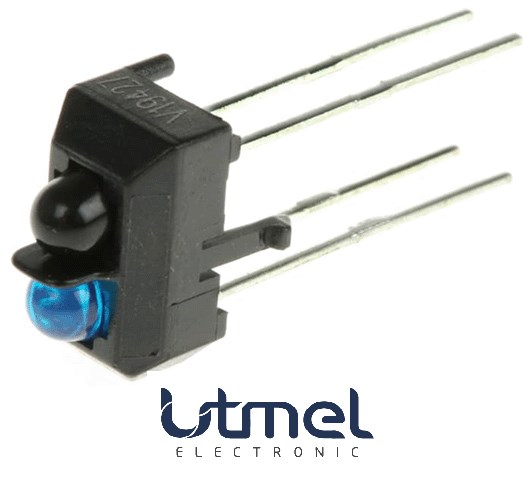 TCRT5000L:Datasheet, Package, and Manufacturer
14 March 20222129
 The LM2596S-5.0 Voltage Regulator: Pinout, Datasheet, Equivalent
29 July 202123702
 Microchip PIC16F1527IMR: In-Depth Overview of Features and Applications
29 February 2024228
 AT89C51CC03: Enhanced 8-bit MCU with CAN Controller and Flash Memory
28 February 2024358
 TIP142 Transistor: Datasheet, Equivalent, Amplifier Circuit
06 December 202114714
 AT89S52 Microcontroller: Application, Pinout and Datasheet
22 September 202118362
 AD8628 Zero-Drift Op-Amp: 1µV Offset Precision, Pinout, and Design Analysis
16 March 2026226
 ATSAM D20E17A/ATSAMD20E18A/ATSAMD20J18A Microcontroller: A Deep Dive Analysis
29 February 2024141
 Clock&Timing - Application Specific: A Dedicated Chip That Helps Produce Signals on the Circuit Board
22 February 20232198
 Nickel-Cadmium Battery: Construction, Features and Working Principle
19 March 202633329
 What is G.654E Fiber?
24 May 20226124
 How does a Photodiode Work?
15 August 202023308
 What is a Printed Circuit Board?
22 April 20217872
 What is ARM Processor?
17 March 20225025
 FPGA Tutorial: A Beginner's Guide to Programmable Logic Design in 2025
15 April 20255637
 AC/DC, DC/DC Converter Fundamental Guide
04 June 202614822
Everlight Electronics Co Ltd
In Stock: 720000
United States
China
Canada
Japan
Russia
Germany
United Kingdom
Singapore
Italy
Hong Kong(China)
Taiwan(China)
France
Korea
Mexico
Netherlands
Malaysia
Austria
Spain
Switzerland
Poland
Thailand
Vietnam
India
United Arab Emirates
Afghanistan
Åland Islands
Albania
Algeria
American Samoa
Andorra
Angola
Anguilla
Antigua & Barbuda
Argentina
Armenia
Aruba
Australia
Azerbaijan
Bahamas
Bahrain
Bangladesh
Barbados
Belarus
Belgium
Belize
Benin
Bermuda
Bhutan
Bolivia
Bonaire, Sint Eustatius and Saba
Bosnia & Herzegovina
Botswana
Brazil
British Indian Ocean Territory
British Virgin Islands
Brunei
Bulgaria
Burkina Faso
Burundi
Cabo Verde
Cambodia
Cameroon
Cayman Islands
Central African Republic
Chad
Chile
Christmas Island
Cocos (Keeling) Islands
Colombia
Comoros
Congo
Congo (DRC)
Cook Islands
Costa Rica
Côte d’Ivoire
Croatia
Cuba
Curaçao
Cyprus
Czechia
Denmark
Djibouti
Dominica
Dominican Republic
Ecuador
Egypt
El Salvador
Equatorial Guinea
Eritrea
Estonia
Eswatini
Ethiopia
Falkland Islands
Faroe Islands
Fiji
Finland
French Guiana
French Polynesia
Gabon
Gambia
Georgia
Ghana
Gibraltar
Greece
Greenland
Grenada
Guadeloupe
Guam
Guatemala
Guernsey
Guinea
Guinea-Bissau
Guyana
Haiti
Honduras
Hungary
Iceland
Indonesia
Iran
Iraq
Ireland
Isle of Man
Israel
Jamaica
Jersey
Jordan
Kazakhstan
Kenya
Kiribati
Kosovo
Kuwait
Kyrgyzstan
Laos
Latvia
Lebanon
Lesotho
Liberia
Libya
Liechtenstein
Lithuania
Luxembourg
Macao(China)
Madagascar
Malawi
Maldives
Mali
Malta
Marshall Islands
Martinique
Mauritania
Mauritius
Mayotte
Micronesia
Moldova
Monaco
Mongolia
Montenegro
Montserrat
Morocco
Mozambique
Myanmar
Namibia
Nauru
Nepal
New Caledonia
New Zealand
Nicaragua
Niger
Nigeria
Niue
Norfolk Island
North Korea
North Macedonia
Northern Mariana Islands
Norway
Oman
Pakistan
Palau
Palestinian Authority
Panama
Papua New Guinea
Paraguay
Peru
Philippines
Pitcairn Islands
Portugal
Puerto Rico
Qatar
Réunion
Romania
Rwanda
Samoa
San Marino
São Tomé & Príncipe
Saudi Arabia
Senegal
Serbia
Seychelles
Sierra Leone
Sint Maarten
Slovakia
Slovenia
Solomon Islands
Somalia
South Africa
South Sudan
Sri Lanka
St Helena, Ascension, Tristan da Cunha
St. Barthélemy
St. Kitts & Nevis
St. Lucia
St. Martin
St. Pierre & Miquelon
St. Vincent & Grenadines
Sudan
Suriname
Svalbard & Jan Mayen
Sweden
Syria
Tajikistan
Tanzania
Timor-Leste
Togo
Tokelau
Tonga
Trinidad & Tobago
Tunisia
Turkey
Turkmenistan
Turks & Caicos Islands
Tuvalu
U.S. Outlying Islands
U.S. Virgin Islands
Uganda
Ukraine
Uruguay
Uzbekistan
Vanuatu
Vatican City
Venezuela
Wallis & Futuna
Yemen
Zambia
Zimbabwe
![H11L1S(TA)]() H11L1S(TA)
H11L1S(TA)Everlight Electronics Co Ltd
![6N137S(TA)]() 6N137S(TA)
6N137S(TA)Everlight Electronics Co Ltd
![EL0631(TA)-V]() EL0631(TA)-V
EL0631(TA)-VEverlight Electronics Co Ltd
![EL0631(TA)]() EL0631(TA)
EL0631(TA)Everlight Electronics Co Ltd
![H11L1M-V]() H11L1M-V
H11L1M-VEverlight Electronics Co Ltd
![ELM611(TA)]() ELM611(TA)
ELM611(TA)Everlight Electronics Co Ltd
![H11L1S(TA)-V]() H11L1S(TA)-V
H11L1S(TA)-VEverlight Electronics Co Ltd
![H11L3S(TA)]() H11L3S(TA)
H11L3S(TA)Everlight Electronics Co Ltd
![EL0600(TA)]() EL0600(TA)
EL0600(TA)Everlight Electronics Co Ltd
![EL0601(TA)]() EL0601(TA)
EL0601(TA)Everlight Electronics Co Ltd


