

 Product
 Brand
Brand Articles
 Tools
Tools
LSM6DSOXTR: 3.6V, iNEMO, Accelerometer and Datasheet

STMICROELECTRONICS - LSM6DSOXTR - Modul MEMS, seria iNEMO LSM6D, IMU, 3V do 3.6V, ±16g, LGA-14


STMICROELECTRONICS - LSM6DSOXTR - Modul MEMS, seria iNEMO LSM6D, IMU, 3V do 3.6V, ±16g, LGA-14
The LSM6DSOX is a system-in-package featuring a 3D digital accelerometer and a 3D digital gyroscope boosting performance at 0.55 mA in high-performance mode and enabling always-on low-power features for an optimal motion experience for the consumer. The LSM6DSOX supports main OS requirements, offering real, virtual, and batch sensors with 9 kbytes for dynamic data batching. This article will introduce more details about LSM6DSOXTR, including Description, CAD model, Features, Absolute maximum ratings, Electrical characteristics, and so on.

LSM6DSOXTR Supplier and ST LSM6DSOXTR Distributor in China - Rantle East Electronic
LSM6DSOXTR Description
The LSM6DSOX is a system-in-package featuring a 3D digital accelerometer and a 3D digital gyroscope boosting performance at 0.55 mA in high-performance mode and enabling always-on low-power features for an optimal motion experience for the consumer. The LSM6DSOX supports main OS requirements, offering real, virtual, and batch sensors with 9 kbytes for dynamic data batching. ST’s family of MEMS sensor modules leverages the robust and mature manufacturing processes already used for the production of micromachined accelerometers and gyroscopes. The various sensing elements are manufactured using specialized micromachining processes, while the IC interfaces are developed using CMOS technology that allows the design of a dedicated circuit which is trimmed to better match the characteristics of the sensing element. The LSM6DSOX has a full-scale acceleration range of ±2/±4/±8/±16 g and an angular rate range of ±125/±250/±500/±1000/±2000 dps. The LSM6DSOX fully supports EIS and OIS applications as the module includes a dedicated configurable signal processing path for OIS and auxiliary SPI, configurable for both the gyroscope and accelerometer. The LSM6DSOX OIS can be configured from the Auxiliary SPI and primary interface (SPI / I²C & MIPI I3CSM). High robustness to mechanical shock makes the LSM6DSOX the preferred choice of system designers for the creation and manufacturing of reliable products. The LSM6DSOX is available in a plastic land grid array (LGA) package.
LSM6DSOXTR CAD Model
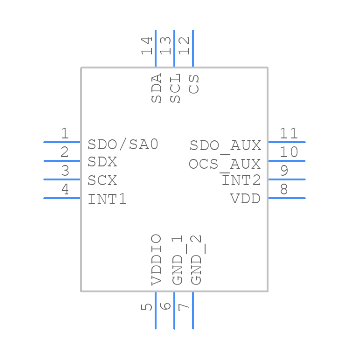
LSM6DSOXTR Symbol
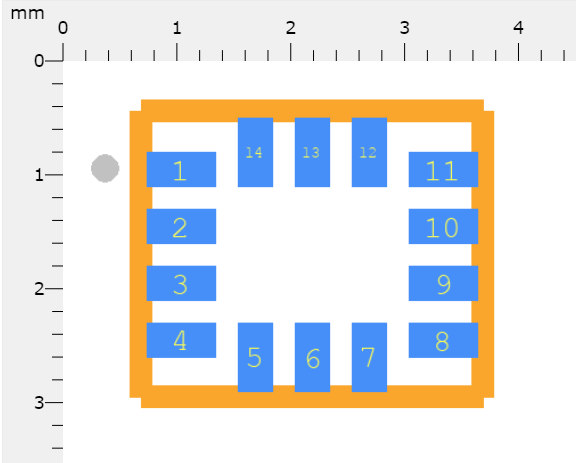
LSM6DSOXTR Footprint
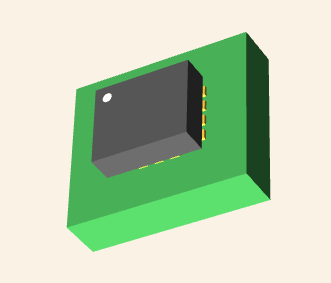
LSM6DSOXTR 3D Model
LSM6DSOXTR Features
• Power consumption: 0.55 mA in combo high-performance mode
• “Always-on" experience with low power consumption for both accelerometer and
gyroscope
• Smart FIFO up to 9 kbyte
• Android compliant
• ±2/±4/±8/±16 g full scale
• ±125/±250/±500/±1000/±2000 dps full scale
• Analog supply voltage: 1.71 V to 3.6 V
• Independent IO supply (1.62 V)
• Compact footprint: 2.5 mm x 3 mm x 0.83 mm
• SPI / I²C & MIPI I3CSM serial interface with main processor data synchronization
• Auxiliary SPI for OIS data output for gyroscope and accelerometer
• OIS configurable from Aux SPI, primary interface (SPI / I²C & MIPI I3CSM)
• Advanced pedometer, step detector and step counter
• Significant Motion Detection, Tilt detection
• Standard interrupts: free-fall, wakeup, 6D/4D orientation, click and double-click
• Programmable finite state machine: accelerometer, gyroscope and external
sensors
• Machine Learning Core
• S4S data synchronization
• Embedded temperature sensor
• ECOPACK®, RoHS, and “Green” compliant
LSM6DSOXTR Absolute maximum ratings
| Symbol | Ratings | Maximum value | Unit |
| Vdd | Supply voltage | -0.3 to 4.8 | V |
| TSTG | Storage temperature range | -40 to +125 | °C |
| Sg | Acceleration g for 0.2 ms | 20,000 | g |
| ESD | Electrostatic discharge protection (HBM) | 2 | kV |
| Vin | Input voltage on any control pin (including CS, SCL/SPC, SDA/SDI/SDO, SDO/SA0) | -0.3 to Vdd_IO +0.3 | V |
LSM6DSOXTR Electrical characteristics
| Symbol | Parameter | Test conditions | Min. | Typ.(1) | Max. | Unit |
| Vdd | Supply voltage | 1.71 | 1.8 | 3.6 | V | |
| Vdd_IO | Power supply for I/O | 1.62 | 3.6 | V | ||
| IddHP | Gyroscope and accelerometer current consumption in high-performance mode | 0.55 | mA | |||
| LA_IddHP | Accelerometer current consumption in high-performance mode | 170 | µA | |||
| LA_IddLP | Accelerometer current consumption in low-power mode | ODR = 50 Hz ODR = 1.6 Hz | 26 4.5 | µA | ||
| LA_IddULP | Accelerometer current consumption in ultra-low-power mode | ODR = 50 Hz ODR = 1.6 Hz | 9.5 4.4 | µA | ||
| IddPD | Gyroscope and accelerometer current consumption during power-down | 3 | µA | |||
| Ton | Turn-on time | 35 | ms | |||
| VIA | Digital high-level input voltage | 0.7 * VDD_IO | V | |||
| VIL | Digital low-level input voltage | 0.3 * VDD_IO | V | |||
| VEOH | High-level output voltage | IOH = 4 mA(2) | VDD_IO -0.2 | V | ||
| VOL | Low-level output voltage | IOL = 4 mA(2) | 0.2 | V | ||
| Top | Operating temperature range | -40 | 85 | °C |
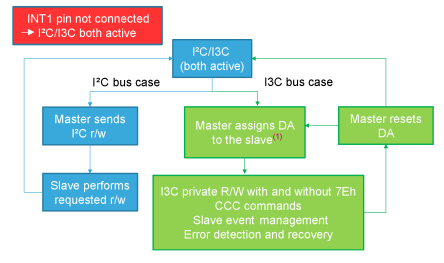
I²C/I3C coexistence in LSM6DSOX
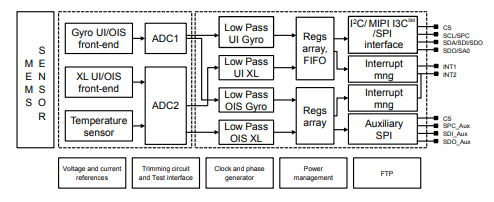
LSM6DSOXTR Block diagram of filters
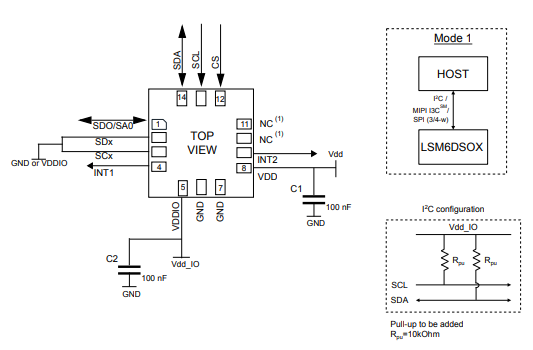
LSM6DSOX Electrical connections
Specifications
- TypeParameter
- Factory Lead Time16 Weeks
- Mounting Type
The "Mounting Type" in electronic components refers to the method used to attach or connect a component to a circuit board or other substrate, such as through-hole, surface-mount, or panel mount.
Surface Mount - Package / Case
refers to the protective housing that encases an electronic component, providing mechanical support, electrical connections, and thermal management.
14-VFLGA Module - Surface Mount
having leads that are designed to be soldered on the side of a circuit board that the body of the component is mounted on.
YES - Usage LevelIndustrial grade
- Operating Temperature
The operating temperature is the range of ambient temperature within which a power supply, or any other electrical equipment, operate in. This ranges from a minimum operating temperature, to a peak or maximum operating temperature, outside which, the power supply may fail.
-40°C~85°C - Packaging
Semiconductor package is a carrier / shell used to contain and cover one or more semiconductor components or integrated circuits. The material of the shell can be metal, plastic, glass or ceramic.
Tape & Reel (TR) - Series
In electronic components, the "Series" refers to a group of products that share similar characteristics, designs, or functionalities, often produced by the same manufacturer. These components within a series typically have common specifications but may vary in terms of voltage, power, or packaging to meet different application needs. The series name helps identify and differentiate between various product lines within a manufacturer's catalog.
iNEMO - Part Status
Parts can have many statuses as they progress through the configuration, analysis, review, and approval stages.
Active - Moisture Sensitivity Level (MSL)
Moisture Sensitivity Level (MSL) is a standardized rating that indicates the susceptibility of electronic components, particularly semiconductors, to moisture-induced damage during storage and the soldering process, defining the allowable exposure time to ambient conditions before they require special handling or baking to prevent failures
3 (168 Hours) - Number of Terminations14
- Terminal Position
In electronic components, the term "Terminal Position" refers to the physical location of the connection points on the component where external electrical connections can be made. These connection points, known as terminals, are typically used to attach wires, leads, or other components to the main body of the electronic component. The terminal position is important for ensuring proper connectivity and functionality of the component within a circuit. It is often specified in technical datasheets or component specifications to help designers and engineers understand how to properly integrate the component into their circuit designs.
BOTTOM - Terminal Form
Occurring at or forming the end of a series, succession, or the like; closing; concluding.
BUTT - Peak Reflow Temperature (Cel)
Peak Reflow Temperature (Cel) is a parameter that specifies the maximum temperature at which an electronic component can be exposed during the reflow soldering process. Reflow soldering is a common method used to attach electronic components to a circuit board. The Peak Reflow Temperature is crucial because it ensures that the component is not damaged or degraded during the soldering process. Exceeding the specified Peak Reflow Temperature can lead to issues such as component failure, reduced performance, or even permanent damage to the component. It is important for manufacturers and assemblers to adhere to the recommended Peak Reflow Temperature to ensure the reliability and functionality of the electronic components.
NOT SPECIFIED - Number of Functions1
- Terminal Pitch
The center distance from one pole to the next.
0.5mm - Reach Compliance Code
Reach Compliance Code refers to a designation indicating that electronic components meet the requirements set by the Registration, Evaluation, Authorization, and Restriction of Chemicals (REACH) regulation in the European Union. It signifies that the manufacturer has assessed and managed the chemical substances within the components to ensure safety and environmental protection. This code is vital for compliance with regulations aimed at minimizing risks associated with hazardous substances in electronic products.
compliant - Time@Peak Reflow Temperature-Max (s)
Time@Peak Reflow Temperature-Max (s) refers to the maximum duration that an electronic component can be exposed to the peak reflow temperature during the soldering process, which is crucial for ensuring reliable solder joint formation without damaging the component.
NOT SPECIFIED - Base Part Number
The "Base Part Number" (BPN) in electronic components serves a similar purpose to the "Base Product Number." It refers to the primary identifier for a component that captures the essential characteristics shared by a group of similar components. The BPN provides a fundamental way to reference a family or series of components without specifying all the variations and specific details.
LSM6D - JESD-30 Code
JESD-30 Code refers to a standardized descriptive designation system established by JEDEC for semiconductor-device packages. This system provides a systematic method for generating designators that convey essential information about the package's physical characteristics, such as size and shape, which aids in component identification and selection. By using JESD-30 codes, manufacturers and engineers can ensure consistency and clarity in the specification of semiconductor packages across various applications and industries.
R-PBGA-B14 - Output Type
The "Output Type" parameter in electronic components refers to the type of signal or data that is produced by the component as an output. This parameter specifies the nature of the output signal, such as analog or digital, and can also include details about the voltage levels, current levels, frequency, and other characteristics of the output signal. Understanding the output type of a component is crucial for ensuring compatibility with other components in a circuit or system, as well as for determining how the output signal can be utilized or processed further. In summary, the output type parameter provides essential information about the nature of the signal that is generated by the electronic component as its output.
I2C, SPI - Supply Voltage-Max (Vsup)
The parameter "Supply Voltage-Max (Vsup)" in electronic components refers to the maximum voltage that can be safely applied to the component without causing damage. It is an important specification to consider when designing or using electronic circuits to ensure the component operates within its safe operating limits. Exceeding the maximum supply voltage can lead to overheating, component failure, or even permanent damage. It is crucial to adhere to the specified maximum supply voltage to ensure the reliable and safe operation of the electronic component.
3.6V - Supply Voltage-Min (Vsup)
The parameter "Supply Voltage-Min (Vsup)" in electronic components refers to the minimum voltage level required for the component to operate within its specified performance range. This parameter indicates the lowest voltage that can be safely applied to the component without risking damage or malfunction. It is crucial to ensure that the supply voltage provided to the component meets or exceeds this minimum value to ensure proper functionality and reliability. Failure to adhere to the specified minimum supply voltage may result in erratic behavior, reduced performance, or even permanent damage to the component.
1.71V - Analog IC - Other Type
Analog IC - Other Type is a parameter used to categorize electronic components that are integrated circuits (ICs) designed for analog signal processing but do not fall into more specific subcategories such as amplifiers, comparators, or voltage regulators. These ICs may include specialized analog functions such as analog-to-digital converters (ADCs), digital-to-analog converters (DACs), voltage references, or signal conditioning circuits. They are typically used in various applications where precise analog signal processing is required, such as in audio equipment, instrumentation, communication systems, and industrial control systems. Manufacturers provide detailed specifications for these components to help engineers select the most suitable IC for their specific design requirements.
ANALOG CIRCUIT - Sensor Type
In electronic components, the parameter "Sensor Type" refers to the specific type of sensor technology used in a particular component to detect and measure physical phenomena such as light, temperature, pressure, motion, or proximity. Different sensor types utilize various principles and mechanisms to convert the detected input into an electrical signal that can be processed by the electronic component. Common sensor types include photodiodes, thermistors, accelerometers, and proximity sensors, each designed for specific applications and environments. Understanding the sensor type is crucial for selecting the right component for a given task and ensuring accurate and reliable sensing capabilities in electronic systems.
Accelerometer, Gyroscope, 6 Axis - Length3mm
- Height Seated (Max)
Height Seated (Max) is a parameter in electronic components that refers to the maximum allowable height of the component when it is properly seated or installed on a circuit board or within an enclosure. This specification is crucial for ensuring proper fit and alignment within the overall system design. Exceeding the maximum seated height can lead to mechanical interference, electrical shorts, or other issues that may impact the performance and reliability of the electronic device. Manufacturers provide this information to help designers and engineers select components that will fit within the designated space and function correctly in the intended application.
0.86mm - Width2.5mm
- RoHS Status
RoHS means “Restriction of Certain Hazardous Substances” in the “Hazardous Substances Directive” in electrical and electronic equipment.
RoHS Compliant
Trend Analysis
Datasheet PDF
- Datasheets :
Parts with Similar Specs
1.What system-in-package features a 3D digital accelerometer and a 3D digital gyroscope?
LSM6DSOX.
2.What is a system-in-package with a 3D digital accelerometer and a 3D digital gyroscope?
0.55 mA.
3.How many kbytes does the LSM6DSOX offer for dynamic data batching?
9 kbytes.
4.What is STs family of?
MEMS sensor modules.
5.What technology allows the design of a dedicated circuit that is trimmed to match the characteristics of the sensing element?
CMOS technology.
 DP83822IRHBR:Layer Transceiver, Pinout, Datasheet
03 March 20223001
![A23 Energizer A23 Batteries Miniature Alkaline 12V [Video]: Datasheet, Application, and Equivalents](https://res.utmel.com/Images/Article/f7ee8460-e4da-4af6-933b-454755320e46.jpg) A23 Energizer A23 Batteries Miniature Alkaline 12V [Video]: Datasheet, Application, and Equivalents
A23 Energizer A23 Batteries Miniature Alkaline 12V [Video]: Datasheet, Application, and Equivalents25 March 20223495
 SN74LVC1G08DCKR positive-AND gate: Features, Applications and Datasheet
20 October 20231535
 RS-485 Port Protection Design Guide: TVS Selection, Surge Staging, and a Practical BOM
03 August 2026296
 BC557B Transistors: Pinout, Features and Datasheet
28 September 20214776
 A Comprehensive Guide to the Analog Devices Inc. 5962-87701022A Digital to Analog Converter (DAC)
06 March 2024337
 Comparing STM32G474RET6 and STM32G474RCT6
24 July 20252787
 TPS61161ADRVR LED Driver: Circuit, Pinout, and Datasheet
20 January 20222581
 The Era of UFS 4.0, Announced?
06 May 20227668
 What is RF Switch?
16 November 20217879
 Several Steps to Choose a Microcontroller MCU
17 June 20224895
 What are Proximity Sensors?
24 October 20258910
 MCU with Built-in NPU: How to Pick an Edge AI Microcontroller in 2026
30 July 20261368
 An Overview of Fiber Optic Cable
10 August 20217160
 Memory Chip: The Key to Smart Connectivity
03 November 20213123
 SIA's Latest Report: Status and Challenges of US Semiconductors
22 February 20233147
STMicroelectronics
In Stock: 25000
United States
China
Canada
Japan
Russia
Germany
United Kingdom
Singapore
Italy
Hong Kong(China)
Taiwan(China)
France
Korea
Mexico
Netherlands
Malaysia
Austria
Spain
Switzerland
Poland
Thailand
Vietnam
India
United Arab Emirates
Afghanistan
Åland Islands
Albania
Algeria
American Samoa
Andorra
Angola
Anguilla
Antigua & Barbuda
Argentina
Armenia
Aruba
Australia
Azerbaijan
Bahamas
Bahrain
Bangladesh
Barbados
Belarus
Belgium
Belize
Benin
Bermuda
Bhutan
Bolivia
Bonaire, Sint Eustatius and Saba
Bosnia & Herzegovina
Botswana
Brazil
British Indian Ocean Territory
British Virgin Islands
Brunei
Bulgaria
Burkina Faso
Burundi
Cabo Verde
Cambodia
Cameroon
Cayman Islands
Central African Republic
Chad
Chile
Christmas Island
Cocos (Keeling) Islands
Colombia
Comoros
Congo
Congo (DRC)
Cook Islands
Costa Rica
Côte d’Ivoire
Croatia
Cuba
Curaçao
Cyprus
Czechia
Denmark
Djibouti
Dominica
Dominican Republic
Ecuador
Egypt
El Salvador
Equatorial Guinea
Eritrea
Estonia
Eswatini
Ethiopia
Falkland Islands
Faroe Islands
Fiji
Finland
French Guiana
French Polynesia
Gabon
Gambia
Georgia
Ghana
Gibraltar
Greece
Greenland
Grenada
Guadeloupe
Guam
Guatemala
Guernsey
Guinea
Guinea-Bissau
Guyana
Haiti
Honduras
Hungary
Iceland
Indonesia
Iran
Iraq
Ireland
Isle of Man
Israel
Jamaica
Jersey
Jordan
Kazakhstan
Kenya
Kiribati
Kosovo
Kuwait
Kyrgyzstan
Laos
Latvia
Lebanon
Lesotho
Liberia
Libya
Liechtenstein
Lithuania
Luxembourg
Macao(China)
Madagascar
Malawi
Maldives
Mali
Malta
Marshall Islands
Martinique
Mauritania
Mauritius
Mayotte
Micronesia
Moldova
Monaco
Mongolia
Montenegro
Montserrat
Morocco
Mozambique
Myanmar
Namibia
Nauru
Nepal
New Caledonia
New Zealand
Nicaragua
Niger
Nigeria
Niue
Norfolk Island
North Korea
North Macedonia
Northern Mariana Islands
Norway
Oman
Pakistan
Palau
Palestinian Authority
Panama
Papua New Guinea
Paraguay
Peru
Philippines
Pitcairn Islands
Portugal
Puerto Rico
Qatar
Réunion
Romania
Rwanda
Samoa
San Marino
São Tomé & Príncipe
Saudi Arabia
Senegal
Serbia
Seychelles
Sierra Leone
Sint Maarten
Slovakia
Slovenia
Solomon Islands
Somalia
South Africa
South Sudan
Sri Lanka
St Helena, Ascension, Tristan da Cunha
St. Barthélemy
St. Kitts & Nevis
St. Lucia
St. Martin
St. Pierre & Miquelon
St. Vincent & Grenadines
Sudan
Suriname
Svalbard & Jan Mayen
Sweden
Syria
Tajikistan
Tanzania
Timor-Leste
Togo
Tokelau
Tonga
Trinidad & Tobago
Tunisia
Turkey
Turkmenistan
Turks & Caicos Islands
Tuvalu
U.S. Outlying Islands
U.S. Virgin Islands
Uganda
Ukraine
Uruguay
Uzbekistan
Vanuatu
Vatican City
Venezuela
Wallis & Futuna
Yemen
Zambia
Zimbabwe
![LSM303AHTR]() LSM303AHTR
LSM303AHTRSTMicroelectronics
![LSM6DSLUSTR]() LSM6DSLUSTR
LSM6DSLUSTRSTMicroelectronics
![LSM9DS1TR]() LSM9DS1TR
LSM9DS1TRSTMicroelectronics
![LSM6DSLTR]() LSM6DSLTR
LSM6DSLTRSTMicroelectronics
![LSM303AGRTR]() LSM303AGRTR
LSM303AGRTRSTMicroelectronics
![LSM6DS3TR]() LSM6DS3TR
LSM6DS3TRSTMicroelectronics
![LSM6DSOTR]() LSM6DSOTR
LSM6DSOTRSTMicroelectronics
![ISM330DLCTR]() ISM330DLCTR
ISM330DLCTRSTMicroelectronics
![LSM303DLHC]() LSM303DLHC
LSM303DLHCSTMicroelectronics


