

 Product
 Brand
Brand Articles
 Tools
Tools
MAX30003 Integrated Biopotential AFE: Circuit, Pinout, MAX30003 vs AD8232 [Video&FAQ]

28 Terminations ECG Front End 28 Pin MAX30003 Specialized ICs 1 Functions 1.8V Min 1.2V V Max 2V V


28 Terminations ECG Front End 28 Pin MAX30003 Specialized ICs 1 Functions 1.8V Min 1.2V V Max 2V V
For wearable applications, the MAX30003 is a comprehensive biopotential analog frontend solution. This article mainly introduces Circuit, Pinout, Datasheet, MAX30003 vs AD8232 and other detailed information about Maxim Integrated MAX30003.
- MAX30003 Description
- MAX30003 Pinout
- MAX30003 CAD Model
- MAX30003 Features
- Specifications
- Parts with Similar Specs
- MAX30003 Functional Block Diagram
- MAX30003 Circuit
- MAX30003 Typical Application Circuit
- MAX30003 Application Diagram
- MAX30003 vs AD8232 Specifications
- MAX30003 Applications
- MAX30003 Manufacturer
- Trend Analysis
- Datasheet PDF
MAX30003 Description
For wearable applications, the MAX30003 is a comprehensive biopotential analog frontend solution. It provides strong performance for clinical and fitness applications while consuming very little power, resulting in a long battery life. The MAX30003 is a single biopotential channel that can detect heart rate and provide ECG waveforms.
ESD protection, EMI filtering, internal lead biasing, DC leads-off detection, ultra-low power leads-on detection during standby mode, and extensive calibration voltages for built-in self-test are all included in the biopotential channel. No significant transients are fed into the electrodes thanks to soft power-up sequencing. In addition, the biopotential channel includes a high input impedance, low noise, high CMRR, configurable gain, multiple low-pass and high-pass filter options, and a high-resolution analog-to-digital converter. The biopotential channel is DC coupled, can withstand significant electrode voltage offsets and features a fast recovery mode for recovering quickly from overdrive circumstances like defibrillation and electrosurgery.
The MAX30003 comes in a 28-pin TQFN and a 30-bump wafer-level package (WLP) with a commercial temperature range of 0°C to +70°C.
MAX30003 Pinout
The following figure is MAX30003 Pinout.
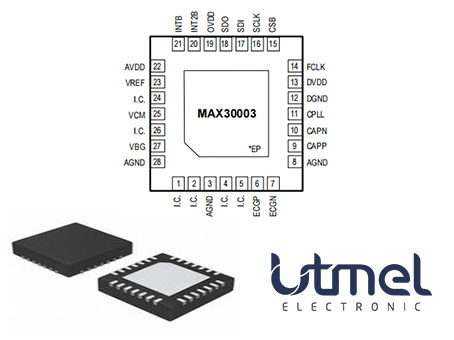
Pinout
| Pin Number | Pin Name | Description |
| 1, 2, 4, 5, 24, 26 | I.C. | Internally Connected. Connect to AGND. |
| 3,8,28 | AGND | Analog Power and Reference Ground. Connect into the printed circuit board ground plane. |
| 6 | ECGP | ECG Positive Input |
| 7 | ECGN | ECG Negative Input |
| 9 | CAPP | Analog High-Pass Filter Input. Connect a 1μF X7R capacitor (CHPF) between CAPP and CAPN to form a 0.5Hz high-pass response in the ECG channel. |
| 10 | CAPN | Analog High-Pass Filter Input. Connect a 1μF X7R capacitor (CHPF) between CAPP and CAPN to form a 0.5Hz high-pass response in the ECG channel. |
| 11 | CPLL | PLL Loop Filter Input. Connect 1nF COG cap between CPLL and AGND. |
| 12 | DGND | Digital Ground for Both Digital Core and I/O Pad Drivers. Recommended to connect to AGND plane. |
| 13 | DVDD | Digital Core Supply Voltage. Connect to AVDD |
| 14 | FCLK | External 32.768kHz Clock that Controls the Sampling of the Internal Sigma-Delta Converters and Decimator. |
| 15 | CSB | Active-Low Chip-Select Input. Enables the serial interface. |
| 16 | SCLK | Serial Clock Input. Clocks data in and out of the serial interface when CSB is low. |
| 17 | SDI | Serial Data Input. SDI is sampled into the device on the rising edge of SCLK when CSB is low. |
| 18 | SDO | Serial Data Output. SDO will change state on the falling edge of SCLK when CSB is low. SDO is three-stated when CSB is high. |
| 19 | OVDD | Logic Interface Supply Voltage |
| 20 | INT2B | Interrupt 2 Output. INT2B is an active-low status output. It can be used to interrupt an external device. |
| 21 | INTB | Interrupt Output. INTB is an active low status output. It can be used to interrupt an external device. |
| 22 | AVDD | Analog Core Supply Voltage. Connect to DVDD. |
| 23 | VREF | ADC Reference Buffer Output. Connect a 10μF X5R ceramic capacitor between VREF and AGND. |
| 25 | VCM | Common Mode Buffer Output. Connect a 10μF X5R ceramic capacitor between VCM and AGND. |
| 27 | VBG | Bandgap Noise Filter Output. Connect a 1.0μF X7R ceramic capacitor between VBG and AGND. |
| EP | — | Exposed Paddle. Connect to AGND. |
MAX30003 CAD Model
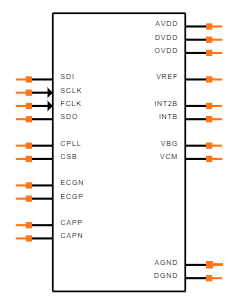
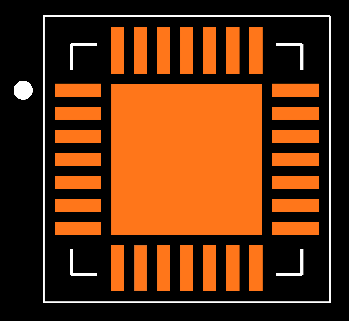
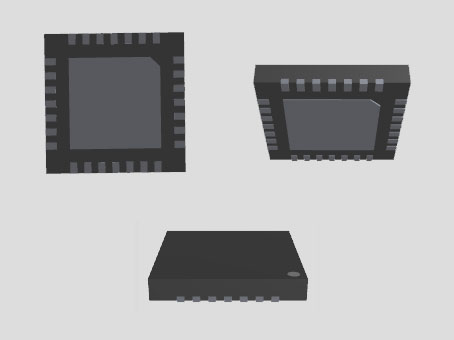
MAX30003 Features
● Clinical-Grade ECG AFE with High-Resolution Data Converter
• 15.5 Bits Effective Resolution with 5µVP-P Noise
● Better Dry Starts Due to Much Improved Real World CMRR and High Input Impedance
• Fully Differential Input Structure with CMRR > 100dB
● Offers Better Common-Mode to Differential Mode Conversion Due to High Input Impedance
• High Input Impedance > 500MΩ for Extremely Low Common-to-Differential Mode Conversion
● Minimum Signal Attenuation at the Input During Dry Start Due to High Electrode Impedance
● High DC Offset Range of ±650mV (1.8V, typ) Allows to Be Used with Wide Variety of Electrodes
● High AC Dynamic Range of 65mVP-P Will Help the AFE Not Saturate in the Presence of Motion/Direct Electrode Hits
● Longer Battery Life Compared to Competing Solutions
• 85µW at 1.1V Supply Voltage
● Leads-On Interrupt Feature Allows to Keep µC in Deep Sleep Mode with RTC Off Until Valid Lead Condition is Detected
• Lead-On Detect Current: 0.7µA (typ)
● Built-In Heart Rate Detection with Interrupt Feature Eliminates the Need to Run HR Algorithm on the µController
• Robust R-R Detection in High Motion Environment at Extremely Low Power
● Configurable Interrupts Allows the µC Wake-Up Only on Every Heart Beat Reducing the Overall System Power
● High Accuracy Allows for More Physiological Data Extractions
● 32-Word FIFO Allows You to Wake Up µController Every 256ms with Full ECG Acquisition
● High-Speed SPI Interface
● Shutdown Current of 0.5µA (typ)
Specifications
- TypeParameter
- Factory Lead Time9 Weeks
- Mounting Type
The "Mounting Type" in electronic components refers to the method used to attach or connect a component to a circuit board or other substrate, such as through-hole, surface-mount, or panel mount.
Surface Mount - Package / Case
refers to the protective housing that encases an electronic component, providing mechanical support, electrical connections, and thermal management.
28-WFQFN Exposed Pad - Surface Mount
having leads that are designed to be soldered on the side of a circuit board that the body of the component is mounted on.
YES - Number of Pins28
- Packaging
Semiconductor package is a carrier / shell used to contain and cover one or more semiconductor components or integrated circuits. The material of the shell can be metal, plastic, glass or ceramic.
Tray - Published2016
- JESD-609 Code
The "JESD-609 Code" in electronic components refers to a standardized marking code that indicates the lead-free solder composition and finish of electronic components for compliance with environmental regulations.
e3 - Pbfree Code
The "Pbfree Code" parameter in electronic components refers to the code or marking used to indicate that the component is lead-free. Lead (Pb) is a toxic substance that has been widely used in electronic components for many years, but due to environmental concerns, there has been a shift towards lead-free alternatives. The Pbfree Code helps manufacturers and users easily identify components that do not contain lead, ensuring compliance with regulations and promoting environmentally friendly practices. It is important to pay attention to the Pbfree Code when selecting electronic components to ensure they meet the necessary requirements for lead-free applications.
yes - Part Status
Parts can have many statuses as they progress through the configuration, analysis, review, and approval stages.
Active - Moisture Sensitivity Level (MSL)
Moisture Sensitivity Level (MSL) is a standardized rating that indicates the susceptibility of electronic components, particularly semiconductors, to moisture-induced damage during storage and the soldering process, defining the allowable exposure time to ambient conditions before they require special handling or baking to prevent failures
1 (Unlimited) - Number of Terminations28
- TypeECG Front End
- Terminal Finish
Terminal Finish refers to the surface treatment applied to the terminals or leads of electronic components to enhance their performance and longevity. It can improve solderability, corrosion resistance, and overall reliability of the connection in electronic assemblies. Common finishes include nickel, gold, and tin, each possessing distinct properties suitable for various applications. The choice of terminal finish can significantly impact the durability and effectiveness of electronic devices.
Matte Tin (Sn) - Max Operating Temperature
The Maximum Operating Temperature is the maximum body temperature at which the thermistor is designed to operate for extended periods of time with acceptable stability of its electrical characteristics.
70°C - Min Operating Temperature
The "Min Operating Temperature" parameter in electronic components refers to the lowest temperature at which the component is designed to operate effectively and reliably. This parameter is crucial for ensuring the proper functioning and longevity of the component, as operating below this temperature may lead to performance issues or even damage. Manufacturers specify the minimum operating temperature to provide guidance to users on the environmental conditions in which the component can safely operate. It is important to adhere to this parameter to prevent malfunctions and ensure the overall reliability of the electronic system.
0°C - Applications
The parameter "Applications" in electronic components refers to the specific uses or functions for which a component is designed. It encompasses various fields such as consumer electronics, industrial automation, telecommunications, automotive, and medical devices. Understanding the applications helps in selecting the right components for a particular design based on performance, reliability, and compatibility requirements. This parameter also guides manufacturers in targeting their products to relevant markets and customer needs.
Heart Rate Monitoring - HTS Code
HTS (Harmonized Tariff Schedule) codes are product classification codes between 8-1 digits. The first six digits are an HS code, and the countries of import assign the subsequent digits to provide additional classification. U.S. HTS codes are 1 digits and are administered by the U.S. International Trade Commission.
8542.39.00.01 - Terminal Position
In electronic components, the term "Terminal Position" refers to the physical location of the connection points on the component where external electrical connections can be made. These connection points, known as terminals, are typically used to attach wires, leads, or other components to the main body of the electronic component. The terminal position is important for ensuring proper connectivity and functionality of the component within a circuit. It is often specified in technical datasheets or component specifications to help designers and engineers understand how to properly integrate the component into their circuit designs.
QUAD - Terminal Form
Occurring at or forming the end of a series, succession, or the like; closing; concluding.
NO LEAD - Peak Reflow Temperature (Cel)
Peak Reflow Temperature (Cel) is a parameter that specifies the maximum temperature at which an electronic component can be exposed during the reflow soldering process. Reflow soldering is a common method used to attach electronic components to a circuit board. The Peak Reflow Temperature is crucial because it ensures that the component is not damaged or degraded during the soldering process. Exceeding the specified Peak Reflow Temperature can lead to issues such as component failure, reduced performance, or even permanent damage to the component. It is important for manufacturers and assemblers to adhere to the recommended Peak Reflow Temperature to ensure the reliability and functionality of the electronic components.
260 - Number of Functions1
- Supply Voltage
Supply voltage refers to the electrical potential difference provided to an electronic component or circuit. It is crucial for the proper operation of devices, as it powers their functions and determines performance characteristics. The supply voltage must be within specified limits to ensure reliability and prevent damage to components. Different electronic devices have specific supply voltage requirements, which can vary widely depending on their design and intended application.
1.8V - Terminal Pitch
The center distance from one pole to the next.
0.5mm - Time@Peak Reflow Temperature-Max (s)
Time@Peak Reflow Temperature-Max (s) refers to the maximum duration that an electronic component can be exposed to the peak reflow temperature during the soldering process, which is crucial for ensuring reliable solder joint formation without damaging the component.
NOT SPECIFIED - Base Part Number
The "Base Part Number" (BPN) in electronic components serves a similar purpose to the "Base Product Number." It refers to the primary identifier for a component that captures the essential characteristics shared by a group of similar components. The BPN provides a fundamental way to reference a family or series of components without specifying all the variations and specific details.
MAX30003 - Temperature Grade
Temperature grades represent a tire's resistance to heat and its ability to dissipate heat when tested under controlled laboratory test conditions.
COMMERCIAL - Max Supply Voltage
In general, the absolute maximum common-mode voltage is VEE-0.3V and VCC+0.3V, but for products without a protection element at the VCC side, voltages up to the absolute maximum rated supply voltage (i.e. VEE+36V) can be supplied, regardless of supply voltage.
2V - Min Supply Voltage
The minimum supply voltage (V min ) is explored for sequential logic circuits by statistically simulating the impact of within-die process variations and gate-dielectric soft breakdown on data retention and hold time.
1.2V - Length5mm
- Height Seated (Max)
Height Seated (Max) is a parameter in electronic components that refers to the maximum allowable height of the component when it is properly seated or installed on a circuit board or within an enclosure. This specification is crucial for ensuring proper fit and alignment within the overall system design. Exceeding the maximum seated height can lead to mechanical interference, electrical shorts, or other issues that may impact the performance and reliability of the electronic device. Manufacturers provide this information to help designers and engineers select components that will fit within the designated space and function correctly in the intended application.
0.8mm - Width5mm
- REACH SVHC
The parameter "REACH SVHC" in electronic components refers to the compliance with the Registration, Evaluation, Authorization, and Restriction of Chemicals (REACH) regulation regarding Substances of Very High Concern (SVHC). SVHCs are substances that may have serious effects on human health or the environment, and their use is regulated under REACH to ensure their safe handling and minimize their impact.Manufacturers of electronic components need to declare if their products contain any SVHCs above a certain threshold concentration and provide information on the safe use of these substances. This information allows customers to make informed decisions about the potential risks associated with using the components and take appropriate measures to mitigate any hazards.Ensuring compliance with REACH SVHC requirements is essential for electronics manufacturers to meet regulatory standards, protect human health and the environment, and maintain transparency in their supply chain. It also demonstrates a commitment to sustainability and responsible manufacturing practices in the electronics industry.
No SVHC - RoHS Status
RoHS means “Restriction of Certain Hazardous Substances” in the “Hazardous Substances Directive” in electrical and electronic equipment.
ROHS3 Compliant
Parts with Similar Specs
- ImagePart NumberManufacturerPackage / CaseNumber of PinsMin Supply VoltageSupply VoltageMax Supply VoltageRoHS StatusMounting TypePeak Reflow Temperature (Cel)View Compare
![MAX30003CTI]()
MAX30003CTI
28-WFQFN Exposed Pad
28
1.2 V
1.8 V
2 V
ROHS3 Compliant
Surface Mount
260
![TLV320AIC23BIPWR]()
28-WFQFN Exposed Pad, CSP
28
1.5 V
3.3 V
3.6 V
ROHS3 Compliant
Surface Mount
260
![SSM2603CPZ-REEL7]()
28-TSSOP (0.173, 4.40mm Width)
28
1.42 V
-
3.6 V
ROHS3 Compliant
Surface Mount
260
![TLV320AIC23BIRHD]()
28-VFQFN Exposed Pad
28
1.42 V
-
3.6 V
ROHS3 Compliant
Surface Mount
260
![TLV320AIC23BRHDR]()
28-VFQFN Exposed Pad
28
1.42 V
-
3.6 V
ROHS3 Compliant
Surface Mount
260


MAX30003 Functional Block Diagram

MAX30003 Circuit
Electrodes are conductive pads attached to the body's surface in ECG system design. The electrical potential differences between the two corresponding attachment places are measured by a pair of electrodes (also known as a lead). Leads can also be produced by connecting a physical electrode to a virtual electrode (the WCT), whose potential is the average of three electrodes on the body.
To establish a typical 3-lead Holter , two or three single-lead MAX30001/MAX30003 devices can be utilized in a parallel configuration to give the requisite biopotential channels. Use two devices in a configuration similar to the following figure if the third lead is derived.
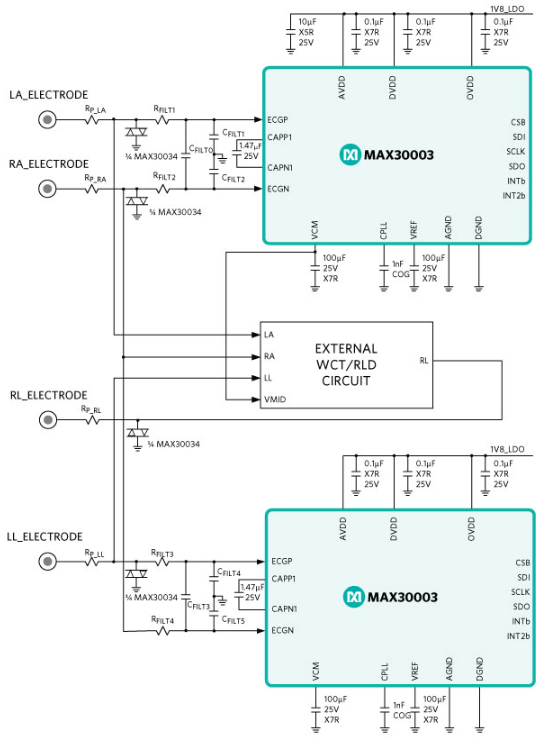
3-lead Holter Monitor Configuration Using Two MAX30003s
A WCT-style common-mode detection approach is used in the circuit shown. Frank Wilson created this technique in 1934 as a theoretical reference point for the potential of a virtual electrode positioned in the center of Einthoven's triangle (approximately in the middle of the thorax). Wilson and his colleagues developed the differential precordial lead voltages V1 through V6 for 12-lead ECG systems using this theoretical reference point as a reference electrode potential (the (-) input). The WCT potential is created by averaging the potentials at the three limb electrodes on the right arm (RA), left arm (LA) and left leg (LL), which is calculated as (RA+LA+LL)/3. This WCT potential was later used to measure the amount of common-mode interference coupling onto the skin from surrounding 50Hz and 60Hz noise sources (i.e., lighting, computers, electrical outlets). Small electrical signals released by the body, such as the ECG sinus rhythm wave, are measured by biological signal amplifiers like the MAX30001. Unfortunately, the human body can operate as an antenna for electromagnetic interference (EMI), particularly 50Hz and 60Hz noise from power lines.
Noise Sources and Common-Mode Interference
Consider an ECG sinus rhythm wave that has been distorted by line noise interference to demonstrate the impact of noise. The signal of interest in this case is quite modest in amplitude. The signal magnitude for most typical sinus rhythms, as well as arrythmias, is less than 5mVpp and can be as low as 100Vpp. Noise sources that are similar in amplitude to the ECG sinus rhythm waveform are widespread since the signal of interest is so little. ECG waveform quality can be significantly harmed by noise sources such as line noise, baseline wander and motion aberrations, and muscle-based electromyographic action potentials1.
Any common-mode noise interference picked up by the WCT inside the RLD amplifier's bandwidth is delivered 180 degrees out of phase by the WCT-based RLD circuit. Under many scenarios, this considerably reduces the level of line noise interference. The WCT-based RLD circuit is of little use because the AFE differential input amplifier entirely eliminates common-mode noise. Some common-mode noise is converted to differential noise due to finite amplifier input impedances that act against mismatches of electrode tissue interface impedance from the limb electrodes. The CMRR of the AFE is quite large but finite, which helps to convert common-mode noise to differential noise. As a result, some design teams opt to include the cost of an additional electrode to help with line noise management. The extra electrode is frequently linked to the right leg (RL). The RLD circuit should set the body potential in typical conditions, when all electrodes appear to be properly attached. Under normal circumstances, active common-mode noise rejection can be used.
Setting the Body Potential
Because these systems all run on batteries, it's critical to set the body potential for wearable biopotential measurement systems including ECG Holter monitors, cardiac event monitors, cardiac telemetry devices, and ECG health patches. On the body, battery-operated systems float. To ensure that the input amplifiers work within their linear range, drive the body potential with the RL electrode to a sufficient voltage relative to the ground and the power supply voltages of the amplifiers within the MAX30001 or MAX30003 AFE.
For example, in the MAX30001 and MAX30003, the body potential can be set at the halfway between the amplifier's power rail and ground, and the VCM output voltage can be used as an acceptable approximation of the linear input range of the input amplifier. If an RL electrode is not utilized, the body potential can be changed using the programmable lead bias resistors in the MAX30001/MAX30003 input mux's CNFG GEN register. The usage of the third RL electrode allows you to not only control the body potential but also employ an active RLD circuit to actively suppress line noise interference, akin to noise-cancelling headphones.
MAX30003 Typical Application Circuit
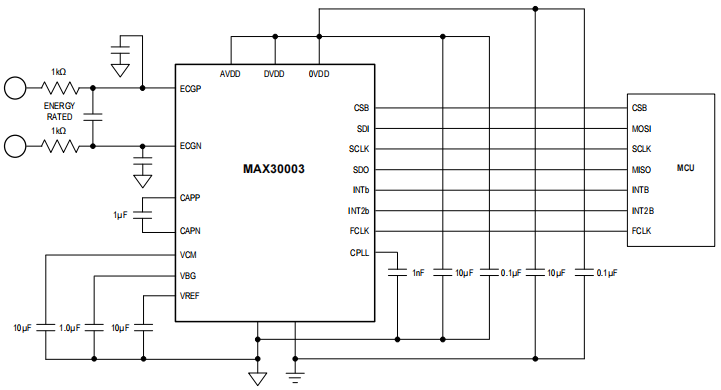
MAX30003 Application Diagram
The following figure is MAX30003 Application Diagram.
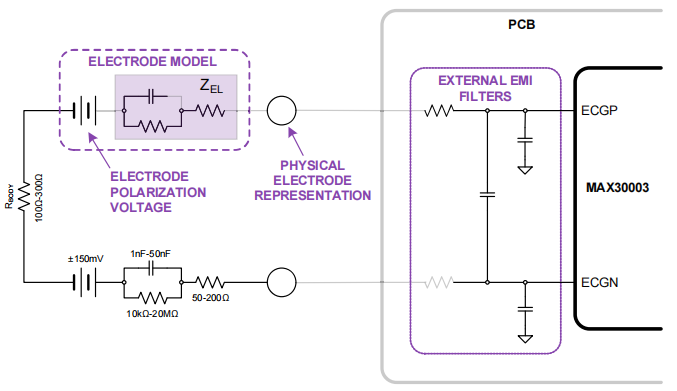
Two Electrode Heart Rate Monitoring for Fitness
MAX30003 vs AD8232 Specifications
| Base Product Number | MAX30003 | Base Product Number | AD8232 |
| Category | Integrated Circuits (ICs) Specialized ICs | Category | Development Boards, Kits, Programmers Evaluation and Demonstration Boards and Kits |
| Mfr | Maxim Integrated | Mfr | Analog Devices Inc. |
| Series | - | Series | - |
| Package | Tray | Package | Box |
| Part Status | Active | Part Status | Active |
| Type | ECG Front End | Type | Interface |
MAX30003 Applications
● Single-Lead Event Monitors for Arrhythmia Detection
● Single-Lead Wireless Patches for At-Home/In-Hospital Monitoring
● Chest Band Heart Rate Monitors for Fitness Applications
● Bio Authentication and ECG-On-Demand Applications
MAX30003 Manufacturer
Analog Devices' Maxim Integrated designs, manufactures, and sells analog and mixed-signal integrated circuits for the automotive, industrial, communications, consumer, and computing applications. Power and battery management ICs, sensors, analog ICs, interface ICs, communications solutions, digital ICs, embedded security, and microcontrollers are all part of Maxim's product line. The company includes design centers, manufacturing facilities, and sales offices all around the world, with its headquarters in San Jose, California.
Trend Analysis
Datasheet PDF
- Datasheets :
- Application Notes :
- Design Resources :
- ConflictMineralStatement :
For what type of applications is the MAX30003 a biopotential analog frontend solution?
Wearable applications.
How much power does the MAX30003 consume?
Very little power.
What does the MAX30003 detect?
Heart rate.
What does soft power-up sequencing mean?
No significant transients are fed into the electrodes.
What is the biopotential channel?
DC coupled.
What is the commercial temperature range of the MAX30003?
0°C to +70°C.
![ESP-01 Wi-Fi Module: ESP-01 Pinout, Programming and ESP-01 VS ESP8266 [FAQ]](https://res.utmel.com/Images/Article/5c3b47fe-f1bf-4463-9d61-296410651370.jpg) ESP-01 Wi-Fi Module: ESP-01 Pinout, Programming and ESP-01 VS ESP8266 [FAQ]
ESP-01 Wi-Fi Module: ESP-01 Pinout, Programming and ESP-01 VS ESP8266 [FAQ]14 December 202163567
 LM2574 0.5A Buck Regulator: Datasheet pdf, Pinout and Circuit
09 December 20212297
 ADG202AKNZ Analog Switch: Feature, Specification, Datasheet
22 May 2021749
 AT89C51 Microcontroller: Pin Description, Datasheet, Programming
18 November 202124325
 ATSAMD21G18AAUT Microcontroller: Technical Overview
29 February 2024194
 74HC04D Hex Inverter: Pinout, Features and Datasheet
20 November 20218274
 LT1083CK Voltage Regulator: Feature, Specification, and Datasheet
02 July 20211742
 M4T28-BR12SH1 Battery: M4T28-BR12SH1 Datasheet, Logic Diagram
07 March 20223554
 What is Wi-Fi 7?
20 August 20216056
 What is ISP (Image Signal Processor)?
15 September 202137550
 The Practical Engineer’s Guide to the NE555N Timer: Pinout, Setup, and Troubleshooting
29 May 2026924
 Development of Ultra-wide Band-gap Ga2O3 Semiconductor Materials in Power MOSFETs
21 October 20224408
 Understanding the Crystal Oscillator: Construction, Working Principles and Applications
08 July 20244743
 An Overview of Top Semiconductor Companies
17 October 202526094
 Types, Structure, and Packages of Integrated Circuits
23 October 202513850
 Chip Packaging Lead Time Has Grown to 50 Weeks
07 April 20226322
Maxim Integrated
In Stock: 35
United States
China
Canada
Japan
Russia
Germany
United Kingdom
Singapore
Italy
Hong Kong(China)
Taiwan(China)
France
Korea
Mexico
Netherlands
Malaysia
Austria
Spain
Switzerland
Poland
Thailand
Vietnam
India
United Arab Emirates
Afghanistan
Åland Islands
Albania
Algeria
American Samoa
Andorra
Angola
Anguilla
Antigua & Barbuda
Argentina
Armenia
Aruba
Australia
Azerbaijan
Bahamas
Bahrain
Bangladesh
Barbados
Belarus
Belgium
Belize
Benin
Bermuda
Bhutan
Bolivia
Bonaire, Sint Eustatius and Saba
Bosnia & Herzegovina
Botswana
Brazil
British Indian Ocean Territory
British Virgin Islands
Brunei
Bulgaria
Burkina Faso
Burundi
Cabo Verde
Cambodia
Cameroon
Cayman Islands
Central African Republic
Chad
Chile
Christmas Island
Cocos (Keeling) Islands
Colombia
Comoros
Congo
Congo (DRC)
Cook Islands
Costa Rica
Côte d’Ivoire
Croatia
Cuba
Curaçao
Cyprus
Czechia
Denmark
Djibouti
Dominica
Dominican Republic
Ecuador
Egypt
El Salvador
Equatorial Guinea
Eritrea
Estonia
Eswatini
Ethiopia
Falkland Islands
Faroe Islands
Fiji
Finland
French Guiana
French Polynesia
Gabon
Gambia
Georgia
Ghana
Gibraltar
Greece
Greenland
Grenada
Guadeloupe
Guam
Guatemala
Guernsey
Guinea
Guinea-Bissau
Guyana
Haiti
Honduras
Hungary
Iceland
Indonesia
Iran
Iraq
Ireland
Isle of Man
Israel
Jamaica
Jersey
Jordan
Kazakhstan
Kenya
Kiribati
Kosovo
Kuwait
Kyrgyzstan
Laos
Latvia
Lebanon
Lesotho
Liberia
Libya
Liechtenstein
Lithuania
Luxembourg
Macao(China)
Madagascar
Malawi
Maldives
Mali
Malta
Marshall Islands
Martinique
Mauritania
Mauritius
Mayotte
Micronesia
Moldova
Monaco
Mongolia
Montenegro
Montserrat
Morocco
Mozambique
Myanmar
Namibia
Nauru
Nepal
New Caledonia
New Zealand
Nicaragua
Niger
Nigeria
Niue
Norfolk Island
North Korea
North Macedonia
Northern Mariana Islands
Norway
Oman
Pakistan
Palau
Palestinian Authority
Panama
Papua New Guinea
Paraguay
Peru
Philippines
Pitcairn Islands
Portugal
Puerto Rico
Qatar
Réunion
Romania
Rwanda
Samoa
San Marino
São Tomé & Príncipe
Saudi Arabia
Senegal
Serbia
Seychelles
Sierra Leone
Sint Maarten
Slovakia
Slovenia
Solomon Islands
Somalia
South Africa
South Sudan
Sri Lanka
St Helena, Ascension, Tristan da Cunha
St. Barthélemy
St. Kitts & Nevis
St. Lucia
St. Martin
St. Pierre & Miquelon
St. Vincent & Grenadines
Sudan
Suriname
Svalbard & Jan Mayen
Sweden
Syria
Tajikistan
Tanzania
Timor-Leste
Togo
Tokelau
Tonga
Trinidad & Tobago
Tunisia
Turkey
Turkmenistan
Turks & Caicos Islands
Tuvalu
U.S. Outlying Islands
U.S. Virgin Islands
Uganda
Ukraine
Uruguay
Uzbekistan
Vanuatu
Vatican City
Venezuela
Wallis & Futuna
Yemen
Zambia
Zimbabwe
![DS3162]() DS3162
DS3162Analog Devices Inc./Maxim Integrated
![DS34T102GN]() DS34T102GN
DS34T102GNMaxim Integrated
![MAX66301ETN]() MAX66301ETN
MAX66301ETNAnalog Devices Inc./Maxim Integrated
![DS2188S TR]() DS2188S TR
DS2188S TRAnalog Devices Inc./Maxim Integrated
![DS3605C TRL]() DS3605C TRL
DS3605C TRLMaxim Integrated
![VT223CR-ADJ]() VT223CR-ADJ
VT223CR-ADJAnalog Devices Inc./Maxim Integrated
![MAX9599AETG]() MAX9599AETG
MAX9599AETGAnalog Devices Inc./Maxim Integrated
![MAX9977AKCCQ D]() MAX9977AKCCQ D
MAX9977AKCCQ DAnalog Devices Inc./Maxim Integrated
![MAX14631EKA T]() MAX14631EKA T
MAX14631EKA TAnalog Devices Inc./Maxim Integrated
![MAX9599AETG T]() MAX9599AETG T
MAX9599AETG TAnalog Devices Inc./Maxim Integrated


