

 Product
 Brand
Brand Articles
 Tools
Tools
MOC3052 Photocoupler: Datasheet, Alternatives and Pinout


OPTOISOLATOR 5KV TRIAC 6DIP
MOC3052 is a 6-pin dip photocoupler. This article enforces datasheet, pinout, alternatives, application, and other details about MOC3052.
MOC3052 Pinout
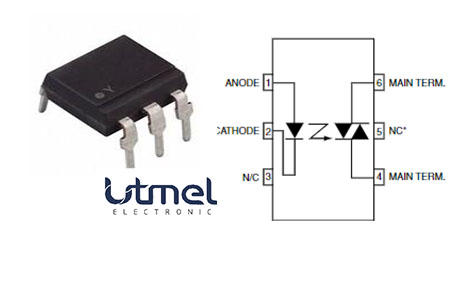
MOC3052 CAD Model
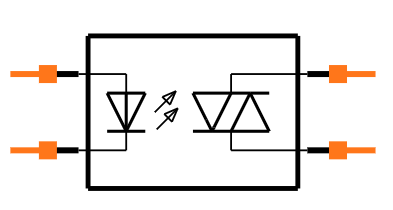
Symbol
Footprint

What is MOC3052?
The MOC3052 consists of an AlGaAs infrared emitting diode optically coupled to a non-zero-crossing silicon bilateral AC switch (Triac). These devices isolate low voltage logic from 115 and 240 Vac lines to provide random phase control of high current trials or thyristors.
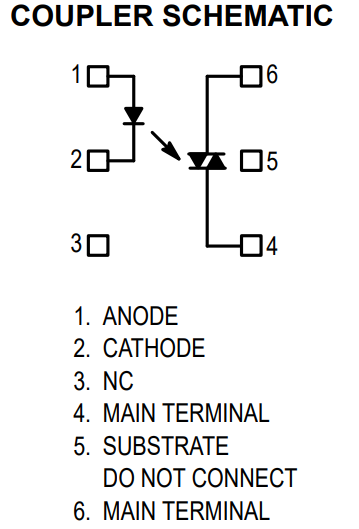
MOC3052 Schematic
Specifications
- TypeParameter
- Factory Lead Time12 Weeks
- Mount
In electronic components, the term "Mount" typically refers to the method or process of physically attaching or fixing a component onto a circuit board or other electronic device. This can involve soldering, adhesive bonding, or other techniques to secure the component in place. The mounting process is crucial for ensuring proper electrical connections and mechanical stability within the electronic system. Different components may have specific mounting requirements based on their size, shape, and function, and manufacturers provide guidelines for proper mounting procedures to ensure optimal performance and reliability of the electronic device.
Through Hole - Mounting Type
The "Mounting Type" in electronic components refers to the method used to attach or connect a component to a circuit board or other substrate, such as through-hole, surface-mount, or panel mount.
Through Hole - Package / Case
refers to the protective housing that encases an electronic component, providing mechanical support, electrical connections, and thermal management.
6-DIP (0.300, 7.62mm) - Number of Pins6
- Current-Hold(Ih)400μA Typ
- Current-LED Trigger(Ift)(Max)10mA
- Number of Elements1
- Voltage-Off State600V
- Zero-Crossing CircuitNo
- Operating Temperature
The operating temperature is the range of ambient temperature within which a power supply, or any other electrical equipment, operate in. This ranges from a minimum operating temperature, to a peak or maximum operating temperature, outside which, the power supply may fail.
-40°C~100°C - Packaging
Semiconductor package is a carrier / shell used to contain and cover one or more semiconductor components or integrated circuits. The material of the shell can be metal, plastic, glass or ceramic.
Tube - Published2010
- Part Status
Parts can have many statuses as they progress through the configuration, analysis, review, and approval stages.
Active - Moisture Sensitivity Level (MSL)
Moisture Sensitivity Level (MSL) is a standardized rating that indicates the susceptibility of electronic components, particularly semiconductors, to moisture-induced damage during storage and the soldering process, defining the allowable exposure time to ambient conditions before they require special handling or baking to prevent failures
1 (Unlimited) - Additional Feature
Any Feature, including a modified Existing Feature, that is not an Existing Feature.
UL RECOGNIZED, VDE APPROVED - Max Power Dissipation
The maximum power that the MOSFET can dissipate continuously under the specified thermal conditions.
330mW - Approval Agency
The parameter "Approval Agency" in electronic components refers to the organization responsible for testing and certifying that a component meets specific safety, quality, and performance standards. These agencies evaluate products to ensure compliance with industry regulations and standards, providing assurance to manufacturers and consumers. Approval from recognized agencies can enhance a component's marketability and acceptance in various applications, particularly in sectors like automotive, aerospace, and healthcare. Common approval agencies include Underwriters Laboratories (UL), International Electrotechnical Commission (IEC), and the American National Standards Institute (ANSI).
CSA, FIMKO, UL - Voltage - Isolation
Voltage - Isolation is a parameter in electronic components that refers to the maximum voltage that can be safely applied between two isolated points without causing electrical breakdown or leakage. It is a crucial specification for components such as transformers, optocouplers, and capacitors that require isolation to prevent electrical interference or safety hazards. The voltage isolation rating ensures that the component can withstand the specified voltage without compromising its performance or safety. It is typically measured in volts and is an important consideration when designing circuits that require isolation between different parts of the system.
5000Vrms - Output Voltage
Output voltage is a crucial parameter in electronic components that refers to the voltage level produced by the component as a result of its operation. It represents the electrical potential difference between the output terminal of the component and a reference point, typically ground. The output voltage is a key factor in determining the performance and functionality of the component, as it dictates the level of voltage that will be delivered to the connected circuit or load. It is often specified in datasheets and technical specifications to ensure compatibility and proper functioning within a given system.
600V - Output Type
The "Output Type" parameter in electronic components refers to the type of signal or data that is produced by the component as an output. This parameter specifies the nature of the output signal, such as analog or digital, and can also include details about the voltage levels, current levels, frequency, and other characteristics of the output signal. Understanding the output type of a component is crucial for ensuring compatibility with other components in a circuit or system, as well as for determining how the output signal can be utilized or processed further. In summary, the output type parameter provides essential information about the nature of the signal that is generated by the electronic component as its output.
Triac - Configuration
The parameter "Configuration" in electronic components refers to the specific arrangement or setup of the components within a circuit or system. It encompasses how individual elements are interconnected and their physical layout. Configuration can affect the functionality, performance, and efficiency of the electronic system, and may influence factors such as signal flow, impedance, and power distribution. Understanding the configuration is essential for design, troubleshooting, and optimizing electronic devices.
SINGLE - Number of Channels1
- Power Dissipation
the process by which an electronic or electrical device produces heat (energy loss or waste) as an undesirable derivative of its primary action.
330mW - Turn On Delay Time
Turn-on delay, td(on), is the time taken to charge the input capacitance of the device before drain current conduction can start.
200 μs - Forward Current
Current which flows upon application of forward voltage.
50mA - Max Input Voltage
Max Input Voltage refers to the maximum voltage level that an electronic component can safely handle without getting damaged. This parameter is crucial for ensuring the proper functioning and longevity of the component. Exceeding the specified maximum input voltage can lead to overheating, electrical breakdown, or permanent damage to the component. It is important to carefully adhere to the manufacturer's guidelines regarding the maximum input voltage to prevent any potential issues and maintain the reliability of the electronic device.
1.4V - Nominal Input Voltage
The actual voltage at which a circuit operates can vary from the nominal voltage within a range that permits satisfactory operation of equipment. The word “nominal” means “named”.
1.2V - Reverse Breakdown Voltage
Reverse Breakdown Voltage is the maximum reverse voltage a semiconductor device can withstand before it starts to conduct heavily in the reverse direction. It is a critical parameter in diodes and other components, indicating the threshold at which the material's insulating properties fail. Beyond this voltage, the device may enter a breakdown region, leading to potential damage if not properly managed. This parameter is essential for ensuring safe operation and reliability in electronic circuits.
6V - Max Input Current
Max Input Current is a parameter that specifies the maximum amount of electrical current that can safely flow into an electronic component without causing damage. It is an important consideration when designing or using electronic circuits to ensure that the component operates within its specified limits. Exceeding the maximum input current can lead to overheating, component failure, or even pose safety risks. Manufacturers provide this parameter in datasheets to help engineers and users understand the limitations of the component and ensure proper operation within the specified parameters.
50mA - Hold Current
the minimum current which must pass through a circuit in order for it to remain in the 'ON' state.
400μA - Static dV/dt (Min)
Static dV/dt (Min) refers to the minimum rate of change of voltage that a device or component can withstand without experiencing breakdown or failure. It is an important parameter in the design and specification of electronic components, particularly for devices exposed to fast voltage transients. A higher static dV/dt value indicates better tolerance to rapid voltage changes, which is crucial in applications like power electronics and signal integrity. This parameter helps ensure reliability and performance in circuits subjected to varying electric fields.
1kV/μs - Input Trigger Current-Nom
The parameter "Input Trigger Current-Nom" in electronic components refers to the nominal current level required to trigger a specific function or operation within the component. This parameter is crucial for determining the threshold at which the component will respond to an input signal or command. It helps in ensuring that the component functions reliably and consistently within its specified operating conditions. Understanding the Input Trigger Current-Nom is essential for designing circuits and systems that rely on precise triggering mechanisms for proper operation.
10mA - RoHS Status
RoHS means “Restriction of Certain Hazardous Substances” in the “Hazardous Substances Directive” in electrical and electronic equipment.
ROHS3 Compliant - Lead Free
Lead Free is a term used to describe electronic components that do not contain lead as part of their composition. Lead is a toxic material that can have harmful effects on human health and the environment, so the electronics industry has been moving towards lead-free components to reduce these risks. Lead-free components are typically made using alternative materials such as silver, copper, and tin. Manufacturers must comply with regulations such as the Restriction of Hazardous Substances (RoHS) directive to ensure that their products are lead-free and environmentally friendly.
Lead Free
MOC3052 Features
•Excellent IFT stability—IR emitting diode has low degradation
•High isolation voltage—minimum 7500 peak VAC
•Underwriters Laboratory (UL) recognized—File #E90700
•600V peak blocking voltage
•VDE recognized (File #94766) -Ordering option V (e.g. MOC3052V-M)
MOC3052 Applications
Ac motor drives
Ac motor starters
E.M. contractors
Lighting controls
Solenoid/value controls
Solid state relays
Static power switches
Temperature controls
MOC3052 Application Circuit

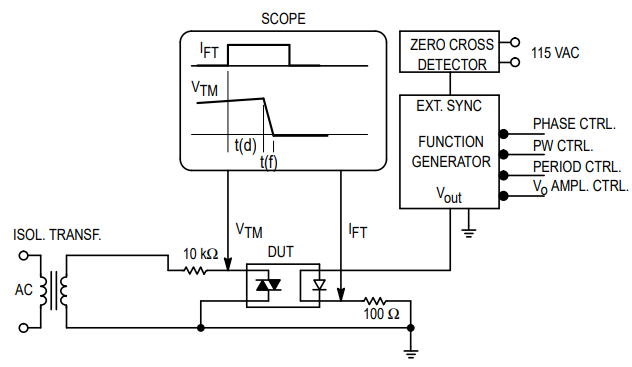
MOC3052 Test Circuit
MOC3052 Alternatives

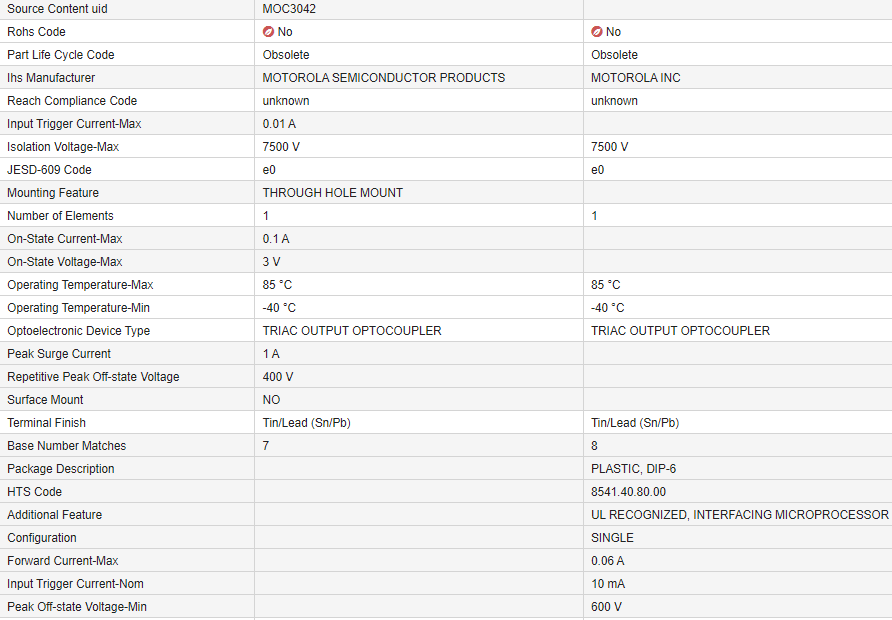
MOC3042 vs.MOC3052
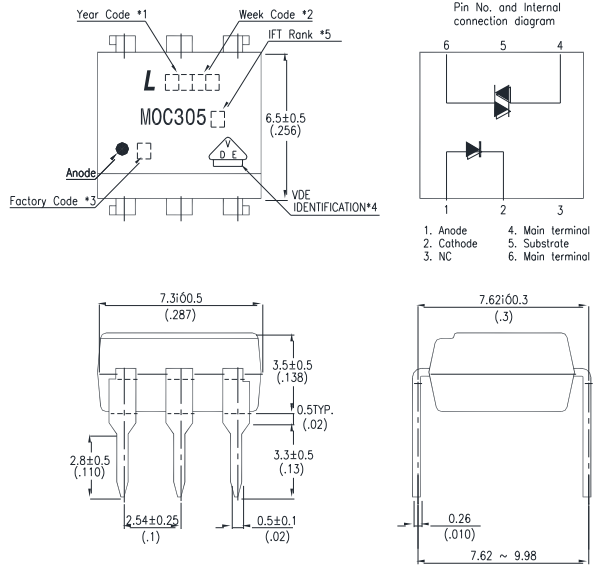
MOC3052 Package
MOC3052 Manufacturer
Lite-On started producing LED lamps in 1975 and has steadily grown into one of the world's largest optoelectronics manufacturers by providing customers with both visible and infrared product solutions. High volume capacities for commodity items and application-specific products, combined with strong R&D and vertical integration, have proven to be key distinguishing factors in Lite-On's success.
Trend Analysis
Datasheet PDF
- Datasheets :
How does MOC3052 work?
The MOC3052 is a semiconductor device that allows an electrical signal to be transmitted between two isolated circuits. Two parts are used in an optocoupler: an LED that emits infrared light and a photosensitive device that detects light from the LED.
Can MOC3052 be used in phase-shifted thyristor dimming circuit?
Yes, but ordinary optocouplers conduct unidirectional conduction. When the triac is triggered to conduct 220V, it can only conduct half-wave. You have to turn the AC into direct current, and then use the optocoupler to trigger the Triac. As long as T1 and It is enough to have a continuous trigger current flowing between G!
 PCA9555PW Expander: Features, Applications and Datasheet
02 November 2023610
 TL431 Shunt Regulator: Where & How to Use TL431?
02 December 202111413
 Mastering the RF Agile Transceiver: 70 MHz to 6.0 GHz SDR Performance and Design Solutions
12 February 2026694
 STM32H723VGT6 Datasheet Guide: How to Find & Interpret Technical Documentation
05 July 20253377
 SR44 Battery: SR44 Equivalent, SR44 vs. LR44,SR44 1.55V Power
11 November 202126028
 H6 vs H7 Battery: Which One Do You Like Better?
01 April 202251153
 TP5100 VS TP4056: Differences between charging and protection modules
09 April 202237284
 STM32F051K8U6TR ARM Microcontroller: Pinout, Datasheet and Applications
05 January 20221212
 Dynamic On-Resistance and its Impact on Power Converters
28 August 20232984
 The Introduction of Oscilloscope Probes
11 January 20228336
 ARM, FPGA, DSP and CPLD: Connection and Difference
15 March 20228677
 Understanding the Flight Sensing Modules of Drones
06 September 20212187
 What is Server and Why does a Server Crash?
14 September 202119096
 Wireless Charging Explained: Working and Standards
26 May 202111043
 Beginners Guide to Precision Resistors
10 April 202529923
 What is a Digital-to-analog Converter?
04 June 20244230
Lite-On Inc.
In Stock: 45
United States
China
Canada
Japan
Russia
Germany
United Kingdom
Singapore
Italy
Hong Kong(China)
Taiwan(China)
France
Korea
Mexico
Netherlands
Malaysia
Austria
Spain
Switzerland
Poland
Thailand
Vietnam
India
United Arab Emirates
Afghanistan
Åland Islands
Albania
Algeria
American Samoa
Andorra
Angola
Anguilla
Antigua & Barbuda
Argentina
Armenia
Aruba
Australia
Azerbaijan
Bahamas
Bahrain
Bangladesh
Barbados
Belarus
Belgium
Belize
Benin
Bermuda
Bhutan
Bolivia
Bonaire, Sint Eustatius and Saba
Bosnia & Herzegovina
Botswana
Brazil
British Indian Ocean Territory
British Virgin Islands
Brunei
Bulgaria
Burkina Faso
Burundi
Cabo Verde
Cambodia
Cameroon
Cayman Islands
Central African Republic
Chad
Chile
Christmas Island
Cocos (Keeling) Islands
Colombia
Comoros
Congo
Congo (DRC)
Cook Islands
Costa Rica
Côte d’Ivoire
Croatia
Cuba
Curaçao
Cyprus
Czechia
Denmark
Djibouti
Dominica
Dominican Republic
Ecuador
Egypt
El Salvador
Equatorial Guinea
Eritrea
Estonia
Eswatini
Ethiopia
Falkland Islands
Faroe Islands
Fiji
Finland
French Guiana
French Polynesia
Gabon
Gambia
Georgia
Ghana
Gibraltar
Greece
Greenland
Grenada
Guadeloupe
Guam
Guatemala
Guernsey
Guinea
Guinea-Bissau
Guyana
Haiti
Honduras
Hungary
Iceland
Indonesia
Iran
Iraq
Ireland
Isle of Man
Israel
Jamaica
Jersey
Jordan
Kazakhstan
Kenya
Kiribati
Kosovo
Kuwait
Kyrgyzstan
Laos
Latvia
Lebanon
Lesotho
Liberia
Libya
Liechtenstein
Lithuania
Luxembourg
Macao(China)
Madagascar
Malawi
Maldives
Mali
Malta
Marshall Islands
Martinique
Mauritania
Mauritius
Mayotte
Micronesia
Moldova
Monaco
Mongolia
Montenegro
Montserrat
Morocco
Mozambique
Myanmar
Namibia
Nauru
Nepal
New Caledonia
New Zealand
Nicaragua
Niger
Nigeria
Niue
Norfolk Island
North Korea
North Macedonia
Northern Mariana Islands
Norway
Oman
Pakistan
Palau
Palestinian Authority
Panama
Papua New Guinea
Paraguay
Peru
Philippines
Pitcairn Islands
Portugal
Puerto Rico
Qatar
Réunion
Romania
Rwanda
Samoa
San Marino
São Tomé & Príncipe
Saudi Arabia
Senegal
Serbia
Seychelles
Sierra Leone
Sint Maarten
Slovakia
Slovenia
Solomon Islands
Somalia
South Africa
South Sudan
Sri Lanka
St Helena, Ascension, Tristan da Cunha
St. Barthélemy
St. Kitts & Nevis
St. Lucia
St. Martin
St. Pierre & Miquelon
St. Vincent & Grenadines
Sudan
Suriname
Svalbard & Jan Mayen
Sweden
Syria
Tajikistan
Tanzania
Timor-Leste
Togo
Tokelau
Tonga
Trinidad & Tobago
Tunisia
Turkey
Turkmenistan
Turks & Caicos Islands
Tuvalu
U.S. Outlying Islands
U.S. Virgin Islands
Uganda
Ukraine
Uruguay
Uzbekistan
Vanuatu
Vatican City
Venezuela
Wallis & Futuna
Yemen
Zambia
Zimbabwe

