

 Product
 Brand
Brand Articles
 Tools
Tools
RP2040 VS ESP32 VS STM32[Video]: What are the differences between them?

512KB 512K x 8 FLASH ARM® Cortex®-M4 32-Bit Microcontroller STM32F4 Series STM32F411 48 Pin 100MHz 48-UFQFN Exposed Pad


512KB 512K x 8 FLASH ARM® Cortex®-M4 32-Bit Microcontroller STM32F4 Series STM32F411 48 Pin 100MHz 48-UFQFN Exposed Pad
RP2040, ESP32, and STM32 are all microcontrollers. This article is going to talk about the differences between them.

#370 Raspberry Pi Pico vs ESP32 (-S2) and STM32 Blackpill
- Overview of RP2040
- Overview of ESP32
- Overview of STM32
- RP2040 VS ESP32 VS STM32 Features
- RP2040 VS ESP32 VS STM32 Pinout
- RP2040 VS ESP32 VS STM32 Block Diagram
- RP2040 VS ESP32 VS STM32 Specifications
- RP2040 VS ESP32 VS STM32 Parameters
- Conclusion of RP2040 VS ESP32 VS STM32
- RP2040 VS ESP32 VS STM32 Datasheet
- RP2040 VS ESP32 VS STM32 Package information
- Popularity by Region
Overview of RP2040
RP2040 brings our distinctive values of high performance, low cost, and ease of use to the microcontroller arena. Because of its large on-chip memory, symmetric dual-core processing complex, deterministic bus fabric, and complete peripheral set reinforced with our unique Programmable I/O (PIO) subsystem, it provides professional users with unequaled power and flexibility. It has a low entry barrier for new and inexperienced users, with detailed documentation, a polished MicroPython port, and a UF2 bootloader in ROM.
The RP2040 is a stateless device with execute-in-place functionality cached in external QSPI memory. This design choice allows you to choose the optimum nonvolatile storage density for your application while simultaneously taking advantage of commodity Flash's low pricing. The RP2040 is based on a cutting-edge 40nm process node that offers outstanding performance, low dynamic power consumption, and minimal leakage, as well as a variety of low-power modes for prolonged battery life.
Overview of ESP32
Espressif Systems' ESP32 is a low-cost, low-power system on a chip (SoC) series with Wi-Fi and dual-mode Bluetooth functionality! The ESP32 family includes the chips ESP32-D0WDQ6 (and ESP32-D0WD), ESP32-D2WD, ESP32-S0WD, and the system in package (SiP) ESP32-PICO-D4. At its core is a Tensilica Xtensa LX6 dual-core or single-core CPU with a clock rate of up to 240 MHz. The ESP32 includes antenna switches, RF baluns, power amplifiers, low-noise receive amplifiers, filters, and power management modules. To achieve ultra-low power consumption, the ESP32 is developed for mobile devices, wearable electronics, and IoT applications, and it employs power-saving technologies such as fine resolution clock gating, various power modes, and dynamic power scaling.
Overview of STM32
STMicroelectronics' STM32 32-Bit ARM® Cortex®-M MCUs are based on the Arm Cortex-M processor and are designed to provide MCU users with new levels of freedom. A 32-bit version of the MCUs is available, which combines high performance, real-time capability, digital signal processing, and low-power, low-voltage operation. This is done while maintaining complete integration and development simplicity.
Arm Cortex-M cores (M0, M0+, M3, M4, and M7), as well as other options, are now available in the STM32 series. This gives developers the option of selecting the optimal STM32 for their needs. The ability to transfer apps from one device to another receives specific attention. The binary compatibility of the STM32 series, together with the similar pinout assignment, hardware IP proliferation, and higher-level programming language, makes the development work substantially easier.
RP2040 VS ESP32 VS STM32 Features
RP2040 Features:
• Dual ARM Cortex-M0+ @ 133MHz
• 264kB on-chip SRAM in six independent banks
• Support for up to 16MB of off-chip Flash memory via dedicated QSPI bus
• DMA controller
• Fully-connected AHB crossbar
• Interpolator and integer divider peripherals
• On-chip programmable LDO to generate a core voltage
• 2 on-chip PLLs to generate USB and core clocks
• 30 GPIO pins, 4 of which can be used as analog inputs
• Peripherals
ESP32 Features:
Processors:
CPU: Xtensa dual-core (or single-core) 32-bit LX6 microprocessor, operating at 160 or 240 MHz and performing at up to 600 DMIPS
Ultra-low-power (ULP) co-processor
Memory: 320 KiB RAM, 448 KiB ROM
Wireless connectivity:
Wi-Fi: 802.11 b/g/n
Bluetooth: v4.2 BR/EDR and BLE (shares the radio with Wi-Fi)
Security:
IEEE 802.11 standard security features are all supported, including WPA, WPA2, WPA3 (depending on the version)[5] and WAPI
Secure boot
Flash encryption
1024-bit OTP, up to 768-bit for customers
Cryptographic hardware acceleration: AES, SHA-2, RSA, elliptic curve cryptography (ECC), random number generator (RNG)
Power management:
Internal low-dropout regulator
Individual power domain for RTC
5 μA deep sleep current
Wake up from GPIO interrupt, timer, ADC measurements, capacitive touch sensor interrupt
STM32 Features:
• ARM® 32-bit Cortex®-M3 CPU Core
• Memories
• Clock, reset and supply management
• Low-power
• 2 x 12-bit, 1 µs A/D converters (up to 16 channels)
• DMA
•Up to 80 fast I/O ports
• Debug mode
• 7 timers
• Up to 9 communication interfaces
• CRC calculation unit, 96-bit unique ID
• Packages are ECOPACK®
RP2040 VS ESP32 VS STM32 Pinout
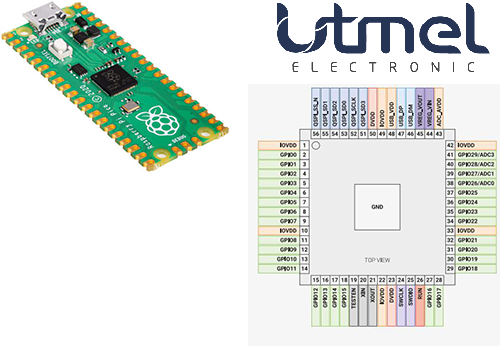
RP2040 Pinout
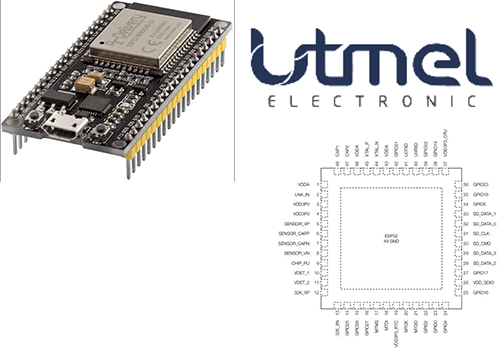
ESP32 Pinout

STM Pinout
RP2040 VS ESP32 VS STM32 Block Diagram
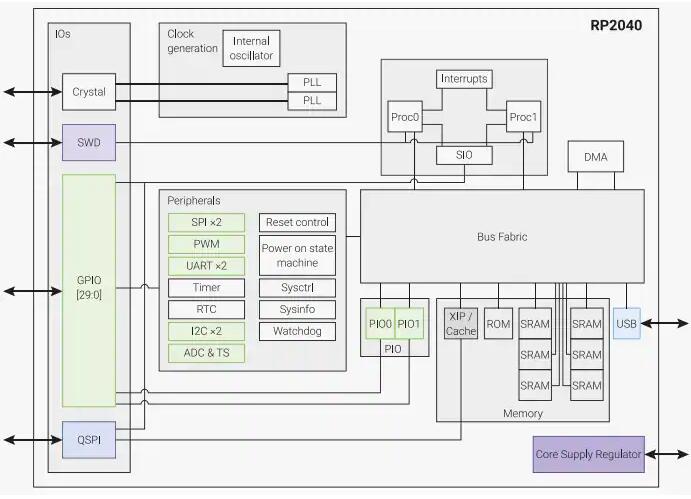
RP2040 Block Diagram

ESP32 Block Diagram
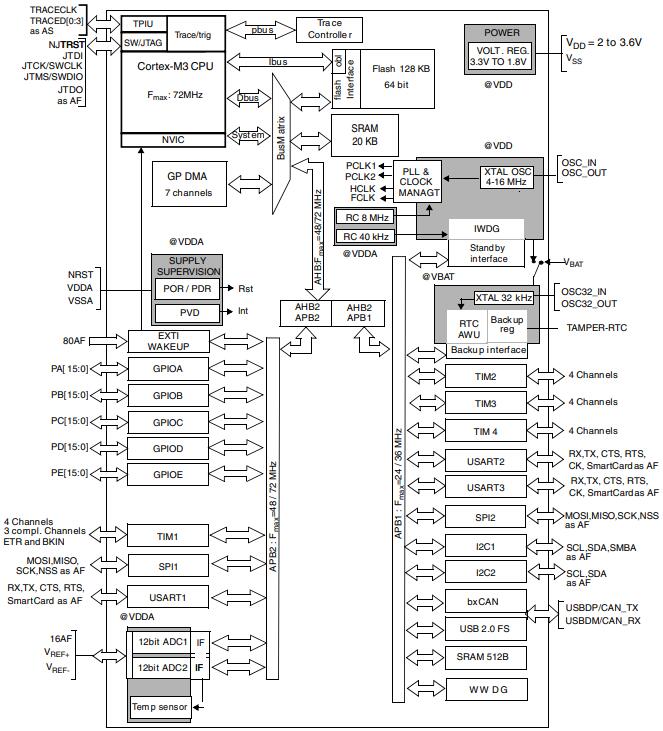
STM Block Diagram
RP2040 VS ESP32 VS STM32 Specifications
| RP2040 | ESP32 | STM32 | |
| Manufacturer | Raspberry Pi | RF Solutions | STMicroelectronics |
| Operating Temperature | -20°C to +85°C | -40°C~85°C | -40°C~85°C |
| Processor Series | Dual ARM Cortex-M0+ cores | Tensilica Xtensa LX6 microprocessor | ARM Cortex M |
| Images | 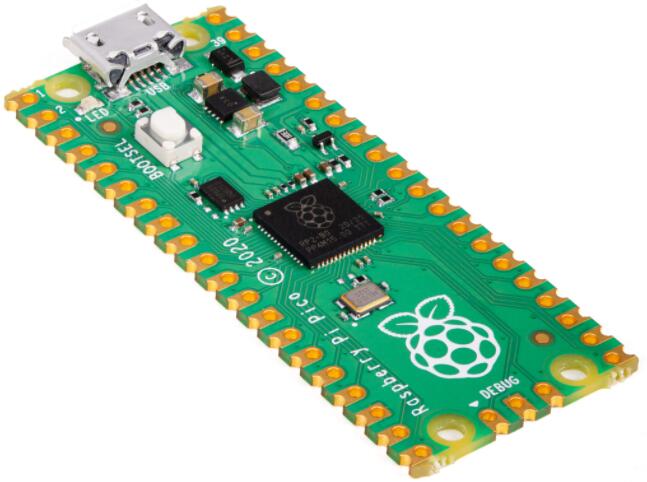 |  |  |
RP2040 VS ESP32 VS STM32 Parameters
| RP2040 | ESP32 | STM32 |
| Dual-core | Dual-core | Signal core |
| 32-bit ARM Cortex M0+ | 32-bit XTENSA | 32-bit ARM Cortex M3/M4 |
| 48MHz Up to 133MHz | 80MHz Up to 240MHz | 72MHz Both |
| 264 Kilobytes | 520 Kilobytes | 20 Kilobytes |
| 2MB | 4MB | 64KB |
| No | 512B | 524KB |
| Micro Python C/C++ | C/C++ JavaScript Arduino IDE | C/C++ |
| USB1.1 | USB2.0 | USB2.0 |
| 3.3 Volts DC | 3.3 Volts DC | 3.3 Volts DC |
| 2-5V PC vis Pin39 | 3.3V via VIN Regulated | 2.0-3.6V |
Conclusion of RP2040 VS ESP32 VS STM32
As others have indicated, the ESP32 can be used for simple networking (BLE and WiFi), whereas the STM32 can be utilized for a wider range of applications. STM32 + Other chipsets are widely used in product communication and sensing applications. The RP2040 features a larger flash memory than the STM32, with 2MB compared to 64KB. The operating temperature of the STM32 is higher than that of the RP2040. The temperature range of the RP2040 is -20°C to +85°C, while the temperature range of the STM32 is -40°C to +85°C. The Raspberry Pi Pico is a beginner-friendly microcontroller board that uses MicroPython to give you a taste of the Internet of Things and microcontrollers. The RP2040 is a well-designed microprocessor that can be utilized in almost any Internet of Things project. On the other side, the ESP 32 is a compact but capable microcontroller board. Because of its low cost, low power consumption, and tiny size, it is a well-developed microprocessor that may be used in a range of IoT applications.
RP2040 VS ESP32 VS STM32 Datasheet
RP2040 VS ESP32 VS STM32 Package information
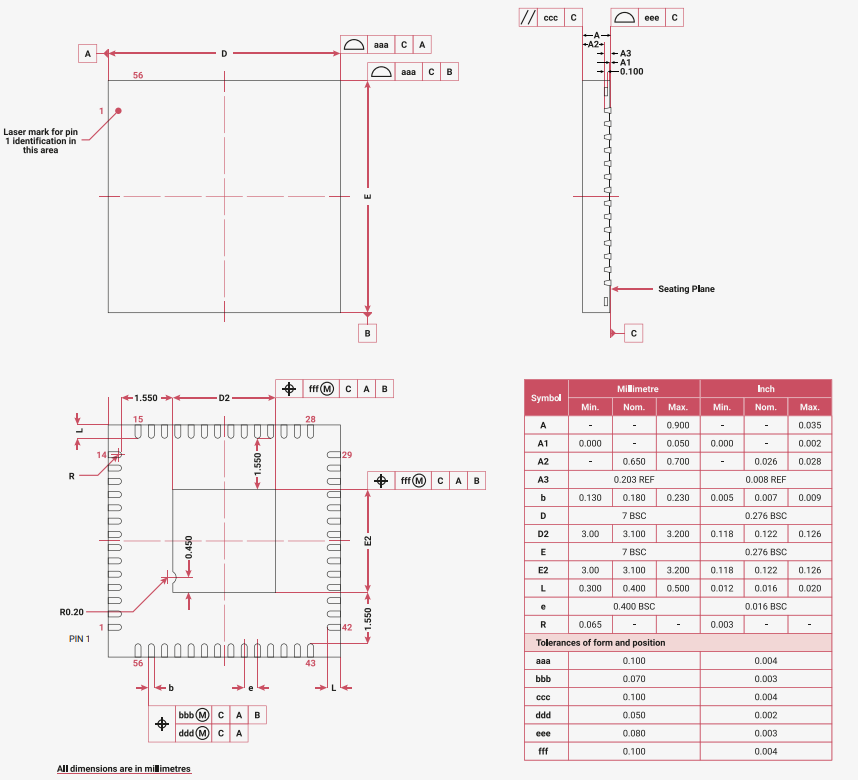
RP2040 Package information

ESP32 Package information

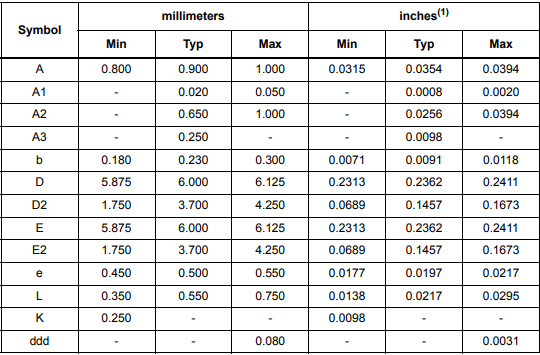
STM Package information
Popularity by Region
What is the difference between ESP32 and STM32?
As others have stated, ESP32 can be used if you simply need connectivity (BLE and WiFi), whereas STM32 can be used for a larger range of applications. STM32 + Other chipsets are extensively utilized in communication and sensing applications in products. The RP2040 is a well-designed microprocessor that can be utilized in almost any Internet of Things project. It has enough power to complete the task quickly. On the other side, the ESP 32 is a compact but capable microcontroller board.
What is the difference between ESP32 and Raspberry Pi?
The Raspberry Pi Pico is a beginner-friendly microcontroller board that uses MicroPython to provide a warm introduction to the IoT branch and microcontrollers. The RP2040 is a well-designed microprocessor that may be used in practically any IoT project. It has sufficient power to get the job done efficiently. ARM M0+ is the CPU type for the dual-core processor. All of these capabilities for about $4 is a fantastic price, especially for students who want to board for a variety of projects that do not require wifi access. The ESP 32, on the other hand, is a small but powerful microcontroller board. It is a very well-developed microchip that may be utilized in a variety of IoT applications because of its low cost, low power consumption, and small size. This microcontroller board. on the other hand, has earned a reputation as one of the best boards for IoT developers because of its wireless connectivity and other fascinating features.
What are the differences between the RP2040 and STM32?
The RP2040 has a larger flash size than the STM32, with 2MB vs. 64KB for the STM32. STM32, on the other hand, has a greater operating temperature than RP2040. The RP2040 has a temperature range of -20°C to +85°C, while the STM32 has a temperature range of -40°C to +85°C.
 LM741CM Operational Amplifier: Datasheet, Schematic Diagram, and Applications
31 August 20217033
 DB9 Tripp Lite In-Line Surge Protector: Datasheet, DB9 connector vs RS232, DB9 Pinout
18 January 20223301
 LSM6DS3TR: 3.6V, 14-VFLGA Module, Pinout and Datasheet
02 March 20222507
 74HC193 Counter: Specification, Pinout and Datasheet PDF
21 June 20217874
 AD8233ACBZ-R7 Heart Rate Monitor: Low Noise, 20WLCSP Monitor and AD8233 Datasheet
21 January 20222255
 LMR240 Times Microwave Coax Cable 50 Ohm 0.240 Diameter: Datasheet, Features, and Application |LMR®-240
12 June 20241787
 TPS54335 Step-Down DC-DC Converter: Datasheet, Pinout, Circuit
21 April 20251783
 TM1650 LED Drive Control: Datasheet pdf, Circuit and Pinout
16 November 202119023
 Basic Introduction to Metal Film Resistor
28 August 202014170
 The Ultimate Guide to Microchip MCUs: From Selection to Real-World Applications
13 September 20251455
 Three-Level Integration of Circuits
05 May 20224028
 In-depth Analysis of the Global Semiconductor Supply Chain
20 January 202213520
 How does the CPU Calculate 1+1?
12 January 20224913
 Trusted Vibration Sensors for Homeowners and Industry Professionals
17 July 20251490
 Beginner’s Handbook for Choosing Circular Connectors
14 July 20254174
 What is Chip: Definition, Classification and Design Process
17 January 20267450
STMicroelectronics
In Stock: 1000
United States
China
Canada
Japan
Russia
Germany
United Kingdom
Singapore
Italy
Hong Kong(China)
Taiwan(China)
France
Korea
Mexico
Netherlands
Malaysia
Austria
Spain
Switzerland
Poland
Thailand
Vietnam
India
United Arab Emirates
Afghanistan
Åland Islands
Albania
Algeria
American Samoa
Andorra
Angola
Anguilla
Antigua & Barbuda
Argentina
Armenia
Aruba
Australia
Azerbaijan
Bahamas
Bahrain
Bangladesh
Barbados
Belarus
Belgium
Belize
Benin
Bermuda
Bhutan
Bolivia
Bonaire, Sint Eustatius and Saba
Bosnia & Herzegovina
Botswana
Brazil
British Indian Ocean Territory
British Virgin Islands
Brunei
Bulgaria
Burkina Faso
Burundi
Cabo Verde
Cambodia
Cameroon
Cayman Islands
Central African Republic
Chad
Chile
Christmas Island
Cocos (Keeling) Islands
Colombia
Comoros
Congo
Congo (DRC)
Cook Islands
Costa Rica
Côte d’Ivoire
Croatia
Cuba
Curaçao
Cyprus
Czechia
Denmark
Djibouti
Dominica
Dominican Republic
Ecuador
Egypt
El Salvador
Equatorial Guinea
Eritrea
Estonia
Eswatini
Ethiopia
Falkland Islands
Faroe Islands
Fiji
Finland
French Guiana
French Polynesia
Gabon
Gambia
Georgia
Ghana
Gibraltar
Greece
Greenland
Grenada
Guadeloupe
Guam
Guatemala
Guernsey
Guinea
Guinea-Bissau
Guyana
Haiti
Honduras
Hungary
Iceland
Indonesia
Iran
Iraq
Ireland
Isle of Man
Israel
Jamaica
Jersey
Jordan
Kazakhstan
Kenya
Kiribati
Kosovo
Kuwait
Kyrgyzstan
Laos
Latvia
Lebanon
Lesotho
Liberia
Libya
Liechtenstein
Lithuania
Luxembourg
Macao(China)
Madagascar
Malawi
Maldives
Mali
Malta
Marshall Islands
Martinique
Mauritania
Mauritius
Mayotte
Micronesia
Moldova
Monaco
Mongolia
Montenegro
Montserrat
Morocco
Mozambique
Myanmar
Namibia
Nauru
Nepal
New Caledonia
New Zealand
Nicaragua
Niger
Nigeria
Niue
Norfolk Island
North Korea
North Macedonia
Northern Mariana Islands
Norway
Oman
Pakistan
Palau
Palestinian Authority
Panama
Papua New Guinea
Paraguay
Peru
Philippines
Pitcairn Islands
Portugal
Puerto Rico
Qatar
Réunion
Romania
Rwanda
Samoa
San Marino
São Tomé & Príncipe
Saudi Arabia
Senegal
Serbia
Seychelles
Sierra Leone
Sint Maarten
Slovakia
Slovenia
Solomon Islands
Somalia
South Africa
South Sudan
Sri Lanka
St Helena, Ascension, Tristan da Cunha
St. Barthélemy
St. Kitts & Nevis
St. Lucia
St. Martin
St. Pierre & Miquelon
St. Vincent & Grenadines
Sudan
Suriname
Svalbard & Jan Mayen
Sweden
Syria
Tajikistan
Tanzania
Timor-Leste
Togo
Tokelau
Tonga
Trinidad & Tobago
Tunisia
Turkey
Turkmenistan
Turks & Caicos Islands
Tuvalu
U.S. Outlying Islands
U.S. Virgin Islands
Uganda
Ukraine
Uruguay
Uzbekistan
Vanuatu
Vatican City
Venezuela
Wallis & Futuna
Yemen
Zambia
Zimbabwe
![STM32F103RBT6]() STM32F103RBT6
STM32F103RBT6STMicroelectronics
![STM32F103ZET6]() STM32F103ZET6
STM32F103ZET6STMicroelectronics
![STM32H743IIT6]() STM32H743IIT6
STM32H743IIT6STMicroelectronics
![STM32F407VET6]() STM32F407VET6
STM32F407VET6STMicroelectronics
![STM32F405RGT6]() STM32F405RGT6
STM32F405RGT6STMicroelectronics
![STM32F030C8T6]() STM32F030C8T6
STM32F030C8T6STMicroelectronics
![STM32F100C8T6B]() STM32F100C8T6B
STM32F100C8T6BSTMicroelectronics
![STM32F103VBT6]() STM32F103VBT6
STM32F103VBT6STMicroelectronics
![STM8S003F3U6TR]() STM8S003F3U6TR
STM8S003F3U6TRSTMicroelectronics
![STM32F429ZIT6]() STM32F429ZIT6
STM32F429ZIT6STMicroelectronics


