

 Product
 Brand
Brand Articles
 Tools
Tools
STUSB4500 USB PD Controller: Pinout, Features and Datasheet

4.1V~22V USB 2.0 I2C Controllers Interface ICs STUSB45 Controller 24-VFQFN Exposed Pad


4.1V~22V USB 2.0 I2C Controllers Interface ICs STUSB45 Controller 24-VFQFN Exposed Pad
The STUSB4500 is a USB power delivery controller that addresses sink devices. It implements a proprietary algorithm to allow the negotiation of a power delivery contract with a source without MCU support (auto-run mode). Furthermore, Huge range of Semiconductors, Capacitors, Resistors and IcS in stock. Welcome RFQ.

What is USB Power Delivery? - Gary Explains
- STUSB4500 Pinout
- STUSB4500 CAD Model
- STUSB4500 Description
- STUSB4500 Functional Description
- STUSB4500 Features
- Specifications
- STUSB4500 Functional Block Diagram
- STUSB4500 Applications
- STUSB4500 Typical Application
- STUSB4500 Package
- STUSB4500 Recommended Footprint
- STUSB4500 Manufacturer
- Trend Analysis
- Datasheet PDF
STUSB4500 Pinout
The following figure is the diagram of STUSB4500 pinout.
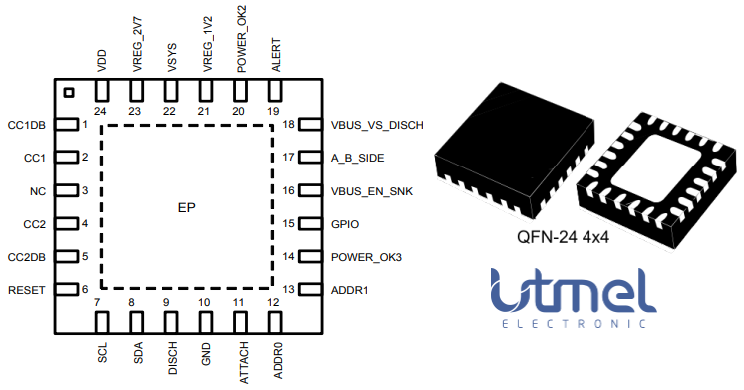
Pinout
STUSB4500 CAD Model
The followings are STUSB4500 Symbol, Footprint, and 3D Model.
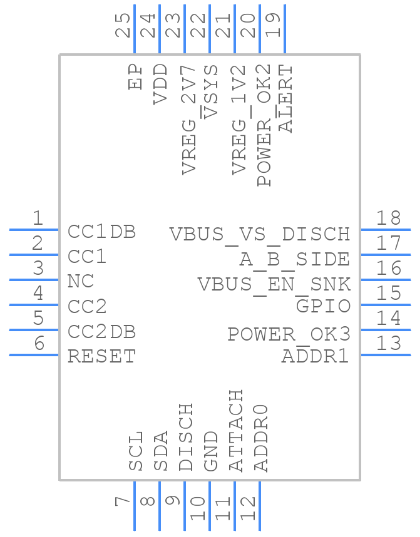
PCB Symbol
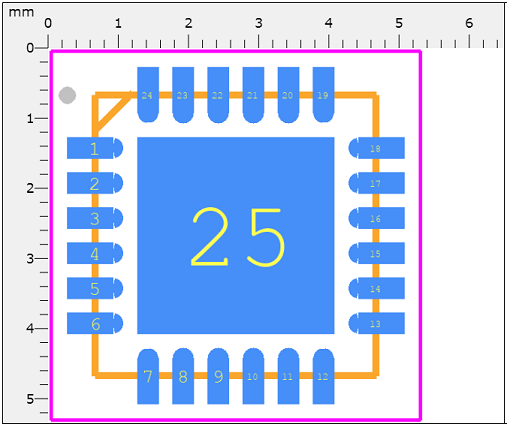
PCB Footprint
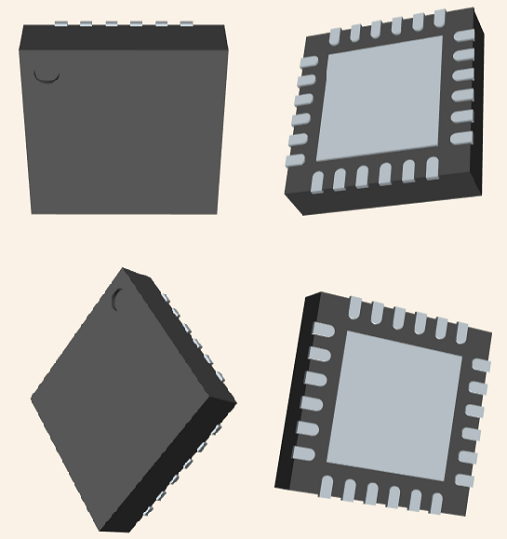
3D Model
STUSB4500 Description
The STUSB4500 is a USB power delivery controller that addresses sink devices. It implements a proprietary algorithm to allow the negotiation of a power delivery contract with a source without MCU support (auto-run mode). PDO profiles are configured in an integrated non-volatile memory. The device supports dead battery mode and is suited for sink devices powered from dead battery state and requiring high power charging profile to be fully operational. Thanks to its 20 V technology, it implements high voltage features to protect the CC pins against short-circuits to VBUS up to 22 V and to support high voltage on the VBUS pins directly connected to the VBUS power path up to 28 V.
This article provides you with a basic overview of the STUSB4500 USB PD Controller, including its pin descriptions, features and specifications, etc., to help you quickly understand what STUSB4500 is.
STUSB4500 Functional Description
The STUSB4500 is a USB Type-C™ and power delivery controller IC for sink applications. It is able to negotiate a power delivery contract with a source without MCU support (auto-run mode). It relies on proprietary algorithms and configurable PDO (power data objects) thanks to an integrated non-volatile memory. It supports dead battery mode to allow a system to be powered from an external source directly. Combined with its capability to negotiate directly a power contract, the STUSB4500 is the ideal controller device for autonomous systems requiring high power charging profile to be fully operational.
The STUSB4500 major role is to:
1. Detect the connection between two USB Type-C ports (attach detection)
2. Establish a valid source-to-sink connection
3. Determine the attached device mode: source or debug accessory
4. Resolve cable orientation and twist connections to establish USB data routing (MUX control)
5. Negotiate a USB power delivery (PD) contract with a PD capable source device
6. Configure the incoming VBUS power path and the charging paths accordingly
7. Monitor the VBUS power path and manage the VBUS voltage transitions
8. Handle the high voltage protections
The STUSB4500 also provides:
● Dead battery mode
● PDO (power data object) customization through NVM
● Internal and/or external VBUS discharge paths
● Dual high power charging path support
● Debug accessory mode detection
● Customization of the device configuration through NVM to support specific applications
STUSB4500 Features
● Auto-run Type-C™ and USB PD sink controller
● Dead battery mode support
● Up to 3 sink PDO configurable profiles
● Dual high power charging path support
● Integrated VBUS switch gate drivers (PMOS)
● Integrated VBUS voltage monitoring
● Internal and/or external VBUS discharge paths
● Short-to-VBUS protections on CC pins (22 V)
● High voltage capability on VBUS pins (28 V)
● Dual power supply (VSYS and/or VDD):
◆ VSYS = [3.0 V; 5.5 V]
◆ VDD = [4.1 V; 22 V]
● Debug accessory mode support
● Temperature range: -40 °C up to 105 °C
● ESD: 3 kV HBM - 1.5 kV CDM
● Certified:
◆ USB Type-C™ rev 1.2
◆ USB PD rev 2.0 (TID #1000133)
● Interoperable with USB PD rev 3.0
Specifications
- TypeParameter
- Factory Lead Time12 Weeks
- Package / Case
refers to the protective housing that encases an electronic component, providing mechanical support, electrical connections, and thermal management.
24-VFQFN Exposed Pad - Operating Temperature
The operating temperature is the range of ambient temperature within which a power supply, or any other electrical equipment, operate in. This ranges from a minimum operating temperature, to a peak or maximum operating temperature, outside which, the power supply may fail.
-40°C~105°C - Packaging
Semiconductor package is a carrier / shell used to contain and cover one or more semiconductor components or integrated circuits. The material of the shell can be metal, plastic, glass or ceramic.
Tape & Reel (TR) - Part Status
Parts can have many statuses as they progress through the configuration, analysis, review, and approval stages.
Active - Moisture Sensitivity Level (MSL)
Moisture Sensitivity Level (MSL) is a standardized rating that indicates the susceptibility of electronic components, particularly semiconductors, to moisture-induced damage during storage and the soldering process, defining the allowable exposure time to ambient conditions before they require special handling or baking to prevent failures
3 (168 Hours) - Voltage - Supply
Voltage - Supply refers to the range of voltage levels that an electronic component or circuit is designed to operate with. It indicates the minimum and maximum supply voltage that can be applied for the device to function properly. Providing supply voltages outside this range can lead to malfunction, damage, or reduced performance. This parameter is critical for ensuring compatibility between different components in a circuit.
4.1V~22V - Peak Reflow Temperature (Cel)
Peak Reflow Temperature (Cel) is a parameter that specifies the maximum temperature at which an electronic component can be exposed during the reflow soldering process. Reflow soldering is a common method used to attach electronic components to a circuit board. The Peak Reflow Temperature is crucial because it ensures that the component is not damaged or degraded during the soldering process. Exceeding the specified Peak Reflow Temperature can lead to issues such as component failure, reduced performance, or even permanent damage to the component. It is important for manufacturers and assemblers to adhere to the recommended Peak Reflow Temperature to ensure the reliability and functionality of the electronic components.
NOT SPECIFIED - Reach Compliance Code
Reach Compliance Code refers to a designation indicating that electronic components meet the requirements set by the Registration, Evaluation, Authorization, and Restriction of Chemicals (REACH) regulation in the European Union. It signifies that the manufacturer has assessed and managed the chemical substances within the components to ensure safety and environmental protection. This code is vital for compliance with regulations aimed at minimizing risks associated with hazardous substances in electronic products.
compliant - Time@Peak Reflow Temperature-Max (s)
Time@Peak Reflow Temperature-Max (s) refers to the maximum duration that an electronic component can be exposed to the peak reflow temperature during the soldering process, which is crucial for ensuring reliable solder joint formation without damaging the component.
NOT SPECIFIED - Base Part Number
The "Base Part Number" (BPN) in electronic components serves a similar purpose to the "Base Product Number." It refers to the primary identifier for a component that captures the essential characteristics shared by a group of similar components. The BPN provides a fundamental way to reference a family or series of components without specifying all the variations and specific details.
STUSB45 - Function
The parameter "Function" in electronic components refers to the specific role or purpose that the component serves within an electronic circuit. It defines how the component interacts with other elements, influences the flow of electrical signals, and contributes to the overall behavior of the system. Functions can include amplification, signal processing, switching, filtering, and energy storage, among others. Understanding the function of each component is essential for designing effective and efficient electronic systems.
Controller - Interface
In electronic components, the term "Interface" refers to the point at which two different systems, devices, or components connect and interact with each other. It can involve physical connections such as ports, connectors, or cables, as well as communication protocols and standards that facilitate the exchange of data or signals between the connected entities. The interface serves as a bridge that enables seamless communication and interoperability between different parts of a system or between different systems altogether. Designing a reliable and efficient interface is crucial in ensuring proper functionality and performance of electronic components and systems.
I2C - Protocol
In electronic components, the parameter "Protocol" refers to a set of rules and standards that govern the communication between devices. It defines the format, timing, sequencing, and error checking methods for data exchange between different components or systems. Protocols ensure that devices can understand and interpret data correctly, enabling them to communicate effectively with each other. Common examples of protocols in electronics include USB, Ethernet, SPI, I2C, and Bluetooth, each with its own specifications for data transmission. Understanding and adhering to protocols is essential for ensuring compatibility and reliable communication between electronic devices.
USB - Consumer IC Type
Consumer IC Type refers to the specific type of integrated circuit (IC) that is designed for use in consumer electronic devices. These ICs are typically optimized for applications in products such as smartphones, tablets, televisions, and other consumer electronics. They are often characterized by features such as low power consumption, small form factor, and high performance to meet the demands of modern consumer devices. Consumer IC types may include microcontrollers, audio amplifiers, display drivers, and other specialized chips tailored for consumer electronics applications. Manufacturers develop and market these ICs to meet the unique requirements of the consumer electronics industry, providing solutions for a wide range of functions and applications in modern devices.
CONSUMER CIRCUIT - Standards
The parameter "Standards" in electronic components refers to established criteria or specifications that ensure interoperability, safety, and performance across various electronic devices and systems. These standards are often set by recognized organizations and describe the characteristics, dimensions, and testing methods for components. Adherence to these standards helps manufacturers produce compatible and reliable products, facilitates communication between devices, and ensures compliance with regulatory requirements. Standards play a crucial role in the consistency and quality of electronic components in the industry.
USB 2.0 - RoHS Status
RoHS means “Restriction of Certain Hazardous Substances” in the “Hazardous Substances Directive” in electrical and electronic equipment.
RoHS Compliant
STUSB4500 Functional Block Diagram
The following is the Functional Block Diagram of STUSB4500.
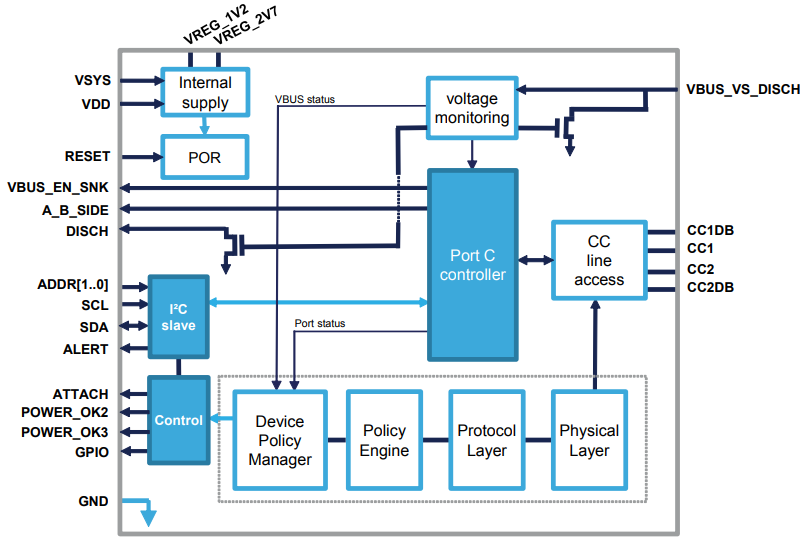
Functional block diagram
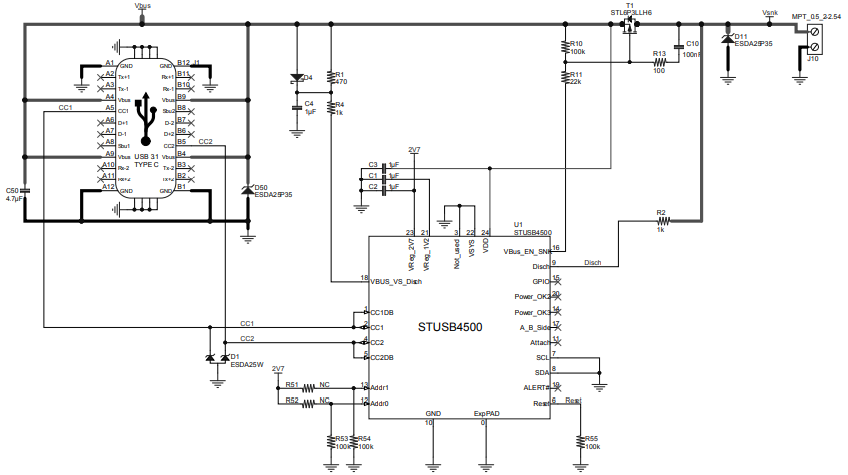
STUSB4500 schematic
Parts with Similar Specs
STUSB4500 Applications
● Printers, camcorders, cameras
● IoT, drones, accessories and battery powered devices
● LED lighting and industrial
● Toys, gaming, POS, scanner
● Healthcare and handheld devices
● Any Type-C sink device
STUSB4500 Typical Application
The following figure is the diagram of STUSB4500 Typical Application.
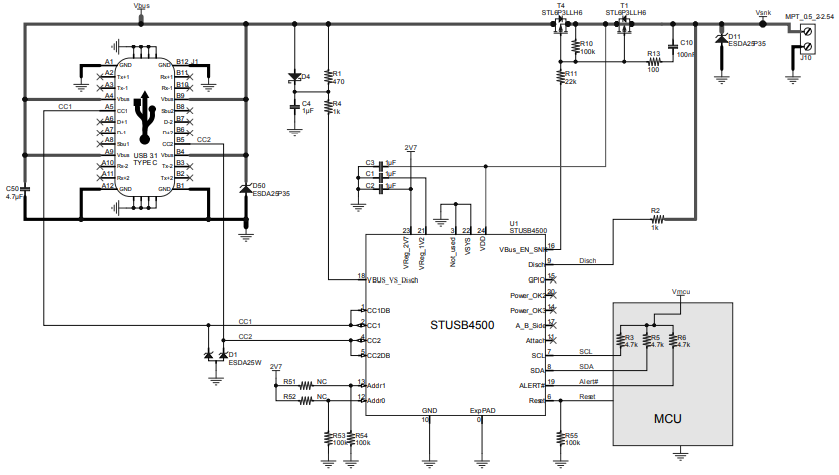
Typical schematic with MCU
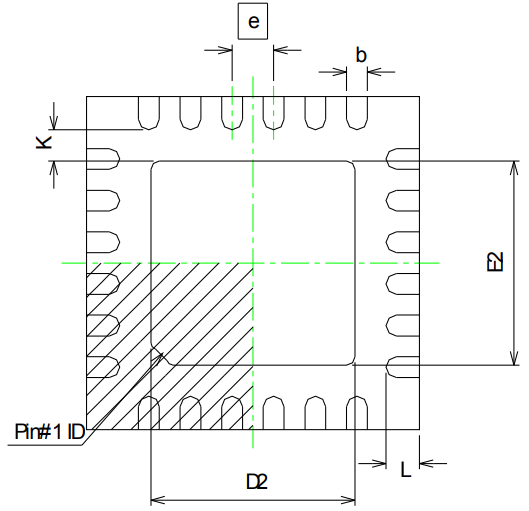
STUSB4500 Package
The following diagram shows the STUSB4500 package.

Top View
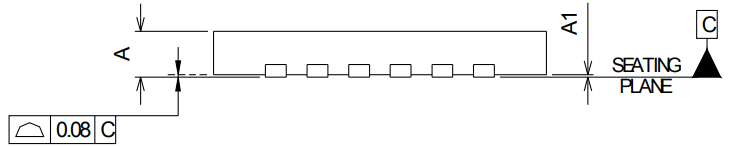
Side View
Bottom View
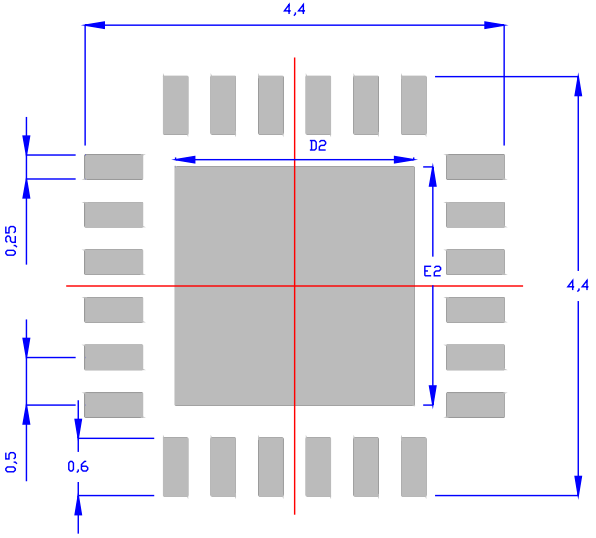
STUSB4500 Recommended Footprint
The following is the Recommended Footprint of STUSB4500.
QFN-24 EP (4x4) recommended footprint
STUSB4500 Manufacturer
STMicroelectronics is a global independent semiconductor company and is a leader in developing and delivering semiconductor solutions across the spectrum of microelectronics applications. An unrivaled combination of silicon and system expertise, manufacturing strength, Intellectual Property (IP) portfolio and strategic partners positions the Company at the forefront of System-on-Chip (SoC) technology and its products play a key role in enabling today's convergence trends.
Trend Analysis
Datasheet PDF
- Datasheets :
Is the STUSB4500 an ideal controller for autonomous systems?
Combined with its capability to negotiate directly a power contract, the STUSB4500 is the ideal controller device for autonomous systems requiring high power charging profile to be fully operational.
Can STUSB4500 equipment withstand high voltage?
The STUSB4500 can be safely used in systems or connected to systems that handle high voltage on the VBUS power path. The device integrates an internal circuitry on the CC pins that tolerates high voltage and ensures protection up to 22 V in case of unexpected short-circuits with the VBUS.
Does the STUSB4500 handle pre-determined hardware failures during system operation?
The STUSB4500 handles during system operation some pre-identified hardware fault conditions. When such conditions happen, the circuit goes into a transient error recovery state named ErrorRecovery in the Type-C FSM as defined in the USB Type-C standard specifications.
 Overcoming EMI and Power Noise with LTM8065: A Silent Switcher µModule Deep Dive
10 April 2026351
 MAX3232ESE+ transceiver:Pinout, Specification, Datasheet
19 May 20212382
 AP7313 Linear Regulator: Pinout, Features and Datasheet
11 April 20221287
 TL081 Single Op-Amp : Pinout, Application and Datasheet
23 July 202110919
 AS6C62256 CMOS SRAM: Features, Pinout and Datasheet
24 February 20226120
 LT3750 Capacitor Charger Controller: Datasheet, Circuit, Equivalent
13 October 20212703
 AT28C64 64K Parallel EEPROM: Pinout, Equivalent and Datasheet
22 April 20222791
![LM3524 Regulating Pulse Width Modulator: Pinout, LM3524 vs. SG3524 [Video]](https://res.utmel.com/Images/Article/e463ae26-8c33-42d9-b1a4-5d493bc8cf87.jpg) LM3524 Regulating Pulse Width Modulator: Pinout, LM3524 vs. SG3524 [Video]
LM3524 Regulating Pulse Width Modulator: Pinout, LM3524 vs. SG3524 [Video]22 December 20223336
 Sourcing GaN Power Devices for AI Servers, EVs, and Industrial Applications
10 July 2026368
 Yahoo Discontinues Services in Mainland China
13 November 20232858
 What is a USB Flash Drive?
25 May 20213713
 What is Chip: Definition, Classification and Design Process
17 January 20267736
 Detailed Introduction of the Chip Design Process
21 December 202118696
 What is a Printed Circuit Board?
22 April 20218150
 What is a Schmitt Trigger?
09 December 20219097
 Commonly Used Circuit Protection Components: How to Match the Right Device to Each Threat
14 July 20267022
STMicroelectronics
In Stock: 30266
United States
China
Canada
Japan
Russia
Germany
United Kingdom
Singapore
Italy
Hong Kong(China)
Taiwan(China)
France
Korea
Mexico
Netherlands
Malaysia
Austria
Spain
Switzerland
Poland
Thailand
Vietnam
India
United Arab Emirates
Afghanistan
Åland Islands
Albania
Algeria
American Samoa
Andorra
Angola
Anguilla
Antigua & Barbuda
Argentina
Armenia
Aruba
Australia
Azerbaijan
Bahamas
Bahrain
Bangladesh
Barbados
Belarus
Belgium
Belize
Benin
Bermuda
Bhutan
Bolivia
Bonaire, Sint Eustatius and Saba
Bosnia & Herzegovina
Botswana
Brazil
British Indian Ocean Territory
British Virgin Islands
Brunei
Bulgaria
Burkina Faso
Burundi
Cabo Verde
Cambodia
Cameroon
Cayman Islands
Central African Republic
Chad
Chile
Christmas Island
Cocos (Keeling) Islands
Colombia
Comoros
Congo
Congo (DRC)
Cook Islands
Costa Rica
Côte d’Ivoire
Croatia
Cuba
Curaçao
Cyprus
Czechia
Denmark
Djibouti
Dominica
Dominican Republic
Ecuador
Egypt
El Salvador
Equatorial Guinea
Eritrea
Estonia
Eswatini
Ethiopia
Falkland Islands
Faroe Islands
Fiji
Finland
French Guiana
French Polynesia
Gabon
Gambia
Georgia
Ghana
Gibraltar
Greece
Greenland
Grenada
Guadeloupe
Guam
Guatemala
Guernsey
Guinea
Guinea-Bissau
Guyana
Haiti
Honduras
Hungary
Iceland
Indonesia
Iran
Iraq
Ireland
Isle of Man
Israel
Jamaica
Jersey
Jordan
Kazakhstan
Kenya
Kiribati
Kosovo
Kuwait
Kyrgyzstan
Laos
Latvia
Lebanon
Lesotho
Liberia
Libya
Liechtenstein
Lithuania
Luxembourg
Macao(China)
Madagascar
Malawi
Maldives
Mali
Malta
Marshall Islands
Martinique
Mauritania
Mauritius
Mayotte
Micronesia
Moldova
Monaco
Mongolia
Montenegro
Montserrat
Morocco
Mozambique
Myanmar
Namibia
Nauru
Nepal
New Caledonia
New Zealand
Nicaragua
Niger
Nigeria
Niue
Norfolk Island
North Korea
North Macedonia
Northern Mariana Islands
Norway
Oman
Pakistan
Palau
Palestinian Authority
Panama
Papua New Guinea
Paraguay
Peru
Philippines
Pitcairn Islands
Portugal
Puerto Rico
Qatar
Réunion
Romania
Rwanda
Samoa
San Marino
São Tomé & Príncipe
Saudi Arabia
Senegal
Serbia
Seychelles
Sierra Leone
Sint Maarten
Slovakia
Slovenia
Solomon Islands
Somalia
South Africa
South Sudan
Sri Lanka
St Helena, Ascension, Tristan da Cunha
St. Barthélemy
St. Kitts & Nevis
St. Lucia
St. Martin
St. Pierre & Miquelon
St. Vincent & Grenadines
Sudan
Suriname
Svalbard & Jan Mayen
Sweden
Syria
Tajikistan
Tanzania
Timor-Leste
Togo
Tokelau
Tonga
Trinidad & Tobago
Tunisia
Turkey
Turkmenistan
Turks & Caicos Islands
Tuvalu
U.S. Outlying Islands
U.S. Virgin Islands
Uganda
Ukraine
Uruguay
Uzbekistan
Vanuatu
Vatican City
Venezuela
Wallis & Futuna
Yemen
Zambia
Zimbabwe
![STUSB4710QTR]() STUSB4710QTR
STUSB4710QTRSTMicroelectronics
![SERC816]() SERC816
SERC816STMicroelectronics
![STUSB4710AQTR]() STUSB4710AQTR
STUSB4710AQTRSTMicroelectronics
![SERC816/TR]() SERC816/TR
SERC816/TRSTMicroelectronics
![ST202CW]() ST202CW
ST202CWSTMicroelectronics
![STE10/100A]() STE10/100A
STE10/100ASTMicroelectronics
![L9997ND]() L9997ND
L9997NDSTMicroelectronics
![VN800S]() VN800S
VN800SSTMicroelectronics
![ST3485ECD]() ST3485ECD
ST3485ECDSTMicroelectronics
![ST232EAW]() ST232EAW
ST232EAWSTMicroelectronics


