

 Product
 Brand
Brand Articles
 Tools
Tools
TSOP1738 IR Receiver: Pinout, Equivalent and Datasheet pdf

TSOP1738 datasheet pdf and Unclassified product details from VISHAY INTERTECHNOLOGY INC stock available at Utmel


TSOP1738 is an IR receiver with an amplifier that acts as a switch and converter within a circuit. This post mainly covers pinout, datasheet, equivalent, circuit, and other details about the TSOP1738 IR receiver. Furthermore, there is a huge range of semiconductors, capacitors, resistors, and ICs in stock. Welcome your RFQ!

What Is TSOP 1738 | TSOP 1738 Working Principle | Wow Electric
TSOP1738 Pinout
The TSOP1738 is merely an IR receiver that also serves as a switch. It just has three pins that connect TSOP to other devices and let it communicate wirelessly.

TSOP1738 Pinout
| Pin Number | Pin Name | Description |
| 1 | Ground | Connected to the Ground of the circuit |
| 2 | Vcc | Typically connected to +5V, a maximum of 6V can be given |
| 3 | Signal | The signal pin gives out the sequence based on the IR signal detected |
Overview of TSOP1738
TSOP1738 is an IR receiver with an amplifier that acts as a switch and converter within a circuit. It has a single input and output that only reacts to the input IR signal. The TSOP1738's main function is to convert IR impulses to electric signals. Every IR receiver operates on a specific frequency. TSOP1738 operates on a 38 kHz IR frequency. It may act owing to a current leakage or other problems if the frequency is higher or lower, but it will not fully perform. It employs silicon-based technology, which operates on a micro-scale and is extremely sensitive and efficient in its activities.
TSOP1738 CAD Model
Symbol

TSOP1738 Symbol
Footprint

TSOP1738 Footprint
TSOP1738 Specifications
Supply Voltage: 5 V
Power consumption: 0.4 to 1.0 mA
Min. Ee irradiation: 0.35 mW/m2 typ.
Angle of detection: 90
Dimensions of the casing (mm): 12.5 x 10 x Thickness 5.8
Temperature range: -25 C to +85 C
TSOP1738 Features
Photodetector and preamplifier in one package
Internal filter for PCM frequency
Improved shielding against electrical field disturbance
TTL and CMOS compatibility
Output active low
Low power consumption
High immunity against ambient light
Continuous data transmission possible (up to 2400 bps)
Suitable burst length 10 cycles/burst
Equivalents for TSOP1738
SM0038, TSOP-17XX
TSOP1738 Applications
Receive IR signals
Decode Remote signals
IR Remote tester circuits
IR Remote tester circuits
Analyze, re-create or duplicate remote Signals
Wireless control applications
Receiver circuit for IR remote controls
Where to Use TSOP1738
The TSOP sensor can read output signals from home remotes such as TV remotes, home theater remotes, and air conditioning remotes, among others. All of these remote controls will operate at a frequency of 38 kHz, and this IC will be able to take up any IR signals, process them, and output them on pin 3. So, if you need a sensor to analyze, re-create, or mimic the functionalities of remote control, this IC is the one for you.
Keep in mind that the TSOP-1738 series will only receive 38 kHz IR signals. In India, all remote controls operate at 38 kHz; please check to see if this is the case in your country.
How to Test TSOP1738

TSOP1738 Pin Circuit
With the help of a resistor and ground pin 1, provide electricity to pin 2. Set your multimeter to 20V in the voltage range. Now connect your multimeter's positive terminal to pin 3 of the TSOP1738 and ground the other end of the multimeter. When you click any button on the remote, the multimeter reading will change. If this occurs, you can assume that your TSOP1738 is responding to a frequency of 38 kHz.
My circuit started operating after I updated the TSOP. As a result, always double-check your component before mounting it, as the name of the component may not be printed on it, which can spend your time troubleshooting.
How does TSOP1738 Work?

TSOP1738 Block Diagram
AGE
Internal components can be seen clearly in the block diagram, but the use of each component is a reason. Although an IR receiver can work on its own, other components in the TSOP make it smart and secure. The IR is connected to the AGC first (Automatic Gain Control). Different sorts of input signals from the IR receiver are amplified using AGC. The output of the AGC is then sent to the Bandpass filter.
Band Pass Filter
In TSOP, the bandpass filter serves various purposes. It converts incoming analog signals to digital output levels before sending them to the demodulator. Because it is common and can be found anywhere, the combination of AGC and bandpass allows it to avoid any ambient light, particularly sunshine. Even though the device has built-in sun protection, the company recommended that it be used at a closer range. Weather changes can sometimes impact the amount of sunshine available, which can affect TSOP transmission. The bandpass filter additionally restricts the IC's operation to a certain frequency of 38 kHz.
Demodulator
On one end, the demodulator is connected to the NPN transistor, and on the other, to the Band Pass Filter. The bandpass filter's output data will be fed into the demodulator, which will use low input signals to operate the NPN transistor. On the collector side, the NPN transistor is directly connected to the power and output, and on the emitter side, it is directly connected to the ground. Every low signal disables the NPN transistor, allowing power to flow to the output pin.
TSOP1738 Package Dimension

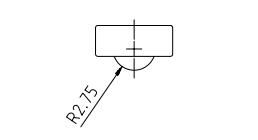
TSOP1738 Package Dimension
TSOP1738 Manufacturer
Vishay Intertechnology is a leading manufacturer famous for its discrete semiconductors and passive electronic components. It has grown rapidly through the acquisition of top names such as Vishay has grown acquisitions to include such top names as Dale, Sfernice, Draloric, etc. Their portfolio brand represents an unmatched collection of discrete semiconductors and passive electronic components.
How do I know if TSOP1738 is working?
Give power supply to pin 2 with the help of resistor and ground pin 1. Set your multimeter in the voltage range at 20V. Now put the positive terminal of your multimeter on pin 3 of TSOP1738 and ground the other end of a multimeter. Now, whenever you press any button on the remote you will see the variation in multimeter reading.
What is the use of TSOP1738?
TSOP1738 is an IR receiver with an amplifier that acts as a switch and converter within a circuit. It has one input and output which only acts on the base of the input IR signal. The basic purpose of TSOP1738 is to convert the IR signal to electric signals
 How to Access the STM32G071RBT6 Datasheet from STMicroelectronics
16 June 2025551
 LM741CM Operational Amplifier: Datasheet, Schematic Diagram, and Applications
31 August 20217103
 7815 Voltage Regulator: 15V Voltage Regulator, 7815 Pinout, Datasheet
14 January 202231855
![282080-1 Rectangular Connectors Housings CONN PLUG BLACK[Video]: Datasheet, Features, and Drawings](https://res.utmel.com/Images/Article/61199823-de3e-4a6f-a253-0628aba362d6.jpg) 282080-1 Rectangular Connectors Housings CONN PLUG BLACK[Video]: Datasheet, Features, and Drawings
282080-1 Rectangular Connectors Housings CONN PLUG BLACK[Video]: Datasheet, Features, and Drawings29 March 20223368
 AS3935 Lightning Sensor: AS3935 Arduino, Pinout, Datasheet
07 July 20213687
 AD8512 Dual Op-Amp: Low Noise, High Precision for Audio & Medical Applications
05 July 2025308
 Arduino Uno Rev3: Pinout Diagram, Features and Applications
26 September 202317457
 STM32F030F4P6 Microcontrollers: Scheme, Pinout, and Datasheet
17 November 202110061
 What are Proximity Sensors?
24 October 20258861
 What is a Piezoelectric Sensor?
26 August 202017963
 What Is a Decoupling Capacitor? Function, Placement, and Selection Guide
14 July 202613886
 Neuromorphic Chips in AI: Silicon Architecture, Spiking Neural Networks, and Hardware Performance
07 September 2026251
 Unveiling the Potential of GaN Semiconductor-Enabled Three-Phase Propulsion Inverters for Enhanced EV Performance
09 August 20231731
 The Introduction to Common Tools and Using Methods of Fiber Optic
07 January 20227459
 7 Common Functions of MOSFET Gate Circuits
22 January 20227648
 How to Design a High-precision ADC?
13 December 20212704
VISHAY INTERTECHNOLOGY INC
In Stock: 1750
United States
China
Canada
Japan
Russia
Germany
United Kingdom
Singapore
Italy
Hong Kong(China)
Taiwan(China)
France
Korea
Mexico
Netherlands
Malaysia
Austria
Spain
Switzerland
Poland
Thailand
Vietnam
India
United Arab Emirates
Afghanistan
Åland Islands
Albania
Algeria
American Samoa
Andorra
Angola
Anguilla
Antigua & Barbuda
Argentina
Armenia
Aruba
Australia
Azerbaijan
Bahamas
Bahrain
Bangladesh
Barbados
Belarus
Belgium
Belize
Benin
Bermuda
Bhutan
Bolivia
Bonaire, Sint Eustatius and Saba
Bosnia & Herzegovina
Botswana
Brazil
British Indian Ocean Territory
British Virgin Islands
Brunei
Bulgaria
Burkina Faso
Burundi
Cabo Verde
Cambodia
Cameroon
Cayman Islands
Central African Republic
Chad
Chile
Christmas Island
Cocos (Keeling) Islands
Colombia
Comoros
Congo
Congo (DRC)
Cook Islands
Costa Rica
Côte d’Ivoire
Croatia
Cuba
Curaçao
Cyprus
Czechia
Denmark
Djibouti
Dominica
Dominican Republic
Ecuador
Egypt
El Salvador
Equatorial Guinea
Eritrea
Estonia
Eswatini
Ethiopia
Falkland Islands
Faroe Islands
Fiji
Finland
French Guiana
French Polynesia
Gabon
Gambia
Georgia
Ghana
Gibraltar
Greece
Greenland
Grenada
Guadeloupe
Guam
Guatemala
Guernsey
Guinea
Guinea-Bissau
Guyana
Haiti
Honduras
Hungary
Iceland
Indonesia
Iran
Iraq
Ireland
Isle of Man
Israel
Jamaica
Jersey
Jordan
Kazakhstan
Kenya
Kiribati
Kosovo
Kuwait
Kyrgyzstan
Laos
Latvia
Lebanon
Lesotho
Liberia
Libya
Liechtenstein
Lithuania
Luxembourg
Macao(China)
Madagascar
Malawi
Maldives
Mali
Malta
Marshall Islands
Martinique
Mauritania
Mauritius
Mayotte
Micronesia
Moldova
Monaco
Mongolia
Montenegro
Montserrat
Morocco
Mozambique
Myanmar
Namibia
Nauru
Nepal
New Caledonia
New Zealand
Nicaragua
Niger
Nigeria
Niue
Norfolk Island
North Korea
North Macedonia
Northern Mariana Islands
Norway
Oman
Pakistan
Palau
Palestinian Authority
Panama
Papua New Guinea
Paraguay
Peru
Philippines
Pitcairn Islands
Portugal
Puerto Rico
Qatar
Réunion
Romania
Rwanda
Samoa
San Marino
São Tomé & Príncipe
Saudi Arabia
Senegal
Serbia
Seychelles
Sierra Leone
Sint Maarten
Slovakia
Slovenia
Solomon Islands
Somalia
South Africa
South Sudan
Sri Lanka
St Helena, Ascension, Tristan da Cunha
St. Barthélemy
St. Kitts & Nevis
St. Lucia
St. Martin
St. Pierre & Miquelon
St. Vincent & Grenadines
Sudan
Suriname
Svalbard & Jan Mayen
Sweden
Syria
Tajikistan
Tanzania
Timor-Leste
Togo
Tokelau
Tonga
Trinidad & Tobago
Tunisia
Turkey
Turkmenistan
Turks & Caicos Islands
Tuvalu
U.S. Outlying Islands
U.S. Virgin Islands
Uganda
Ukraine
Uruguay
Uzbekistan
Vanuatu
Vatican City
Venezuela
Wallis & Futuna
Yemen
Zambia
Zimbabwe