

 Product
 Brand
Brand Articles
 Tools
Tools
LM6172 Voltage Feedback Amplifier: Pinout, Application and Datasheet


1.2μA Instrumentational OP Amps 5.5V~36V ±2.75V~18V 8-DIP (0.300, 7.62mm)
The LM6172 is a dual high-speed, low power, voltage feedback amplifier. It is unity-gain stable and offers outstanding performance with only 2.3mA of supply current per channel. Furthermore, Huge range of Semiconductors, Capacitors, Resistors and IcS in stock. Welcome RFQ.
LM6172 Pinout

Pinout
LM6172 CAD Model

Symbol
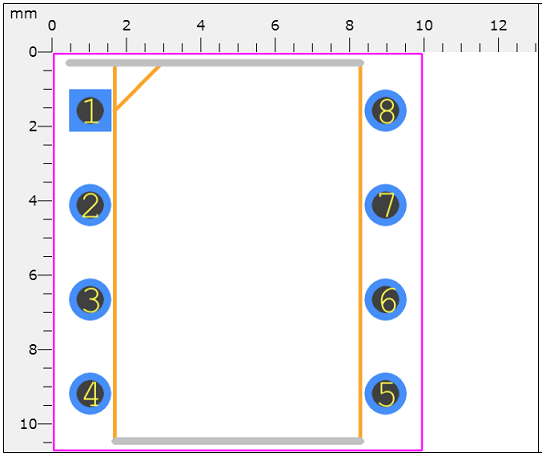
Footprint
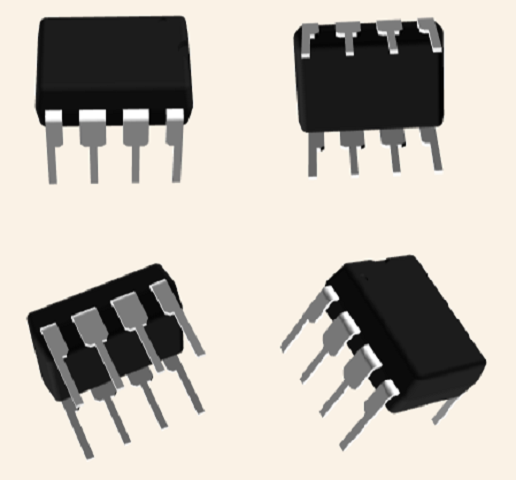
3D Model
LM6172 Overview
The LM6172 is a dual high speed voltage feedback amplifier. It is unity-gain stable and provides excellent DC and AC performance. With 100MHz unity-gain bandwidth, 3000V/μs slew rate and 50mA of output current per channel, the LM6172 offers high performance in dual amplifiers; yet it only consumes 2.3mA of supply current each channel.
The LM6172 operates on ±15V power supply for systems requiring large voltage swings, such as ADSL, scanners and ultrasound equipment. It is also specified at ±5V power supply for low voltage applications such as portable video systems. The LM6172 is built with TI's advanced VIP III (Vertically Integrated PNP) complementary bipolar process.
This article provides you with a basic overview of the LM6172 Voltage Feedback Amplifier, including its pin descriptions, features and specifications, etc., to help you quickly understand what LM6172 is.
LM6172 Features
● (Typical Unless Otherwise Noted)
● Easy to Use Voltage Feedback Topology
● High Slew Rate 3000V/μs
● Wide Unity-Gain Bandwidth 100MHz
● Low Supply Current 2.3mA/Channel
● High Output Current 50mA/channel
● Specified for ±15V and ±5V Operation
LM6172 Advantage
The LM6172 is a dual high-speed, low power, voltage feedback amplifier. It is unity-gain stable and offers outstanding performance with only 2.3mA of supply current per channel. The combination of 100MHz unity-gain bandwidth, 3000V/μs slew rate, 50mA per channel output current and other attractive features makes it easy to implement the LM6172 in various applications. Quiescent power of the LM6172 is 138mW operating at ±15V supply and 46mW at ±5V supply.
The slew rate of LM6172 is determined by the current available to charge and discharge an internal high impedance node capacitor. This current is the differential input voltage divided by the total degeneration resistor RE. Therefore, the slew rate is proportional to the input voltage level, and the higher slew rates are achievable in the lower gain configurations. When a very fast large signal pulse is applied to the input of an amplifier, some overshoot or undershoot occurs. By placing an external series resistor such as 1kΩ to the input of LM6172, the slew rate is reduced to help lower the overshoot, which reduces settling time.
The LM6172 has a very fast slew rate that causes overshoot and undershoot. To reduce settling time on LM6172, a 1kΩ resistor can be placed in series with the input signal to decrease slew rate. A feedback capacitor can also be used to reduce overshoot and undershoot. This feedback capacitor serves as a zero to increase the stability of the amplifier circuit. A 2pF feedback capacitor is recommended for initial evaluation. When the LM6172 is configured as a buffer, a feedback resistor of 1kΩ must be added in parallel to the feedback capacitor.
Specifications
- TypeParameter
- Package / Case
refers to the protective housing that encases an electronic component, providing mechanical support, electrical connections, and thermal management.
8-DIP (0.300, 7.62mm) - Mounting Type
The "Mounting Type" in electronic components refers to the method used to attach or connect a component to a circuit board or other substrate, such as through-hole, surface-mount, or panel mount.
Through Hole - Supplier Device Package
The parameter "Supplier Device Package" in electronic components refers to the physical packaging or housing of the component as provided by the supplier. It specifies the form factor, dimensions, and layout of the component, which are crucial for compatibility and integration into electronic circuits and systems. The supplier device package information typically includes details such as the package type (e.g., DIP, SOP, QFN), number of pins, pitch, and overall size, allowing engineers and designers to select the appropriate component for their specific application requirements. Understanding the supplier device package is essential for proper component selection, placement, and soldering during the manufacturing process to ensure optimal performance and reliability of the electronic system.
8-PDIP - Frequency - Gain Bandwidth Product (GBP)100MHz
- Series
In electronic components, the "Series" refers to a group of products that share similar characteristics, designs, or functionalities, often produced by the same manufacturer. These components within a series typically have common specifications but may vary in terms of voltage, power, or packaging to meet different application needs. The series name helps identify and differentiate between various product lines within a manufacturer's catalog.
VIP™ III - Packaging
Semiconductor package is a carrier / shell used to contain and cover one or more semiconductor components or integrated circuits. The material of the shell can be metal, plastic, glass or ceramic.
Tube - Operating Temperature
The operating temperature is the range of ambient temperature within which a power supply, or any other electrical equipment, operate in. This ranges from a minimum operating temperature, to a peak or maximum operating temperature, outside which, the power supply may fail.
-40°C~85°C - Part Status
Parts can have many statuses as they progress through the configuration, analysis, review, and approval stages.
Obsolete - Moisture Sensitivity Level (MSL)
Moisture Sensitivity Level (MSL) is a standardized rating that indicates the susceptibility of electronic components, particularly semiconductors, to moisture-induced damage during storage and the soldering process, defining the allowable exposure time to ambient conditions before they require special handling or baking to prevent failures
1 (Unlimited) - Number of Circuits2
- Current - Supply
Current - Supply is a parameter in electronic components that refers to the maximum amount of electrical current that the component can provide to the circuit it is connected to. It is typically measured in units of amperes (A) and is crucial for determining the power handling capability of the component. Understanding the current supply rating is important for ensuring that the component can safely deliver the required current without overheating or failing. It is essential to consider this parameter when designing circuits to prevent damage to the component and ensure proper functionality of the overall system.
4.6mA - Slew Rate
the maximum rate of output voltage change per unit time.
3000V/μs - Amplifier Type
Amplifier Type refers to the classification or categorization of amplifiers based on their design, functionality, and characteristics. Amplifiers are electronic devices that increase the amplitude of a signal, such as voltage or current. The type of amplifier determines its specific application, performance capabilities, and operating characteristics. Common types of amplifiers include operational amplifiers (op-amps), power amplifiers, audio amplifiers, and radio frequency (RF) amplifiers. Understanding the amplifier type is crucial for selecting the right component for a particular circuit or system design.
Voltage Feedback - Current - Input Bias
The parameter "Current - Input Bias" in electronic components refers to the amount of current required at the input terminal of a device to maintain proper operation. It is a crucial specification as it determines the minimum input current needed for the component to function correctly. Input bias current can affect the performance and accuracy of the device, especially in precision applications where small signal levels are involved. It is typically specified in datasheets for operational amplifiers, transistors, and other semiconductor devices to provide users with important information for circuit design and analysis.
1.2μA - Voltage - Supply, Single/Dual (±)
The parameter "Voltage - Supply, Single/Dual (±)" in electronic components refers to the power supply voltage required for the proper operation of the component. This parameter indicates whether the component requires a single power supply voltage (e.g., 5V) or a dual power supply voltage (e.g., ±15V). For components that require a single power supply voltage, only one voltage level is needed for operation. On the other hand, components that require a dual power supply voltage need both positive and negative voltage levels to function correctly.Understanding the voltage supply requirements of electronic components is crucial for designing and integrating them into circuits to ensure proper functionality and prevent damage due to incorrect voltage levels.
5.5V~36V ±2.75V~18V - Voltage - Input Offset
Voltage - Input Offset is a parameter that refers to the difference in voltage between the input terminals of an electronic component, such as an operational amplifier, when the input voltage is zero. It is an important characteristic that can affect the accuracy and performance of the component in various applications. A low input offset voltage is desirable as it indicates that the component will have minimal error in its output when the input signal is near zero. Manufacturers typically provide this specification in the component's datasheet to help users understand the component's behavior and make informed decisions when designing circuits.
400μV - Current - Output / Channel
The parameter "Current - Output / Channel" in electronic components refers to the maximum amount of current that can be delivered by a single output channel of the component. This specification is important for determining the capacity of the component to drive external loads such as motors, LEDs, or other devices. It is typically expressed in units of amperes (A) and indicates the maximum current that can be safely drawn from the output channel without causing damage to the component. Designers and engineers use this parameter to ensure that the component can provide sufficient current to meet the requirements of the connected load while operating within its specified limits.
90mA - -3db Bandwidth
The "-3dB bandwidth" of an electronic component refers to the frequency range over which the component's output signal power is reduced by 3 decibels (dB) compared to its maximum output power. This parameter is commonly used to describe the frequency response of components such as amplifiers, filters, and other signal processing devices. The -3dB point is significant because it represents the half-power point, where the output signal power is reduced to half of its maximum value. Understanding the -3dB bandwidth is important for designing and analyzing electronic circuits to ensure that signals are accurately processed within the desired frequency range.
160MHz - RoHS Status
RoHS means “Restriction of Certain Hazardous Substances” in the “Hazardous Substances Directive” in electrical and electronic equipment.
Non-RoHS Compliant
LM6172 Functional Block Diagram

Connection Diagram
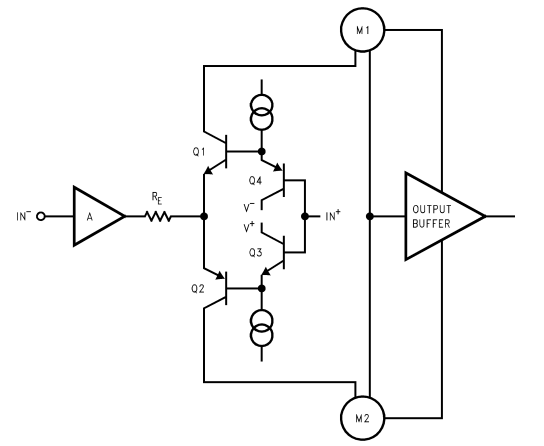
LM6172 Simplified Schematic (Each Amplifier)
Parts with Similar Specs
LM6172 Application
● Scanner I-to-V Converters
● ADSL/HDSL Drivers
● Multimedia Broadcast Systems
● Video Amplifiers
● NTSC, PAL and SECAM Systems
● ADC/DAC Buffers
● Pulse Amplifiers and Peak Detectors
LM6172 Application Circuits
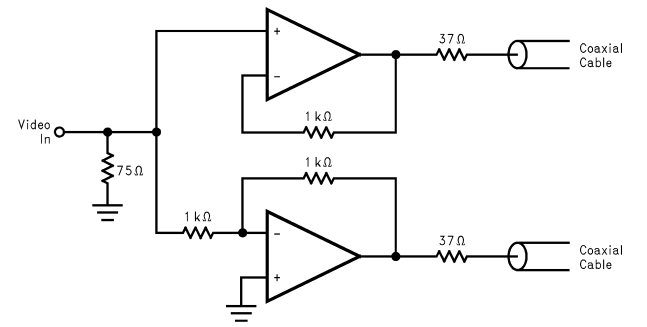
Differential Line Driver
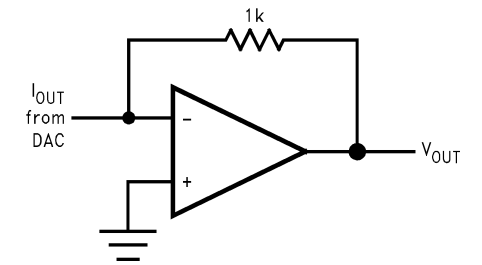
I-to-V Converters
LM6172 Manufacturer
Rochester Electronics ranks a global leading semiconductor provider. Due to their products' characteristics of high quality and durability, these products are suitable for long-term production and maintenance in the fields of industry, transportation and high-reliability markets. Their large inventory including more than 100,000 products and 15 billion units, making them exceed other companies in terms of selection, capacibilities, or solutions.
Datasheet PDF
- Datasheets :
What is the essential property of the LM6172?
The LM6172 is a dual high speed voltage feedback amplifier. It is unity-gain stable and provides excellent DC and AC performance.
What determines the conversion rate of LM6172?
The slew rate of LM6172 is determined by the current available to charge and discharge an internal high impedance node capacitor.
The LM6172 has a very fast slew rate, will it cause any problems?
The LM6172 has a very fast slew rate that causes overshoot and undershoot. To reduce settling time on LM6172, a 1kΩ resistor can be placed in series with the input signal to decrease slew rate.
 TDA2004 Stereo Amplifier: Circuit, Datasheet, Working
10 November 202114019
 AV101KE Through Hole Resistor: Datasheet, Application, Features
30 July 2021978
 BF245 Transistors: Replacement, Pinout and Datasheet
02 September 202117643
 ADG1408 Multiplexer: Datasheet, Circuit and Price
12 November 20214328
 ADG608BN Multiplexers: Feature, Circuit, Datasheet
26 May 2021980
 STM32F207 Microcontroller: Features, Datasheet and Pinout
06 December 20216056
![KSZ8081MNXCA 10BASE-T/100BASE-TX Physical Layer Transceiver[FAQ]: Datasheet, Features, and Pinout](https://res.utmel.com/Images/Article/0e97f563-2d35-4876-a8e2-c19212086fdd.jpg) KSZ8081MNXCA 10BASE-T/100BASE-TX Physical Layer Transceiver[FAQ]: Datasheet, Features, and Pinout
KSZ8081MNXCA 10BASE-T/100BASE-TX Physical Layer Transceiver[FAQ]: Datasheet, Features, and Pinout22 March 2022446
 STM32U575VGT6 Price Trends 2025: Best Buying Strategies & Vendor Comparison
05 July 2025436
 HF PCB Circuit Design 10 Questions
16 March 20225460
![Comprehensive Guide to Car Chips [FAQs]](https://res.utmel.com/Images/Article/e686e156-9363-4bbc-b1fd-c44fbe3ecbda.jpg) Comprehensive Guide to Car Chips [FAQs]
Comprehensive Guide to Car Chips [FAQs]11 January 20226512
 What are Smart Sensors?
27 October 20253836
 How to Choose MOSFET for Switching Power Supply?
02 March 20229191
 What are Resonators?
07 January 202618086
 What is an LTPO Display?
08 October 20219213
 What is Time Delay Relay?
18 December 202516889
 Introduction to EPROM and EEPROM
08 January 202619052
Rochester Electronics, LLC
In Stock
United States
China
Canada
Japan
Russia
Germany
United Kingdom
Singapore
Italy
Hong Kong(China)
Taiwan(China)
France
Korea
Mexico
Netherlands
Malaysia
Austria
Spain
Switzerland
Poland
Thailand
Vietnam
India
United Arab Emirates
Afghanistan
Åland Islands
Albania
Algeria
American Samoa
Andorra
Angola
Anguilla
Antigua & Barbuda
Argentina
Armenia
Aruba
Australia
Azerbaijan
Bahamas
Bahrain
Bangladesh
Barbados
Belarus
Belgium
Belize
Benin
Bermuda
Bhutan
Bolivia
Bonaire, Sint Eustatius and Saba
Bosnia & Herzegovina
Botswana
Brazil
British Indian Ocean Territory
British Virgin Islands
Brunei
Bulgaria
Burkina Faso
Burundi
Cabo Verde
Cambodia
Cameroon
Cayman Islands
Central African Republic
Chad
Chile
Christmas Island
Cocos (Keeling) Islands
Colombia
Comoros
Congo
Congo (DRC)
Cook Islands
Costa Rica
Côte d’Ivoire
Croatia
Cuba
Curaçao
Cyprus
Czechia
Denmark
Djibouti
Dominica
Dominican Republic
Ecuador
Egypt
El Salvador
Equatorial Guinea
Eritrea
Estonia
Eswatini
Ethiopia
Falkland Islands
Faroe Islands
Fiji
Finland
French Guiana
French Polynesia
Gabon
Gambia
Georgia
Ghana
Gibraltar
Greece
Greenland
Grenada
Guadeloupe
Guam
Guatemala
Guernsey
Guinea
Guinea-Bissau
Guyana
Haiti
Honduras
Hungary
Iceland
Indonesia
Iran
Iraq
Ireland
Isle of Man
Israel
Jamaica
Jersey
Jordan
Kazakhstan
Kenya
Kiribati
Kosovo
Kuwait
Kyrgyzstan
Laos
Latvia
Lebanon
Lesotho
Liberia
Libya
Liechtenstein
Lithuania
Luxembourg
Macao(China)
Madagascar
Malawi
Maldives
Mali
Malta
Marshall Islands
Martinique
Mauritania
Mauritius
Mayotte
Micronesia
Moldova
Monaco
Mongolia
Montenegro
Montserrat
Morocco
Mozambique
Myanmar
Namibia
Nauru
Nepal
New Caledonia
New Zealand
Nicaragua
Niger
Nigeria
Niue
Norfolk Island
North Korea
North Macedonia
Northern Mariana Islands
Norway
Oman
Pakistan
Palau
Palestinian Authority
Panama
Papua New Guinea
Paraguay
Peru
Philippines
Pitcairn Islands
Portugal
Puerto Rico
Qatar
Réunion
Romania
Rwanda
Samoa
San Marino
São Tomé & Príncipe
Saudi Arabia
Senegal
Serbia
Seychelles
Sierra Leone
Sint Maarten
Slovakia
Slovenia
Solomon Islands
Somalia
South Africa
South Sudan
Sri Lanka
St Helena, Ascension, Tristan da Cunha
St. Barthélemy
St. Kitts & Nevis
St. Lucia
St. Martin
St. Pierre & Miquelon
St. Vincent & Grenadines
Sudan
Suriname
Svalbard & Jan Mayen
Sweden
Syria
Tajikistan
Tanzania
Timor-Leste
Togo
Tokelau
Tonga
Trinidad & Tobago
Tunisia
Turkey
Turkmenistan
Turks & Caicos Islands
Tuvalu
U.S. Outlying Islands
U.S. Virgin Islands
Uganda
Ukraine
Uruguay
Uzbekistan
Vanuatu
Vatican City
Venezuela
Wallis & Futuna
Yemen
Zambia
Zimbabwe
![ICL7621BCPA]() ICL7621BCPA
ICL7621BCPARochester Electronics, LLC
![LM614CWMX]() LM614CWMX
LM614CWMXRochester Electronics
![ICL7641CCPD]() ICL7641CCPD
ICL7641CCPDRochester Electronics, LLC
![ICL7650CPD]() ICL7650CPD
ICL7650CPDRochester Electronics, LLC
![MAX4200EUK-T]() MAX4200EUK-T
MAX4200EUK-TRochester Electronics, LLC
![MAX4183ESD]() MAX4183ESD
MAX4183ESDRochester Electronics, LLC
![LPC660AIMX]() LPC660AIMX
LPC660AIMXRochester Electronics
![MAX478ESA]() MAX478ESA
MAX478ESARochester Electronics, LLC
![MAX4164ESD T]() MAX4164ESD T
MAX4164ESD TRochester Electronics, LLC
![LM747H]() LM747H
LM747HRochester Electronics


