
 Product
 Brand
 Articles
 Tools

How to Audit STM32, STPOWER, and Analog Lines Before the Year-End Cutoff
For electronics manufacturing services (EMS) teams, original equipment manufacturers (OEMs), and independent procurement engineers, preparing for an STMicroelectronics price increase 2027 cycle requires separating verifiable supply-chain signals from unconfirmed market rumors. As of research on November 17, 2026 (Asia/Shanghai), no official STMicroelectronics press-room confirmation of a fourth 2026 price letter was found, and neither an official percentage increase nor an itemized list of affected part numbers (MPNs) has been published. Current industry reporting rests on a circulating customer notice reported as dated November 4, 2026[5] by Limchip (published in its November 11 Market Watch) and secondary trade coverage published by TrendForce on November 12, 2026, which reports that prices on selected ST products will rise effective January 1, 2027[2] due to persistent inflation and supply-chain cost pass-through.
Because STMicroelectronics executes segmented adjustments across product lines rather than publishing a single global price sheet, rushing blind year-end purchase orders can backfire—especially when STM32 lead time 2026 channel samples stretch across three to four quarters. Before pulling in orders ahead of the December 31 cutoff, procurement and component engineering teams should evaluate every active ST line item against a four-part commercial and technical decision framework.
Executive Takeaways & Pre-Audit Decision Framework
Known vs. Unconfirmed Baseline: Channel reports document three earlier ST price rounds in 2026 (effective April 26, June 28, and August 23), followed by the reported November 4 customer letter taking effect January 1, 2027. However, buyers must not assume a flat blanket percentage or project earlier round figures onto January 2027 without written confirmation from their franchised distributor or ST account representative.
Why Early-November Reviews Missed Round 4: Many procurement teams closed their 2027 standard cost rolls around the Electronica trade fair in early November, when widely circulated market alerts still stopped at ST's August 23 third round. This makes the November 4 notice a newer calendar event that requires a supplementary mid-November BOM audit.
Four Variables to Audit Before Pulling In Orders:
Quote Timestamp vs. ST's 2026 Calendar: Was your current contract or spot unit price established before or after ST's April 26, June 28, and August 23 adjustments?
Family Lead-Time Horizon: Does the part sit in a 40-to-52-week factory backlog window (sampled for mainstream MCUs and reported for certain power devices) or an approximately 26-week window (sampled for DC-DC converters)?
Contractual Invoicing Trigger: Does your supplier agreement lock unit pricing by the PO booking date, or does it re-price open backlog according to the shipment/dock date in 2027?
Year-End Rebate & SPA Expiration: Do your Special Pricing Agreements (SPAs) or distributor ship-and-debit authorizations expire on December 31, 2026, risking a simultaneous rebate loss and book-price reset on January 1?
What Is Known vs. Unconfirmed About ST's Fourth 2026 Price Letter (Effective January 1, 2027)
As of November 17, 2026, industry reporting on STMicroelectronics' January 1, 2027 price adjustment rests on a circulating customer notice reported as dated November 4, 2026 by Limchip and secondary trade coverage published by TrendForce on November 12, 2026. This represents ST's fourth reported price-adjustment cycle tied to the 2026 calendar—following rounds effective April 26, June 28, and August 23—citing persistent inflation alongside rising raw material, logistics, labor, and operating costs, while exact percentage amplitudes and affected MPN lists remain officially undisclosed.
Stated Cost Drivers and the 2026 Repricing Staircase
According to TrendForce's November 12, 2026 report, the circulating customer notice attributes the January 1, 2027 adjustment to ongoing inflationary pressure across raw materials, logistics, labor, and manufacturing operations. Rather than absorbing these upstream input increases, semiconductor suppliers have increasingly passed foundry, back-end outsourced semiconductor assembly and test (OSAT), and fab transition expenses down to the bill of materials—a structural pattern tracked throughout the year in Utmel's 2026 Semiconductor and Electronic Components Price Trends.
What makes STMicroelectronics' calendar unique for BOM managers is the frequency of its 2026 adjustments. Instead of a single annual reset, channel documentation shows four distinct notices spanning nine months:
Round 1: Notice dated March 24, 2026, effective April 26, 2026 across multiple product lines.
Round 2: Notice dated May 28, 2026, effective June 28, 2026 for selected product lines[6] (corroborated by SemiMedia and TrendForce).
Round 3: Notice dated July 23, 2026, effective August 23, 2026 across multiple product lines.
Round 4 (Reported): Customer letter reported as dated November 4, 2026, taking effect January 1, 2027 on selected products.
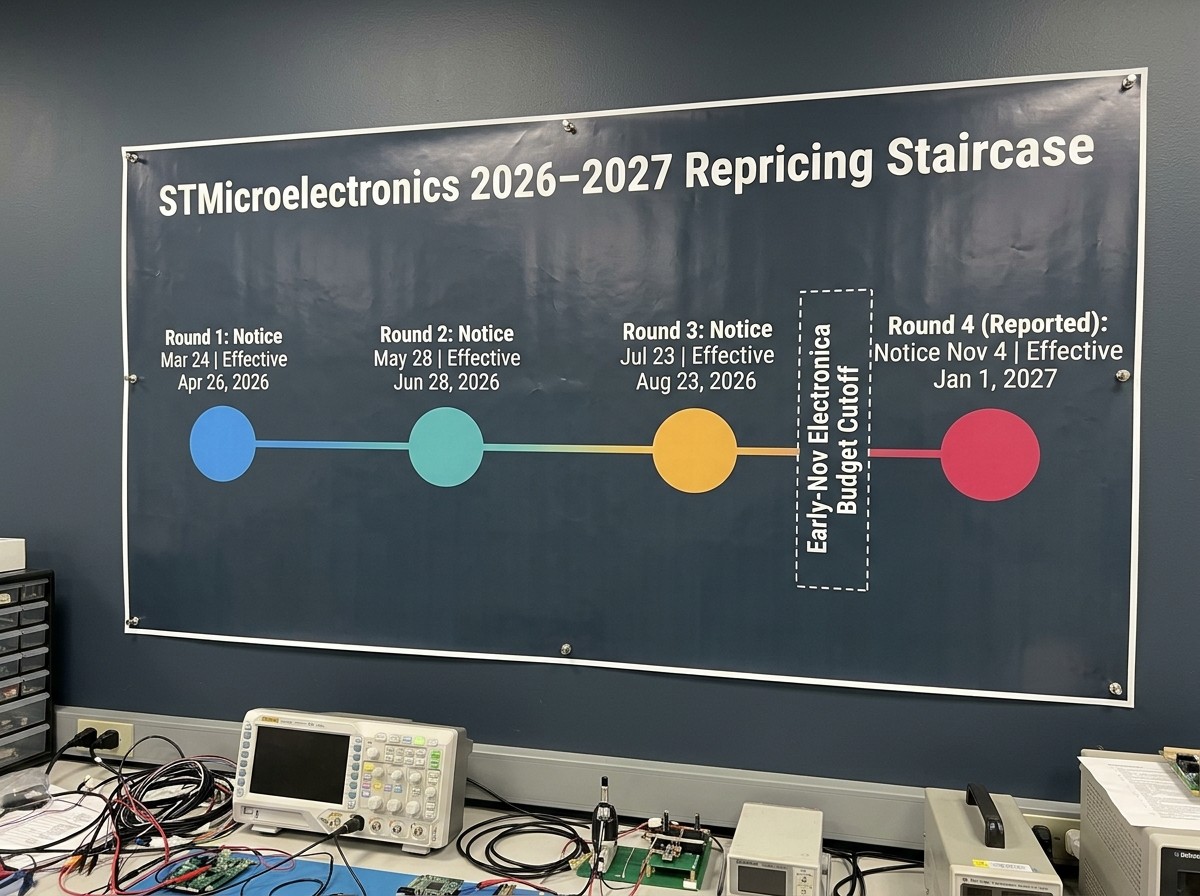
The "Electronica Calendar Gap": Why Early-November Budgets Missed This Notice
If your procurement team finalized its Q1 2027 cost rolls during the first ten days of November, your baseline likely missed this fourth ST letter. Market intelligence briefings prepared for the Electronica trade fair in Munich during early November 2026 (including channel alerts from European observers such as Alantys) still listed ST's August 23 third round as the latest pricing event. Because the November 4 customer letter only gained wider trade-press visibility between November 11 and November 12, it represents a newer calendar development than the parallel supplier window analyzed in our guide to January 2027 Component Price Increases: NXP's Third Letter, Foundry/OSAT Pass-Through, and a Year-End Price-Lock Checklist.
Why Automated Summaries and Broker Blogs Disagree on Percentages
When researching an STMicroelectronics price increase 2027 online, buyers frequently encounter conflicting percentage claims. This happens because automated search summaries and secondary broker blogs often blend channel observations from ST's earlier 2026 rounds into the January 2027 narrative. For example, during the August 23 third round, channel observers noted localized increases of 15% to 20% on certain automotive microcontrollers. Procurement teams must not automatically project that August third-round 15%–20% figure onto the reported January 1, 2027 letter. Because ST has not published an official MPN list or percentage table for January 1, each active ordering code must be verified directly against your distributor's updated price book.
| Adjustment Round | Reported Notice Date | Effective Date | Verification Status & Channel Context | BOM Audit Implication for Existing Quotes |
|---|---|---|---|---|
| Round 1 (Spring 2026) | March 24, 2026 | April 26, 2026 | Channel-documented multi-line adjustment (TrendForce). | Annual quotes locked in Q1 2026 face up to four cumulative adjustments upon contract renewal. |
| Round 2 (Summer 2026) | May 28, 2026 | June 28, 2026 | Channel-documented second round (SemiMedia, TrendForce). | Mid-Q2 2026 quotes absorbed Round 1 but remain exposed to H2 2026 and Jan 2027 revisions. |
| Round 3 (Late Summer 2026) | July 23, 2026 | August 23, 2026 | Channel-documented third round; power device lead times reportedly reached 52 weeks (TrendForce). | The baseline where early-November Electronica market alerts stopped. |
| Round 4 (New Year 2027) | November 4, 2026 (Limchip) | January 1, 2027 (TrendForce) | Circulating customer notice; no official ST press-room post, % rate, or MPN list as of Nov 17, 2026. | Requires immediate audit of Q3/Q4 quotes, open 2027 backlog, and expiring Dec 31 SPAs. |
Family-Level BOM Triage: Auditing STM32/STM8, STPOWER, and ST Analog / Power-Management Lines
Because STMicroelectronics rolls out segmented adjustments rather than publishing a single public SKU table, procurement teams must triage their bills of materials by product family (STM32/STM8, STPOWER, and ST Analog/PMIC), quote vintage, and redesign friction. Effective triage requires weighing sampled mid-November channel lead times—such as 40 to 52 weeks for mainstream MCUs and roughly 26 weeks for DC-DC converters (reported by CM Telec in Week 46), alongside power device lead times reportedly reaching up to 52 weeks (noted by TrendForce)—against whether a component is firmware-locked or pin-compatible.
Before reviewing individual part numbers, categorize every ST line item across three commercial and engineering dimensions:
Wafer Node & Package Maturity: Older 8-inch mature nodes and specialized automotive packages face tighter foundry and back-end OSAT capacity than newer 300mm platforms.
Grade & Qualification Tier: Automotive-grade (
AEC-Q100/AEC-Q101) and industrial-temperature parts carry strict Approved Vendor List (AVL) locks that prevent rapid vendor switching before year-end.Firmware & Footprint Lock-In: A single-source microcontroller requires months of software regression testing to replace, whereas standard-package MOSFETs or linear regulators can often be dual-sourced using existing board footprints.
STM32 and STM8 Microcontrollers (Legacy Mature Nodes vs. Unified Platform Ramps)
General-purpose and automotive microcontrollers—including legacy STM32F0, STM32F1, STM32F4, low-power STM32L4, high-performance STM32H7, and automotive STM8A families—represent the highest commercial exposure on an industrial or automotive-adjacent BOM. Because embedded firmware, peripheral register maps, and electromagnetic compatibility (EMC) certifications are tied to the exact silicon family, buyers cannot easily swap out an STM32 in six weeks to avoid a January 1 price adjustment.
Furthermore, evaluating STM32 lead time 2026 data shows why timing is critical. In its Week 46 market check (covering data week November 9–15, 2026 and published November 16, 2026), CM Telec sampled mainstream 32-bit MCUs at a major distributor quoting factory lead times of 40 to 52 weeks[4], noting that buyer requests across those lines jumped 2x to nearly 5x within two weeks. When lead times span nearly a full year, industrial buyers also face indirect pressure from automotive tier-1 allocation priorities—a dynamic explored in our background analysis on Automotive MCU Allocation Spillover 2026: Lead Times, Industrial Buyers, and Second-Source Qualification.
The STM32H5 and STM32C5 Lifecycle Boundary: Many engineers and buyers are currently querying how ST's newer microcontroller families affect 2027 supply and pricing. On November 4, 2026, at STM32 Summit 2026 in Geneva, STMicroelectronics officially announced its unified STM32 MCU platform[1]—introducing the new STM32A automotive/high-safety series alongside existing mainstream (STM32C5, STM32C0, STM32G0, STM32F0/F1) and high-performance (STM32H5, STM32H7, STM32N6, STM32F4) lines to streamline IP and software reuse across industrial, automotive, and physical AI applications. In parallel, 2026 financial coverage tracked by QuiverQuant highlighted ST's plans to expand local volume production in China for lines including STM32H5 and STM32C5[7].
While migrating from a legacy STM32F1 or STM32F4 to a newer STM32C5 or STM32H5 is a strong medium-term architectural move to improve 2027–2028 supply resilience, it is not a pre-January 1 price shield. PCB layout modifications, HAL/LL driver migration, and end-product re-qualification mean open Q1 and Q2 2027 demand on legacy STM32 parts must still be managed through contractual backlog verification.
STPOWER Silicon-Power and Wide-Bandgap Lines (MOSFETs, IGBTs, and SiC)
For buyers tracking an STPOWER price increase January 2027 impact, discrete power semiconductors and power modules require a split audit strategy. Automotive and industrial power stages absorbed sustained demand pressure throughout the first three rounds of 2026; TrendForce's November 12 report noted that during ST's late-summer adjustments, power device lead times reportedly reached up to 52 weeks.
When auditing STPOWER lines before the year-end cutoff, separate your BOM into two buckets:
High-Friction / Single-Source Power Lines: Silicon carbide (
SiC) traction MOSFETs, automotive-qualifiedVIPowersmart high-side switches, and proprietary IGBT power modules. Thermal design, gate-drive tuning, and automotive qualification lock these MPNs to ST, making written backlog price protection your primary defense.Standard-Package Silicon Discretes: High-voltage
MDmeshand low-voltageSTripFETsilicon MOSFETs, ultrafast recovery diodes, and thyristors in industry-standard packages (TO-220,DPAK,D2PAK,PowerFLAT). If your engineering team has already qualified a second source on the AVL, activating competitive split-award quotes before December 31 gives you tangible commercial leverage when negotiating 2027 contract renewals.
ST Analog, Signal-Conditioning, and Power-Management ICs (DC-DC, LDOs, Interfaces)
Analog and power-management integrated circuits (PMICs) operate on a different lead-time horizon than mainstream MCUs, but they carry a hidden commercial trap. In CM Telec's Week 46 market check (published November 16, 2026), three of four checked DC-DC voltage regulators had zero distributor stock and quoted factory lead times of about 26 weeks. Even more telling for automotive and industrial buyers, CM Telec observed that sourcing demand for automotive DC-DC regulators, low-dropout (LDO) regulators, and CAN transceivers was running at 9x its 12-week average. (For broader historical context on how PMIC and MCU bottlenecks interact across connected boards, see IoT Chips Lead Time 2026: Navigating MCU, PMIC, and Sensor Shortages.)
The "C-Class BOM Tail" Hidden Risk: In year-end negotiations, procurement teams naturally dedicate 90% of their time to high-ASP STM32H7 microcontrollers or STPOWER SiC modules. Meanwhile, dozens of low-unit-cost ST operational amplifiers, comparators, LDOs, voltage references, and RS-485/CAN interface ICs sit unattended on expiring spot quotes. When January 1 arrives, those unhedged C-class analog lines can automatically revert to higher 2027 book prices—and with zero distributor stock on key DC-DC regulators and a 26-week factory lead time, buyers who delay Q2 2027 bookings risk both higher unit costs and late-spring line-down shortages.
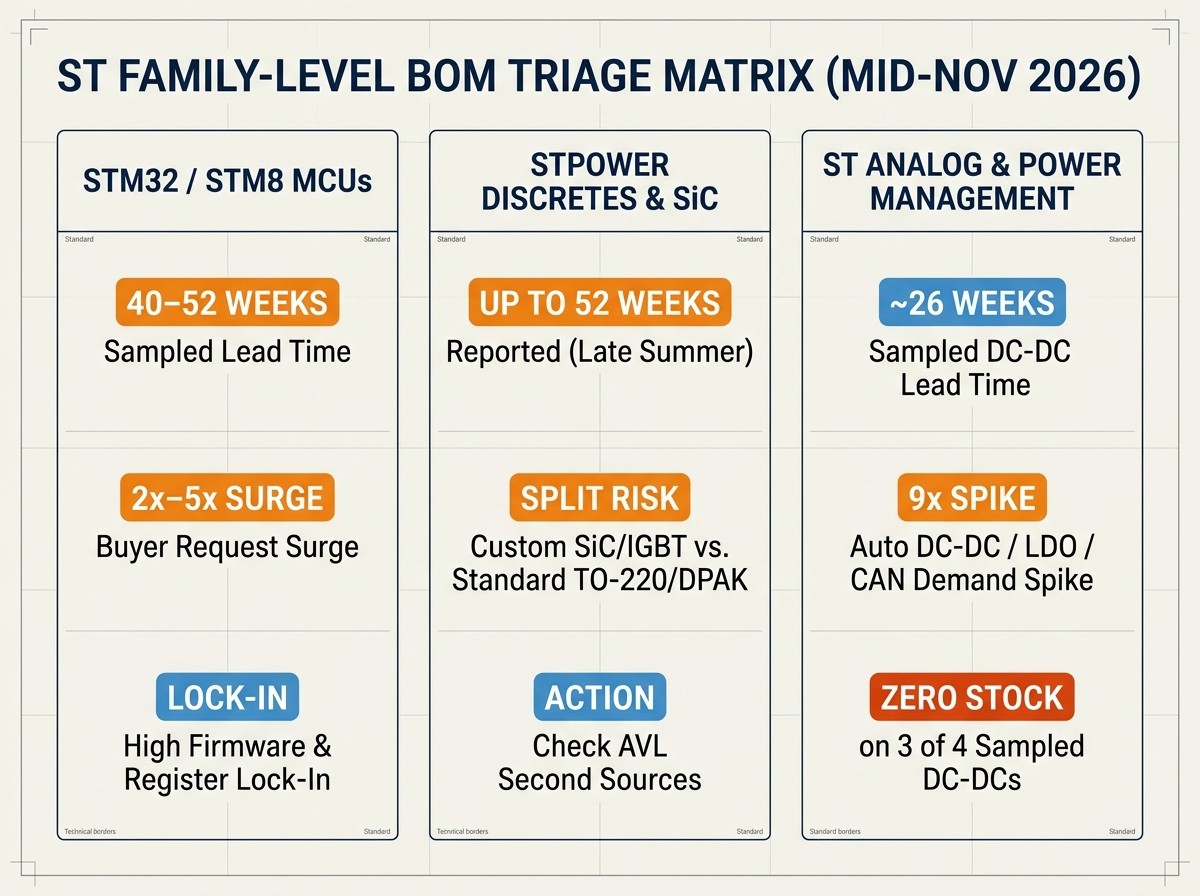
| ST Product Pillar | Attributed Channel Lead-Time Sample | Primary Repricing & Supply Risk | Redesign / Second-Source Friction | Who Should Pull In Orders vs. Who Should Not |
|---|---|---|---|---|
| STM32 / STM8 (Legacy & Automotive Grades) | 40–52 weeks (Mainstream 32-bit MCUs per CM Telec Week 46, Nov 16, 2026). | High cumulative exposure if quoted before Apr/Jun/Aug 2026; buyer requests up 2x–5x in two weeks. | Very High: Firmware registers, pinouts, and safety certs lock the MPN. | Pull In / Lock: OEMs with written booking-date price protection and firm 2027 demand. Do Not Pull In: Buyers on ship-date pricing without a written cap. |
STM32 Unified Platform (STM32H5, STM32C5, STM32A) | Variable by package; local China volume ramp in 2026 (QuiverQuant, ST Newsroom). | Newer architecture offers better long-term wafer alignment, but not exempt from global cost pass-through. | Medium-High: Unified IP aids software reuse, but still requires PCB/firmware validation. | Pull In / Lock: Programs already qualified on H5/C5 for H1 2027 ramps. Do Not Pull In: Teams hoping to swap from STM32F4 before Jan 1 without a qualified board. |
STPOWER Discretes & Modules (SiC, IGBTs, MOSFETs) | Reported up to 52 weeks in late-summer rounds (TrendForce, Nov 12, 2026). | Heavy power-stage demand; custom automotive modules face strict capacity ceilings. | Split: High for SiC/VIPower/modules; Low-to-Medium for standard TO-220/DPAK MOSFETs. | Pull In / Lock: Single-sourced SiC/IGBT users with confirmed price caps. Do Not Pull In: Standard MOSFET buyers who have lower-cost AVL alternates in stock. |
ST Analog & Power Management (DC-DC, LDOs, CAN) | ~26 weeks for DC-DC regulators (CM Telec Week 46, Nov 16, 2026). | 3 of 4 sampled DC-DCs had zero stock; auto DC-DC, LDO, and CAN demand hit 9x the 12-week average. | Low-to-Medium: Many standard op-amps, LDOs, and transceivers have pin-compatible crosses. | Pull In / Lock: Buyers covering Q2 2027 build schedules (~26w horizon) where stock is zero. Do Not Pull In: Over-buffered lines with qualified drop-in replacements. |
Mid-November 2026 Supply Context: Lead Times, Distribution Inventory, and the AI Capacity Shift
Mid-November 2026 supply-chain intelligence reveals structural capacity and inventory bottlenecks underneath STMicroelectronics' reported January 2027 price adjustment. Speaking ahead of the Electronica trade fair in Munich on November 9, 2026 (reported by Reuters on November 10, 2026), STMicroelectronics CEO Jean-Marc Chery warned that foundries and packaging suppliers are shifting resources away from mature automotive and industrial lines toward AI data-center products[3], while CM Telec's Week 46 report (published November 16, 2026) noted that ST distribution inventory remained below target as of October 29, alongside 40-to-52-week mainstream MCU lead times and 26-week DC-DC lead times.
Foundry and OSAT Capacity Crowding Out Automotive and Industrial Lines
A recurring question from industrial procurement teams in late 2026 is why semiconductor manufacturers are issuing fourth-quarter price letters when traditional European and North American industrial automation demand feels uneven. The answer lies on the supply side of the wafer and packaging ecosystem.
As Reuters reported from Munich on November 10, 2026, STMicroelectronics CEO Jean-Marc Chery told an Electronica executive panel that wafer foundries and outsourced assembly and packaging companies are increasingly "disengaging" from mature automotive and industrial segments to chase booming, higher-margin AI data-center demand. Warning that "We see many bottlenecks," Chery highlighted how third-party manufacturing partners are prioritizing AI allocations over legacy nodes. This structural reallocation—and its ripple effect across Q4 component availability—aligns with the macro trends documented in Utmel's 2026 Q4 Electronic Components Market Analysis Report: Supply, Pricing, and Procurement Outlook.
Manufacturing Reshaping and Transition Friction: "Remodeling the House While Living in It"
Beyond external foundry and OSAT pass-through, broader 2026 operational commentary and investor briefings highlight how STMicroelectronics is absorbing internal transition costs as it reshapes its global manufacturing footprint:
Legacy Fab Consolidation: Industry analysts note that ST is bearing the short-term operational expense of consolidating older legacy semiconductor fabs while migrating production toward modernized, higher-efficiency 200mm and 300mm facilities (alongside the localized
STM32volume manufacturing expansions tracked by QuiverQuant). In operational terms, executing a multi-fab footprint transition while maintaining high-mix industrial and automotive output is akin to remodeling a house while living in it—creating temporary cost friction and limiting the buffer capacity available to absorb raw material inflation.Pivot to Next-Generation Infrastructure (Silicon Photonics and LEO Satellite): Simultaneously, echoing CEO Jean-Marc Chery's November 10 Electronica comments to Reuters about industry capacity shifting toward high-growth segments, cleanroom resources and capital expenditure are increasingly pulled toward next-generation infrastructure. In 2026 operational commentary, observers point to ST's ramp in AI data-center silicon photonics—replacing heat-constrained electrical copper interconnects with laser-based optical signaling (effectively upgrading data transmission from a congested highway to a bullet train)—as well as capacity-gated demand for Low Earth Orbit (LEO) satellite components. Because complex optical and space-grade lines cannot be switched on overnight, this internal pivot keeps mature-node capacity tight and reinforces the supply-chain cost pass-through cited in the November 12 TrendForce report.
STMicroelectronics Q3 2026 Financial Results (STM)
Below-Target Distribution Buffer Stock
The most actionable mid-November data point for spot and franchised buyers comes from CM Telec's Week 46 report (published November 16, 2026), which noted that STMicroelectronics stated its distribution inventory remained below target as of October 29, 2026.
In a normal market with bloated distributor warehouses, OEMs can sometimes sidestep a January 1 manufacturer price hike by buying off-the-shelf franchised buffer stock during December or early Q1. When ST's distribution inventory sits below target entering November—and three out of four sampled DC-DC regulators already show zero stock alongside 9x demand spikes on automotive LDOs, DC-DCs, and CAN transceivers—buyers cannot assume franchised shelf inventory will be available to bridge Q1 2027 production at 2026 prices.
Common Mistakes and Market Noise to Filter Out
When building your internal executive brief for 2027 budgeting, avoid three common analytical traps circulating in late-2026 component commentary:
Mistaking Channel Samples for Official Factory Tables: CM Telec's 40–52 week MCU and ~26-week DC-DC figures, along with TrendForce's reference to 52-week power device lead times, are attributed channel observations and market samples. Lead times vary significantly by wafer fab, back-end assembly location, package code (e.g.,
LQFPvs.WLCSP), and temperature grade. Always verify exact factory lead times by full ordering code.Blending Competitor Bottlenecks into ST Risk Models: Multi-vendor Q4 market alerts frequently bundle lead-time rumors or schedule adjustments from competing European, American, or Japanese microcontroller and programmable-logic vendors alongside ST news. Keep your ST audit strictly anchored to ST's four-round 2026 calendar and verified channel metrics rather than importing unrelated competitor figures.
Relying on Unverified Raw-Material Rumors: Base your internal cost-escalation justifications on documented supplier drivers—specifically TrendForce's November 12 report on inflation, raw material, logistics, labor, and operating cost pass-through, and Reuters' November 10 Electronica report on AI capacity diversion—rather than unverified social media posts or uncorroborated laminate/substrate rumors.
Year-End Procurement Actions: Auditing Open Orders, SPAs, and Invoicing Rules Before December 31
Submitting a purchase order before December 31, 2026 only shields an OEM or EMS buyer from STMicroelectronics' reported January 1, 2027 price increase if the supplier confirms in writing that unit pricing is governed by the order-booking date rather than the shipment date. Because sampled channel lead times run 40 to 52 weeks for mainstream MCUs and roughly 26 weeks for DC-DC converters (CM Telec Week 46), procurement teams must audit expiring December 31 Special Pricing Agreements (SPAs), verify ship-and-debit renewal terms, and separate firmware-locked STM32 backlog from dual-sourceable STPOWER and analog lines.
Rather than applying a generic year-end PO checklist, execute a four-step audit tailored specifically to STMicroelectronics' product families and 2026 repricing history:
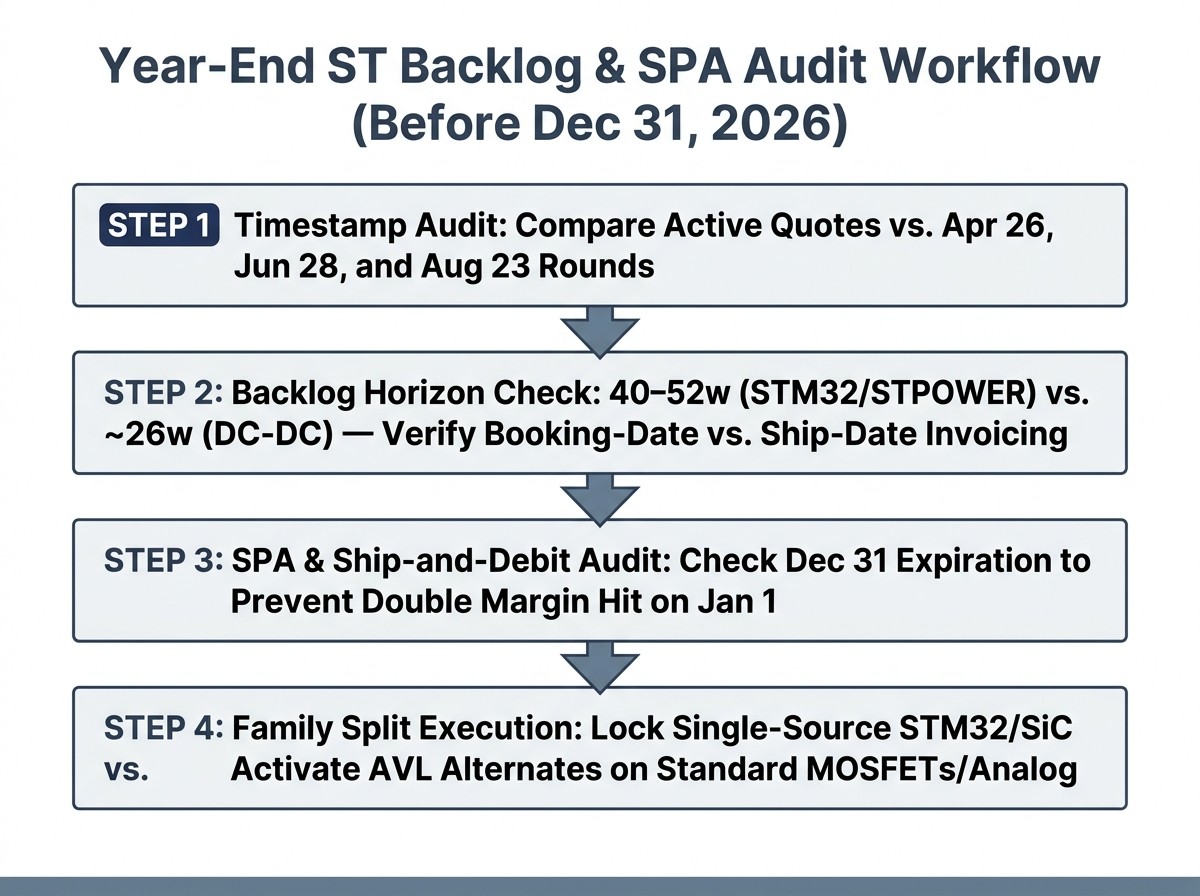
Step 1: Reconcile Active Unit Prices Against ST's Four 2026 Round Dates
Export all open purchase orders, blanket schedules, and active distributor quotes for STM32, STM8, STPOWER, and ST Analog/PMIC part numbers. Group every line item by the timestamp of its last price update:
Pre-April 26, 2026 Quotes: Highly vulnerable. If an annual fixed-price contract locked in Q1 2026 expires on December 31, the MPN may face a stacked true-up reflecting Rounds 1, 2, 3, and the reported January 1, 2027 Round 4 adjustment.
May–August 2026 Quotes: Partially adjusted. Verify with your distributor which of the spring/summer rounds (April 26, June 28, or August 23) were already absorbed into your current unit price.
Post-August 23, 2026 Quotes: Already reflect the first three 2026 rounds; audit exposure is limited strictly to whether the specific MPN is included in the November 4 customer letter for January 1, 2027.
Step 2: Resolve the 40–52 Week Backlog Trap (Booking-Date vs. Ship-Date Pricing)
Do the calendar math before rushing a year-end purchase order. If a mainstream STM32 microcontroller or STPOWER device carries a 40-to-52-week factory lead time, a new PO booked in late November or December 2026 will not leave the factory dock until Q3 or Q4 2027. Even an ST DC-DC regulator on an approximately 26-week lead time will ship in late Q2 2027.
In standard semiconductor distribution agreements, unless a contract explicitly specifies booking-date price protection, orders are billed at the "price in effect at the time of shipment." Furthermore, existing unshipped backlog scheduled for delivery after January 1 is frequently re-valued when a manufacturer adjustment takes effect.
Action Required: Send a written inquiry to your franchised distributor or ST account manager asking: "Does the reported January 1, 2027 price adjustment apply only to new purchase orders booked on or after January 1, 2027, or will it be applied to existing unshipped backlog delivering in Q1–Q4 2027?"
NCNR Guardrail: Never sign a Non-Cancelable, Non-Returnable (NCNR) backlog pull-in or 52-week blanket commitment in December without a written clause capping the ship-date unit price.
Step 3: Audit Expiring December 31 SPAs and Ship-and-Debit Authorizations
Many mid-to-large OEMs and EMS providers purchase high-volume STM32 and STPOWER lines below standard distributor book price through calendar-year Special Pricing Agreements (SPAs), Corporate Price Agreements (CPAs), or distributor ship-and-debit authorizations.
Many ship-and-debit agreements are tied to calendar-year volume commitments and expire on December 31, 2026. If your SPA expires at year-end without a signed renewal bridge, any shipment crossing the dock in January 2027 can trigger a double margin hit:
Your distributor loses factory debit authorization and reverts your account from the discounted SPA price back to standard book price.
That standard book price simultaneously reflects the higher January 1, 2027 adjustment.
Verify the exact expiration date and renewal notice window (often 30 days prior to year-end) on every active ST ship-and-debit authorization number before mid-December.
Step 4: Split Single-Source STM32 Commitments from Cross-Referenceable STPOWER and Analog Lines
Finally, align your procurement execution with engineering replacement friction:
For Firmware-Locked
STM32/STM8and ProprietarySTPOWERModules: Focus on contractual backlog verification, checking whether alternative packing suffixes (such as tape-and-reelTRvs. tray) or industrial-vs-extended temperature grades have available buffer stock, and securing firm delivery schedules.For Standard
STPOWERDiscretes andST Analog/PMICLines: Where CM Telec Week 46 data shows zero distributor stock and 26-week factory lead times on DC-DC regulators—or where standard MOSFETs and LDOs face January repricing—activate pre-qualified second sources on your AVL to keep unit costs competitive.
When franchised buffer inventory is below target and factory lead times stretch from 26 to 52 weeks, engineering and purchasing teams often use an electronic-components distributor like Utmel to compare multi-channel stock availability across constrained STM32 package variants, evaluate pin-compatible STPOWER and analog alternatives, and manage BOM cost and shortage risk with verified lot traceability before the year-end cutoff.
| Audit Dimension | ST Family Focus | Exact Question to Verify in Writing With Supplier | Red Flag / Hidden Risk if Unchecked |
|---|---|---|---|
| Invoicing Trigger Rule | STM32 & STPOWER on 40–52w backlog; DC-DC on ~26w backlog | "Does the reported Jan 1, 2027 adjustment apply to existing open POs shipping in 2027, or only to new POs booked on/after Jan 1?" | Standard terms often bill at "price in effect at shipment," nullifying rushed December POs that ship in Q2–Q4 2027. |
| SPA & Ship-and-Debit Validity | High-volume STM32, STPOWER, and PMIC contracts | "What is the exact expiration date of our current SPA / ship-and-debit authorization, and is the base book price locked upon renewal?" | Calendar-year SPAs expiring Dec 31 can revert to higher 2027 book prices on Jan 1, causing a double cost jump. |
| Quote Vintage & Round History | All active ST BOM line items | "Which of ST's 2026 adjustment rounds (Apr 26, Jun 28, Aug 23) are already reflected in our current unit quote, and is this MPN on the Jan 1 list?" | Quotes locked in Q1/Q2 2026 face steep cumulative catch-up adjustments if treated as single-round updates. |
| Ordering Code & Buffer Stock | STM32 package/packing suffixes; zero-stock DC-DC & CAN ICs | "Are alternative packing suffixes (e.g., TR vs. tray) available in existing distribution stock with a hard reservation at 2026 pricing?" | Per CM Telec Week 46, ST distribution inventory was below target as of Oct 29; unreserved shelf stock cannot be assumed for Q1. |
Frequently Asked Questions (FAQ)
Has STMicroelectronics officially confirmed the January 1, 2027 price increase and affected part numbers?
As of November 17, 2026, STMicroelectronics has not published an official press-room announcement confirming the fourth 2026 price letter, nor has it officially released a percentage increase or an itemized list of affected MPNs. Current industry reporting rests on a circulating customer notice reported as dated November 4, 2026 by Limchip and secondary trade coverage published by TrendForce on November 12, 2026, which states that selected products will see price increases effective January 1, 2027 due to persistent inflation and rising raw material, logistics, labor, and operating costs.
How many times has STMicroelectronics raised prices in 2026?
Channel reports document four price-adjustment notices issued by STMicroelectronics during 2026:
Round 1: Notice dated March 24, 2026, taking effect April 26, 2026.
Round 2: Notice dated May 28, 2026, taking effect June 28, 2026.
Round 3: Notice dated July 23, 2026, taking effect August 23, 2026.
Round 4 (Reported): Circulating customer letter reported as dated November 4, 2026, taking effect January 1, 2027.
What are current STM32, STPOWER, and DC-DC lead times in mid-November 2026?
According to attributed mid-November 2026 channel observations, lead times remain extended across core families. In its Week 46 market report (published November 16, 2026), CM Telec sampled mainstream 32-bit MCU factory lead times at 40 to 52 weeks and DC-DC voltage regulators at about 26 weeks (with three of four checked DC-DCs out of stock and automotive DC-DC, LDO, and CAN transceiver demand running at 9x its 12-week average), while noting that ST's distribution inventory remained below target as of October 29, 2026. Separately, TrendForce noted that during ST's late-summer 2026 adjustments, power device lead times reportedly reached up to 52 weeks. These figures are channel samples rather than official ST factory tables for every part number.
Does ST's local volume ramp of newer MCUs like STM32H5 and STM32C5 offset 2027 price and lead-time pressure?
Only over the medium-to-long term. While STMicroelectronics announced its unified MCU platform at STM32 Summit 2026 on November 4, 2026 (spanning STM32A, STM32C5, STM32H5, and related series) and outlined plans in 2026 to expand local volume production in China for lines including STM32H5 and STM32C5, migrating from a legacy STM32F1 or STM32F4 requires PCB redesign, firmware validation, and customer re-qualification. Consequently, newer platform ramps improve 2027–2028 supply resilience but cannot shield open Q1 2027 purchase orders on legacy microcontrollers before the January 1 cutoff.
Sources and references used for this guide
STM32 Summit 2026: STMicroelectronics announces its unified MCU platform, addressing technology convergence across industrial, automotive and physical AI applications
Source type: official company documentation
Used for: Verifying official STM32 unified MCU platform roadmap and confirming the absence of an official press-room announcement regarding the January 1, 2027 price letter as of November 17, 2026.
Caution: Official manufacturer product documentation; does not publish customer-specific pricing letters or distributor lead-time tables.[News] STMicroelectronics Reportedly to Hike Prices on Jan. 1, 2027 After Three Rounds in 2026, Citing Supply Chain Costs
Source type: reputable professional source
Used for: Supporting the November 12, 2026 report of ST's fourth price-adjustment notice effective January 1, 2027, the three prior 2026 rounds (April 26, June 28, August 23), stated inflation/supply-chain cost drivers, and late-summer reports of power device lead times reaching up to 52 weeks.
Caution: Secondary trade reporting based on a circulating customer notice; notes that specific product lists and percentage increases have not been officially confirmed by ST.Chipmakers warn AI demand is creating bottlenecks in automotive supply chain
Source type: reputable professional source
Used for: Supporting November 10, 2026 Reuters coverage from Electronica reporting ST commentary that foundry and packaging capacity is shifting away from automotive and industrial markets due to AI demand.
Caution: Provides macro foundry and packaging capacity context; does not confirm specific January 2027 unit price increases.Component Market Insights: Nov 9 – 15, 2026
Source type: reputable professional source
Used for: Supporting attributed Week 46 (published November 16, 2026) channel observations sampling mainstream MCU lead times at 40–52 weeks, DC-DC converters at roughly 26 weeks, and noting ST distribution inventory remained below target as of October 29, 2026.
Caution: Channel market sample and distributor observation; must not be presented as an official STMicroelectronics factory lead-time table.Market Updates | Semiconductor Pricing, Supply & Industry News (STMicroelectronics Price Adjustment January 2027)
Source type: vendor article
Used for: Supporting the reported November 4, 2026 date on the circulating ST customer letter announcing the January 1, 2027 price adjustment on selected products.
Caution: Secondary channel distributor report; use strictly for the attributed November 4 letter date and not as official manufacturer confirmation.ST issues new price increase notice effective June 28
Source type: background source
Used for: Corroborating STMicroelectronics' second 2026 price-adjustment round taking effect on June 28, 2026.
Caution: Secondary trade blog used only to cross-check the historical 2026 adjustment timeline.STMicroelectronics shares rise as investors focus on China-made STM32 ramp and reaffirmed 2026 targets
Source type: background source
Used for: Providing background context on ST's 2026 expansion of local volume production for microcontroller lines including STM32H5 and STM32C5.
Caution: Financial news summary; local volume production ramp does not mean STM32H5 or STM32C5 lines are exempt from global pricing adjustments.
 UTMEL

We are the professional distributor of electronic components, providing a large variety of products to save you a lot of time, effort, and cost with our efficient self-customized service. careful order preparation fast delivery service
 Power Semiconductor Procurement After the Nexperia Shake-Up—NXP for Stability, ON for Technology, or Nexperia for Value?UTMEL04 November 20255164
The recent supply chain turmoil surrounding Netherlands-based Nexperia has sent shockwaves through the global semiconductor industry, forcing procurement professionals to re-evaluate their sourcing strategies.
Read More AI Computing Power Gap: How Token Consumption is Reshaping Server Component SourcingUTMEL23 June 20261172
As global token consumption drives the transition to high-density 100kW+ AI data centers, power delivery networks require advanced Wide-Bandgap semiconductors (SiC/GaN) and high-capacitance MLCCs. This shift has triggered a component procurement crisis with lead times exceeding 24 weeks. To bypass shortages, hardware buyers must abandon just-in-time manufacturing and leverage independent global distributor networks to secure critical power and passive components.
Read More The BSPDN Revolution: Overcoming IR Drop in Sub-2nm GAAFET Nodes with Backside Power DeliveryUTMEL25 June 20261358
As semiconductor manufacturing enters the sub-2nm era, Backside Power Delivery Networks (BSPDN) are replacing traditional front-side routing to overcome critical IR drop bottlenecks. By separating power and signal delivery, chipmakers like Intel and TSMC drastically improve performance and density in GAAFET designs. However, this radical shift introduces manufacturing complexities, thermal challenges, and demands advanced packaging and power management solutions.
Read More Power Management ICs Trends 2026: AI Demand, Supply Risks, and Sourcing StrategiesUTMEL06 July 20261826
As AI server racks surpass 100kW by 2026, data centers are shifting toward wide-bandgap semiconductors like SiC and GaN. However, this demand has triggered a critical shortage of mature-node Power Management ICs (PMICs). To prevent production halts, sourcing teams must abandon 'just-in-time' models, implement proactive 'just-in-case' strategies, and rapidly qualify pin-to-pin alternative components to secure their supply chains.
Read More onsemi Synaptics Acquisition Impact: BOM Risk Checklist and Second-Source Strategy for Edge AI DesignsUTMEL27 July 2026526
The onsemi acquisition of Synaptics provides hardware program managers a 12-to-18-month window before potential product cancellations occur in mid-2027. This guide outlines how to audit BOM exposure across overlap and non-core product lines, calculate Last-Time-Buy volumes including hidden storage costs, establish proactive second-sourcing triggers, and implement supply chain monitoring to prevent line-down events.
Read More
Subscribe to Utmel !
![SLI-343M8C3F]() SLI-343M8C3F
ROHM Semiconductor
![BLM18SG700TN1D]() BLM18SG700TN1D
Murata Electronics
![SLI-343D8C3F]() SLI-343D8C3F
ROHM Semiconductor
![VVGRC6E-100]() VVGRC6E-100
Carling Technologies
![BUY40]() BUY40
Central Semiconductor
![56000001009]() 56000001009
Littelfuse Inc.
![BLM15BD102SN1D]() BLM15BD102SN1D
Murata Electronics
![H050X034H1T]() H050X034H1T
Panduit Corp
![03420014H]() 03420014H
Littelfuse Inc.
![DSS1NB32A271Q55B]() DSS1NB32A271Q55B
Murata Electronics