

Achieving Studio-Grade Audio with the AD797: Ultralow Noise Op Amp Deep Dive

1 Channels 50mA per Channel 250nA 130 dB Instrumentational OP Amps 2μA ±5V~15V AD797 8 Pins 8-SOIC (0.154, 3.90mm Width)


1 Channels 50mA per Channel 250nA 130 dB Instrumentational OP Amps 2μA ±5V~15V AD797 8 Pins 8-SOIC (0.154, 3.90mm Width)
Discover the AD797 ultralow noise op amp. Featuring 0.9 nV/√Hz noise and -120 dB THD, it's ideal for pro audio and medical imaging. Design your high-end BOM today.
- Executive Summary: What is the AD797?
- 1. Technical Specifications & Performance Analysis
- 2. Pinout, Package, and Configuration
- 3. Design & Integration Guide (For Engineers & Makers)
- 4. Typical Applications & Use Cases
- 5. Alternatives and Cross-Reference Guide
- 6. Frequently Asked Questions (FAQ)
- Specifications
- Parts with Similar Specs
- Datasheet PDF
Executive Summary: What is the AD797?
The AD797 is a high-performance, ultralow distortion, and ultralow noise operational amplifier specifically engineered for precision preamplification and signal conditioning. It is widely recognized in the industry for its ability to maintain signal integrity in the most demanding analog environments.
Market Position: High-performance precision analog; considered a "gold standard" for low-noise bipolar op amps.
Top Features: 0.9 nV/√Hz noise floor, -120 dB Total Harmonic Distortion (THD), and a wide 110 MHz gain bandwidth.
Primary Audience: Ideal for professional audio designers, medical imaging engineers (ultrasound), and instrumentation specialists.
Supply Status: Active; widely available from major distributors like Analog Devices.
1. Technical Specifications & Performance Analysis
The AD797 is a bipolar operational amplifier designed for applications requiring the lowest possible input voltage noise and high output drive capability.
1.1 Core Architecture (CPU/Logic/Power)
The AD797 utilizes a specialized bipolar input stage to achieve its record-breaking 0.9 nV/√Hz noise specification. Unlike JFET-input amplifiers which prioritize low input bias current, the AD797’s architecture is optimized for raw speed and minimal voltage noise, making it the preferred choice for low-impedance sources like high-end microphones and moving-coil phono cartridges.
1.2 Key Electrical Characteristics
Engineers must account for the following power and performance parameters during the design phase: - Supply Voltage: Operates on a wide range from ±5V to ±15V. - Slew Rate: A fast 20 V/μs ensures the device handles transient signals without dynamic distortion. - Output Current: Capable of driving 50 mA, allowing it to interface directly with low-impedance loads or heavy capacitive cables. - DC Precision: Features an impressive 80 μV maximum input offset voltage, reducing the need for trim potentiometers in precision DC circuits.
1.3 Interfaces and Connectivity
As an analog component, the AD797 interfaces via standard DIP or SOIC pinouts. It is frequently used as a high-speed buffer for high-resolution SAR and Sigma-Delta ADCs, ensuring the input signal remains clean before quantization.
2. Pinout, Package, and Configuration
Understanding the physical layout of the AD797 is critical for PCB routing and thermal management.
2.1 Pin Configuration Guide
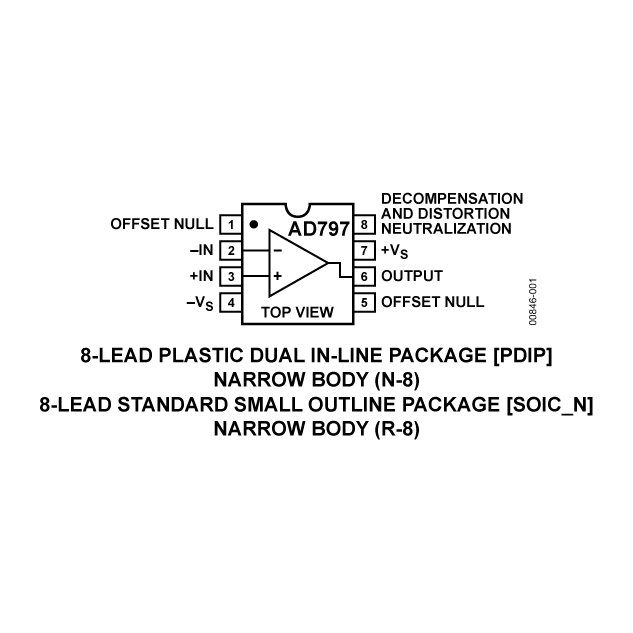
Pin 2 & 3 (Inputs): Inverting and Non-inverting inputs. Note the high input bias current typical of bipolar stages.
Pin 4 & 7 (Power): Negative (V-) and Positive (V+) supply rails.
Pin 6 (Output): High-drive output pin.
Pin 8 (Decompensation/Null): Used for external frequency compensation or offset nulling.
2.2 Naming Convention & Ordering Codes
Understanding the Part Numbers:- AD797AN: Standard plastic 8-lead PDIP (Through-hole).
AD797ARZ: 8-lead SOIC (Surface Mount) with "Z" indicating RoHS compliance.
AD797BRZ: Higher grade version with tighter offset voltage and drift specifications.
2.3 Available Packages
| Package Type | Dimensions | Common Use Case |
|---|---|---|
| PDIP-8 | 9.27mm x 6.35mm | Prototyping and Hand-soldering |
| SOIC-8 | 4.9mm x 3.9mm | Compact industrial and audio PCBs |
3. Design & Integration Guide (For Engineers & Makers)
Pro Tip: Always verify pin compatibility before migrating from older series. The AD797 is a high-speed device and requires careful layout to avoid instability.
3.1 Hardware Implementation
Bypass Capacitors: Use a combination of 0.1 μF ceramic and 10 μF electrolytic capacitors placed as close to the power pins as possible to prevent high-frequency oscillation.
PCB Layout: Utilize a solid ground plane. Keep input traces as short as possible to minimize noise pickup and stray capacitance.
Thermal Management: While not requiring a dedicated heatsink in most applications, ensure the SOIC package has sufficient copper pour on the V- pin to dissipate heat when driving 50 mA loads.
3.2 Common Design Challenges
Issue: Oscillation at Unity Gain -> Fix: The AD797 is not naturally stable at unity gain without compensation. Add a small feedback capacitor (approx. 15-22 pF) or a 100Ω isolation resistor at the inverting input.
Issue: High Input Bias Current -> Fix: Ensure source impedances are matched to cancel out DC offset errors, or use the offset nulling pins.
Issue: Heat Dissipation -> Fix: Increase PCB trace width and use thermal vias if the device is operating at the maximum ±15V supply into low-impedance loads.
4. Typical Applications & Use Cases
The AD797 is the "go-to" component for any application where the noise floor is the primary constraint.
4.1 Real-World Example: Professional Audio Preamplifier
In a high-end recording studio console, the AD797 serves as the primary microphone preamplifier. Because of its -120 dB THD, it can amplify delicate vocal signals to line level without adding audible hiss or harmonic coloration, maintaining the "transparency" required by audiophiles and sound engineers.
5. Alternatives and Cross-Reference Guide
If the AD797 is out of stock or does not meet specific JFET requirements, consider these alternatives:
Direct Replacements: LT1028 (Linear Technology) offers even lower voltage noise but may have different stability characteristics.
Better Performance (Modern): ADA4898 is a newer generation part from Analog Devices offering high speed and low noise with improved stability.
Cost-Effective/JFET Options: Texas Instruments OPA627 is an excellent alternative if you require very low input bias current, though it has a higher noise floor than the AD797.
6. Frequently Asked Questions (FAQ)
Q: What is the difference between AD797 and OPA627?
A: The AD797 is a bipolar op amp with lower voltage noise (0.9 nV/√Hz), while the OPA627 is a JFET op amp with much lower input bias current, making the OPA627 better for high-impedance sensors.
Q: Can AD797 be used in battery-operated devices?
A: It is generally not recommended for low-power battery apps due to its high quiescent current (approx. 8.2 mA).
Q: How do I prevent the AD797 from oscillating?
A: Use external compensation on Pin 8 or ensure your gain is set higher than 10. For unity gain, use a feedback capacitor.
Q: Is the AD797 suitable for automotive applications?
A: While technically capable, it lacks AEC-Q100 qualification. Check the datasheet for specific temperature range tolerances.
Specifications
Parts with Similar Specs
- ImagePart NumberManufacturerPackage / CaseNumber of PinsSlew RateGain Bandwidth ProductInput Offset Voltage (Vos)Power Supply Rejection Ratio (PSRR)Common Mode Rejection RatioSupply VoltageView Compare
![AD797BRZ-REEL7]()
AD797BRZ-REEL7
8-SOIC (0.154, 3.90mm Width)
8
20V/μs
110MHz
40 μV
130 dB
130 dB
15 V
![AD797BRZ]()
8-SOIC (0.154, 3.90mm Width)
8
20V/μs
-
40 μV
130 dB
130 dB
15 V
![AD797AR-REEL7]()
8-SOIC (0.154, 3.90mm Width)
8
20V/μs
-
40 μV
130 dB
130 dB
15 V
![AD797ARZ-REEL7]()
8-SOIC (0.154, 3.90mm Width)
8
20V/μs
110MHz
40 μV
130 dB
130 dB
15 V

Datasheet PDF
- Datasheets :
- Other Related Documents :
- ConflictMineralStatement :
 NE5534 Op-Amp: Pinout, Applications and Datasheet
16 September 20219244
 TMC2208 Power Driver: Pinout, Datasheet and Circuit
12 July 20216534
 STM32F303CCT6 Microcontroller: 72MHz, 48-LQFP, Pinout and Datasheet
11 February 20223833
 RF101 Diode: Datasheet, Features, Dimensions
21 July 2021733
![DS18B20 Temperature Sensor[FAQ+Video]: Circuit, Equivalents,and Pinout](https://res.utmel.com/Images/Article/50daa56f-b3f7-4f8a-8cf2-00186ccb88bd.jpg) DS18B20 Temperature Sensor[FAQ+Video]: Circuit, Equivalents,and Pinout
DS18B20 Temperature Sensor[FAQ+Video]: Circuit, Equivalents,and Pinout17 April 20253030
 CD4027 JK Flip-Flop IC:Pinout, Diagram and Datasheet
12 August 20216714
 A Comprehensive Guide to LTC6655BHLS8-4.096#PBF Voltage Reference IC
06 March 2024256
 CA3140E Circuit - 8-PDIP IC OPAMP GP 1:Datasheet, Circuit, Pinout, and Equivalents
18 February 2022824
 What is a Fixed Inductor?
15 April 202111228
 Emerging Storage Technologies: MRAM, RRAM, and PCRAM
08 January 20269512
 What is a Force Sensor?
19 April 202111395
 Low Temperature Drift Resistors Increase the Accuracy of Analog Circuits
11 February 20251037
 VFD Driving Guide: What to Do When Your MCU Runs Out of Pins?
22 July 2025803
 Spiral wrap choices that keep hoses damage free
15 July 2025533
 What is Amplifier?
08 November 20255842
 How to Design a High-precision ADC?
13 December 20212230
Analog Devices Inc.
In Stock: 1000
United States
China
Canada
Japan
Russia
Germany
United Kingdom
Singapore
Italy
Hong Kong(China)
Taiwan(China)
France
Korea
Mexico
Netherlands
Malaysia
Austria
Spain
Switzerland
Poland
Thailand
Vietnam
India
United Arab Emirates
Afghanistan
Åland Islands
Albania
Algeria
American Samoa
Andorra
Angola
Anguilla
Antigua & Barbuda
Argentina
Armenia
Aruba
Australia
Azerbaijan
Bahamas
Bahrain
Bangladesh
Barbados
Belarus
Belgium
Belize
Benin
Bermuda
Bhutan
Bolivia
Bonaire, Sint Eustatius and Saba
Bosnia & Herzegovina
Botswana
Brazil
British Indian Ocean Territory
British Virgin Islands
Brunei
Bulgaria
Burkina Faso
Burundi
Cabo Verde
Cambodia
Cameroon
Cayman Islands
Central African Republic
Chad
Chile
Christmas Island
Cocos (Keeling) Islands
Colombia
Comoros
Congo
Congo (DRC)
Cook Islands
Costa Rica
Côte d’Ivoire
Croatia
Cuba
Curaçao
Cyprus
Czechia
Denmark
Djibouti
Dominica
Dominican Republic
Ecuador
Egypt
El Salvador
Equatorial Guinea
Eritrea
Estonia
Eswatini
Ethiopia
Falkland Islands
Faroe Islands
Fiji
Finland
French Guiana
French Polynesia
Gabon
Gambia
Georgia
Ghana
Gibraltar
Greece
Greenland
Grenada
Guadeloupe
Guam
Guatemala
Guernsey
Guinea
Guinea-Bissau
Guyana
Haiti
Honduras
Hungary
Iceland
Indonesia
Iran
Iraq
Ireland
Isle of Man
Israel
Jamaica
Jersey
Jordan
Kazakhstan
Kenya
Kiribati
Kosovo
Kuwait
Kyrgyzstan
Laos
Latvia
Lebanon
Lesotho
Liberia
Libya
Liechtenstein
Lithuania
Luxembourg
Macao(China)
Madagascar
Malawi
Maldives
Mali
Malta
Marshall Islands
Martinique
Mauritania
Mauritius
Mayotte
Micronesia
Moldova
Monaco
Mongolia
Montenegro
Montserrat
Morocco
Mozambique
Myanmar
Namibia
Nauru
Nepal
New Caledonia
New Zealand
Nicaragua
Niger
Nigeria
Niue
Norfolk Island
North Korea
North Macedonia
Northern Mariana Islands
Norway
Oman
Pakistan
Palau
Palestinian Authority
Panama
Papua New Guinea
Paraguay
Peru
Philippines
Pitcairn Islands
Portugal
Puerto Rico
Qatar
Réunion
Romania
Rwanda
Samoa
San Marino
São Tomé & Príncipe
Saudi Arabia
Senegal
Serbia
Seychelles
Sierra Leone
Sint Maarten
Slovakia
Slovenia
Solomon Islands
Somalia
South Africa
South Sudan
Sri Lanka
St Helena, Ascension, Tristan da Cunha
St. Barthélemy
St. Kitts & Nevis
St. Lucia
St. Martin
St. Pierre & Miquelon
St. Vincent & Grenadines
Sudan
Suriname
Svalbard & Jan Mayen
Sweden
Syria
Tajikistan
Tanzania
Timor-Leste
Togo
Tokelau
Tonga
Trinidad & Tobago
Tunisia
Turkey
Turkmenistan
Turks & Caicos Islands
Tuvalu
U.S. Outlying Islands
U.S. Virgin Islands
Uganda
Ukraine
Uruguay
Uzbekistan
Vanuatu
Vatican City
Venezuela
Wallis & Futuna
Yemen
Zambia
Zimbabwe
![AD826AR-REEL7]() AD826AR-REEL7
AD826AR-REEL7Analog Devices Inc.
![AD8062ARM]() AD8062ARM
AD8062ARMAnalog Devices Inc.
![AD8532ARU-REEL]() AD8532ARU-REEL
AD8532ARU-REELAnalog Devices Inc.
![OP113ES]() OP113ES
OP113ESAnalog Devices Inc.
![SSM2142P]() SSM2142P
SSM2142PAnalog Devices, Inc.
![LTC1050CS8]() LTC1050CS8
LTC1050CS8Linear Technology/Analog Devices
![AMP02EPZ]() AMP02EPZ
AMP02EPZAnalog Devices Inc.
![AD822ARZ-REEL7]() AD822ARZ-REEL7
AD822ARZ-REEL7Analog Devices Inc.
![OP2177ARZ-REEL7]() OP2177ARZ-REEL7
OP2177ARZ-REEL7Analog Devices Inc.
![AD8066ARZ-R7]() AD8066ARZ-R7
AD8066ARZ-R7Analog Devices Inc.


