

 Product
 Brand
Brand Articles
 Tools
Tools
TMC2208 Power Driver: Pinout, Datasheet and Circuit


900μm mm 5mm mm Motor Drivers 28 24V V 5V V 5mm mm
The TMC2208 provides an integrated motor driver solution for 3D-Printing, Cameras, Scanners and other automated equipment applications. This blog covers pinout, datasheet, circuit and other information about TMC2208.

TMC2208 guide - Stepper driver upgrades part 2
TMC2208 Description
The TMC2208 provides an integrated motor driver solution for 3D-Printing, Cameras, Scanners and other automated equipment applications. The device has an integrated microstepping indexer, the completely noiseless current control mode StealthChop2™ and is intended to drive a bipolar stepper motor. The output driver block consists of low RDSon N-Channel power MOSFETs configured as full H-bridges to drive the motor windings. The TMC2208 is capable of driving up to 2A of current from each output (with proper heatsinking). TMC2208 is designed for a supply voltage of 5...36V. The device has a step and direction interface and can be configured with digital pins.
TMC2208 Pinout
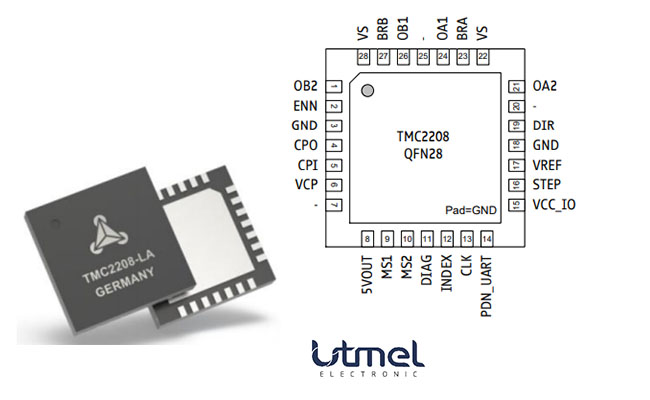

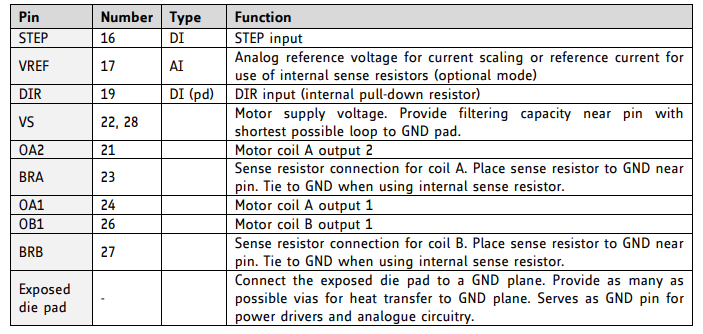
TMC2208 CAD Model
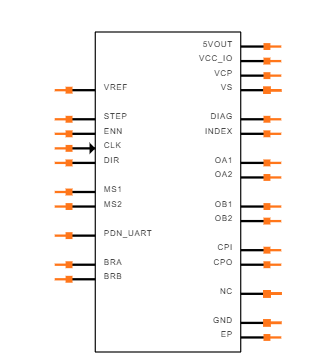
Symbol
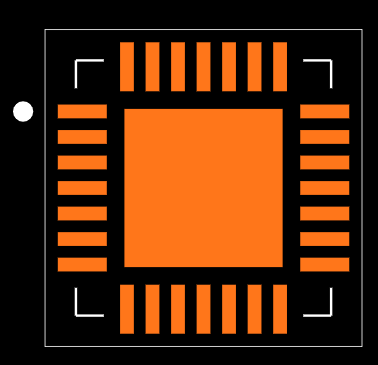
Footprint
Specifications
- TypeParameter
- Factory Lead Time8 Weeks
- Mounting Type
The "Mounting Type" in electronic components refers to the method used to attach or connect a component to a circuit board or other substrate, such as through-hole, surface-mount, or panel mount.
Surface Mount - Package / Case
refers to the protective housing that encases an electronic component, providing mechanical support, electrical connections, and thermal management.
28-VFQFN Exposed Pad - Surface Mount
having leads that are designed to be soldered on the side of a circuit board that the body of the component is mounted on.
YES - Manufacturer Package Identifier
The Manufacturer Package Identifier is a unique code or label assigned by the manufacturer to identify a specific package or housing style of an electronic component. This identifier helps in distinguishing between different package types of the same component, such as integrated circuits, transistors, or diodes. It typically includes information about the package dimensions, lead configuration, and other physical characteristics of the component. The Manufacturer Package Identifier is crucial for ensuring compatibility and proper assembly of electronic components in various devices and circuits.
TMC2208-LA-T - Operating Temperature
The operating temperature is the range of ambient temperature within which a power supply, or any other electrical equipment, operate in. This ranges from a minimum operating temperature, to a peak or maximum operating temperature, outside which, the power supply may fail.
-40°C~125°C TJ - Packaging
Semiconductor package is a carrier / shell used to contain and cover one or more semiconductor components or integrated circuits. The material of the shell can be metal, plastic, glass or ceramic.
Tape & Reel (TR) - Published2016
- JESD-609 Code
The "JESD-609 Code" in electronic components refers to a standardized marking code that indicates the lead-free solder composition and finish of electronic components for compliance with environmental regulations.
e3 - Pbfree Code
The "Pbfree Code" parameter in electronic components refers to the code or marking used to indicate that the component is lead-free. Lead (Pb) is a toxic substance that has been widely used in electronic components for many years, but due to environmental concerns, there has been a shift towards lead-free alternatives. The Pbfree Code helps manufacturers and users easily identify components that do not contain lead, ensuring compliance with regulations and promoting environmentally friendly practices. It is important to pay attention to the Pbfree Code when selecting electronic components to ensure they meet the necessary requirements for lead-free applications.
yes - Part Status
Parts can have many statuses as they progress through the configuration, analysis, review, and approval stages.
Active - Moisture Sensitivity Level (MSL)
Moisture Sensitivity Level (MSL) is a standardized rating that indicates the susceptibility of electronic components, particularly semiconductors, to moisture-induced damage during storage and the soldering process, defining the allowable exposure time to ambient conditions before they require special handling or baking to prevent failures
3 (168 Hours) - Number of Terminations28
- Terminal Finish
Terminal Finish refers to the surface treatment applied to the terminals or leads of electronic components to enhance their performance and longevity. It can improve solderability, corrosion resistance, and overall reliability of the connection in electronic assemblies. Common finishes include nickel, gold, and tin, each possessing distinct properties suitable for various applications. The choice of terminal finish can significantly impact the durability and effectiveness of electronic devices.
Matte Tin (Sn) - Applications
The parameter "Applications" in electronic components refers to the specific uses or functions for which a component is designed. It encompasses various fields such as consumer electronics, industrial automation, telecommunications, automotive, and medical devices. Understanding the applications helps in selecting the right components for a particular design based on performance, reliability, and compatibility requirements. This parameter also guides manufacturers in targeting their products to relevant markets and customer needs.
General Purpose - Additional Feature
Any Feature, including a modified Existing Feature, that is not an Existing Feature.
ALSO REQUIRES 3.3V TO 5.25V IO SUPPLY VOLTAGE - Max Power Dissipation
The maximum power that the MOSFET can dissipate continuously under the specified thermal conditions.
2.5W - Voltage - Supply
Voltage - Supply refers to the range of voltage levels that an electronic component or circuit is designed to operate with. It indicates the minimum and maximum supply voltage that can be applied for the device to function properly. Providing supply voltages outside this range can lead to malfunction, damage, or reduced performance. This parameter is critical for ensuring compatibility between different components in a circuit.
5.5V~36V - Terminal Position
In electronic components, the term "Terminal Position" refers to the physical location of the connection points on the component where external electrical connections can be made. These connection points, known as terminals, are typically used to attach wires, leads, or other components to the main body of the electronic component. The terminal position is important for ensuring proper connectivity and functionality of the component within a circuit. It is often specified in technical datasheets or component specifications to help designers and engineers understand how to properly integrate the component into their circuit designs.
QUAD - Terminal Form
Occurring at or forming the end of a series, succession, or the like; closing; concluding.
NO LEAD - Peak Reflow Temperature (Cel)
Peak Reflow Temperature (Cel) is a parameter that specifies the maximum temperature at which an electronic component can be exposed during the reflow soldering process. Reflow soldering is a common method used to attach electronic components to a circuit board. The Peak Reflow Temperature is crucial because it ensures that the component is not damaged or degraded during the soldering process. Exceeding the specified Peak Reflow Temperature can lead to issues such as component failure, reduced performance, or even permanent damage to the component. It is important for manufacturers and assemblers to adhere to the recommended Peak Reflow Temperature to ensure the reliability and functionality of the electronic components.
260 - Supply Voltage
Supply voltage refers to the electrical potential difference provided to an electronic component or circuit. It is crucial for the proper operation of devices, as it powers their functions and determines performance characteristics. The supply voltage must be within specified limits to ensure reliability and prevent damage to components. Different electronic devices have specific supply voltage requirements, which can vary widely depending on their design and intended application.
24V - Terminal Pitch
The center distance from one pole to the next.
0.5mm - Time@Peak Reflow Temperature-Max (s)
Time@Peak Reflow Temperature-Max (s) refers to the maximum duration that an electronic component can be exposed to the peak reflow temperature during the soldering process, which is crucial for ensuring reliable solder joint formation without damaging the component.
NOT SPECIFIED - JESD-30 Code
JESD-30 Code refers to a standardized descriptive designation system established by JEDEC for semiconductor-device packages. This system provides a systematic method for generating designators that convey essential information about the package's physical characteristics, such as size and shape, which aids in component identification and selection. By using JESD-30 codes, manufacturers and engineers can ensure consistency and clarity in the specification of semiconductor packages across various applications and industries.
S-XQCC-N28 - Function
The parameter "Function" in electronic components refers to the specific role or purpose that the component serves within an electronic circuit. It defines how the component interacts with other elements, influences the flow of electrical signals, and contributes to the overall behavior of the system. Functions can include amplification, signal processing, switching, filtering, and energy storage, among others. Understanding the function of each component is essential for designing effective and efficient electronic systems.
Driver - Fully Integrated, Control and Power Stage - Number of Outputs1
- Output Voltage
Output voltage is a crucial parameter in electronic components that refers to the voltage level produced by the component as a result of its operation. It represents the electrical potential difference between the output terminal of the component and a reference point, typically ground. The output voltage is a key factor in determining the performance and functionality of the component, as it dictates the level of voltage that will be delivered to the connected circuit or load. It is often specified in datasheets and technical specifications to ensure compatibility and proper functioning within a given system.
5V - Supply Voltage-Max (Vsup)
The parameter "Supply Voltage-Max (Vsup)" in electronic components refers to the maximum voltage that can be safely applied to the component without causing damage. It is an important specification to consider when designing or using electronic circuits to ensure the component operates within its safe operating limits. Exceeding the maximum supply voltage can lead to overheating, component failure, or even permanent damage. It is crucial to adhere to the specified maximum supply voltage to ensure the reliable and safe operation of the electronic component.
36V - Interface
In electronic components, the term "Interface" refers to the point at which two different systems, devices, or components connect and interact with each other. It can involve physical connections such as ports, connectors, or cables, as well as communication protocols and standards that facilitate the exchange of data or signals between the connected entities. The interface serves as a bridge that enables seamless communication and interoperability between different parts of a system or between different systems altogether. Designing a reliable and efficient interface is crucial in ensuring proper functionality and performance of electronic components and systems.
Logic, UART - Output Configuration
Output Configuration in electronic components refers to the arrangement or setup of the output pins or terminals of a device. It defines how the output signals are structured and how they interact with external circuits or devices. The output configuration can determine the functionality and compatibility of the component in a circuit design. Common types of output configurations include single-ended, differential, open-drain, and push-pull configurations, each serving different purposes and applications in electronic systems. Understanding the output configuration of a component is crucial for proper integration and operation within a circuit.
Half Bridge (4) - Voltage - Load
Voltage - Load refers to the voltage across a load component in an electronic circuit when it is connected and operational. It represents the electrical potential difference that drives current through the load, which can be a resistor, motor, or other devices that consume electrical power. The voltage - load relationship is crucial for determining how much power the load will utilize and how it will affect the overall circuit performance. Properly managing voltage - load is essential for ensuring devices operate efficiently and safely within their specified limits.
5.5V~36V - Max Junction Temperature (Tj)
Max Junction Temperature (Tj) refers to the maximum allowable temperature at the junction of a semiconductor device, such as a transistor or integrated circuit. It is a critical parameter that influences the performance, reliability, and lifespan of the component. Exceeding this temperature can lead to thermal runaway, breakdown, or permanent damage to the device. Proper thermal management is essential to ensure the junction temperature remains within safe operating limits during device operation.
125°C - Motor Type
Motor Type in electronic components refers to the classification or categorization of motors based on their design, construction, and operating characteristics. This parameter helps in identifying the specific type of motor being used in a particular electronic device or system. Common motor types include DC motors, AC motors, stepper motors, servo motors, and brushless motors, each with its own unique features and applications. Understanding the motor type is crucial for selecting the right motor for a given application, as different types of motors have different performance characteristics, efficiency levels, and control requirements. It is important to consider the motor type when designing or troubleshooting electronic systems to ensure optimal performance and reliability.
Stepper - Motor Type - Stepper
Motor Type - Stepper refers to a type of electromechanical device that converts electrical pulses into discrete mechanical movements. Stepper motors move in fixed angular increments or steps, allowing for precise control of position and speed. They are commonly used in applications requiring accurate positioning, such as 3D printers, CNC machines, and robotics. Stepper motors typically operate by energizing coils in a specific sequence, creating a magnetic field that moves the rotor in defined steps.
Bipolar - Step Resolution
Servo motor resolution is determined by feedback device of motor. I.e. 1000 PPR (pulses per revolution) quadrature encoder yields 1/4000 revolution resolution because 1000 PPR equals 4000 counts per revolution after standard 4X decoding.
1 ~ 1/256 - Height900μm
- Length5mm
- Width5mm
- RoHS Status
RoHS means “Restriction of Certain Hazardous Substances” in the “Hazardous Substances Directive” in electrical and electronic equipment.
ROHS3 Compliant
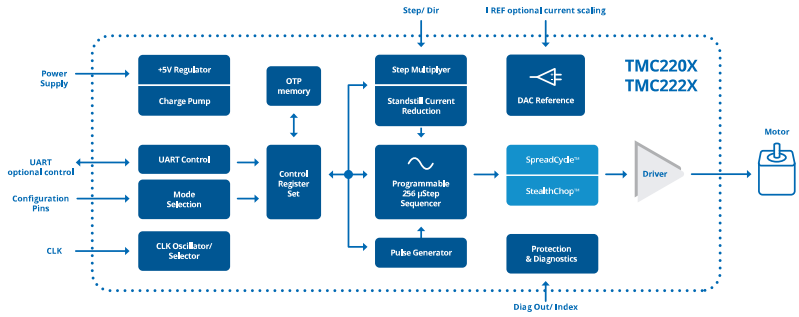
TMC Block Diagram
TMC2208 Features
2-phase stepper motors up to 2A coil current (peak)
STEP/DIR Interface with 2, 4, 8, 16 or 32 microstep pin setting
Smooth Running 256 microsteps by MicroPlyer™ interpolation
StealthChop2™ silent motor operation
SpreadCycle™ highly dynamic motor control chopper
Low RDSon LS 280mΩ & HS 290mΩ (typ. at 25°C)
Voltage Range 4.75… 36V DC
Automatic Standby current reduction (option)
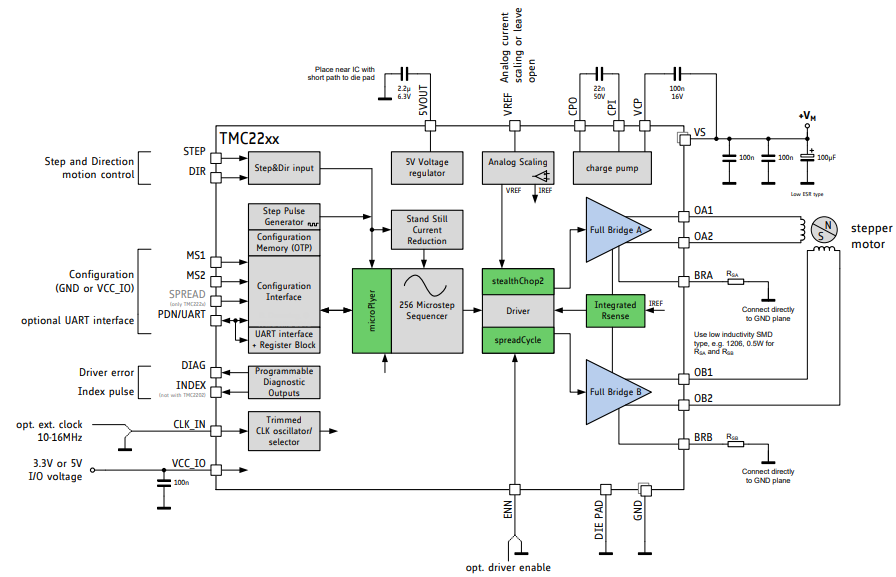
Internal Sense Resistor option (no sense resistors required)
Passive Braking and Freewheeling
Single Wire UART & OTP for advanced configuration options
Integrated Pulse Generator for standalone motion
Full Protection & Diagnostics
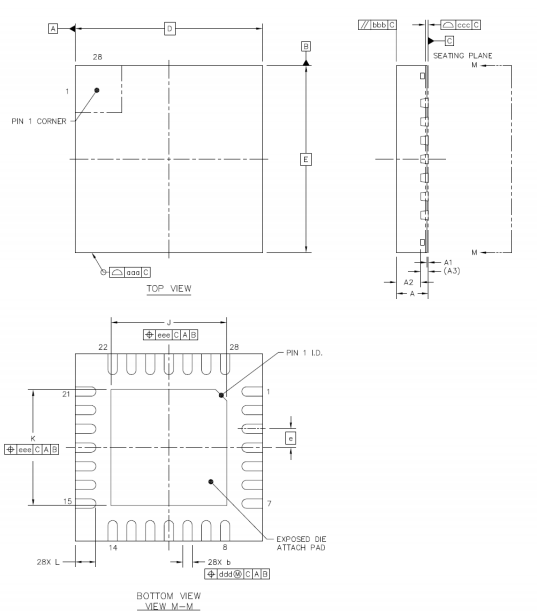
Choice of QFN and wettable QFN packages for best fit
TMC2208 Circuit
TMC2208 Applications
Compatible Design Upgrade
3D Printers
Printers, POS
Office and home automation
Textile, Sewing Machines
CCTV, Security
ATM, Cash recycler
HVAC
TMC2208 Package
TMC2208 Manufacturer
TRINAMIC Motion Control GmbH provides integrated circuitsand modules for motor and motion control to customers all over the world, most of them leaders in their industry. TRINAMIC products are used in leading-edge industries such as biotechnology, lab automation, semiconductor handling equipment, CCTV, factory automation, and control all kinds of embedded motion control systems.
Trend Analysis
Datasheet PDF
- Datasheets :
- Environmental Information :
What is a TMC2208?
The TMC2208 provides an integrated motor driver solution for 3D-Printing, Cameras, Scanners and other automated equipment applications. The device has an integrated microstepping indexer, the completely noiseless current control mode StealthChop2™ and is intended to drive a bipolar stepper motor.
Are TMC2208 drivers silent?
The TMC2202, TMC2208 and TMC2224 are ultra-silent motor driver ICs for two-phase stepper motors. Integrated power- MOSFETs handle motor current up to 1.4A RMS.
Why is TMC2208 silent?
Why use only two TMC2208? The most noise comes from the Y-axis and the X-axis. Because the Z-axis rarely moves when printing you do not hear much noise. The TMC2208 can deliver less power than the standard A4988 driver.
 UC3843 PWM Controller: Pinout, Datasheet and Uses
16 August 202151483
 Where & How to Use SN74LS74AN Dual D Flip-Flop IC?
14 July 20224879
 Exploring the Cypress MB91520 Series: 32-bit FR81S Microcontroller for Automotive Devices
29 February 2024192
 onsemi BCP54 Guide for Amplifier and Switching Circuits
19 August 2025374
![SN74LS47N Decoder/Driver: Features, Pinout, and Datasheet [Video&FAQ]](https://res.utmel.com/Images/Article/eb1c86dc-0f82-4ac9-8440-314d68b78f25.png) SN74LS47N Decoder/Driver: Features, Pinout, and Datasheet [Video&FAQ]
SN74LS47N Decoder/Driver: Features, Pinout, and Datasheet [Video&FAQ]28 October 202123136
 6N137 Photocoupler: Datasheet, Pinout and Circuit
14 August 202110737
![A Basic Overview of BD139 NPN transistor[FAQ+Video]](https://res.utmel.com/Images/Article/0aacea9e-1010-4f26-8f3b-49fb7e276555.jpg) A Basic Overview of BD139 NPN transistor[FAQ+Video]
A Basic Overview of BD139 NPN transistor[FAQ+Video]05 May 20229464
 M95020-W EEPROM: Pinout, Features and Datasheet
07 January 20222252
 DoD Allocates $238 Million for Semiconductor Centers under CHIPS and Science Act
23 September 20232814
 Arduino Authorized Distributor | UTMEL Electronics
22 February 20257838
 Devices based on Semiconductor Laser Chaos for Optical Communications
22 February 20232388
 Top 5 SR44 Battery Brands for Reliable Power
20 August 20254897
 Comparing Heat Sink Types for Modern Applications
19 July 20253673
 All You Need to Know about Wireless Access Point
26 October 20214878
 Latest Advances in Occupancy Sensor Detection Methods
14 July 20251435
 Trusted Vibration Sensors for Homeowners and Industry Professionals
17 July 20251415
Trinamic Motion Control GmbH
In Stock: 5940
United States
China
Canada
Japan
Russia
Germany
United Kingdom
Singapore
Italy
Hong Kong(China)
Taiwan(China)
France
Korea
Mexico
Netherlands
Malaysia
Austria
Spain
Switzerland
Poland
Thailand
Vietnam
India
United Arab Emirates
Afghanistan
Åland Islands
Albania
Algeria
American Samoa
Andorra
Angola
Anguilla
Antigua & Barbuda
Argentina
Armenia
Aruba
Australia
Azerbaijan
Bahamas
Bahrain
Bangladesh
Barbados
Belarus
Belgium
Belize
Benin
Bermuda
Bhutan
Bolivia
Bonaire, Sint Eustatius and Saba
Bosnia & Herzegovina
Botswana
Brazil
British Indian Ocean Territory
British Virgin Islands
Brunei
Bulgaria
Burkina Faso
Burundi
Cabo Verde
Cambodia
Cameroon
Cayman Islands
Central African Republic
Chad
Chile
Christmas Island
Cocos (Keeling) Islands
Colombia
Comoros
Congo
Congo (DRC)
Cook Islands
Costa Rica
Côte d’Ivoire
Croatia
Cuba
Curaçao
Cyprus
Czechia
Denmark
Djibouti
Dominica
Dominican Republic
Ecuador
Egypt
El Salvador
Equatorial Guinea
Eritrea
Estonia
Eswatini
Ethiopia
Falkland Islands
Faroe Islands
Fiji
Finland
French Guiana
French Polynesia
Gabon
Gambia
Georgia
Ghana
Gibraltar
Greece
Greenland
Grenada
Guadeloupe
Guam
Guatemala
Guernsey
Guinea
Guinea-Bissau
Guyana
Haiti
Honduras
Hungary
Iceland
Indonesia
Iran
Iraq
Ireland
Isle of Man
Israel
Jamaica
Jersey
Jordan
Kazakhstan
Kenya
Kiribati
Kosovo
Kuwait
Kyrgyzstan
Laos
Latvia
Lebanon
Lesotho
Liberia
Libya
Liechtenstein
Lithuania
Luxembourg
Macao(China)
Madagascar
Malawi
Maldives
Mali
Malta
Marshall Islands
Martinique
Mauritania
Mauritius
Mayotte
Micronesia
Moldova
Monaco
Mongolia
Montenegro
Montserrat
Morocco
Mozambique
Myanmar
Namibia
Nauru
Nepal
New Caledonia
New Zealand
Nicaragua
Niger
Nigeria
Niue
Norfolk Island
North Korea
North Macedonia
Northern Mariana Islands
Norway
Oman
Pakistan
Palau
Palestinian Authority
Panama
Papua New Guinea
Paraguay
Peru
Philippines
Pitcairn Islands
Portugal
Puerto Rico
Qatar
Réunion
Romania
Rwanda
Samoa
San Marino
São Tomé & Príncipe
Saudi Arabia
Senegal
Serbia
Seychelles
Sierra Leone
Sint Maarten
Slovakia
Slovenia
Solomon Islands
Somalia
South Africa
South Sudan
Sri Lanka
St Helena, Ascension, Tristan da Cunha
St. Barthélemy
St. Kitts & Nevis
St. Lucia
St. Martin
St. Pierre & Miquelon
St. Vincent & Grenadines
Sudan
Suriname
Svalbard & Jan Mayen
Sweden
Syria
Tajikistan
Tanzania
Timor-Leste
Togo
Tokelau
Tonga
Trinidad & Tobago
Tunisia
Turkey
Turkmenistan
Turks & Caicos Islands
Tuvalu
U.S. Outlying Islands
U.S. Virgin Islands
Uganda
Ukraine
Uruguay
Uzbekistan
Vanuatu
Vatican City
Venezuela
Wallis & Futuna
Yemen
Zambia
Zimbabwe
![TMC2660-PA]() TMC2660-PA
TMC2660-PATrinamic Motion Control GmbH
![TMC262-LA]() TMC262-LA
TMC262-LATrinamic Motion Control GmbH
![TMC5160-TA]() TMC5160-TA
TMC5160-TATrinamic Motion Control GmbH
![TMC5130A-TA]() TMC5130A-TA
TMC5130A-TATrinamic Motion Control GmbH
![TMC260A-PA]() TMC260A-PA
TMC260A-PATrinamic Motion Control GmbH
![TMC261-PA]() TMC261-PA
TMC261-PATrinamic Motion Control GmbH
![TMC429-LI]() TMC429-LI
TMC429-LITrinamic Motion Control GmbH
![TMC236B-PA]() TMC236B-PA
TMC236B-PATrinamic Motion Control GmbH
![TMCM-343-H-CANOPEN]() TMCM-343-H-CANOPEN
TMCM-343-H-CANOPENTRINAMIC Motion Control GmbH


