

 Product
 Brand
Brand Articles
 Tools
Tools
Everything you need to know about DRV8825 Stepper Motor Driver


EVAL MODULE FOR DRV8825
The DRV8825 is a stepper motor driver providing an integrated motor driver for printers, scanners, and other automated equipment applications.

How to interface DRV8825 and stepper motor with Arduino|ULECTRON|
What is DRV8825?
The DRV8825 is a stepper motor driver providing an integrated motor driver for printers, scanners, and other automated equipment applications. The DRV8825 stepper motor driver has two H-bridge drivers and a microstepping indexer and the DRV8266 driver can drive a bipolar stepper motor with an output current of up to 2.5 A per coil. DRV8825 Stepper Motor is suitable for driving motors at a wide range of voltages from 8.2 V to 45 V.
DRV8825 Pinout

DRV8825 Pinout
| Pin Name | Description |
| VDD & GND | Connected to 5V and GND of Controller |
| VMOT & GND MOT | Used to power the motor |
| B1, B2 & A1, A2 | Output Pins, Connected to the 4 Wires of motor |
| DIRECTION | Motor Direction Control pin |
| STEP | Steps Control Pin |
| M0, M1, M2 | Microstep Selection Pins |
| FAULT | Fault Detection Pin |
| SLEEP | Pins For Controlling Power States |
| RESET | |
| ENABLE |
DRV8825 Schematic Diagram

DRV8825 Schematic Diagram
Specifications
- TypeParameter
- Lifecycle Status
Lifecycle Status refers to the current stage of an electronic component in its product life cycle, indicating whether it is active, obsolete, or transitioning between these states. An active status means the component is in production and available for purchase. An obsolete status indicates that the component is no longer being manufactured or supported, and manufacturers typically provide a limited time frame for support. Understanding the lifecycle status is crucial for design engineers to ensure continuity and reliability in their projects.
ACTIVE (Last Updated: 3 days ago) - Factory Lead Time4 Weeks
- Package / Case
refers to the protective housing that encases an electronic component, providing mechanical support, electrical connections, and thermal management.
Module - Number of Pins0
- Part Status
Parts can have many statuses as they progress through the configuration, analysis, review, and approval stages.
Active - Moisture Sensitivity Level (MSL)
Moisture Sensitivity Level (MSL) is a standardized rating that indicates the susceptibility of electronic components, particularly semiconductors, to moisture-induced damage during storage and the soldering process, defining the allowable exposure time to ambient conditions before they require special handling or baking to prevent failures
1 (Unlimited) - TypePower Management
- Function
The parameter "Function" in electronic components refers to the specific role or purpose that the component serves within an electronic circuit. It defines how the component interacts with other elements, influences the flow of electrical signals, and contributes to the overall behavior of the system. Functions can include amplification, signal processing, switching, filtering, and energy storage, among others. Understanding the function of each component is essential for designing effective and efficient electronic systems.
Motor Controller/Driver, Stepper - Interface
In electronic components, the term "Interface" refers to the point at which two different systems, devices, or components connect and interact with each other. It can involve physical connections such as ports, connectors, or cables, as well as communication protocols and standards that facilitate the exchange of data or signals between the connected entities. The interface serves as a bridge that enables seamless communication and interoperability between different parts of a system or between different systems altogether. Designing a reliable and efficient interface is crucial in ensuring proper functionality and performance of electronic components and systems.
USB - Output Current
The rated output current is the maximum load current that a power supply can provide at a specified ambient temperature. A power supply can never provide more current that it's rated output current unless there is a fault, such as short circuit at the load.
2.5A - Utilized IC / Part
Utilized IC / Part is a parameter that refers to the extent to which an integrated circuit (IC) or electronic component is being used or consumed within a system or application. It typically indicates the percentage or ratio of the component's capabilities that are being utilized in a given scenario. This parameter is important for assessing the efficiency and performance of the component, as well as for determining if the component is being underutilized or overburdened in a particular application. Monitoring and optimizing the utilization of ICs and electronic parts can help improve overall system reliability, efficiency, and cost-effectiveness.
DRV8825 - Supplied Contents
Supplied Contents in electronic components refers to the items or materials that are included with the component when it is purchased. These contents can vary depending on the specific component and manufacturer, but typically include things like user manuals, installation guides, cables, connectors, and any additional accessories needed for the component to function properly. The supplied contents are important for ensuring that the user has everything they need to set up and use the electronic component correctly. It is recommended to carefully check the supplied contents upon receiving a new electronic component to make sure that nothing is missing and to familiarize oneself with the included materials for optimal use.
Board(s) - Evaluation Kit
An Evaluation Kit is a collection of hardware and software components designed to help engineers and developers assess and test the functionality of a particular electronic component or system. It typically includes a development board, sample code, utilities, and documentation to facilitate development and prototype testing. Evaluation Kits enable users to quickly prototype applications, evaluate performance characteristics, and determine compatibility with other systems. They are commonly used in the design and development phases of electronic projects to simplify the integration of complex components.
Yes - Primary Attributes
Primary attributes in electronic components refer to the essential characteristics that define the performance and functionality of the component. These attributes typically include parameters such as voltage rating, current rating, resistance, capacitance, and power dissipation. Understanding these primary attributes is crucial for selecting the appropriate component for specific applications and ensuring reliable operation within the desired electrical specifications.
Dual Full-Bridge (H-Bridge) Driver with PWM Current Controller - Embedded
The term "Embedded" in electronic components refers to a system or device that is designed to perform specific functions within a larger system or product. These components are typically integrated into a larger system and are not meant to be easily removed or replaced. Embedded components are often used in applications where space is limited, and where specific functions need to be performed efficiently and reliably. These components can include microcontrollers, sensors, memory chips, and other specialized hardware that work together to provide the desired functionality within the overall system. Overall, embedded components play a crucial role in the operation of various electronic devices and systems by providing specific functions and capabilities.
Yes, MCU, 16-Bit - Secondary Attributes
In electronic components, secondary attributes refer to additional characteristics or properties of a component beyond its primary function or specifications. These attributes may include features such as operating temperature range, tolerance levels, packaging type, and environmental certifications. Secondary attributes are important for ensuring compatibility, reliability, and performance of the component in a specific application or environment. Understanding and considering these secondary attributes is crucial for selecting the right component that meets the requirements of a particular electronic system or design.
Graphic User Interface - REACH SVHC
The parameter "REACH SVHC" in electronic components refers to the compliance with the Registration, Evaluation, Authorization, and Restriction of Chemicals (REACH) regulation regarding Substances of Very High Concern (SVHC). SVHCs are substances that may have serious effects on human health or the environment, and their use is regulated under REACH to ensure their safe handling and minimize their impact.Manufacturers of electronic components need to declare if their products contain any SVHCs above a certain threshold concentration and provide information on the safe use of these substances. This information allows customers to make informed decisions about the potential risks associated with using the components and take appropriate measures to mitigate any hazards.Ensuring compliance with REACH SVHC requirements is essential for electronics manufacturers to meet regulatory standards, protect human health and the environment, and maintain transparency in their supply chain. It also demonstrates a commitment to sustainability and responsible manufacturing practices in the electronics industry.
No SVHC - RoHS Status
RoHS means “Restriction of Certain Hazardous Substances” in the “Hazardous Substances Directive” in electrical and electronic equipment.
Non-RoHS Compliant
DRV8825 Features
PWM Microstepping Stepper Motor Driver
Built-In Microstepping Indexer
Up to 1/32 Microstepping
Multiple Decay Modes
Mixed Decay
Slow Decay
Fast Decay
8.2V to 45V Operating Supply Voltage Range
2.5A Maximum Drive Current at 24V and TA = 25°C
Simple STEP /DIR Interface
Low Current Sleep Mode
Built-In 3.3V Reference Output
Small Package and Footprint
Protection Features
Overcurrent Protection (OCP)
Thermal Shutdown (TSD)
VM Undervoltage Lockout (UVLO)
Fault Condition Indication Pin (nFAULT)
DRV8825 Applications
Printers
Scanners
Robotics
Gaming Machines
Automatic Teller Machines
Money Handling Machines
Video Security Cameras
Office Automation Machines
Factory Automation
Alternatives for DRV8825
A4988, NEMA 17, A498, L6474, L6207, L6208, TMC2208, TMC2209
DRV8825 VS A4988: Key differences between the DRV8825 and A4988
The following are the key differences between DRV8825 and A4988
The DRV8825 has a 1/32 microstepping capability, whereas the A4988 only has a 1/16 microstepping capability. Higher microstepping provides smoother, quieter operation, but it isn't always necessary.
The current limit potentiometer is located somewhere else.
The reference voltage and the current limit have distinct relationships.
The DRV8825 requires a minimum STEP pulse duration of 1.9 seconds, while the A4988 requires a minimum pulse duration of 1 second.
A higher voltage motor power source can be used with the DRV8825 (45 V vs 35 V). This means it's less likely to be harmed by LC voltage spikes.
Without any additional cooling, the DRV8825 can deliver a slightly greater current than the A4988.
How to control a stepper motor with DRV8825 driver?
The stepper motor may be controlled using only a few pins on the DRV8825. The A4988 stepper motor driver carrier's pinout and interface are essentially identical to those of the module. The following is the DRV8825 diagram.

DRV8825 Diagram
To drive the stepper motor, the microcontroller is connected to the module's DIR, STEP, and FAULT pins. The number of steps is controlled by the STEP pin, while the direction is controlled by the DIR pin.
The DRV8825's FAULT pin is shorted to the SLEEP pin, so driving the Fault pin low disables the entire chip. Microstep pins (M0, M1, and M2) are used to regulate the driver module's step functionality. In the above circuit, the M0, M1,and M2 pins are left unconnected, indicating that the driver will operate in full-step mode. The DRV8825 is vulnerable to voltage spikes since it has low-ESR ceramic capacitors onboard. As a result, a 47f capacitor should be installed across the motor power supply pins at the very least. It's commonly used to power NEMA series stepper motors including the NEMA17, NEMA23, and NEMA34.
DRV8825 Dimensions
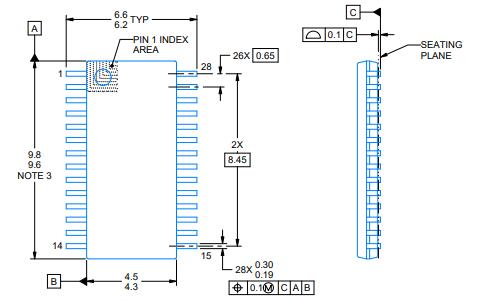
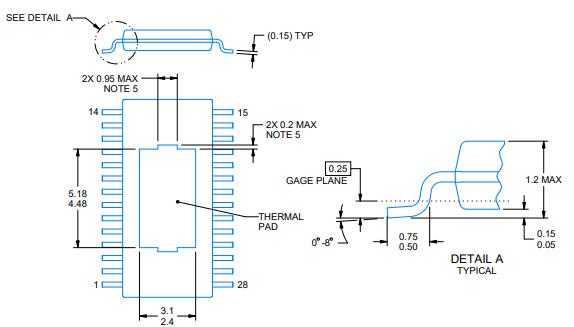
DRV8825 Dimensions
DRV8825 Manufacturer
Texas Instruments Incorporated is a semiconductor manufacturer that specializes in analog technologies, digital signal processing (DSP), and microcontrollers (MCUs). TI is a market leader in analog and digital embedded and applications processing semiconductors. TI is a multinational semiconductor firm with operations in more than 30 countries. It innovates through design, sales, and production.
How stepper motors work?
The stepper motors use a cogged wheel and electromagnets to rotate the wheel one ‘step’ at a time. Each HIGH pulse sent, energizes the coil, attracts the nearest teeth of the cogged wheel, and drives the motor one step.
What is the voltage range of the DRV8825 Stepper Motor?
The DRV8825 voltage ranges from 8.2 V to 45 V.
What is the FAULT pin on the DRV8825 shorted to?
SLEEP pin
What type of capacitors does the DRV8825 have onboard?
low-ESR ceramic capacitors
How much capacitor should be placed across the motor power supply pins?
47f capacitors.
What type of motor is the DRV8825 used to drive?
stepper motors
 Exploring the MCF51QU128 Microcontroller: Features, Specifications, and Applications
29 February 2024245
 ATxmega64A1U and ATxmega128A1U Microcontrollers: Technical Overview and Specifications
29 February 2024317
 TLE8209 8.6A H-Bridge Driver: Technical Datasheet, Pinout, and NRND Migration Analysis
18 March 2026245
 BQ2005S Fast- Charge IC: Datasheet, Alternatives, Block Diagram
17 September 2021763
 LPC824 Microcontroller: Datasheet, Pinout, NXP LPC824
23 August 20212502
 MAX3232ESE+ transceiver:Pinout, Specification, Datasheet
19 May 20212352
 AD795 Precision FET Op-Amp: OPA111 Replacement Notes and Design Trade-Offs
13 May 2026472
 An Overview of STM32L082xx Ultra-Low-Power 32-bit MCU
29 February 2024372
 What is Bluetooth Low Energy (BLE) Audio Technology?
26 April 20227239
 UTMEL Showcases One-Stop Electronic Component Sourcing Services at electronica Shanghai 2026
07 July 2026269
 An Overview of Linear Integrated Circuits
23 October 202512990
 Working Principles and Applications of Pressure Sensors
07 April 202536514
 Role of On-Chip Optical Communication in Overcoming CMOS Scaling Challenges
22 August 20242425
 Optocouplers Guide: Understanding Types, Applications, and Circuit Design Tutorial
06 June 20254659
 L298N: A Motor Driver That Accepts High Voltages
24 February 20234687
 MOSFET vs IGBT: Structure, Switching Behavior, and How to Choose
21 September 202624346
Texas Instruments
In Stock: 2881
United States
China
Canada
Japan
Russia
Germany
United Kingdom
Singapore
Italy
Hong Kong(China)
Taiwan(China)
France
Korea
Mexico
Netherlands
Malaysia
Austria
Spain
Switzerland
Poland
Thailand
Vietnam
India
United Arab Emirates
Afghanistan
Åland Islands
Albania
Algeria
American Samoa
Andorra
Angola
Anguilla
Antigua & Barbuda
Argentina
Armenia
Aruba
Australia
Azerbaijan
Bahamas
Bahrain
Bangladesh
Barbados
Belarus
Belgium
Belize
Benin
Bermuda
Bhutan
Bolivia
Bonaire, Sint Eustatius and Saba
Bosnia & Herzegovina
Botswana
Brazil
British Indian Ocean Territory
British Virgin Islands
Brunei
Bulgaria
Burkina Faso
Burundi
Cabo Verde
Cambodia
Cameroon
Cayman Islands
Central African Republic
Chad
Chile
Christmas Island
Cocos (Keeling) Islands
Colombia
Comoros
Congo
Congo (DRC)
Cook Islands
Costa Rica
Côte d’Ivoire
Croatia
Cuba
Curaçao
Cyprus
Czechia
Denmark
Djibouti
Dominica
Dominican Republic
Ecuador
Egypt
El Salvador
Equatorial Guinea
Eritrea
Estonia
Eswatini
Ethiopia
Falkland Islands
Faroe Islands
Fiji
Finland
French Guiana
French Polynesia
Gabon
Gambia
Georgia
Ghana
Gibraltar
Greece
Greenland
Grenada
Guadeloupe
Guam
Guatemala
Guernsey
Guinea
Guinea-Bissau
Guyana
Haiti
Honduras
Hungary
Iceland
Indonesia
Iran
Iraq
Ireland
Isle of Man
Israel
Jamaica
Jersey
Jordan
Kazakhstan
Kenya
Kiribati
Kosovo
Kuwait
Kyrgyzstan
Laos
Latvia
Lebanon
Lesotho
Liberia
Libya
Liechtenstein
Lithuania
Luxembourg
Macao(China)
Madagascar
Malawi
Maldives
Mali
Malta
Marshall Islands
Martinique
Mauritania
Mauritius
Mayotte
Micronesia
Moldova
Monaco
Mongolia
Montenegro
Montserrat
Morocco
Mozambique
Myanmar
Namibia
Nauru
Nepal
New Caledonia
New Zealand
Nicaragua
Niger
Nigeria
Niue
Norfolk Island
North Korea
North Macedonia
Northern Mariana Islands
Norway
Oman
Pakistan
Palau
Palestinian Authority
Panama
Papua New Guinea
Paraguay
Peru
Philippines
Pitcairn Islands
Portugal
Puerto Rico
Qatar
Réunion
Romania
Rwanda
Samoa
San Marino
São Tomé & Príncipe
Saudi Arabia
Senegal
Serbia
Seychelles
Sierra Leone
Sint Maarten
Slovakia
Slovenia
Solomon Islands
Somalia
South Africa
South Sudan
Sri Lanka
St Helena, Ascension, Tristan da Cunha
St. Barthélemy
St. Kitts & Nevis
St. Lucia
St. Martin
St. Pierre & Miquelon
St. Vincent & Grenadines
Sudan
Suriname
Svalbard & Jan Mayen
Sweden
Syria
Tajikistan
Tanzania
Timor-Leste
Togo
Tokelau
Tonga
Trinidad & Tobago
Tunisia
Turkey
Turkmenistan
Turks & Caicos Islands
Tuvalu
U.S. Outlying Islands
U.S. Virgin Islands
Uganda
Ukraine
Uruguay
Uzbekistan
Vanuatu
Vatican City
Venezuela
Wallis & Futuna
Yemen
Zambia
Zimbabwe
![ISO1050EVM]() ISO1050EVM
ISO1050EVMTexas Instruments
![LMP91000EVM/NOPB]() LMP91000EVM/NOPB
LMP91000EVM/NOPBTexas Instruments
![ISO154XEVM]() ISO154XEVM
ISO154XEVMTexas Instruments
![BQ76PL536EVM-3]() BQ76PL536EVM-3
BQ76PL536EVM-3Texas Instruments
![ISO5852SEVM]() ISO5852SEVM
ISO5852SEVMTexas Instruments
![TPS3808G01DBVEVM]() TPS3808G01DBVEVM
TPS3808G01DBVEVMTexas Instruments
![BQ24610EVM]() BQ24610EVM
BQ24610EVMTexas Instruments
![XTR300EVM]() XTR300EVM
XTR300EVMTexas Instruments
![BQ24075TEVM]() BQ24075TEVM
BQ24075TEVMTexas Instruments
![BQ24075EVM]() BQ24075EVM
BQ24075EVMTexas Instruments


