

 Product
 Brand
Brand Articles
 Tools
Tools
How to Interface TMC2209 Stepper Driver with Microcontroller?
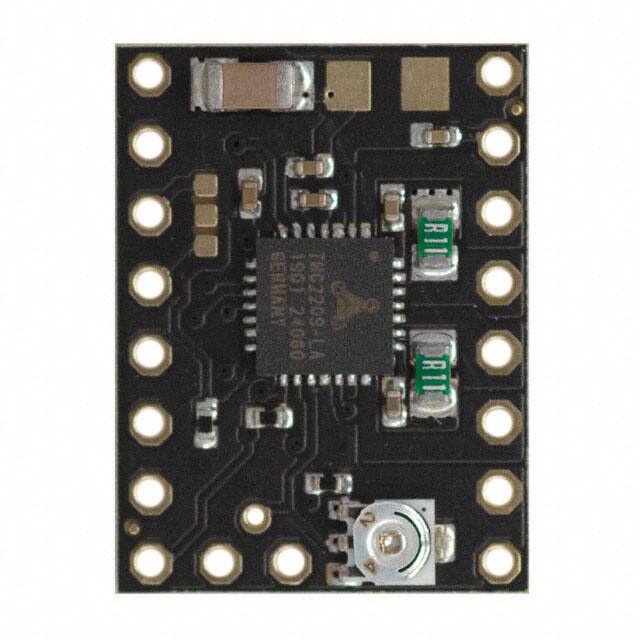


TMC2209 STEPPER DRIVER BOARD
TMC2209 Silent Step Stick is a step/direction driver for two-phase bipolar stepper motors having a current of up to 2.8A peak to peak and 2A RMS. This article will show you more about the TMC2209 Silent Step Stick. There is a huge range of Semiconductors, Capacitors, Resistors and ICs in stock. Welcome RFQ.
TMC2209 and TMC 5160: Guide for MKS Gen L and SKR V1.3
- TMC2209 Stepper Motor Driver Overview
- TMC2209 Stepper Motor Driver Pinout
- TMC2209 Stepper Motor Driver Block Diagram
- TMC2209 Stepper Motor Driver Schematic
- How to Interface TMC2209 Stepper Driver with Microcontroller?
- TMC2209 Stepper Motor Driver Feature
- TMC2209 Stepper Motor Driver Application
- TMC2209 Stepper Motor Driver Alternative
- Specifications
- Datasheet PDF
TMC2209 Stepper Motor Driver Overview
TMC2209 SilentStepStick is a two-phase bipolar stepper motor step/direction driver with a current of up to 2.8A peak to peak and 2A RMS. It can run a 2-phase bipolar stepper motor in increments ranging from 1 to 1/256. Furthermore, the TMC2209 includes a simple UART interface that may be used to tune and control the device using any microcontroller with a UART port.
TRIAMINIC introduced the TMC2209 stepper motor driver module. The TMC2209 module features TRIAMINIC technology, which makes the driver module extremely quiet and precise. This stepper motor module includes an internal oscillator with a frequency of 12.5 MHz, a UART for serial data transfer, and high-resolution steps with a full resolution of 1/256 steps to achieve smoothness. There are nine distinct micro-step resolution options available for these steps. The device is low-power, low-cost, and dependable.
TMC2209 can be used in robotics, 3D printing, and automation projects, among other things. Pinout, schematic, features, specs, interface, and applications are all covered in this course.
TMC2209 Stepper Motor Driver Pinout

TMC2209 Pinout
Pin Name | Function |
VM | Motor power supply pin – Connect power supply for Arduino to this pin |
GND | Ground pin |
M2B | Motor Coil 2 pin |
M2A | Motor Coil 2 pin |
M1B | Motor Coil 1 pin |
M1A | Motor Coil 1 pin |
VIO | Logic Power supply pin |
DIR | Motor direction input pin |
STEP | Motor step signal input pin |
PDN_UART | Power down control or UART pin(GND=0, VIO=off) |
SPREAD | Chopper mode selection pin If high, SpreadCycle is selected and Stealthchop is selected on vice versa. |
MS2 | Microstep configuration pin |
MS1 | Microstep configuration pin It adjusts microstep resolution. |
EN | Output enable pin(GND=0, VIO=off) |
DIAG | Output Diagnostic pin (VIO=error) |
VREF | Reference voltage pin |
INDEX | Output Index pin (one pulse for every four pins) |
TMC2209 Stepper Motor Driver Block Diagram
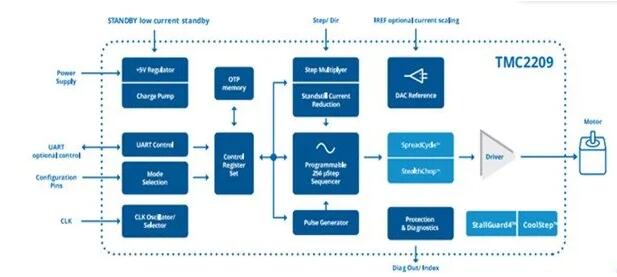
TMC2209 Stepper Motor Driver Module Block Diagram
TMC2209 Stepper Motor Driver Schematic
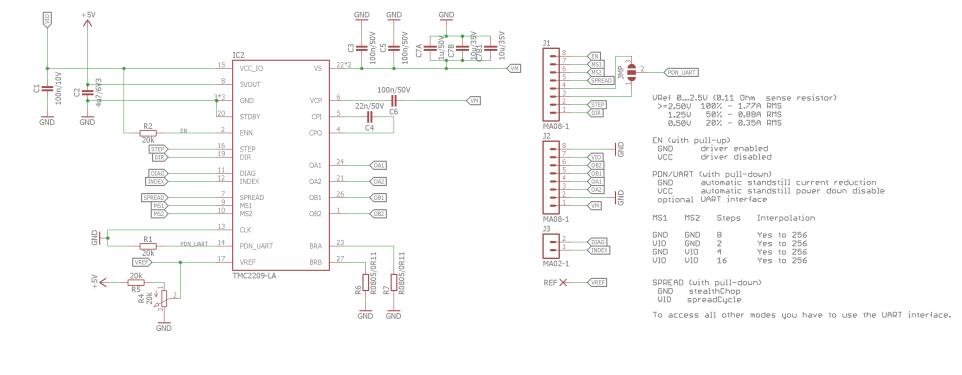 TMC2209 Stepper Motor Driver Module Schematic
How to Interface TMC2209 Stepper Driver with Microcontroller?
The TMC2209 Stepper motor module is connected to a microcontroller unit in this area below.

Interfacing TMC2209 Stepper Driver with Microcontroller
The TMC2209 Stepper Motor Driver Module functions similarly to the A4988. The distinction is that it uses noiseless and efficient dynamic motion in the stepper motor thanks to technologies like Stealthchop2 and StallGuard. The VIO and GND pins of the module are connected to the MCU power pins, which normally range from 3 to 5 Volts. The VMOT pin is connected to a supply voltage of 4.75 – 28 Volts to suit the motor's supply requirements.
The coils of the 2-phase stepper motor would be linked to the four output motor pins. Also connected are the pins EN, STEP, and DIR. EN controls the motor outputs, whereas STEP controls the motor steps. DIR controls the motor's direction, which can be clockwise or anticlockwise, depending on its condition. The step resolution of the TMC2209 Stepper driver module can be set in nine different ways. It's made by adjusting the logic levels of the MS1 and MS2 pins to acquire the desired measurements.
To connect the module with Arduino, you must first install the TMCStepper library in the Arduino IDE. Example sketches are available in the Arduino library to help you learn and observe how to write and then code according to your needs.
TMC2209 Stepper Motor Driver Feature
•TMC2209-LA stepper motor controller & driver
• Supply voltage 4.75-28V
• Continuous I phase = 1.4ARMS
• I phase up to 1.77ARMS = 2.5Apeak for a short time
• Quiet operation with StealthChop™
• Sensorless homing with StallGuard4™
• Energy savings with CoolStep™
• Configuration and extended diagnostics via UART
• Control via Step&Dir interface
• Board width 0.6", board height 0.8"
• 2x8 pin 0.1" header rows for pins/connectors
TMC2209 Stepper Motor Driver Application
3D applications
Home automation
Robotics
ATM Machines
Security purposes
Textile industry
Printers & Scanners
TMC2209 Stepper Motor Driver Alternative
TMC2208
L6474
L6207
L6208
Specifications
- TypeParameter
- Factory Lead Time6 Weeks
- Series
In electronic components, the "Series" refers to a group of products that share similar characteristics, designs, or functionalities, often produced by the same manufacturer. These components within a series typically have common specifications but may vary in terms of voltage, power, or packaging to meet different application needs. The series name helps identify and differentiate between various product lines within a manufacturer's catalog.
Landungsbrücke, Startrampe - Part Status
Parts can have many statuses as they progress through the configuration, analysis, review, and approval stages.
Active - Moisture Sensitivity Level (MSL)
Moisture Sensitivity Level (MSL) is a standardized rating that indicates the susceptibility of electronic components, particularly semiconductors, to moisture-induced damage during storage and the soldering process, defining the allowable exposure time to ambient conditions before they require special handling or baking to prevent failures
1 (Unlimited) - TypePower Management
- Function
The parameter "Function" in electronic components refers to the specific role or purpose that the component serves within an electronic circuit. It defines how the component interacts with other elements, influences the flow of electrical signals, and contributes to the overall behavior of the system. Functions can include amplification, signal processing, switching, filtering, and energy storage, among others. Understanding the function of each component is essential for designing effective and efficient electronic systems.
Motor Controller/Driver - Utilized IC / Part
Utilized IC / Part is a parameter that refers to the extent to which an integrated circuit (IC) or electronic component is being used or consumed within a system or application. It typically indicates the percentage or ratio of the component's capabilities that are being utilized in a given scenario. This parameter is important for assessing the efficiency and performance of the component, as well as for determining if the component is being underutilized or overburdened in a particular application. Monitoring and optimizing the utilization of ICs and electronic parts can help improve overall system reliability, efficiency, and cost-effectiveness.
TMC2209 - Supplied Contents
Supplied Contents in electronic components refers to the items or materials that are included with the component when it is purchased. These contents can vary depending on the specific component and manufacturer, but typically include things like user manuals, installation guides, cables, connectors, and any additional accessories needed for the component to function properly. The supplied contents are important for ensuring that the user has everything they need to set up and use the electronic component correctly. It is recommended to carefully check the supplied contents upon receiving a new electronic component to make sure that nothing is missing and to familiarize oneself with the included materials for optimal use.
Board(s) - Primary Attributes
Primary attributes in electronic components refer to the essential characteristics that define the performance and functionality of the component. These attributes typically include parameters such as voltage rating, current rating, resistance, capacitance, and power dissipation. Understanding these primary attributes is crucial for selecting the appropriate component for specific applications and ensuring reliable operation within the desired electrical specifications.
Motors (Stepper) - RoHS Status
RoHS means “Restriction of Certain Hazardous Substances” in the “Hazardous Substances Directive” in electrical and electronic equipment.
ROHS3 Compliant
Parts with Similar Specs
Datasheet PDF
- Datasheets :
What is the difference between TMC2208 and TMC2209?
Differences between TMC2208 and TMC2209 The TMC2209 drivers have lower resistance conducting output drivers (RDSon). This provides them with less power dissipation and higher current. The new TMC2209 drivers feature CoolStep and StallGuard4, fully optimized for StealthChop2.
How do I wire A4988?
TMC2209 Wiring A4988 stepper motor driver with Arduino UNO Connections are fairly simple. Start by connecting VDD and GND(next to VDD) to the 5V and ground pins on the Arduino. DIR and STEP input pins are connected to #2 & #3 digital output pins on Arduino respectively. connect the stepper motor to the 2B, 2A, 1A & 1B pins.
What are the best TMC drivers?
TMC2208;
TMC2209;
A4988;
TMC2100.
DRV8825.
TMC2130.
TMC2225;
LV8729.
TMC2660 vs TMC2209?
TMC2660 is capable of handling increased motor current.
TMC2209 can interpolate to x256 microstepping from any input microstepping; TMC2660 can only interpolate to x16 microstepping.
TMC2209 supports stationary current reduction, which is, in my opinion, its most significant advantage over TMC2660.
What is a TMC stepper driver?
The TMC2100 provides an integrated motor driver solution for 3D-Printing, Cameras, Scanners and other automated equipment applications. The device has an integrated microstepping indexer, the completely noiseless current control mode StealthChop™ and is intended to drive a bipolar stepper motor.
 2N3904 VS 2N2222 NPN Transistor: What’s the Differences?
07 April 20229166
 2N4401 NPN Transistor: Datasheet, Pinout, and Equivalent
25 August 202117530
 MSP430FE42x Mixed Signal Microcontroller: Comprehensive Technical Overview
29 February 2024177
 STM32H7 Series 480 MHz MCU: Performance Analysis, Pinout, and Design Handbook
10 February 20263356
 FT234XD-R USB: Pinout, Block Diagram, Alternatives
20 February 20232601
 TLP250 Photocoupler: Schematic, Pinout and Datasheet
11 September 202118727
 J113 N-Channel Switch: J113 Transistor Equivalents and Datasheet
26 March 20226473
 TIP31C Power Transistor: Pinout, Datasheet, and Specification
03 July 20218957
 Solid-state Drive (SSD): Classification and Architecture
22 May 202117460
 What is PLL(Phase Locked Loop)?
29 November 20216784
 Semiconductor Devices: Impact on IoT and Modern Communication (Part-1)
22 July 20242683
 Volkswagen Overhauls Semiconductor Sourcing Strategy Amid Supply Challenges
01 September 20234605
 How does an Inverter Work?
06 April 202110433
 What are Varactor Diodes?
24 November 202512509
 0 Ohm Resistor Explained
10 December 202120333
 Structure and Working Principle of Field Effect Transistors
07 April 202540658
Trinamic Motion Control GmbH
In Stock: 494
United States
China
Canada
Japan
Russia
Germany
United Kingdom
Singapore
Italy
Hong Kong(China)
Taiwan(China)
France
Korea
Mexico
Netherlands
Malaysia
Austria
Spain
Switzerland
Poland
Thailand
Vietnam
India
United Arab Emirates
Afghanistan
Åland Islands
Albania
Algeria
American Samoa
Andorra
Angola
Anguilla
Antigua & Barbuda
Argentina
Armenia
Aruba
Australia
Azerbaijan
Bahamas
Bahrain
Bangladesh
Barbados
Belarus
Belgium
Belize
Benin
Bermuda
Bhutan
Bolivia
Bonaire, Sint Eustatius and Saba
Bosnia & Herzegovina
Botswana
Brazil
British Indian Ocean Territory
British Virgin Islands
Brunei
Bulgaria
Burkina Faso
Burundi
Cabo Verde
Cambodia
Cameroon
Cayman Islands
Central African Republic
Chad
Chile
Christmas Island
Cocos (Keeling) Islands
Colombia
Comoros
Congo
Congo (DRC)
Cook Islands
Costa Rica
Côte d’Ivoire
Croatia
Cuba
Curaçao
Cyprus
Czechia
Denmark
Djibouti
Dominica
Dominican Republic
Ecuador
Egypt
El Salvador
Equatorial Guinea
Eritrea
Estonia
Eswatini
Ethiopia
Falkland Islands
Faroe Islands
Fiji
Finland
French Guiana
French Polynesia
Gabon
Gambia
Georgia
Ghana
Gibraltar
Greece
Greenland
Grenada
Guadeloupe
Guam
Guatemala
Guernsey
Guinea
Guinea-Bissau
Guyana
Haiti
Honduras
Hungary
Iceland
Indonesia
Iran
Iraq
Ireland
Isle of Man
Israel
Jamaica
Jersey
Jordan
Kazakhstan
Kenya
Kiribati
Kosovo
Kuwait
Kyrgyzstan
Laos
Latvia
Lebanon
Lesotho
Liberia
Libya
Liechtenstein
Lithuania
Luxembourg
Macao(China)
Madagascar
Malawi
Maldives
Mali
Malta
Marshall Islands
Martinique
Mauritania
Mauritius
Mayotte
Micronesia
Moldova
Monaco
Mongolia
Montenegro
Montserrat
Morocco
Mozambique
Myanmar
Namibia
Nauru
Nepal
New Caledonia
New Zealand
Nicaragua
Niger
Nigeria
Niue
Norfolk Island
North Korea
North Macedonia
Northern Mariana Islands
Norway
Oman
Pakistan
Palau
Palestinian Authority
Panama
Papua New Guinea
Paraguay
Peru
Philippines
Pitcairn Islands
Portugal
Puerto Rico
Qatar
Réunion
Romania
Rwanda
Samoa
San Marino
São Tomé & Príncipe
Saudi Arabia
Senegal
Serbia
Seychelles
Sierra Leone
Sint Maarten
Slovakia
Slovenia
Solomon Islands
Somalia
South Africa
South Sudan
Sri Lanka
St Helena, Ascension, Tristan da Cunha
St. Barthélemy
St. Kitts & Nevis
St. Lucia
St. Martin
St. Pierre & Miquelon
St. Vincent & Grenadines
Sudan
Suriname
Svalbard & Jan Mayen
Sweden
Syria
Tajikistan
Tanzania
Timor-Leste
Togo
Tokelau
Tonga
Trinidad & Tobago
Tunisia
Turkey
Turkmenistan
Turks & Caicos Islands
Tuvalu
U.S. Outlying Islands
U.S. Virgin Islands
Uganda
Ukraine
Uruguay
Uzbekistan
Vanuatu
Vatican City
Venezuela
Wallis & Futuna
Yemen
Zambia
Zimbabwe
![PD-1141-CABLE]() PD-1141-CABLE
PD-1141-CABLETRINAMIC Motion Control GmbH
![TMC5160-BOB]() TMC5160-BOB
TMC5160-BOBTrinamic Motion Control GmbH
![TMC2130-EVAL-KIT]() TMC2130-EVAL-KIT
TMC2130-EVAL-KITTrinamic Motion Control GmbH
![TMC5160-EVAL-KIT]() TMC5160-EVAL-KIT
TMC5160-EVAL-KITTrinamic Motion Control GmbH
![TMC4671-TOSV-REF]() TMC4671-TOSV-REF
TMC4671-TOSV-REFTrinamic Motion Control GmbH
![TMC2225-EVAL]() TMC2225-EVAL
TMC2225-EVALTrinamic Motion Control GmbH
![TMC4671-LEV-REF]() TMC4671-LEV-REF
TMC4671-LEV-REFTrinamic Motion Control GmbH
![TMC2225-EVAL-KIT]() TMC2225-EVAL-KIT
TMC2225-EVAL-KITTrinamic Motion Control GmbH
![TMC2225-BOB]() TMC2225-BOB
TMC2225-BOBTrinamic Motion Control GmbH
![TMC5130-HBS-KIT]() TMC5130-HBS-KIT
TMC5130-HBS-KITTrinamic Motion Control GmbH


