

 Product
 Brand
Brand Articles
 Tools
Tools
AT24C256 Two-wire Serial EEPROM: Pinout, Datasheet and Address


Through Hole Memory IC AT24C256 256 kb kb 3mA mA
AT24C256 is a Two-wire Serial EEPROM. This article is going to introduce a datasheet, PDF, pinout, address, Arduino, and other details about AT24C256 EEPROM. Furthermore, there is a huge range of semiconductors, capacitors, resistors, and ICs in stock. Welcome your RFQ!
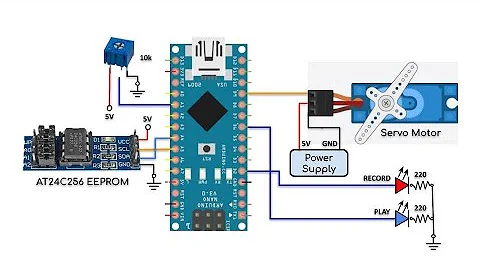
Servo Motor Control using AT24C256 EEPROM
Overview of AT24C256 EEPROM
The AT24C256 EEPROM is an 8-pin, 32-Kbyte Electrically Erasable Programmable Read-Only Memory Integrated Chip that stores data and information even when the power is turned off. It functions similarly to a pen drive. If necessary, the information on this IC can be rewritten or retrieved.
The wide range of operating voltage of AT24C256 EEPROM is from 1.7 Volts to 5.5 Volts, which can be used as an ideal EEPROM in both 3.3 Volts and 5 Volts systems. The storage space of this IC is 32 Kbyte Or 256Kbit and it is possible to cascade 8 similar EEPROM chips for expansion.
AT24C256 EEPROM Pinout
The AT24C256 EEPROM is an 8-pin integrated chip with 32 Kbyte memories. The AT24C256 EEPROM pin configuration is shown in the below tabular form. The pin diagram and the AT24C256 IC are shown in the figure below.

AT24C256 EEPROM Pinout
| Pin No | Pin Name | Description |
| 1 | A0 | User Configurable Chip Select |
| 2 | A1 | User Configurable Chip Select |
| 3 | NC | No Connection |
| 4 | GND | Ground Pin |
| 5 | SDA | Serial Data Pin |
| 6 | SCL | Serial Clock Pin |
| 7 | WP | Write Protect Pin |
| 8 | VCC | Power Supply Pin |
AT24C256 EEPROM CAD Model
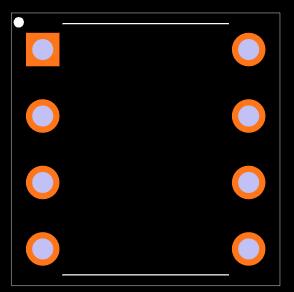
AT24C256 Footprint
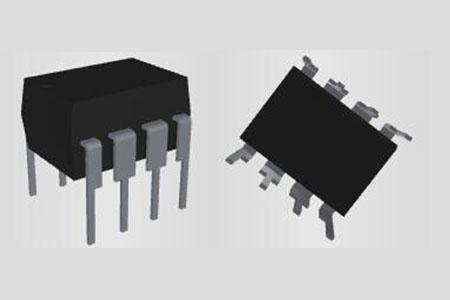
AT24C256 3D Model
Specifications
- TypeParameter
- Mount
In electronic components, the term "Mount" typically refers to the method or process of physically attaching or fixing a component onto a circuit board or other electronic device. This can involve soldering, adhesive bonding, or other techniques to secure the component in place. The mounting process is crucial for ensuring proper electrical connections and mechanical stability within the electronic system. Different components may have specific mounting requirements based on their size, shape, and function, and manufacturers provide guidelines for proper mounting procedures to ensure optimal performance and reliability of the electronic device.
Through Hole - Mounting Type
The "Mounting Type" in electronic components refers to the method used to attach or connect a component to a circuit board or other substrate, such as through-hole, surface-mount, or panel mount.
Through Hole - Package / Case
refers to the protective housing that encases an electronic component, providing mechanical support, electrical connections, and thermal management.
8-DIP (0.300, 7.62mm) - Number of Pins8
- Supplier Device Package
The parameter "Supplier Device Package" in electronic components refers to the physical packaging or housing of the component as provided by the supplier. It specifies the form factor, dimensions, and layout of the component, which are crucial for compatibility and integration into electronic circuits and systems. The supplier device package information typically includes details such as the package type (e.g., DIP, SOP, QFN), number of pins, pitch, and overall size, allowing engineers and designers to select the appropriate component for their specific application requirements. Understanding the supplier device package is essential for proper component selection, placement, and soldering during the manufacturing process to ensure optimal performance and reliability of the electronic system.
8-PDIP - Memory TypesNon-Volatile
- Operating Temperature
The operating temperature is the range of ambient temperature within which a power supply, or any other electrical equipment, operate in. This ranges from a minimum operating temperature, to a peak or maximum operating temperature, outside which, the power supply may fail.
-40°C~85°C TA - Packaging
Semiconductor package is a carrier / shell used to contain and cover one or more semiconductor components or integrated circuits. The material of the shell can be metal, plastic, glass or ceramic.
Tube - Published1997
- Part Status
Parts can have many statuses as they progress through the configuration, analysis, review, and approval stages.
Obsolete - Moisture Sensitivity Level (MSL)
Moisture Sensitivity Level (MSL) is a standardized rating that indicates the susceptibility of electronic components, particularly semiconductors, to moisture-induced damage during storage and the soldering process, defining the allowable exposure time to ambient conditions before they require special handling or baking to prevent failures
1 (Unlimited) - Max Operating Temperature
The Maximum Operating Temperature is the maximum body temperature at which the thermistor is designed to operate for extended periods of time with acceptable stability of its electrical characteristics.
85°C - Min Operating Temperature
The "Min Operating Temperature" parameter in electronic components refers to the lowest temperature at which the component is designed to operate effectively and reliably. This parameter is crucial for ensuring the proper functioning and longevity of the component, as operating below this temperature may lead to performance issues or even damage. Manufacturers specify the minimum operating temperature to provide guidance to users on the environmental conditions in which the component can safely operate. It is important to adhere to this parameter to prevent malfunctions and ensure the overall reliability of the electronic system.
-40°C - Voltage - Supply
Voltage - Supply refers to the range of voltage levels that an electronic component or circuit is designed to operate with. It indicates the minimum and maximum supply voltage that can be applied for the device to function properly. Providing supply voltages outside this range can lead to malfunction, damage, or reduced performance. This parameter is critical for ensuring compatibility between different components in a circuit.
1.8V~5.5V - Frequency
In electronic components, the parameter "Frequency" refers to the rate at which a signal oscillates or cycles within a given period of time. It is typically measured in Hertz (Hz) and represents how many times a signal completes a full cycle in one second. Frequency is a crucial aspect in electronic components as it determines the behavior and performance of various devices such as oscillators, filters, and communication systems. Understanding the frequency characteristics of components is essential for designing and analyzing electronic circuits to ensure proper functionality and compatibility with other components in a system.
1MHz - Base Part Number
The "Base Part Number" (BPN) in electronic components serves a similar purpose to the "Base Product Number." It refers to the primary identifier for a component that captures the essential characteristics shared by a group of similar components. The BPN provides a fundamental way to reference a family or series of components without specifying all the variations and specific details.
AT24C256 - Interface
In electronic components, the term "Interface" refers to the point at which two different systems, devices, or components connect and interact with each other. It can involve physical connections such as ports, connectors, or cables, as well as communication protocols and standards that facilitate the exchange of data or signals between the connected entities. The interface serves as a bridge that enables seamless communication and interoperability between different parts of a system or between different systems altogether. Designing a reliable and efficient interface is crucial in ensuring proper functionality and performance of electronic components and systems.
2-Wire, I2C, Serial - Max Supply Voltage
In general, the absolute maximum common-mode voltage is VEE-0.3V and VCC+0.3V, but for products without a protection element at the VCC side, voltages up to the absolute maximum rated supply voltage (i.e. VEE+36V) can be supplied, regardless of supply voltage.
5.5V - Min Supply Voltage
The minimum supply voltage (V min ) is explored for sequential logic circuits by statistically simulating the impact of within-die process variations and gate-dielectric soft breakdown on data retention and hold time.
1.8V - Memory Size
The memory capacity is the amount of data a device can store at any given time in its memory.
256Kb 32K x 8 - Nominal Supply Current
Nominal current is the same as the rated current. It is the current drawn by the motor while delivering rated mechanical output at its shaft.
3mA - Clock Frequency
Clock frequency, also known as clock speed, refers to the rate at which a processor or electronic component can execute instructions. It is measured in hertz (Hz) and represents the number of cycles per second that the component can perform. A higher clock frequency typically indicates a faster processing speed and better performance. However, it is important to note that other factors such as architecture, efficiency, and workload also play a significant role in determining the overall performance of a component. In summary, clock frequency is a crucial parameter that influences the speed and efficiency of electronic components in processing data and executing tasks.
1MHz - Access Time
Access time in electronic components refers to the amount of time it takes for a system to retrieve data from memory or storage once a request has been made. It is typically measured in nanoseconds or microseconds and indicates the speed at which data can be accessed. Lower access time values signify faster performance, allowing for more efficient processing in computing systems. Access time is a critical parameter in determining the overall responsiveness of electronic devices, particularly in applications requiring quick data retrieval.
550ns - Memory Format
Memory Format in electronic components refers to the specific organization and structure of data storage within a memory device. It defines how data is stored, accessed, and managed within the memory module. Different memory formats include RAM (Random Access Memory), ROM (Read-Only Memory), and various types of flash memory. The memory format determines the speed, capacity, and functionality of the memory device, and it is crucial for compatibility with other components in a system. Understanding the memory format is essential for selecting the right memory module for a particular application or device.
EEPROM - Memory Interface
An external memory interface is a bus protocol for communication from an integrated circuit, such as a microprocessor, to an external memory device located on a circuit board.
I2C - Write Cycle Time - Word, Page
Write Cycle Time - Word, Page refers to the duration required to write data to a specific memory cell or a page of memory in electronic components, particularly in non-volatile memories like Flash or EEPROM. It indicates the time taken to complete a writing operation for a single word or an entire page of data. This parameter is crucial for determining the performance and speed of memory devices in applications where quick data storage is essential. It impacts the overall efficiency in data handling, affecting both read and write speeds in memory-related operations.
5ms - Density
In electronic components, "Density" refers to the mass or weight of a material per unit volume. It is a physical property that indicates how tightly packed the atoms or molecules are within the material. The density of a component can affect its performance and characteristics, such as its strength, thermal conductivity, and electrical properties. Understanding the density of electronic components is important for designing and manufacturing processes to ensure optimal performance and reliability.
256 kb - Max Frequency
Max Frequency refers to the highest frequency at which an electronic component can operate effectively without degradation of performance. It is a critical parameter for devices such as transistors, capacitors, and oscillators, indicating their limitations in speed and response time. Exceeding the max frequency can lead to issues like signal distortion, heat generation, and potential failure of the component. Understanding this parameter is essential for designing circuits to ensure reliable and efficient operation.
400kHz - REACH SVHC
The parameter "REACH SVHC" in electronic components refers to the compliance with the Registration, Evaluation, Authorization, and Restriction of Chemicals (REACH) regulation regarding Substances of Very High Concern (SVHC). SVHCs are substances that may have serious effects on human health or the environment, and their use is regulated under REACH to ensure their safe handling and minimize their impact.Manufacturers of electronic components need to declare if their products contain any SVHCs above a certain threshold concentration and provide information on the safe use of these substances. This information allows customers to make informed decisions about the potential risks associated with using the components and take appropriate measures to mitigate any hazards.Ensuring compliance with REACH SVHC requirements is essential for electronics manufacturers to meet regulatory standards, protect human health and the environment, and maintain transparency in their supply chain. It also demonstrates a commitment to sustainability and responsible manufacturing practices in the electronics industry.
No SVHC - Radiation Hardening
Radiation hardening is the process of making electronic components and circuits resistant to damage or malfunction caused by high levels of ionizing radiation, especially for environments in outer space (especially beyond the low Earth orbit), around nuclear reactors and particle accelerators, or during nuclear accidents or nuclear warfare.
No - RoHS Status
RoHS means “Restriction of Certain Hazardous Substances” in the “Hazardous Substances Directive” in electrical and electronic equipment.
ROHS3 Compliant
Features of AT24C256 EEPROM
• Low-voltage and Standard-voltage Operation
– 1.8 (VCC = 1.8V to 5.5V)
• Internally Organized as 32,768 x 8
• Two-wire Serial Interface
• Schmitt Trigger, Filtered Inputs for Noise Suppression
• Bidirectional Data Transfer Protocol
• 1 MHz (5.0V, 2.7V, 2.5V), and 400 kHz (1.8V) Compatibility
• Write Protect Pin for Hardware and Software Data Protection
• 64-byte Page Write Mode (Partial Page Writes Allowed)
• Self-timed Write Cycle (5 ms Max)
• High Reliability
– Endurance: One Million Write Cycles
– Data Retention: 40 Years
• Lead-free/Halogen-free Devices Available
• 8-lead JEDEC PDIP, 8-lead JEDEC SOIC, EIAJ SOIC, 8-lead Ultra-Thin Small Array
Package (SAP), 8-lead TSSOP, and 8-ball dBGA2 Packages
• Die Sales: Wafer Form, Waffle Pack, and Bumped Wafers
AT24C256 EEPROM Applications
Data Logging
Audio devices
Remote storage devices
Data analytics
Storage devices
Used where Flash memory of MCU is less
AT24C256 EEPROM Equivalents
24LC512, AT24C256 EEPROM
AT24C256 Alternatives EEPROM
24C04, 24LC1026, 25LC040, 24C32
How to Use AT24C256 EEPROM?
With the help of a little example circuit schematic, let's learn how to use the AT24C256 EEPROM IC. The AT24C256 EEPROM IC communicates with the help of the I2C protocol. The circuit diagram for connecting an EEPROM IC to a microcontroller is given in the diagram below. The IC is given a supply voltage of 3.3 or 5 volts, and its communication lines are linked as indicated in the circuit diagram below.

AT24C256 EEPROM Circuit
Connect pin 6 SCK (Serial Clock) to the microcontroller's SCK pin and pin 5 SDA (Serial Data) to the microcontroller's SDA pin. Two pull-up resistors are used to pull the SCK and SDA pins to a high communication line, similar to I2C communication. This aids in maintaining the bus's idle state at a high level.
When more than one EEPROM or I2C device is connected to the same MCU, the A0, A1, and A2 select pins of this IC are used (Microcontroller unit). These address pins are otherwise connected to the ground. These three pins are linked to the GPIO pins in the preceding circuit layout because more than one EEPROM IC can be cascaded if necessary.
The Write Protect Pin on pin 7 of the AT24C256 EEPROM is utilized to strengthen data security in this IC. If WP (Write Protect) is set to zero (logic 0), the data on the EEPROM IC can be deleted or written. The data written on the IC is otherwise unchanged. If data security isn't a concern, this pin can be grounded (0). Regardless of the state of the WP pin, we can read the data from the EEPROM.
After successful communication, we can program the MCU to write/read the data to the EEPROM IC by using the values of the right register. Firstly we should specify the address of the location to where the data is to be read/written. This shows the normal process of how the data is read/written byte by byte.
An additional option of Page Write is provided by the equivalent 24LC512 EEPROM IC so that the user can write the data of 126 bytes continuously without mentioning any address of each byte of data.
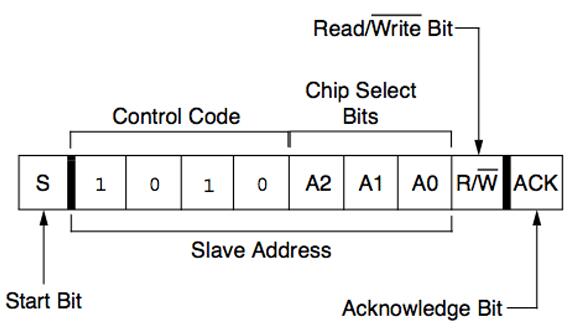
Data Exchange
The data interchange between the microcontroller and the EEPROM IC is depicted in the diagram above. The complete message may be broken down into four parts: the start bit, the slave address, the read/write bit, and finally the acknowledgment bit. The Slave address is further broken down into Control code and chip select bits. Because the control code is hardcoded and we are unable to change it, the value will always be 1010. The MCU determines the value of Chip Select bits. For example, if all three pins A2, A1, and A0 are set to low, the device's address will be 0x50. To learn more about how to communicate with the IC, read the datasheet at the bottom of the page.
AT24C256 EEPROM Dimensions
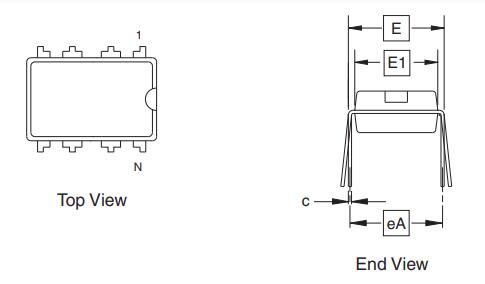
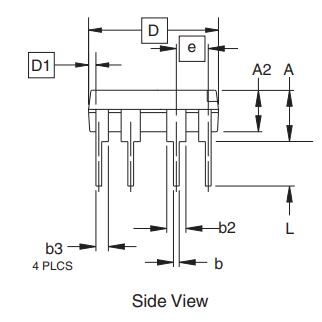
AT24C256 EEPROM Dimensions
AT24C256 EEPROM Manufacturer
Microchip Technology Inc. is a leader that provides microcontroller and analog semiconductors. The microchip was headquartered in Chandler, Arizona. We are dedicated to offering low-risk product development, reducing total system cost, and accelerating time to market. We mainly serve different fields of customers applications around the world. To provide prominent technical support along with reliable delivery and quality is our goal.
What is the use of AT24C256 EEPROM?
The AT24C256 EEPROM is an 8-pin, 32 Kbyte Electrically Erasable Programmable Read-Only Memory Integrated Chip, which is used to store the data/information on this chip and remains even when the power is OFF. It works like a pen drive.
How is data stored in AT24C256 EEPROM?
AT24C256 EEPROM stands for electrically erasable programmable read-only memory. It is a non-volatile flash memory device, that is, stored information is retained when the power is removed. Data saved in an EEPROM chip is permanent until the client chooses to delete and replace the data that it contains.
Is AT24C256 EPROM volatile or nonvolatile?
An AT24C256 EPROM is a non-volatile memory chip which is why it is used to store the program.
 AD7891AP-1REEL IC DAS: Feature, Circuit,Specification
14 August 2024751
 ATTINY20 8-bit AVR Microcontroller: Pinout, Features and Datasheet
22 March 20221479
 1N5401 Standard Recovery Rectifier: Datasheet, Schematics and Equivalents
25 September 20217086
 STM32F103RET6 Microcontroller: 72MHz,64-LQFP, Pinout and Features
09 February 20226243
 TL072 JFET: Datasheet, Equivalent and Diagram
29 April 202210635
 L7805 VS LM259: What’s the difference?
25 May 20225339
 AD7703CNZ A/D converter: Pinout, Specification, and Datasheet
31 May 2021564
 IRL540 Power MOSFET: N-Channel, IRL540 Datasheet, Pinout, Equivalent
19 January 20228687
 Three Phase Inverter - 180 Degree Conduction Mode
05 October 202320672
 Texas Semiconductor Summit: A Step Towards Overcoming Chip Shortage
14 October 20232828
 How Proper Thermal Management Extends the Life of Your Electronics
18 July 20251840
 Role of Solar Energy in Wide-Band Gap Devices for Photovoltaic Applications
15 March 20244573
 What is Digital Counter?
01 September 202012840
 Is there a Limit to the Chip Process Node?
02 November 202121484
 Advantages of Single-Phase Liquid Immersion Cooling Technology
13 November 20232834
 Basic Introduction to RF Connector
30 October 20258273
Microchip Technology
In Stock: 12500
United States
China
Canada
Japan
Russia
Germany
United Kingdom
Singapore
Italy
Hong Kong(China)
Taiwan(China)
France
Korea
Mexico
Netherlands
Malaysia
Austria
Spain
Switzerland
Poland
Thailand
Vietnam
India
United Arab Emirates
Afghanistan
Åland Islands
Albania
Algeria
American Samoa
Andorra
Angola
Anguilla
Antigua & Barbuda
Argentina
Armenia
Aruba
Australia
Azerbaijan
Bahamas
Bahrain
Bangladesh
Barbados
Belarus
Belgium
Belize
Benin
Bermuda
Bhutan
Bolivia
Bonaire, Sint Eustatius and Saba
Bosnia & Herzegovina
Botswana
Brazil
British Indian Ocean Territory
British Virgin Islands
Brunei
Bulgaria
Burkina Faso
Burundi
Cabo Verde
Cambodia
Cameroon
Cayman Islands
Central African Republic
Chad
Chile
Christmas Island
Cocos (Keeling) Islands
Colombia
Comoros
Congo
Congo (DRC)
Cook Islands
Costa Rica
Côte d’Ivoire
Croatia
Cuba
Curaçao
Cyprus
Czechia
Denmark
Djibouti
Dominica
Dominican Republic
Ecuador
Egypt
El Salvador
Equatorial Guinea
Eritrea
Estonia
Eswatini
Ethiopia
Falkland Islands
Faroe Islands
Fiji
Finland
French Guiana
French Polynesia
Gabon
Gambia
Georgia
Ghana
Gibraltar
Greece
Greenland
Grenada
Guadeloupe
Guam
Guatemala
Guernsey
Guinea
Guinea-Bissau
Guyana
Haiti
Honduras
Hungary
Iceland
Indonesia
Iran
Iraq
Ireland
Isle of Man
Israel
Jamaica
Jersey
Jordan
Kazakhstan
Kenya
Kiribati
Kosovo
Kuwait
Kyrgyzstan
Laos
Latvia
Lebanon
Lesotho
Liberia
Libya
Liechtenstein
Lithuania
Luxembourg
Macao(China)
Madagascar
Malawi
Maldives
Mali
Malta
Marshall Islands
Martinique
Mauritania
Mauritius
Mayotte
Micronesia
Moldova
Monaco
Mongolia
Montenegro
Montserrat
Morocco
Mozambique
Myanmar
Namibia
Nauru
Nepal
New Caledonia
New Zealand
Nicaragua
Niger
Nigeria
Niue
Norfolk Island
North Korea
North Macedonia
Northern Mariana Islands
Norway
Oman
Pakistan
Palau
Palestinian Authority
Panama
Papua New Guinea
Paraguay
Peru
Philippines
Pitcairn Islands
Portugal
Puerto Rico
Qatar
Réunion
Romania
Rwanda
Samoa
San Marino
São Tomé & Príncipe
Saudi Arabia
Senegal
Serbia
Seychelles
Sierra Leone
Sint Maarten
Slovakia
Slovenia
Solomon Islands
Somalia
South Africa
South Sudan
Sri Lanka
St Helena, Ascension, Tristan da Cunha
St. Barthélemy
St. Kitts & Nevis
St. Lucia
St. Martin
St. Pierre & Miquelon
St. Vincent & Grenadines
Sudan
Suriname
Svalbard & Jan Mayen
Sweden
Syria
Tajikistan
Tanzania
Timor-Leste
Togo
Tokelau
Tonga
Trinidad & Tobago
Tunisia
Turkey
Turkmenistan
Turks & Caicos Islands
Tuvalu
U.S. Outlying Islands
U.S. Virgin Islands
Uganda
Ukraine
Uruguay
Uzbekistan
Vanuatu
Vatican City
Venezuela
Wallis & Futuna
Yemen
Zambia
Zimbabwe
![24LC16BT-I/OT]() 24LC16BT-I/OT
24LC16BT-I/OTMicrochip Technology
![AT93C46DN-SH-T]() AT93C46DN-SH-T
AT93C46DN-SH-TMicrochip Technology
![24LC32AT-I/SN]() 24LC32AT-I/SN
24LC32AT-I/SNMicrochip Technology
![AT24C01C-SSHM-T]() AT24C01C-SSHM-T
AT24C01C-SSHM-TMicrochip Technology
![AT24C04D-SSHM-T]() AT24C04D-SSHM-T
AT24C04D-SSHM-TMicrochip Technology
![AT93C66B-SSHM-T]() AT93C66B-SSHM-T
AT93C66B-SSHM-TMicrochip Technology
![AT25020B-SSHL-T]() AT25020B-SSHL-T
AT25020B-SSHL-TMicrochip Technology
![23K256T-I/SN]() 23K256T-I/SN
23K256T-I/SNMicrochip Technology
![AT93C46D-PU]() AT93C46D-PU
AT93C46D-PUMicrochip Technology
![24LC16BT-I/SN]() 24LC16BT-I/SN
24LC16BT-I/SNMicrochip Technology


