

 Product
 Brand
Brand Articles
 Tools
Tools
MCP4822 Digital-to-Analog Converter: Datasheet, Pinout and MCP4822 Arduino


DAC Voltage - Buffered Through Hole String DAC R 1.5 B B 3.3mm μm 6.35mm mm
The MCP4822 devices are dual 8-bit, 10-bit and 12-bit buffered voltage output Digital-to-Analog Converters (DACs), respectively. This post will unlock more details about MCP222. There is a huge range of Semiconductors, Capacitors, Resistors and ICs in stock. Welcome RFQ.
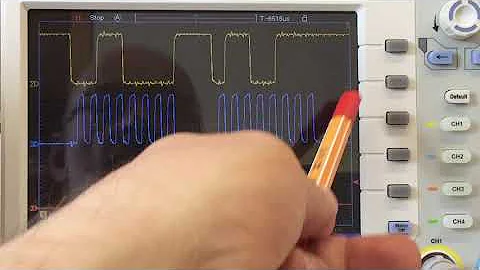
Arduino MCUs and MCP48XX/MCP49XX Family DACs – The Details
MCP4822 Pinout
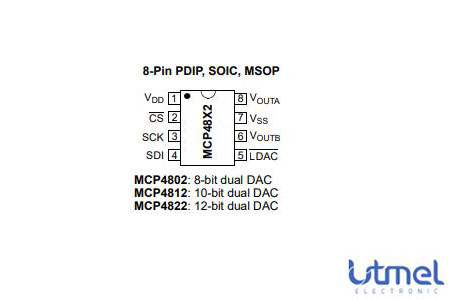
MCP4822 Pinout
MCP4822 CAD Model
Symbol
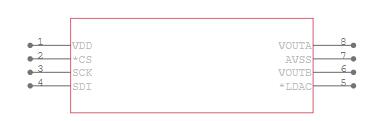
MCP4822 Symbol
Footprint
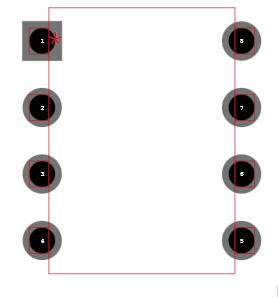
MCP4822 Footprint
3D Model
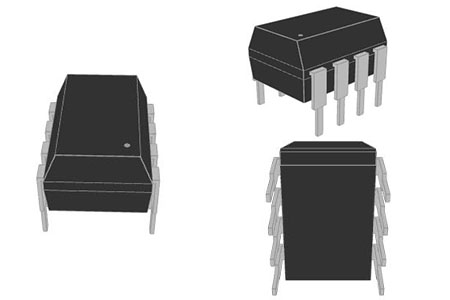
MCP4822 3D Model
MCP4822 Overview
The MCP4822 device is dual 8-bit, 10-bit and 12-bit buffered voltage output Digital-to-Analog Converters (DACs), respectively. The devices operate from a single 2.7V to 5.5V supply with SPI compatible Serial Peripheral Interface. The devices have a high precision internal voltage reference (VREF = 2.048V). The user can configure the full-scale range of the device to be 2.048V or 4.096V by setting the Gain Selection Option bit (gain of 1 of 2).
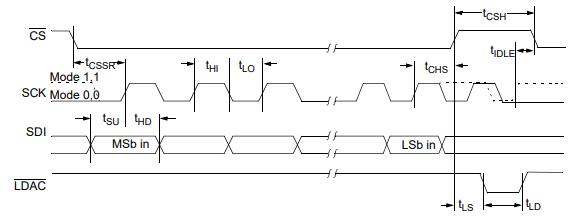
SPI Input Timing Data
MCP4822 Manufacturer
Microchip Technology Inc., is a leader that provides microcontroller and analogue semiconductors. The microchip was headquartered in Chandler, Arizona. We are dedicated to offering low-risk product development, reducing total system cost and accelerating time to market. We mainly serve different fields of customers applications around the world. To provide prominent technical support along with reliable delivery and quality is our goal.
MCP4822 Features
• MCP4822: Dual 12-Bit Voltage Output DAC
• Rail-to-Rail Output
• SPI Interface with 20 MHz Clock Support
• Simultaneous Latching of the Dual DACs with LDAC pin
• Fast Settling Time of 4.5 µs
• Selectable Unity or 2x Gain Output
• 2.048V Internal Voltage Reference
• 50 ppm/°C VREF Temperature Coefficient
• 2.7V to 5.5V Single-Supply Operation
• Extended Temperature Range: -40°C to +125°C
MCP4822 Block Diagram
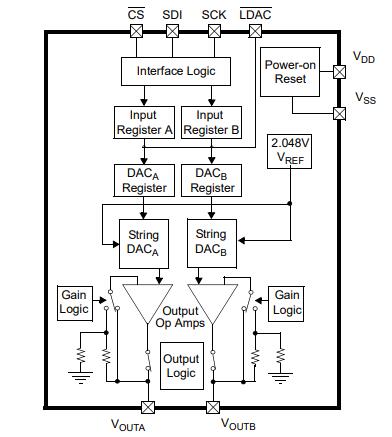
MCP4822 Block Diagram
MCP4822 Application
• Set Point or Offset Trimming
• Sensor Calibration
• Precision Selectable Voltage Reference
• Portable Instrumentation (Battery-Powered)
• Calibration of Optical Communication Devices
MCP4822 Typical Application Circuit
The MCP4822 device utilizes a 3-wire synchronous serial protocol to transfer the DAC's setup and input codes from the digital devices. The serial protocol can be interfaced to SPI or Microwire peripherals that is common on many microcontroller units (MCUs), including Microchip’s PIC® MCUs and dsPIC® DSCs. In addition to the three serial connections (CS, SCK and SDI), the LDAC signal synchronizes the two DAC outputs. By bringing down the LDAC pin to “low”, all DAC input codes and settings in the two DAC input registers are latched into their DAC output registers at the same time. Therefore, both DACA and DACB outputs are updated at the same time. The circuit below shows an example of the pin connections. Note that the LDAC pin can be tied low (VSS) to reduce the required connections from four to three I/O pins. In this case, the DAC output can be immediately updated when a valid 16 clock transmission has been received and the CS pin has been raised.

MCP4822 Typical Connection
Specifications
- TypeParameter
- Factory Lead Time3 Weeks
- Mount
In electronic components, the term "Mount" typically refers to the method or process of physically attaching or fixing a component onto a circuit board or other electronic device. This can involve soldering, adhesive bonding, or other techniques to secure the component in place. The mounting process is crucial for ensuring proper electrical connections and mechanical stability within the electronic system. Different components may have specific mounting requirements based on their size, shape, and function, and manufacturers provide guidelines for proper mounting procedures to ensure optimal performance and reliability of the electronic device.
Through Hole - Mounting Type
The "Mounting Type" in electronic components refers to the method used to attach or connect a component to a circuit board or other substrate, such as through-hole, surface-mount, or panel mount.
Through Hole - Package / Case
refers to the protective housing that encases an electronic component, providing mechanical support, electrical connections, and thermal management.
8-DIP (0.300, 7.62mm) - Number of Pins8
- Operating Temperature
The operating temperature is the range of ambient temperature within which a power supply, or any other electrical equipment, operate in. This ranges from a minimum operating temperature, to a peak or maximum operating temperature, outside which, the power supply may fail.
-40°C~125°C - Packaging
Semiconductor package is a carrier / shell used to contain and cover one or more semiconductor components or integrated circuits. The material of the shell can be metal, plastic, glass or ceramic.
Tube - Published2005
- JESD-609 Code
The "JESD-609 Code" in electronic components refers to a standardized marking code that indicates the lead-free solder composition and finish of electronic components for compliance with environmental regulations.
e3 - Pbfree Code
The "Pbfree Code" parameter in electronic components refers to the code or marking used to indicate that the component is lead-free. Lead (Pb) is a toxic substance that has been widely used in electronic components for many years, but due to environmental concerns, there has been a shift towards lead-free alternatives. The Pbfree Code helps manufacturers and users easily identify components that do not contain lead, ensuring compliance with regulations and promoting environmentally friendly practices. It is important to pay attention to the Pbfree Code when selecting electronic components to ensure they meet the necessary requirements for lead-free applications.
yes - Part Status
Parts can have many statuses as they progress through the configuration, analysis, review, and approval stages.
Active - Moisture Sensitivity Level (MSL)
Moisture Sensitivity Level (MSL) is a standardized rating that indicates the susceptibility of electronic components, particularly semiconductors, to moisture-induced damage during storage and the soldering process, defining the allowable exposure time to ambient conditions before they require special handling or baking to prevent failures
1 (Unlimited) - Number of Terminations8
- ECCN Code
An ECCN (Export Control Classification Number) is an alphanumeric code used by the U.S. Bureau of Industry and Security to identify and categorize electronic components and other dual-use items that may require an export license based on their technical characteristics and potential for military use.
EAR99 - Terminal Finish
Terminal Finish refers to the surface treatment applied to the terminals or leads of electronic components to enhance their performance and longevity. It can improve solderability, corrosion resistance, and overall reliability of the connection in electronic assemblies. Common finishes include nickel, gold, and tin, each possessing distinct properties suitable for various applications. The choice of terminal finish can significantly impact the durability and effectiveness of electronic devices.
Matte Tin (Sn) - Terminal Position
In electronic components, the term "Terminal Position" refers to the physical location of the connection points on the component where external electrical connections can be made. These connection points, known as terminals, are typically used to attach wires, leads, or other components to the main body of the electronic component. The terminal position is important for ensuring proper connectivity and functionality of the component within a circuit. It is often specified in technical datasheets or component specifications to help designers and engineers understand how to properly integrate the component into their circuit designs.
DUAL - Number of Functions1
- Supply Voltage
Supply voltage refers to the electrical potential difference provided to an electronic component or circuit. It is crucial for the proper operation of devices, as it powers their functions and determines performance characteristics. The supply voltage must be within specified limits to ensure reliability and prevent damage to components. Different electronic devices have specific supply voltage requirements, which can vary widely depending on their design and intended application.
5V - Base Part Number
The "Base Part Number" (BPN) in electronic components serves a similar purpose to the "Base Product Number." It refers to the primary identifier for a component that captures the essential characteristics shared by a group of similar components. The BPN provides a fundamental way to reference a family or series of components without specifying all the variations and specific details.
MCP4822 - Pin Count
a count of all of the component leads (or pins)
8 - Output Type
The "Output Type" parameter in electronic components refers to the type of signal or data that is produced by the component as an output. This parameter specifies the nature of the output signal, such as analog or digital, and can also include details about the voltage levels, current levels, frequency, and other characteristics of the output signal. Understanding the output type of a component is crucial for ensuring compatibility with other components in a circuit or system, as well as for determining how the output signal can be utilized or processed further. In summary, the output type parameter provides essential information about the nature of the signal that is generated by the electronic component as its output.
Voltage - Buffered - Operating Supply Voltage
The voltage level by which an electrical system is designated and to which certain operating characteristics of the system are related.
5V - Polarity
In electronic components, polarity refers to the orientation or direction in which the component must be connected in a circuit to function properly. Components such as diodes, capacitors, and LEDs have polarity markings to indicate which terminal should be connected to the positive or negative side of the circuit. Connecting a component with incorrect polarity can lead to malfunction or damage. It is important to pay attention to polarity markings and follow the manufacturer's instructions to ensure proper operation of electronic components.
Bipolar, Unipolar - Interface
In electronic components, the term "Interface" refers to the point at which two different systems, devices, or components connect and interact with each other. It can involve physical connections such as ports, connectors, or cables, as well as communication protocols and standards that facilitate the exchange of data or signals between the connected entities. The interface serves as a bridge that enables seamless communication and interoperability between different parts of a system or between different systems altogether. Designing a reliable and efficient interface is crucial in ensuring proper functionality and performance of electronic components and systems.
SPI, Serial - Max Supply Voltage
In general, the absolute maximum common-mode voltage is VEE-0.3V and VCC+0.3V, but for products without a protection element at the VCC side, voltages up to the absolute maximum rated supply voltage (i.e. VEE+36V) can be supplied, regardless of supply voltage.
5.5V - Min Supply Voltage
The minimum supply voltage (V min ) is explored for sequential logic circuits by statistically simulating the impact of within-die process variations and gate-dielectric soft breakdown on data retention and hold time.
2.7V - Nominal Supply Current
Nominal current is the same as the rated current. It is the current drawn by the motor while delivering rated mechanical output at its shaft.
415μA - Number of Bits12
- Architecture
In electronic components, the parameter "Architecture" refers to the overall design and structure of the component. It encompasses the arrangement of internal components, the layout of circuitry, and the physical form of the component. The architecture of an electronic component plays a crucial role in determining its functionality, performance, and compatibility with other components in a system. Different architectures can result in variations in power consumption, speed, size, and other key characteristics of the component. Designers often consider the architecture of electronic components carefully to ensure optimal performance and integration within a larger system.
String DAC - Converter Type
The parameter "Converter Type" in electronic components refers to the classification of devices that convert one form of energy or signal to another. This includes devices such as analog-to-digital converters (ADCs), digital-to-analog converters (DACs), and various types of signal converters used in communication, power management, and measurement systems. Each converter type is designed to facilitate the manipulation or transformation of signals to meet specific application requirements. The choice of converter type typically depends on factors such as the signal characteristics, required accuracy, and conversion speed.
D/A CONVERTER - Supply Type
Supply Type in electronic components refers to the classification of power sources used to operate the component. It indicates whether the component requires DC or AC power, and if DC, specifies the voltage levels such as low, medium, or high. Different supply types can affect the performance, compatibility, and application of the component in electronic circuits. Understanding the supply type is crucial for proper component selection and integration into electronic designs.
Single - Reference Voltage
A voltage reference is an electronic device that ideally produces a fixed (constant) voltage irrespective of the loading on the device, power supply variations, temperature changes, and the passage of time. Voltage references are used in power supplies, analog-to-digital converters, digital-to-analog converters, and other measurement and control systems. Voltage references vary widely in performance; a regulator for a computer power supply may only hold its value to within a few percent of the nominal value, whereas laboratory voltage standards have precisions and stability measured in parts per million.
2.048V - Reference Type
a code object that is not stored directly where it is created, but that acts as a kind of pointer to a value stored elsewhere.
Internal - Input Offset Voltage (Vos)
Input Offset Voltage (Vos) is a key parameter in electronic components, particularly in operational amplifiers. It refers to the voltage difference that must be applied between the two input terminals of the amplifier to nullify the output voltage when the input terminals are shorted together. In simpler terms, it represents the voltage required to bring the output of the amplifier to zero when there is no input signal present. Vos is an important parameter as it can introduce errors in the output signal of the amplifier, especially in precision applications where accuracy is crucial. Minimizing Vos is essential to ensure the amplifier operates with high precision and accuracy.
820μV - Data Interface
A Data Interface in EDQ is a template of a set of attributes representing a given entity, used to create processes that read from, or write to, interfaces rather than directly from or to sources or targets of data.
SPI - Differential Output
a differential output voltage in electronics is the difference between the values of two AC voltages, 180° out of phase, present at the output terminals of an amplifier when you apply a differential input voltage to the input terminals of an amplifier.
No - Resolution
Resolution in electronic components refers to the smallest increment of measurement or change that can be detected or represented by the component. It is a crucial specification in devices such as sensors, displays, and converters, as it determines the level of detail or accuracy that can be achieved. For example, in a digital camera, resolution refers to the number of pixels that make up an image, with higher resolution indicating a greater level of detail. In analog-to-digital converters, resolution is the number of discrete values that can be represented in the digital output, determining the precision of the conversion process. Overall, resolution plays a significant role in determining the performance and capabilities of electronic components in various applications.
1.5 B - Voltage - Supply, Analog
Voltage - Supply, Analog is a parameter in electronic components that specifies the range of voltage levels required to power the analog circuitry within the component. This parameter indicates the minimum and maximum voltage levels that the component can accept for proper operation of its analog functions. It is crucial to ensure that the voltage supplied to the component falls within this specified range to prevent damage and ensure optimal performance. Understanding and adhering to the "Voltage - Supply, Analog" parameter is essential for the proper functioning of analog circuits in electronic components.
2.7V~5.5V - Voltage - Supply, Digital
Voltage - Supply, Digital is a parameter that specifies the voltage level required to power the digital circuitry within an electronic component, such as an integrated circuit or a microcontroller. This parameter is crucial for ensuring proper operation of the digital components, as supplying the correct voltage level is essential for reliable performance. The specified voltage range typically includes both minimum and maximum values within which the component can operate safely and efficiently. It is important to adhere to the recommended voltage supply range to prevent damage to the component and to maintain the integrity of the digital signals being processed.
2.7V~5.5V - Settling Time
In control theory the settling time of a dynamical system such as an amplifier or other output device is the time elapsed from the application of an ideal instantaneous step input to the time at which the amplifier output has entered and remained within a specified error band.
4.5μs (Typ) - Integral Nonlinearity (INL)
Integral Nonlinearity (INL) is a measure of the deviation of a transfer function from a straight line when considering the entire output range of a device, such as a digital-to-analog converter or an analog-to-digital converter. It is quantified as the maximum deviation of the actual output from the ideal output across the entire input range, expressed as a percentage of the full-scale output. INL indicates how closely the output follows a linear model, influencing the accuracy of the signal representation in electronic components. A lower INL value signifies better linearity and higher precision in signal processing applications.
12 LSB - Input Bit Code
"Input Bit Code" is a parameter used in electronic components, particularly in digital devices such as microcontrollers and integrated circuits. It refers to the binary code or sequence of bits that are used to represent input data or commands to the component. The input bit code is typically specified by the manufacturer and is used to configure the behavior or functionality of the component.In simpler terms, the input bit code is like a set of instructions that the electronic component understands and acts upon accordingly. By providing the correct input bit code, users can control the operation of the component and make it perform specific tasks or functions. Understanding and correctly using the input bit code is essential for proper operation and integration of electronic components in various electronic systems and applications.
BINARY - Number of Converters2
- INL/DNL (LSB)
INL (Integral Non-Linearity) and DNL (Differential Non-Linearity) are parameters used to quantify the accuracy and performance of analog-to-digital converters (ADCs) and digital-to-analog converters (DACs). INL refers to the maximum deviation of the actual transfer function of a converter from a perfect straight line, representing the overall accuracy of the converter. DNL measures the difference between the actual step size of the output and the ideal step size, indicating the uniformity of the quantization levels. Both parameters are expressed in least significant bits (LSB), providing a standardized measure of the errors relative to the converter's resolution.
±4, ±0.25 - Analog Output Voltage-Max
Analog Output Voltage-Max refers to the maximum voltage level that an electronic component can produce at its output in an analog circuit. This parameter is crucial in determining the range of voltage signals that the component can handle or generate without causing damage or distortion. It is typically specified in datasheets to provide users with information on the upper limit of the output voltage that can be safely applied or expected from the component. Designers use this parameter to ensure that the component operates within its specified limits and to prevent any potential issues related to overvoltage conditions.
5.46V - Analog Output Voltage-Min
Analog Output Voltage-Min is a parameter that specifies the minimum voltage level that an electronic component, such as a sensor or integrated circuit, can output in an analog signal. This parameter is crucial for determining the range of voltages that the component can produce accurately. It is important to ensure that the output voltage does not fall below this minimum value to prevent signal distortion or loss of data integrity. Designers and engineers use this specification to select components that meet the required voltage output range for their specific application.
0.01V - Height3.3mm
- Length9.4mm
- Width6.35mm
- REACH SVHC
The parameter "REACH SVHC" in electronic components refers to the compliance with the Registration, Evaluation, Authorization, and Restriction of Chemicals (REACH) regulation regarding Substances of Very High Concern (SVHC). SVHCs are substances that may have serious effects on human health or the environment, and their use is regulated under REACH to ensure their safe handling and minimize their impact.Manufacturers of electronic components need to declare if their products contain any SVHCs above a certain threshold concentration and provide information on the safe use of these substances. This information allows customers to make informed decisions about the potential risks associated with using the components and take appropriate measures to mitigate any hazards.Ensuring compliance with REACH SVHC requirements is essential for electronics manufacturers to meet regulatory standards, protect human health and the environment, and maintain transparency in their supply chain. It also demonstrates a commitment to sustainability and responsible manufacturing practices in the electronics industry.
No SVHC - RoHS Status
RoHS means “Restriction of Certain Hazardous Substances” in the “Hazardous Substances Directive” in electrical and electronic equipment.
ROHS3 Compliant - Lead Free
Lead Free is a term used to describe electronic components that do not contain lead as part of their composition. Lead is a toxic material that can have harmful effects on human health and the environment, so the electronics industry has been moving towards lead-free components to reduce these risks. Lead-free components are typically made using alternative materials such as silver, copper, and tin. Manufacturers must comply with regulations such as the Restriction of Hazardous Substances (RoHS) directive to ensure that their products are lead-free and environmentally friendly.
Lead Free
Parts with Similar Specs
- ImagePart NumberManufacturerPackage / CaseNumber of PinsNumber of BitsSettling TimeInterfaceIntegral Nonlinearity (INL)PolarityMin Supply VoltageSupply VoltageView Compare
![MCP4822-E/P]()
MCP4822-E/P
8-DIP (0.300, 7.62mm)
8
12
4.5μs (Typ)
SPI, Serial
12 LSB
Bipolar, Unipolar
2.7 V
5 V
![MCP4821-E/P]()
8-DIP (0.300, 7.62mm)
-
8
4μs (Typ)
SPI, Serial
-
-
2.5 V
-
![MCP4812-E/P]()
8-DIP (0.300, 7.62mm)
8
12
4.5μs (Typ)
SPI, Serial
12 LSB
Bipolar, Unipolar
2.7 V
5 V
![MCP4921-E/P]()
8-DIP (0.300, 7.62mm)
8
10
4.5μs (Typ)
SPI, Serial
3.5 LSB
Bipolar
2.7 V
5 V
![MAX548ACPA]()
8-DIP (0.300, 7.62mm)
8
12
4.5μs (Typ)
SPI, Serial
12 LSB
Bipolar
2.7 V
5 V

Datasheet PDF
- PCN Packaging :
- ConflictMineralStatement :
- Datasheets :
Popularity by Region
What is MCP4800?
The MCP4822 device is dual 8-bit, 10-bit and 12-bit buffered voltage output Digital-to-Analog Converters (DACs), respectively. The devices operate from a single 2.7V to 5.5V supply with SPI compatible Serial Peripheral Interface. The devices have a high precision internal voltage reference (VREF = 2.048V). The user can configure the full-scale range of the device to be 2.048V or 4.096V by setting the Gain Selection Option bit (gain of 1 of 2).
What mode can be each DAC operate?
Each DAC channel can be operated in Active or Shutdown mode individually by setting the Configuration register bits. In Shutdown mode, most of the internal circuits in the shutdown change are turned off for power savings and the output amplifier is configured to present a known high resistance output load (500 typical).
What is the advantage of the MCP4822?
The devices utilize a resistive string architecture, with its inherent advantages of low DNL error, low ratiometric temperature coefficient and fast settling time. These devices are specified over the extended temperature range (+125°C).
 High-Performance XC822/824 Microcontroller: Features, Applications, and Reference Designs
29 February 2024285
 Maxim Integrated DS2431+ Guide for Easy Electronics Projects
29 August 2025380
 BD679 Transistor: Pinout, Equivalent and Datasheet
31 August 20217349
 ICL7107CPLZ A/D Converter: Features, Pinout, and Datasheet
25 February 20223830
 ISO1050DUB Isolated CAN Transceiver: Pinout, Specification, and Datasheet
07 July 20214363
 STM32F051C8T6 Microcontroller: Features, Applications and Datasheet
08 December 2023866
![How to Use BC547B Transistor as a Switch or an Amplifier?[ Video]](https://res.utmel.com/Images/Article/334c4527-7050-48e2-a137-ec8df881fc76.jpg) How to Use BC547B Transistor as a Switch or an Amplifier?[ Video]
How to Use BC547B Transistor as a Switch or an Amplifier?[ Video]07 April 20223750
 L6203 Bridge Driver: Circuit, Pinout, and Datasheet
22 October 20216020
 What is an Electromagnetic Relay?
13 October 202012157
 AC/DC, DC/DC Converter Fundamental Guide
04 June 202614704
 What are Resonators?
07 January 202617908
 Inductance Basis: Definition, Structure and Applications
18 April 20229700
 Shift Register: Classification and Working Principle
26 December 202012020
 How do Solar Cells Work?
20 November 20203204
 Domestic SSD Master Chip Maker, Achieving a New Breakthrough in PCIe 5.0
27 April 2022723
 DoD Allocates $238 Million for Semiconductor Centers under CHIPS and Science Act
23 September 20232824
Microchip Technology
In Stock: 5
United States
China
Canada
Japan
Russia
Germany
United Kingdom
Singapore
Italy
Hong Kong(China)
Taiwan(China)
France
Korea
Mexico
Netherlands
Malaysia
Austria
Spain
Switzerland
Poland
Thailand
Vietnam
India
United Arab Emirates
Afghanistan
Åland Islands
Albania
Algeria
American Samoa
Andorra
Angola
Anguilla
Antigua & Barbuda
Argentina
Armenia
Aruba
Australia
Azerbaijan
Bahamas
Bahrain
Bangladesh
Barbados
Belarus
Belgium
Belize
Benin
Bermuda
Bhutan
Bolivia
Bonaire, Sint Eustatius and Saba
Bosnia & Herzegovina
Botswana
Brazil
British Indian Ocean Territory
British Virgin Islands
Brunei
Bulgaria
Burkina Faso
Burundi
Cabo Verde
Cambodia
Cameroon
Cayman Islands
Central African Republic
Chad
Chile
Christmas Island
Cocos (Keeling) Islands
Colombia
Comoros
Congo
Congo (DRC)
Cook Islands
Costa Rica
Côte d’Ivoire
Croatia
Cuba
Curaçao
Cyprus
Czechia
Denmark
Djibouti
Dominica
Dominican Republic
Ecuador
Egypt
El Salvador
Equatorial Guinea
Eritrea
Estonia
Eswatini
Ethiopia
Falkland Islands
Faroe Islands
Fiji
Finland
French Guiana
French Polynesia
Gabon
Gambia
Georgia
Ghana
Gibraltar
Greece
Greenland
Grenada
Guadeloupe
Guam
Guatemala
Guernsey
Guinea
Guinea-Bissau
Guyana
Haiti
Honduras
Hungary
Iceland
Indonesia
Iran
Iraq
Ireland
Isle of Man
Israel
Jamaica
Jersey
Jordan
Kazakhstan
Kenya
Kiribati
Kosovo
Kuwait
Kyrgyzstan
Laos
Latvia
Lebanon
Lesotho
Liberia
Libya
Liechtenstein
Lithuania
Luxembourg
Macao(China)
Madagascar
Malawi
Maldives
Mali
Malta
Marshall Islands
Martinique
Mauritania
Mauritius
Mayotte
Micronesia
Moldova
Monaco
Mongolia
Montenegro
Montserrat
Morocco
Mozambique
Myanmar
Namibia
Nauru
Nepal
New Caledonia
New Zealand
Nicaragua
Niger
Nigeria
Niue
Norfolk Island
North Korea
North Macedonia
Northern Mariana Islands
Norway
Oman
Pakistan
Palau
Palestinian Authority
Panama
Papua New Guinea
Paraguay
Peru
Philippines
Pitcairn Islands
Portugal
Puerto Rico
Qatar
Réunion
Romania
Rwanda
Samoa
San Marino
São Tomé & Príncipe
Saudi Arabia
Senegal
Serbia
Seychelles
Sierra Leone
Sint Maarten
Slovakia
Slovenia
Solomon Islands
Somalia
South Africa
South Sudan
Sri Lanka
St Helena, Ascension, Tristan da Cunha
St. Barthélemy
St. Kitts & Nevis
St. Lucia
St. Martin
St. Pierre & Miquelon
St. Vincent & Grenadines
Sudan
Suriname
Svalbard & Jan Mayen
Sweden
Syria
Tajikistan
Tanzania
Timor-Leste
Togo
Tokelau
Tonga
Trinidad & Tobago
Tunisia
Turkey
Turkmenistan
Turks & Caicos Islands
Tuvalu
U.S. Outlying Islands
U.S. Virgin Islands
Uganda
Ukraine
Uruguay
Uzbekistan
Vanuatu
Vatican City
Venezuela
Wallis & Futuna
Yemen
Zambia
Zimbabwe
![MCP4922-E/SL]() MCP4922-E/SL
MCP4922-E/SLMicrochip Technology
![MCP4912T-E/ST]() MCP4912T-E/ST
MCP4912T-E/STMicrochip Technology
![MCP47A1T-A0E/LT]() MCP47A1T-A0E/LT
MCP47A1T-A0E/LTMicrochip Technology
![MCP4921-E/P]() MCP4921-E/P
MCP4921-E/PMicrochip Technology
![MCP4821-E/P]() MCP4821-E/P
MCP4821-E/PMicrochip Technology
![MCP4822-E/SN]() MCP4822-E/SN
MCP4822-E/SNMicrochip Technology
![MCP4921-E/SN]() MCP4921-E/SN
MCP4921-E/SNMicrochip Technology
![MCP4728A0T-E/UN]() MCP4728A0T-E/UN
MCP4728A0T-E/UNMicrochip Technology
![MCP4728-E/UN]() MCP4728-E/UN
MCP4728-E/UNMicrochip Technology


