

 Product
 Brand
Brand Articles
 Tools
Tools
Unlocking the Details of the onsemi SB360 Datasheet

Schottky Diode Rectifier Fast Recovery =< 500ns, > 200mA (Io) 740mV @ 3A -65°C~125°C 500μA @ 60V Tape & Reel (TR) DO-201AD, Axial Through Hole
Unit Price: $0.116001
Ext Price: $0.12


Schottky Diode Rectifier Fast Recovery =< 500ns, > 200mA (Io) 740mV @ 3A -65°C~125°C 500μA @ 60V Tape & Reel (TR) DO-201AD, Axial Through Hole
onsemi SB360 datasheet insights: key specs, ratings, and application tips for SMPS and power supply design. Compare, select, and use SB360 confidently.
Product Introduction
You often see the onsemi sb360 in switch mode power supply circuits. This guide gives you a clear path to use the datasheet for any smps or switch mode power supply project. Many engineers select the onsemi sb360 for smps because it fits many application needs. If you want a strong design guide for any switch mode power supply, this guide helps you compare and improve your application. Even though onsemi sb360 is discontinued, you can still use this design guide for your next application or switch mode power supply build.
onsemi SB360 Datasheet
Layout Overview
You will find the onsemi sb360 as a Schottky rectifier. This part comes in a DO-201AD-2 package. You may notice that onsemi no longer makes this ic, but you can still use the datasheet for learning and comparison. When you start a switch mode power supply project, you need to understand every detail in the datasheet. This guide helps you break down each section so you can use the onsemi sb360 for your next smps or power supply design.
The datasheet gives you a map for using the onsemi sb360 in any application. You will see a clear pinout, which shows you how to connect the ic in your circuit. The datasheet also lists all the electrical limits, so you know how much power the part can handle. You will find graphs and tables that help you compare the onsemi sb360 to other parts for your switch mode power supply or smps project.
Tip: Always check the pinout before you place the onsemi sb360 in your power supply design. A wrong connection can damage your ic or the whole supply.
Main Sections
You will see that the datasheet has several main sections. Each section gives you important information for your power supply design or smps application. Here is a quick guide to what you will find:
Features and Description
This part tells you what makes the onsemi sb360 special. You learn about its low forward voltage drop and fast switching. These features help you build efficient switch mode power supply circuits.Pinout and Package Information
The datasheet shows you the pinout for the DO-201AD-2 package. You see which end connects to the positive and negative sides of your supply. This guide helps you avoid mistakes in your application.Absolute Maximum Ratings
You find the highest voltage, current, and power the onsemi sb360 can handle. This section is key for safe power supply design. If you go over these numbers, you risk damaging your ic or your whole supply.Electrical Characteristics
This table lists the main specs for the onsemi sb360. You see values like forward current, reverse voltage, and power loss. These numbers help you compare the onsemi sb360 to other parts for your smps or switch mode power supply.Thermal Data
You learn how much heat the ic can handle. This section helps you plan for cooling in your power supply design. Good thermal management keeps your application safe and reliable.Performance Graphs
The datasheet gives you graphs for forward voltage, reverse current, and power loss. You use these graphs to see how the onsemi sb360 works in real switch mode power supply circuits.Application Notes
Some datasheets include tips for using the onsemi sb360 in smps, inverter, or other power supply design projects. You may find sample circuits or best practices for your application.
| Section | What You Learn | Why It Matters for SMPS or Power Supply Design |
|---|---|---|
| Features/Description | Key specs and benefits | Helps you pick the right part |
| Pinout/Package | How to connect the ic | Prevents wiring mistakes |
| Max Ratings | Voltage, current, and power limits | Keeps your supply safe |
| Electrical Data | Main specs for comparison | Guides your design choices |
| Thermal Data | Heat handling | Protects your application |
| Graphs | Real-world performance | Fine-tunes your smps or supply |
| Application Notes | Usage tips and sample circuits | Improves your design guide |
You can use this guide to read any datasheet for a Schottky rectifier. When you understand each section, you make better choices for your switch mode power supply, smps, or any power application. The onsemi sb360 datasheet gives you all the details you need for a strong design guide. You can use this knowledge for your next application, even if you pick a different ic or need to replace the onsemi sb360 in your supply.
Electrical Characteristics
Maximum Ratings
When you start a switch mode power supply project, you must know the maximum ratings of your ic. These ratings tell you how much stress the part can handle before it fails. The onsemi SB360 gives you strong limits for safe power supply design. You see these ratings in the datasheet as voltage, current, and temperature values.
Here is a table that shows the main maximum ratings for the SB360 and similar Schottky rectifiers:
| Parameter | SB360 | 1N5820 | SB3100 | 1N5822 |
|---|---|---|---|---|
| Package | DO-201AD Axial | DO-201AD Axial | DO-201AD Axial | DO-201AD Axial |
| Maximum Forward Current | 3A | 3A | 3A | 3A |
| Maximum Reverse Voltage | 60V | 60V | 60V | 60V |
| Maximum Reverse Leakage | 500μA | 500μA | 500μA | 500μA |
| Forward Voltage Drop @3A | 740mV | 525mV | 475mV | 850mV |
You can see that the SB360 matches other popular Schottky rectifiers in current and voltage. The maximum forward current is 3A, and the maximum reverse voltage is 60V. These values help you choose the right ic for your power supply design. If your application needs more current or voltage, you must pick a different part.
Note: Never exceed these ratings in your switch mode power supply. If you do, your ic may overheat or fail, which can damage your supply and lower efficiency.
Forward Current and Voltage
The forward current and voltage drop are key for any power supply design. The SB360 can handle up to 3A of forward current. This makes it a good choice for many switch mode power supply circuits. You also see a typical forward voltage drop of about 680 mV at 3A. This low voltage drop means less power loss and higher efficiency in your application.
Here is a chart that compares the forward voltage drop at 3A for the SB360 and similar rectifiers:
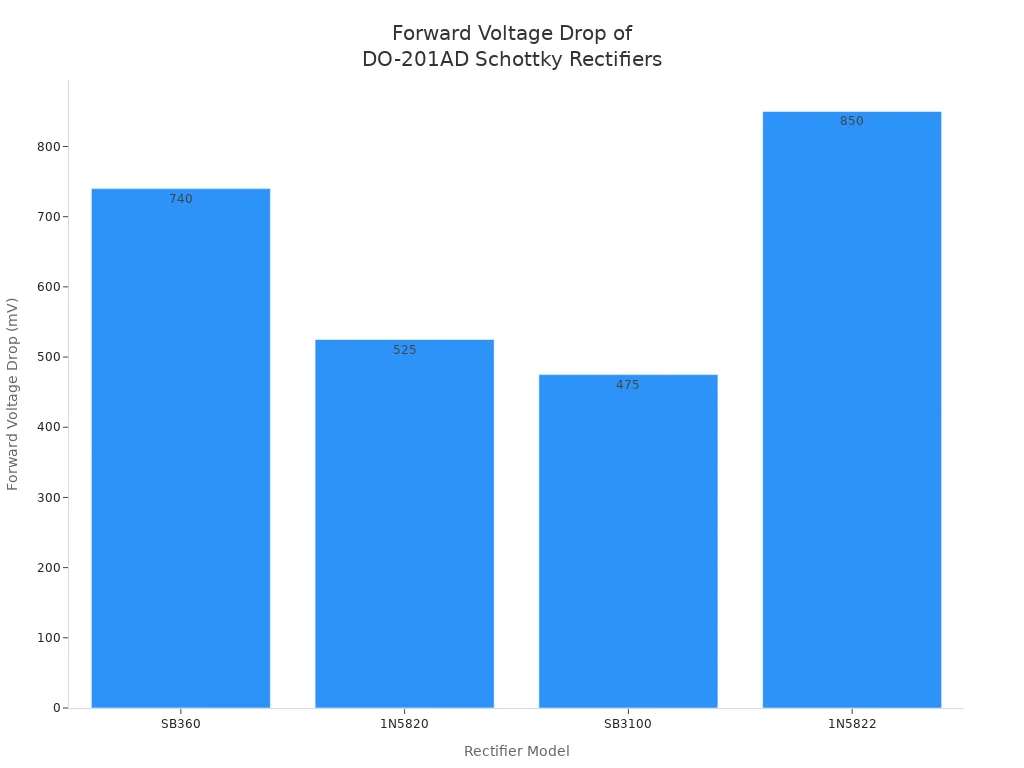
You want a low forward voltage drop in your switch mode power supply. Lower voltage drop means your ic wastes less power as heat. This boosts efficiency and keeps your supply cool. Schottky rectifiers like the SB360 work better than standard silicon diodes because they have a lower forward voltage drop. This helps your power supply design run with less energy loss.
The SB360 also has a maximum reverse leakage current of 500μA at 60V. This value stays the same across the temperature range, so you do not need to worry about extra leakage at high temperatures. Low leakage keeps your supply stable and efficient.
Tip: Always check the forward voltage drop and leakage current in your datasheet. These numbers help you pick the best ic for your application and keep your power supply design efficient.
Thermal Data
Thermal data tells you how much heat your ic can handle. The SB360 works in a wide temperature range from -65°C to +150°C. You can use this ic in many power supply designs, even in hot or cold environments. Good thermal performance means your switch mode power supply stays reliable in tough conditions.
If your application runs at high current, your ic will get hot. You must plan for cooling in your power supply design. Use heat sinks or good airflow to keep the ic below its maximum temperature. This keeps your supply safe and extends the life of your ic.
Schottky rectifiers like the SB360 help your switch mode power supply stay efficient. Their low forward voltage drop means less heat is made during operation. This makes it easier to manage temperature in your power supply design.
Alert: Always follow safety standards for power electronics. The International Electrotechnical Commission (IEC) sets rules for safe operation. These standards help you build a safe and efficient supply for any application.
How to Use These Specs
You use these electrical characteristics to match the SB360 to your switch mode power supply needs. Check the maximum ratings first. Make sure your supply never goes over the voltage, current, or temperature limits. Look at the forward voltage drop and leakage current. Pick the ic that gives you the best efficiency for your application.
Schottky rectifiers give you many advantages in power supply design. They switch fast and waste less power. This makes them perfect for high-frequency switch mode power supply circuits. You get better efficiency, less heat, and a longer-lasting supply.
Guide: Always use the datasheet as your main tool for power supply design. It gives you the facts you need for safe, efficient, and reliable operation in any application.
Package Info
Dimensions
You will find the onsemi SB360 in a DO-201AD-2 package. This package is a classic choice for many power supply projects. The body of the ic is cylindrical and has metal leads on both ends. The length of the body is about 9.5 mm, and the diameter is about 5.5 mm. Each lead is about 1.2 mm thick. These leads make it easy to place the ic on a circuit board.
You can check the datasheet for a drawing with all the measurements. This drawing helps you plan your layout. You will know how much space the ic needs on your board. If you want to replace the SB360 with another part, you can use these dimensions to find a match.
Tip: Always measure the space on your board before you order parts. This step helps you avoid problems during assembly.
Mounting
You will mount the SB360 using through-hole technology. This means you push the leads of the ic through holes in your circuit board. You then solder the leads on the other side. Through-hole mounting gives you a strong connection. It works well for power supplies that need to handle high current.
Manufacturers often ship the SB360 in tape and reel packaging. This packaging helps machines place the ic on boards quickly. If you use automated assembly, tape and reel saves time and reduces errors.
You should check the package type when you pick a replacement. If you choose a different ic, make sure it fits the same holes and has the same lead size. This step makes repairs and upgrades much easier.
Note: Good mounting keeps your ic cool and secure. Always follow the datasheet for best results.
Performance Curves
Forward Voltage Graphs
You can learn a lot from the forward voltage graphs in the SB360 datasheet. These graphs show how the voltage drop changes as you increase the current. In a switch mode power supply, you want to keep the voltage drop low. This helps you get better efficiency and less heat in your power circuit.
When you look at the graph, you see that the forward voltage stays low even when the current goes up. For example, at 1 amp, the voltage drop is much lower than with a regular diode. At 3 amps, the SB360 still keeps the voltage drop under control. This means your switch mode power supply will waste less power as heat.
Tip: Use these graphs to compare the SB360 with other diodes. Lower voltage drop means higher efficiency for your power design.
You can use the forward voltage graph to pick the best part for your switch mode power supply. If you want to boost efficiency, always check this curve before you choose a rectifier.
Reverse Current Charts
Reverse current charts help you see how much current leaks when the diode blocks voltage. In a switch mode power supply, you want this leakage to stay low. High leakage can lower your power supply’s efficiency and cause problems in your circuit.
The SB360 datasheet shows that reverse current stays low across a wide range of voltages and temperatures. Even when the power supply gets hot, the leakage does not rise much. This keeps your switch mode power supply stable and safe.
Here is a simple table to help you understand:
| Temperature (°C) | Reverse Current (μA) |
|---|---|
| 25 | 100 |
| 75 | 300 |
| 125 | 500 |
You should always check the reverse current chart when you design a switch mode power supply. Low leakage means your power supply will have better efficiency and longer life.
Note: Charts like these help you spot problems before you build your power circuit. Use them to make smart choices for efficiency and safety.
smps and Other Applications
Circuit Use
You often see the onsemi SB360 in smps circuits. This part works well in switch mode power supply designs because it has a low forward voltage drop and fast switching. You use it in the rectifier stage to turn AC into DC. This helps your power supply design run cooler and more efficiently. In inverter circuits, you use the SB360 for freewheeling. It lets current flow when the main switch turns off, which protects your supply. You also use this diode for polarity protection. If someone connects the supply backward, the SB360 blocks the wrong current and saves your application.
A good design guide shows you where to place the SB360 in your circuit. You follow the datasheet to match the voltage and current needs of your power supply. This guide helps you pick the right part for your application and avoid problems in your switch mode power supply.
Common Mistakes
Many people make mistakes when they use Schottky diodes in smps or switch mode power supply projects. One common error is picking a diode with the wrong voltage rating. If you choose a part below your supply voltage, the diode can fail. Another mistake is ignoring the thermal limits. Schottky diodes like the SB360 can get hot in power supply design. If you do not plan for cooling, your supply may overheat.
Some users forget that Schottky diodes have higher junction capacitance. This can cause issues with inductors in your switch mode power supply. Always check the datasheet and use a design guide to avoid these problems in your application.
Tip: Always double-check the voltage, current, and temperature ratings in your guide before you finish your power supply design.
Best Practices
You get the best results in smps and switch mode power supply circuits when you follow a strong design guide. Use Schottky diodes like the SB360 for supply voltages below 100V. For higher voltages, look for ultrafast or hyperfast diodes. Always check the forward voltage drop and leakage current in your datasheet. This helps you keep your power supply efficient.
Use synchronous rectification for low voltage, high current outputs in your application.
Plan for good cooling in your power supply design to prevent thermal runaway.
Compare the SB360 to trench Schottky diodes if you want even lower voltage drop in your supply.
For input bridge rectification, standard recovery diodes may work better in your switch mode power supply.
A good design guide helps you select the best substitute if the SB360 is not available. Always match the package, ratings, and performance to your application. This keeps your power supply safe and reliable.
You unlock better switch mode power supply results when you follow a clear design guide for the onsemi SB360. Start by checking electrical and thermal specs, then review graphs and package details to match your power supply design. Use datasheet analysis to compare Schottky rectifiers for any smps or application. Understanding specs helps you build safe, efficient supply circuits that meet standards. Keep using a design guide for every power supply design, even if the part is discontinued. Explore more datasheets to improve your next application or switch mode power supply project.
FAQ
What does "discontinued" mean for the SB360?
Discontinued means the manufacturer no longer makes the SB360. You can still find it from some suppliers. You should use the datasheet to find a good replacement if you cannot buy the original part.
Can you use the SB360 in new designs?
You can use the SB360 if you have stock or can buy it. For new projects, you should compare similar Schottky rectifiers. Always check the datasheet to match voltage, current, and package.
How do you read the maximum ratings table?
Look for the highest voltage, current, and temperature values. These numbers show the safe limits for the SB360. Never let your circuit go over these values. This keeps your design safe.
What is the main advantage of a Schottky rectifier like the SB360?
Schottky rectifiers have a low forward voltage drop. This means your circuit loses less power as heat. You get better efficiency in your power supply or inverter.
How do you find a replacement for the SB360?
Check the datasheet for voltage, current, and package size.
Search for Schottky rectifiers with the same or better specs.
Make sure the new part fits your board and meets your needs.
Specifications
- TypeParameter
- Lifecycle Status
Lifecycle Status refers to the current stage of an electronic component in its product life cycle, indicating whether it is active, obsolete, or transitioning between these states. An active status means the component is in production and available for purchase. An obsolete status indicates that the component is no longer being manufactured or supported, and manufacturers typically provide a limited time frame for support. Understanding the lifecycle status is crucial for design engineers to ensure continuity and reliability in their projects.
ACTIVE (Last Updated: 4 days ago) - Factory Lead Time13 Weeks
- Mount
In electronic components, the term "Mount" typically refers to the method or process of physically attaching or fixing a component onto a circuit board or other electronic device. This can involve soldering, adhesive bonding, or other techniques to secure the component in place. The mounting process is crucial for ensuring proper electrical connections and mechanical stability within the electronic system. Different components may have specific mounting requirements based on their size, shape, and function, and manufacturers provide guidelines for proper mounting procedures to ensure optimal performance and reliability of the electronic device.
Through Hole - Mounting Type
The "Mounting Type" in electronic components refers to the method used to attach or connect a component to a circuit board or other substrate, such as through-hole, surface-mount, or panel mount.
Through Hole - Package / Case
refers to the protective housing that encases an electronic component, providing mechanical support, electrical connections, and thermal management.
DO-201AD, Axial - Number of Pins2
- Supplier Device Package
The parameter "Supplier Device Package" in electronic components refers to the physical packaging or housing of the component as provided by the supplier. It specifies the form factor, dimensions, and layout of the component, which are crucial for compatibility and integration into electronic circuits and systems. The supplier device package information typically includes details such as the package type (e.g., DIP, SOP, QFN), number of pins, pitch, and overall size, allowing engineers and designers to select the appropriate component for their specific application requirements. Understanding the supplier device package is essential for proper component selection, placement, and soldering during the manufacturing process to ensure optimal performance and reliability of the electronic system.
DO-201AD - Weight360mg
- Packaging
Semiconductor package is a carrier / shell used to contain and cover one or more semiconductor components or integrated circuits. The material of the shell can be metal, plastic, glass or ceramic.
Tape & Reel (TR) - Published2001
- Part Status
Parts can have many statuses as they progress through the configuration, analysis, review, and approval stages.
Active - Moisture Sensitivity Level (MSL)
Moisture Sensitivity Level (MSL) is a standardized rating that indicates the susceptibility of electronic components, particularly semiconductors, to moisture-induced damage during storage and the soldering process, defining the allowable exposure time to ambient conditions before they require special handling or baking to prevent failures
1 (Unlimited) - Max Operating Temperature
The Maximum Operating Temperature is the maximum body temperature at which the thermistor is designed to operate for extended periods of time with acceptable stability of its electrical characteristics.
125°C - Min Operating Temperature
The "Min Operating Temperature" parameter in electronic components refers to the lowest temperature at which the component is designed to operate effectively and reliably. This parameter is crucial for ensuring the proper functioning and longevity of the component, as operating below this temperature may lead to performance issues or even damage. Manufacturers specify the minimum operating temperature to provide guidance to users on the environmental conditions in which the component can safely operate. It is important to adhere to this parameter to prevent malfunctions and ensure the overall reliability of the electronic system.
-65°C - Voltage - Rated DC
Voltage - Rated DC is a parameter that specifies the maximum direct current (DC) voltage that an electronic component can safely handle without being damaged. This rating is crucial for ensuring the proper functioning and longevity of the component in a circuit. Exceeding the rated DC voltage can lead to overheating, breakdown, or even permanent damage to the component. It is important to carefully consider this parameter when designing or selecting components for a circuit to prevent any potential issues related to voltage overload.
60V - Current Rating
Current rating is the maximum current that a fuse will carry for an indefinite period without too much deterioration of the fuse element.
3A - Base Part Number
The "Base Part Number" (BPN) in electronic components serves a similar purpose to the "Base Product Number." It refers to the primary identifier for a component that captures the essential characteristics shared by a group of similar components. The BPN provides a fundamental way to reference a family or series of components without specifying all the variations and specific details.
SB360 - Polarity
In electronic components, polarity refers to the orientation or direction in which the component must be connected in a circuit to function properly. Components such as diodes, capacitors, and LEDs have polarity markings to indicate which terminal should be connected to the positive or negative side of the circuit. Connecting a component with incorrect polarity can lead to malfunction or damage. It is important to pay attention to polarity markings and follow the manufacturer's instructions to ensure proper operation of electronic components.
Standard - Element Configuration
The distribution of electrons of an atom or molecule (or other physical structure) in atomic or molecular orbitals.
Single - Speed
In electronic components, "Speed" typically refers to the rate at which data can be processed or transferred within the component. It is a measure of how quickly the component can perform its functions, such as executing instructions or transmitting signals. Speed is often specified in terms of frequency, such as clock speed in processors or data transfer rate in memory modules. Higher speed components can perform tasks more quickly, leading to improved overall performance in electronic devices. It is an important parameter to consider when designing or selecting electronic components for specific applications.
Fast Recovery =< 500ns, > 200mA (Io) - Diode Type
In electronic components, the parameter "Diode Type" refers to the specific type or configuration of a diode, which is a semiconductor device that allows current to flow in one direction only. There are various types of diodes, each designed for specific applications and functions. Common diode types include rectifier diodes, zener diodes, light-emitting diodes (LEDs), and Schottky diodes, among others. The diode type determines the diode's characteristics, such as forward voltage drop, reverse breakdown voltage, and maximum current rating, making it crucial for selecting the right diode for a particular circuit or application. Understanding the diode type is essential for ensuring proper functionality and performance in electronic circuits.
Schottky - Current - Reverse Leakage @ Vr
Current - Reverse Leakage @ Vr is a parameter that describes the amount of current that flows in the reverse direction through a diode or other semiconductor component when a reverse voltage (Vr) is applied across it. This leakage current is typically very small, but it is important to consider in electronic circuits as it can affect the overall performance and reliability of the component. The reverse leakage current is influenced by factors such as the material properties of the semiconductor, temperature, and the magnitude of the reverse voltage applied. Manufacturers provide this parameter in datasheets to help engineers and designers understand the behavior of the component in reverse bias conditions.
500μA @ 60V - Output Current
The rated output current is the maximum load current that a power supply can provide at a specified ambient temperature. A power supply can never provide more current that it's rated output current unless there is a fault, such as short circuit at the load.
3A - Voltage - Forward (Vf) (Max) @ If
The parameter "Voltage - Forward (Vf) (Max) @ If" refers to the maximum voltage drop across a diode when it is forward-biased and conducting a specified forward current (If). It indicates the maximum potential difference the diode can withstand while allowing current to flow in the forward direction without breaking down. This value is crucial for designing circuits as it helps determine how much voltage will be lost across the diode during operation. Higher Vf values can lead to reduced efficiency in power applications, making this parameter essential for optimizing circuit performance.
740mV @ 3A - Forward Current
Current which flows upon application of forward voltage.
3A - Max Reverse Leakage Current
Max Reverse Leakage Current refers to the maximum amount of current that can flow through a semiconductor device, such as a diode or transistor, when it is reverse biased. This current is an important parameter as it indicates the level of unintended current that can flow when the device is not conducting in the forward direction. High values of reverse leakage current can lead to power loss, reduced efficiency, and may affect the performance and reliability of electronic circuits. It is particularly critical in applications where precise current control and low power consumption are necessary.
500μA - Operating Temperature - Junction
Operating Temperature - Junction refers to the maximum temperature at which the junction of an electronic component can safely operate without causing damage or performance degradation. This parameter is crucial for determining the reliability and longevity of the component, as excessive heat can lead to thermal stress and failure. Manufacturers specify the operating temperature range to ensure that the component functions within safe limits under normal operating conditions. It is important for designers and engineers to consider the operating temperature - junction when selecting and using electronic components to prevent overheating and ensure optimal performance.
-65°C~125°C - Max Surge Current
Surge current is a peak non repetitive current. Maximum (peak or surge) forward current = IFSM or if(surge), the maximum peak amount of current the diode is able to conduct in forward bias mode.
80A - Voltage - DC Reverse (Vr) (Max)
Voltage - DC Reverse (Vr) (Max) is a parameter in electronic components that specifies the maximum reverse voltage that the component can withstand without breaking down. This parameter is crucial for components like diodes and transistors that are often subjected to reverse voltage during operation. Exceeding the maximum reverse voltage can lead to the component failing or getting damaged. Designers need to consider this parameter when selecting components to ensure the reliability and longevity of their circuits.
60V - Current - Average Rectified (Io)
The parameter "Current - Average Rectified (Io)" in electronic components refers to the average value of the rectified current flowing through the component. This parameter is important in determining the average power dissipation and thermal considerations of the component. It is typically specified in datasheets for diodes, rectifiers, and other components that handle alternating current (AC) and convert it to direct current (DC). Understanding the average rectified current helps in selecting the appropriate component for a given application to ensure reliable operation and prevent overheating.
3A - Forward Voltage
the amount of voltage needed to get current to flow across a diode.
740mV - Max Reverse Voltage (DC)
Max Reverse Voltage (DC) refers to the maximum voltage that a semiconductor device, such as a diode, can withstand in the reverse bias direction without failing. Exceeding this voltage can lead to breakdown and potential damage to the component. It is a critical parameter in circuit design to ensure reliability and prevent failure when the device is subjected to reverse voltage conditions.
60V - Average Rectified Current
Mainly used to characterize alternating voltage and current. It can be computed by averaging the absolute value of a waveform over one full period of the waveform.
3A - Peak Reverse Current
The maximum voltage that a diode can withstand in the reverse direction without breaking down or avalanching.If this voltage is exceeded the diode may be destroyed. Diodes must have a peak inverse voltage rating that is higher than the maximum voltage that will be applied to them in a given application.
500μA - Max Repetitive Reverse Voltage (Vrrm)
The Max Repetitive Reverse Voltage (Vrrm) is a crucial parameter in electronic components, particularly in diodes and transistors. It refers to the maximum voltage that can be applied across the component in the reverse direction without causing damage. This parameter is important for ensuring the proper functioning and longevity of the component in circuits where reverse voltage may be present. Exceeding the Vrrm rating can lead to breakdown and failure of the component, so it is essential to carefully consider this specification when designing or selecting components for a circuit.
60V - Capacitance @ Vr, F
Capacitance @ Vr, F refers to the capacitance value of a capacitor measured at a specified rated voltage (Vr). It indicates how much electrical charge the capacitor can store per volt when subjected to this voltage. This parameter is essential for understanding the behavior of capacitors in circuits, particularly under different voltage conditions, and ensures that the component operates within its safe limits. The unit of measurement is Farads (F), which quantifies the capacitor's ability to hold an electrical charge.
180pF @ 4V 1MHz - Peak Non-Repetitive Surge Current
Peak Non-Repetitive Surge Current is a specification in electronic components that refers to the maximum current that the component can withstand for a short duration without sustaining damage. This surge current typically occurs as a result of sudden voltage spikes or transient events in the circuit. It is important to consider this parameter when designing or selecting components to ensure they can handle occasional high-current surges without failing. The value of Peak Non-Repetitive Surge Current is usually specified in amperes and is crucial for protecting the component and maintaining the overall reliability of the circuit.
80A - Max Forward Surge Current (Ifsm)
Max Forward Surge Current (Ifsm) is a parameter used to specify the maximum peak current that a diode or other electronic component can withstand for a short duration during a surge event. Surge currents can occur due to sudden changes in voltage or power supply fluctuations, and the Ifsm rating helps determine the component's ability to handle such transient overloads without being damaged. It is important to consider the Ifsm rating when selecting components for applications where surge currents are expected, such as in power supplies, motor drives, and other high-power circuits. Exceeding the Ifsm rating can lead to overheating, degradation, or failure of the component, so it is crucial to ensure that the chosen component can safely handle the expected surge currents in the circuit.
80A - Diameter
In electronic components, the parameter "Diameter" typically refers to the measurement of the width of a circular component, such as a resistor, capacitor, or inductor. It is a crucial dimension that helps determine the physical size and fit of the component within a circuit or on a circuit board. The diameter is usually measured in millimeters (mm) or inches (in) and is important for ensuring proper placement and soldering of the component during assembly. Understanding the diameter of electronic components is essential for selecting the right size for a specific application and ensuring compatibility with other components and the overall design of the circuit.
5.6mm - Height6.35mm
- Length9.5mm
- Width6.35mm
- REACH SVHC
The parameter "REACH SVHC" in electronic components refers to the compliance with the Registration, Evaluation, Authorization, and Restriction of Chemicals (REACH) regulation regarding Substances of Very High Concern (SVHC). SVHCs are substances that may have serious effects on human health or the environment, and their use is regulated under REACH to ensure their safe handling and minimize their impact.Manufacturers of electronic components need to declare if their products contain any SVHCs above a certain threshold concentration and provide information on the safe use of these substances. This information allows customers to make informed decisions about the potential risks associated with using the components and take appropriate measures to mitigate any hazards.Ensuring compliance with REACH SVHC requirements is essential for electronics manufacturers to meet regulatory standards, protect human health and the environment, and maintain transparency in their supply chain. It also demonstrates a commitment to sustainability and responsible manufacturing practices in the electronics industry.
No SVHC - Radiation Hardening
Radiation hardening is the process of making electronic components and circuits resistant to damage or malfunction caused by high levels of ionizing radiation, especially for environments in outer space (especially beyond the low Earth orbit), around nuclear reactors and particle accelerators, or during nuclear accidents or nuclear warfare.
No - RoHS Status
RoHS means “Restriction of Certain Hazardous Substances” in the “Hazardous Substances Directive” in electrical and electronic equipment.
ROHS3 Compliant - Lead Free
Lead Free is a term used to describe electronic components that do not contain lead as part of their composition. Lead is a toxic material that can have harmful effects on human health and the environment, so the electronics industry has been moving towards lead-free components to reduce these risks. Lead-free components are typically made using alternative materials such as silver, copper, and tin. Manufacturers must comply with regulations such as the Restriction of Hazardous Substances (RoHS) directive to ensure that their products are lead-free and environmentally friendly.
Lead Free
Parts with Similar Specs
- ImagePart NumberManufacturerMountPackage / CaseForward VoltageForward CurrentMax Reverse Leakage CurrentRoHS StatusMoisture Sensitivity Level (MSL)Diode TypeView Compare
![SB360]()
SB360
Through Hole
DO-201AD, Axial
740 mV
3 A
500 μA
ROHS3 Compliant
1 (Unlimited)
Schottky
![BAT54CTA]()
Surface Mount, Through Hole
TO-236-3, SC-59, SOT-23-3
800 mV
200 mA
-
ROHS3 Compliant
1 (Unlimited)
Schottky
![SB3100]()
Through Hole
DO-201AD, Axial
525 mV
3 A
500 μA
ROHS3 Compliant
1 (Unlimited)
Schottky
![1N5822]()
Through Hole
DO-201AD, Axial
475 mV
3 A
500 μA
ROHS3 Compliant
1 (Unlimited)
Schottky
![1N5820]()
Through Hole
DO-201AD, Axial
850 mV
3 A
500 μA
ROHS3 Compliant
1 (Unlimited)
Schottky


Datasheet PDF
- Datasheets :
- Environmental Information :
- PCN Design/Specification :
- PCN Packaging :
 LR44 vs. 357: Are LR44 and 357 cells interchangeable?
01 August 2026239487
 SI5346 Clock Generator: Features, Pinout and Datasheet
19 April 2022441
 LM2575 Step-Down Switching Regulators: Datasheet pdf, Equivalents and Circuit
03 December 20215399
 AD825 125 V/µs High-Speed JFET Op-Amp: Performance Analysis, Pinout, and Audio Design Guide
17 March 2026153
 S9013 NPN Silicon Transistors: Datasheet, Pinout and Equivalents
13 April 202225229
 2SC4793 Transistor: 2SC4793, 2SC4793 Datasheet, Equivalent
18 December 202121455
![PIC16F628A Microcontroller: Diagram, Pinout, and Datasheet [Video]](https://res.utmel.com/Images/Article/c9ce9c43-edc0-4633-b3f4-d4ea92ba894a.png) PIC16F628A Microcontroller: Diagram, Pinout, and Datasheet [Video]
PIC16F628A Microcontroller: Diagram, Pinout, and Datasheet [Video]19 October 202114028
 AD719x Series 24-Bit ADC: Low-Noise Performance Analysis and SPI Implementation Guide
03 March 2026241
 Introduction to FinFET
18 March 202130586
 Lithium-ion Battery: Structure, Working Principle and Package
08 November 202526664
 What is an Optical Sensor?
19 March 20217198
 Advanced Aircraft Power Electronics Systems and Influence of Simulation, Standards, and Wide Band-Gap Devices
18 February 20242942
 The Comprehensive Guide to MOSFETs: Principles, Types, and Parameters (2026 Edition)
16 January 202620315
 Classification of Current Sensors
18 November 20254441
 What is a PIN Diode?
04 February 202110314
 What is PWM "Dead Band"?
21 April 20228160
ON Semiconductor
In Stock: 47
Minimum: 1 Multiples: 1
Qty
Unit Price
Ext Price
1
$0.116001
$0.12
10
$0.109435
$1.09
100
$0.103240
$10.32
500
$0.097397
$48.70
1000
$0.091884
$91.88
Not the price you want? Send RFQ Now and we'll contact you ASAP.
Inquire for More Quantity
![RB521S30T1G]() RB521S30T1G
RB521S30T1GON Semiconductor
![MBRS130T3]() MBRS130T3
MBRS130T3ON Semiconductor
![MBRS3100T3G]() MBRS3100T3G
MBRS3100T3GON Semiconductor
![MMSD4148T1G]() MMSD4148T1G
MMSD4148T1GON Semiconductor
![1N4148WT]() 1N4148WT
1N4148WTON Semiconductor
![1N914BWS]() 1N914BWS
1N914BWSON Semiconductor
![RB751S40T1G]() RB751S40T1G
RB751S40T1GON Semiconductor
![1N4148WS]() 1N4148WS
1N4148WSON Semiconductor
![BAS16HT1G]() BAS16HT1G
BAS16HT1GON Semiconductor
![MBR0520LT1G]() MBR0520LT1G
MBR0520LT1GON Semiconductor


