Product
 Brand
Brand Articles
 Tools
Tools
13 Semiconductor Startups Poised for Success in 2024, According to Investors
Semiconductor startups have had a remarkable year in 2023, with record-breaking funding and a surge in interest from investors. As the demand for chip technology continues to grow, VCs have identified 13 promising startups that are poised for success in the semiconductor sector in 2024. German startup FaradaIC is developing miniaturized gas-sensing chips using novel materials and techniques. With growing concerns over climate change, the demand for gas-sensing chip applications in health, energy, and foodtech is on the rise. Innatera, a spin-off from the Delft University of Technology in the Netherlands, is focused on developing neuromorphic processors based on the structures of biological brains. These processors have applications in true presence detection, voice recognition, and autonomous vehicles. Denmark-based Skycore Semiconductors is building high-voltage integrated circuits that cater to a wide range of applications, from consumer electronics to power grids. With the increasing electrification and digitization of our world, the demand for high-performance chips with design flexibility is on the rise. Mignon, a UK-based startup, is revolutionizing AI acceleration with its advanced AI accelerator architecture design technology. With up to 10k times improvements in on-chip inference, Mignon's design enables intelligent compute on energy-efficient devices with limited internet coverage. Black Semiconductor, also based in Germany, is taking photonic-based microchip technology out of research labs and into mass-production. Photonic interfaces on chips can process data significantly faster than standard chips, making them crucial for AI-based systems and data centers. HIDRA, a UK startup spinning out from the UK's National Physical Laboratory, has developed semiconductor wafer imaging technology that improves semiconductor yield. By rapidly capturing high-resolution images, HIDRA ensures maximum chip count on one wafer, boosting efficiency. Akhetonics, a German startup, is building a photonic general-purpose CPU/GPU that overcomes the limitations of electronic devices. This technology promises highly parallel processing and energy efficiency, paving the way for advanced computing systems. LIGENTEC, based in Switzerland, manufactures photonic integrated circuits (PIC) used in quantum tech, ground-to-space communications, and biosensors. These circuits offer advantages such as small carbon footprints, high scalability, low cost, and power efficiency. Quobly, a French startup, is working on quantum computing using silicon spin qubit processors. These processors can operate at higher temperatures, simplifying and reducing the cost of cooling technology required for quantum systems. Salience Labs, a UK-based startup, is developing a multi-chip processor that combines photonics and traditional microelectronics. This combination makes their chips compatible with current systems while meeting the growing demands of AI models. SEMRON, a German startup, is building AI chips for autonomous vehicles, smart manufacturing, healthcare monitoring, and smart home devices. Their participation in Intel Ignite's accelerator program highlights their potential for success. GEMESYS, a German startup, is focused on neuromorphic computing, imitating the information-processing mechanisms of the human brain. Their chip design trains neural networks more efficiently, reducing costs and increasing performance. Synthara, a Swiss startup, enhances microcontroller (MCU) platforms with their computational memory technology. This technology makes MCUs 50x more efficient, allowing developers to experiment with neural network and signal processing algorithms. As the semiconductor sector continues to thrive, these 13 startups are well-positioned to make significant contributions and drive innovation in 2024. Investors are keeping a close eye on these promising ventures as they have the potential to shape the future of chip technology.
 UTMEL
UTMEL
We are the professional distributor of electronic components, providing a large variety of products to save you a lot of time, effort, and cost with our efficient self-customized service. careful order preparation fast delivery service
 Power Semiconductor Procurement After the Nexperia Shake-Up—NXP for Stability, ON for Technology, or Nexperia for Value?UTMEL04 November 20254859
The recent supply chain turmoil surrounding Netherlands-based Nexperia has sent shockwaves through the global semiconductor industry, forcing procurement professionals to re-evaluate their sourcing strategies.
Read More AI Computing Power Gap: How Token Consumption is Reshaping Server Component SourcingUTMEL23 June 2026939
As global token consumption drives the transition to high-density 100kW+ AI data centers, power delivery networks require advanced Wide-Bandgap semiconductors (SiC/GaN) and high-capacitance MLCCs. This shift has triggered a component procurement crisis with lead times exceeding 24 weeks. To bypass shortages, hardware buyers must abandon just-in-time manufacturing and leverage independent global distributor networks to secure critical power and passive components.
Read More The BSPDN Revolution: Overcoming IR Drop in Sub-2nm GAAFET Nodes with Backside Power DeliveryUTMEL25 June 2026897
As semiconductor manufacturing enters the sub-2nm era, Backside Power Delivery Networks (BSPDN) are replacing traditional front-side routing to overcome critical IR drop bottlenecks. By separating power and signal delivery, chipmakers like Intel and TSMC drastically improve performance and density in GAAFET designs. However, this radical shift introduces manufacturing complexities, thermal challenges, and demands advanced packaging and power management solutions.
Read More Power Management ICs Trends 2026: AI Demand, Supply Risks, and Sourcing StrategiesUTMEL06 July 20261403
As AI server racks surpass 100kW by 2026, data centers are shifting toward wide-bandgap semiconductors like SiC and GaN. However, this demand has triggered a critical shortage of mature-node Power Management ICs (PMICs). To prevent production halts, sourcing teams must abandon 'just-in-time' models, implement proactive 'just-in-case' strategies, and rapidly qualify pin-to-pin alternative components to secure their supply chains.
Read More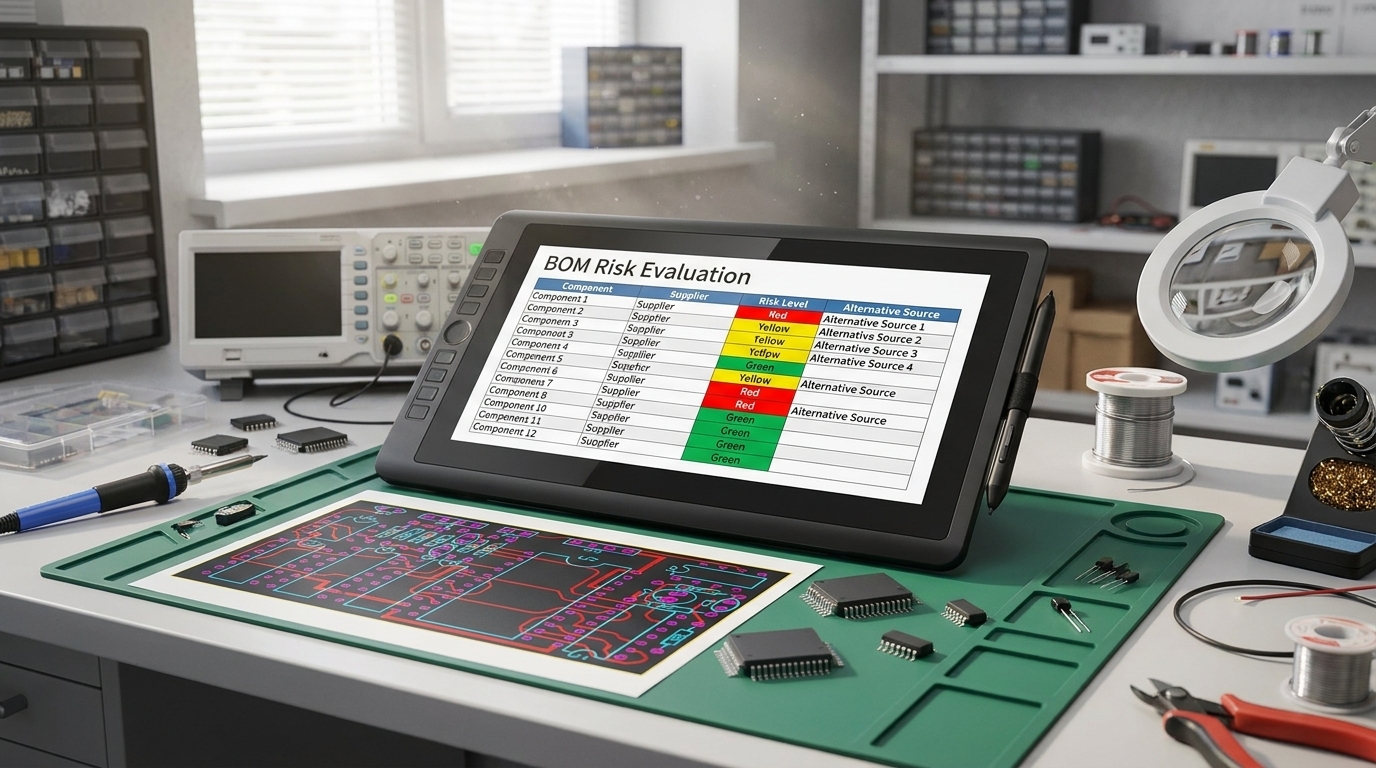 onsemi Synaptics Acquisition Impact: BOM Risk Checklist and Second-Source Strategy for Edge AI DesignsUTMEL27 July 2026330
The onsemi acquisition of Synaptics provides hardware program managers a 12-to-18-month window before potential product cancellations occur in mid-2027. This guide outlines how to audit BOM exposure across overlap and non-core product lines, calculate Last-Time-Buy volumes including hidden storage costs, establish proactive second-sourcing triggers, and implement supply chain monitoring to prevent line-down events.
Read More
Subscribe to Utmel !
![EEF-CS1E150R]() EEF-CS1E150R
EEF-CS1E150RPanasonic Electronic Components
![AFBR-2418TZ]() AFBR-2418TZ
AFBR-2418TZBroadcom Limited
![SFH 4713A]() SFH 4713A
SFH 4713AOSRAM Opto Semiconductors Inc.
![TZY2Z060AC01R00]() TZY2Z060AC01R00
TZY2Z060AC01R00Murata Electronics
![SML-S13RTT86]() SML-S13RTT86
SML-S13RTT86ROHM Semiconductor
![TZY2Z100AC01R00]() TZY2Z100AC01R00
TZY2Z100AC01R00Murata Electronics
![DGD2136S28-13]() DGD2136S28-13
DGD2136S28-13Diodes Incorporated
![TEN-HS5]() TEN-HS5
TEN-HS5Traco Power
![HEF4044BT,652]() HEF4044BT,652
HEF4044BT,652NXP USA Inc.
![T9GV5L14-22]() T9GV5L14-22
T9GV5L14-22TE Connectivity