

 Product
 Brand
Brand Articles
 Tools
Tools
Atmega8a vs Atmega328P[Video+FAQ]

32KB 16K x 16 FLASH AVR 8-Bit Microcontroller AVR® ATmega Series ATMEGA328P 28 Pin 20MHz 28-DIP (0.300, 7.62mm)


32KB 16K x 16 FLASH AVR 8-Bit Microcontroller AVR® ATmega Series ATMEGA328P 28 Pin 20MHz 28-DIP (0.300, 7.62mm)
ATmega8A and Atmega328P are two low-power controllers. Although they look the same, their names are different--8A and 328P. By comparing ATmega8A and Atmega328P, we’ll see if the two are interchangeable, and what their differences are. Here we will compare the main specs, features, and block diagram of ATmega8A and Atmega328P batteries

ATMega8A vs ATMega328p
- Overview of Atmega8a & Atmega328P
- Atmega8a vs Atmega328P: Features
- Atmega8a & Atmega328P: Applications
- Atmega8a vs Atmega328P: Parameters
- Atmega8a vs Atmega328P: Equivalents
- Atmega8a vs Atmega328P: Functional Block Diagram
- Atmega8a vs Atmega328P: Datasheet
- How to Run Atmega328P & Atmega8a for a Long Time in Safety?
Overview of Atmega8a & Atmega328P
ATmega8A Overview
The Microchip AVR® ATmega8A is a low-power CMOS 8-bit microcontroller based on the AVR RISC architecture. By executing powerful instructions in a single clock cycle, the ATmega8A achieves throughputs approaching 1 MIPS per MHz, allowing the system designer to optimize power consumption versus processing speed.
ATmega328P Overview
Microchip's ATMEGA328P is a high-performance, low-power controller. The ATMEGA328P is an 8-bit microprocessor built on the AVR RISC architecture. It is the most widely used AVR controller, as it is found in ARDUINO boards.

The ATMEGA328P and ATmega8A are two 28-pin chips, and they have the same pinout as illustrated in the pin diagram above. Many of the chip's pins have many functions. In the table below, we will describe the functions of each pin.
| pin number | Description | Function |
| 1 | PC6 | Reset |
| 2 | PD0 | DigitalPin (RX) |
| 3 | PD1 | DigitalPin (TX) |
| 4 | PD2 | DigitalPin |
| 5 | PD3 | DigitalPin (PWM) |
| 6 | PD4 | DigitalPin |
| 7 | Vcc | PositiveVoltage (Power) |
| 8 | GND | Ground |
| 9 | XTAL 1 | crystal oscillator |
| 10 | XTAL2 | crystal oscillator |
| 11 | PD5 | DigitalPin (PWM) |
| 12 | PD6 | DigitalPin (PWM) |
| 13 | PD7 | DigitalPin |
| 14 | PB0 | DigitalPin |
| 15 | PB1 | DigitalPin (PWM) |
| 16 | PB2 | DigitalPin (PWM) |
| 17 | PB3 | DigitalPin (PWM) |
| 18 | PB4 | DigitalPin |
| 19 | PB5 | DigitalPin |
| 20 | AV CC | Positive voltage for ADC (power) |
| 21 | A REF | reference voltage |
| 22 | GND | Ground |
| 23 | PC0 | analog input |
| 24 | PC1 | analog input |
| 25 | PC2 | analog input |
| 26 | PC3 | analog input |
| 27 | PC4 | analog input |
| 28 | PC5 | analog input |
Atmega8a vs Atmega328P: Features
Atmega8a Features
High-performance, Low-power Atmel AVR 8-bit Microcontroller
Advanced RISC Architecture
- 131 powerful instructions – most single clock cycle execution
- 32 × 8 General Purpose Working Registers + Peripheral Control Registers
- Fully Static Operation
- Up to 16MIPS Throughput at 16MHz
- On-chip 2-cycle Multiplier
High Endurance Non-volatile Memory segments
- 8KBytes of In-System Self-programmable Flash program memory
- 512Bytes EEPROM
- 1KByte Internal SRAM
- Write/erase cycles: 10,000 flash/100,000 EEPROM
- Data retention: 20 years at 85°C/100 years at 25°C(1)
- Optional Boot Code Section with Independent Lock Bits
In-System Programming by On-chip Boot Program
True Read-While-Write Operation
- Programming Lock for Software Security
Peripheral Features
– Two 8-bit Timer/Counters with Separate Prescaler and compare mode
– One 16-bit Timer/Counter with Separate Prescaler, Compare Mode, and Capture Mode
– Real-Time Counter with Separate Oscillator
– Three PWM Channels
– 8-channel ADC in TQFP and VQFN package
Eight Channels 10-bit Accuracy
– 6-channel ADC in the PDIP package
Six Channels 10-bit Accuracy
– Master/Slave SPI Serial Interface
– Programmable Watchdog Timer with On-chip Oscillator
– On-chip Analog Comparator
– Byte-Oriented 2-wire Serial Interface
Special Microcontroller Features
– Power-on Reset and Programmable Brown-out Detection
– Internal Calibrated RC Oscillator
– External and Internal Interrupt Sources
– Six Sleep Modes: Idle, ADC Noise Reduction, Power-save, Power-down, Standby, and Extended Standby 'I/O and Packages
̶ - 23 Programmable I/O Lines
̶ -28-lead PDIP, 32-lead TQFP, and 32-pad VQFN
Operating voltage
– 2.7 - 5.5V
– 0 - 16MHz
Power Consumption at 4MHz, 3V, 25°C
- Active: 3.6mA
- Idle Mode: 1.0mA
- Power-down Mode: 0.5µA
Atmega328P Features
High Performance, Low Power AVR® 8-Bit Microcontroller Family
Advanced RISC Architecture
-131 Powerful Instructions – Most Single Clock Cycle Execution
-32 x 8 General Purpose Working Registers
-Fully Static Operation
-Up to 20 MIPS Throughput at 20MHz
-On-chip 2-cycle Multiplier
High Endurance Non-volatile Memory Segments
-4/8/16/32KBytes of In-System Self-Programmable Flash program memory
-256/512/512/1KBytes EEPROM
-512/1K/1K/2KBytes Internal SRAM
-Write/Erase Cycles: 10,000 Flash/100,000 EEPROM
-Data retention: 20 years at 85°C/100 years at 25°C(1)
-Optional Boot Code Section with Independent Lock Bits
In-System Programming by On-chip Boot Program
True Read-While-Write Operation
Programming Lock for Software Security
QTouch® library support
-Capacitive touch buttons, sliders, and wheels
-QTouch and QMatrix™ acquisition
-Up to 64 sense channels
Peripheral Features
-Two 8-bit Timer /Counters with Separate Prescaler and Compare Mode
-One 16-bit Timer/Counter with Separate Prescaler, Compare Mode, and Capture Mode
-Real-Time Counter with Separate Oscillator
-Six PWM Channels
-8-channel 10-bit ADC in TQFP and QFN /MLF package
Temperature Measurement
-6-channel 10-bit ADC in PDIP Package
Temperature Measurement
-Programmable Serial USART
-Master/Slave SPI Serial Interface
-Byte-oriented 2-wire Serial Interface (Philips I2C compatible)
-Programmable Watchdog Timer with Separate On-chip Oscillator
-On-chip Analog Comparator
-Interrupt and Wake-up on Pin Change
Special Microcontroller Features
-Power-on Reset and Programmable Brown-out Detection
-Internal Calibrated Oscillator
-External and Internal Interrupt Sources
-Six Sleep Modes: Idle, ADC Noise Reduction, Power-save, Power-down, Standby, and Extended Standby
I/O and Packages
-23 Programmable I/O Lines
-28-pin PDIP, 32-lead TQFP, 28-pad QFN/MLF, and 32-pad QFN/MLF
Operating Voltage:
-1.8 - 5.5V
Temperature Range:
--40°C to 85°C
Speed Grade:
̶ 0 - 4MHz@1.8 - 5.5V, 0 - 10MHz@2.7 - 5.5.V, 0 - 20MHz @ 4.5 - 5.5V
Power Consumption at 1MHz, 1.8V, 25°C
̶ Active Mode: 0.2mA
̶ Power-down Mode: 0.1µA
Power-save Mode: 0.75µA (Including 32kHz RTC)
Atmega8a & Atmega328P: Applications
Atmega8a and Atmega328P can be used in the same applications due to their similar parameters. And some examples are listed below:
Weather systems
Wireless communication applications
Security-based applications
Medical & health-related projects & systems
Automobile related applications
Industrial machinery controlling systems
Solar-powered machinery and applications
IoT based applications
Power supply and charger based applications
Atmega8a vs Atmega328P: Parameters
| ATMEGA8A | ATMEGA328P | |
| Package / Case | 28-DIP (0.300, 7.62mm) | 28-DIP (0.300, 7.62mm) |
| Number of ADC Channels | 6 | 8 |
| Operating Temperature | -40°C~85°C TA | -40°C~105°C TA |
| Number of Terminations | 28 | 28 |
| Height | 4.572mm | 4.064mm |
| Width | 7.49mm | 7.49mm |
| Voltage - Supply (Vcc/Vdd) | 2.7V~5.5V | 1.8V~5.5V |
| Number of PWM Channels | 3 | 6 |
| Frequency | 16MHz | 20MHz |
| Program Memory Size | 8KB 4K x 16 | 32kB |
| RAM Size | 1K x 8 | 2K x 8 |
Atmega8a vs Atmega328P: Equivalents
ATMEGA328P can be replaced by ATMEGA8
ATMEGA8 can be replaced by ATMEGA328P
Atmega8a vs Atmega328P: Functional Block Diagram
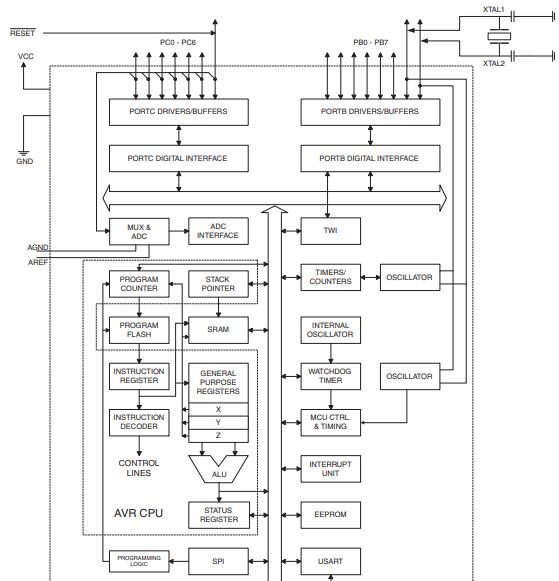
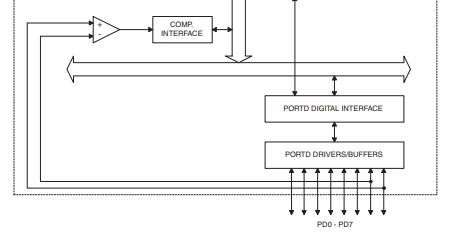
Atmega8P Block Diagram
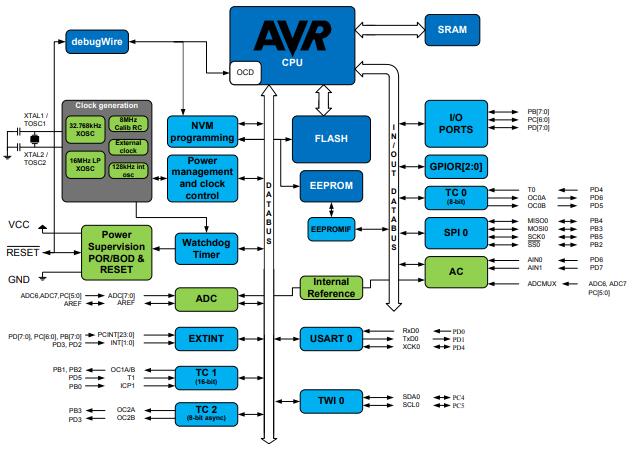
Atmega328P Block Diagram
Atmega8a vs Atmega328P: Datasheet
How to Run Atmega328P & Atmega8a for a Long Time in Safety?
To gain long-term performance or to use the Atmega328P and Atmega8a for years in your electronic device or project, keep in mind that chips or ICs are quite delicate and must be handled with care. The supplied voltage should not be more than 5.5V. Before connecting to the IC, always check the voltage source output. When testing on the breadboard or soldering in a circuit, it is strongly advised to verify all of the pins for the short circuits before powering on the IC. It is preferable to use an IC socket for the IC, but check the IC socket pins for a short circuit before placing the IC in it.
What is meant by ATMEGA328P?
ATMEGA328P is a high-performance, low-power controller from Microchip. ATMEGA328P is an 8-bit microcontroller based on AVR RISC architecture. It is the most popular of all AVR controllers as it is used in ARDUINO boards.
Why ATMEGA328 is used in Arduino?
The ATMEGA328/P is a low-power CMOS 8-bit microcontroller based on the AVR® enhanced RISC (reduced instruction set computer) architecture. In Order to maximize performance and parallelism, the AVR uses Harvard architecture – with separate memories and buses for program and data.
Is ATMEGA328P a microcontroller?
The ATMEGA328 is a single-chip microcontroller created by Atmel in the megaAVR family (later Microchip Technology acquired Atmel in 2016). It has a modified Harvard architecture 8-bit RISC processor core.
What is the difference between ATMEGA328 and ATMEGA328P?
ATMEGA328P and ATMEGA328 are the same in every sense architecturally.
ATMEGA328P just consumes lower power than ATMEGA328, which means that the 328P is manufactured in a finer process than the 328.
Can the ATMEGA328P microcontroller be used without the Arduino board?
Yes. You can use ATMega328P without an Arduino board. You can use an Arduino board with the IC. Program the IC and then take it out and use it in your circuit. You will have to use a 16MHZ Oscillator with capacitors.
 TPS3700DDCR: Pinout, Datasheet
14 March 20221385
 TL494 Control Circuit: Features, Specifications and Applications
13 May 20213730
 An In-Depth Look at the LTC6602IUF#TRPBF Active Filter: Features, Applications, and Reference Designs
06 March 2024227
 A Comprehensive Guide to LTC6903IMS8#TRPBF Programmable Timer and Oscillator
06 March 2024528
![TL494CN PWM Controllers[FAQ+Video]:Circuit, datasheet, Alternatives](https://res.utmel.com/Images/Article/058514b3-8095-480a-941d-b06f72acfa5f.jpg) TL494CN PWM Controllers[FAQ+Video]:Circuit, datasheet, Alternatives
TL494CN PWM Controllers[FAQ+Video]:Circuit, datasheet, Alternatives13 April 20228685
 CSD18543Q3A Power MOSFET: Features, Pinout, and Datasheet
18 April 20222683
 LD1117S50TR: Overview, applications and Datasheet
23 November 2023993
 TPS1H200AQDGNRQ1 High-Side Switch: Diagram, Pinout, and Datasheet
30 March 20222966
 Understanding of Coaxial Cable
06 August 202140063
 What is Mouse in Computer?
14 February 20226686
 Battery Charger IC Guide
16 February 202212460
 High-speed Connectors Shortage Outlook 2026: Supply, Lead Times, and Sourcing Options
16 July 20261015
 Applications of Sensors on CNC Machine Tools
13 September 202119768
 Introduction to Lead Acid Battery: Construction, Working Principle and Types
04 March 202111085
 SR44 vs LR44 Which Battery Should You Use
21 August 20253159
 ON Semiconductor Provides Soft Fourth-Quarter Guidance. The Stock Drops.
13 March 20243178
Microchip Technology
In Stock: 100000
United States
China
Canada
Japan
Russia
Germany
United Kingdom
Singapore
Italy
Hong Kong(China)
Taiwan(China)
France
Korea
Mexico
Netherlands
Malaysia
Austria
Spain
Switzerland
Poland
Thailand
Vietnam
India
United Arab Emirates
Afghanistan
Åland Islands
Albania
Algeria
American Samoa
Andorra
Angola
Anguilla
Antigua & Barbuda
Argentina
Armenia
Aruba
Australia
Azerbaijan
Bahamas
Bahrain
Bangladesh
Barbados
Belarus
Belgium
Belize
Benin
Bermuda
Bhutan
Bolivia
Bonaire, Sint Eustatius and Saba
Bosnia & Herzegovina
Botswana
Brazil
British Indian Ocean Territory
British Virgin Islands
Brunei
Bulgaria
Burkina Faso
Burundi
Cabo Verde
Cambodia
Cameroon
Cayman Islands
Central African Republic
Chad
Chile
Christmas Island
Cocos (Keeling) Islands
Colombia
Comoros
Congo
Congo (DRC)
Cook Islands
Costa Rica
Côte d’Ivoire
Croatia
Cuba
Curaçao
Cyprus
Czechia
Denmark
Djibouti
Dominica
Dominican Republic
Ecuador
Egypt
El Salvador
Equatorial Guinea
Eritrea
Estonia
Eswatini
Ethiopia
Falkland Islands
Faroe Islands
Fiji
Finland
French Guiana
French Polynesia
Gabon
Gambia
Georgia
Ghana
Gibraltar
Greece
Greenland
Grenada
Guadeloupe
Guam
Guatemala
Guernsey
Guinea
Guinea-Bissau
Guyana
Haiti
Honduras
Hungary
Iceland
Indonesia
Iran
Iraq
Ireland
Isle of Man
Israel
Jamaica
Jersey
Jordan
Kazakhstan
Kenya
Kiribati
Kosovo
Kuwait
Kyrgyzstan
Laos
Latvia
Lebanon
Lesotho
Liberia
Libya
Liechtenstein
Lithuania
Luxembourg
Macao(China)
Madagascar
Malawi
Maldives
Mali
Malta
Marshall Islands
Martinique
Mauritania
Mauritius
Mayotte
Micronesia
Moldova
Monaco
Mongolia
Montenegro
Montserrat
Morocco
Mozambique
Myanmar
Namibia
Nauru
Nepal
New Caledonia
New Zealand
Nicaragua
Niger
Nigeria
Niue
Norfolk Island
North Korea
North Macedonia
Northern Mariana Islands
Norway
Oman
Pakistan
Palau
Palestinian Authority
Panama
Papua New Guinea
Paraguay
Peru
Philippines
Pitcairn Islands
Portugal
Puerto Rico
Qatar
Réunion
Romania
Rwanda
Samoa
San Marino
São Tomé & Príncipe
Saudi Arabia
Senegal
Serbia
Seychelles
Sierra Leone
Sint Maarten
Slovakia
Slovenia
Solomon Islands
Somalia
South Africa
South Sudan
Sri Lanka
St Helena, Ascension, Tristan da Cunha
St. Barthélemy
St. Kitts & Nevis
St. Lucia
St. Martin
St. Pierre & Miquelon
St. Vincent & Grenadines
Sudan
Suriname
Svalbard & Jan Mayen
Sweden
Syria
Tajikistan
Tanzania
Timor-Leste
Togo
Tokelau
Tonga
Trinidad & Tobago
Tunisia
Turkey
Turkmenistan
Turks & Caicos Islands
Tuvalu
U.S. Outlying Islands
U.S. Virgin Islands
Uganda
Ukraine
Uruguay
Uzbekistan
Vanuatu
Vatican City
Venezuela
Wallis & Futuna
Yemen
Zambia
Zimbabwe
![ATMEGA8515L-8AU]() ATMEGA8515L-8AU
ATMEGA8515L-8AUMicrochip Technology
![DSPIC30F6014A-30I/PF]() DSPIC30F6014A-30I/PF
DSPIC30F6014A-30I/PFMicrochip Technology
![ATMEGA32A-AU]() ATMEGA32A-AU
ATMEGA32A-AUMicrochip Technology
![ATXMEGA128A1U-AU]() ATXMEGA128A1U-AU
ATXMEGA128A1U-AUMicrochip Technology
![PIC18F46K20-I/PT]() PIC18F46K20-I/PT
PIC18F46K20-I/PTMicrochip Technology
![PIC18F6722-I/PT]() PIC18F6722-I/PT
PIC18F6722-I/PTMicrochip Technology
![PIC16F883-I/SS]() PIC16F883-I/SS
PIC16F883-I/SSMicrochip Technology
![PIC16F877-20I/PT]() PIC16F877-20I/PT
PIC16F877-20I/PTMicrochip Technology
![ATMEGA8535L-8AU]() ATMEGA8535L-8AU
ATMEGA8535L-8AUMicrochip Technology
![PIC18F4685-I/PT]() PIC18F4685-I/PT
PIC18F4685-I/PTMicrochip Technology


