

 Product
 Brand
Brand Articles
 Tools
Tools
How to Differentiate:74HC595 vs. 74LS595 vs. 74HC164 vs. MCP23017[FAQ&Video]

Shift Register 2/6V -55°C~125°C Shift Register 74HC Series 74HC595 16 Pin 3V 16-SOIC (0.154, 3.90mm Width)


Shift Register 2/6V -55°C~125°C Shift Register 74HC Series 74HC595 16 Pin 3V 16-SOIC (0.154, 3.90mm Width)
One of the most often utilized shift registers is the 74HC595. As a popular component, it has a plethora of alternatives with extremely similar specs, uses, and pinout. In this post, we'll look at the differences between the 74HC595 and its alternative components, such as the 74LS595, 74HC164, and MCP23017, to see if they can be used interchangeably, and so on.

How Shift Registers Work - The Learning Circuit
74HC595 vs. 74LS595
74HC595 Overview
The 74HC595 is a silicon gate C2MOS high-speed CMOS 8-BIT SHIFT REGISTERS/OUTPUT LATCHES (3-STATE) integrated circuit. An 8-bit serial-in, parallel-out shift register feeds an 8-bit D-type store register in this device. There are 8 3-STATE outputs on the storage register. Both the shift register and the storage register have their own clocks.
For cascading, the shift register includes a direct-overriding clear, serial input, and serial output (standard) pins. Positive-edge triggered clocks are used in both the shift register and the storage register. The shift register state will always be one clock pulse ahead of the storage register if both clocks are coupled together. Static discharge and transient excess voltage safety circuits are installed on all inputs.
74LS595 Overview
An 8-bit serial-in, parallel-out shift register feeds an 8-bit D-type storage register in the 74LS595. The outputs of the storage register are either parallel 3-state ('LS595) or open-collector ('LS596). Both the shift register and the storage register have their own clocks. For cascading, the shift register features a direct-overriding clear, serial input, and serial output pins.
The clocks in the shift register and storage register are both triggered on the positive edge. The shift register state will always be one clock pulse ahead of the storage register if the user decides to connect both clocks.
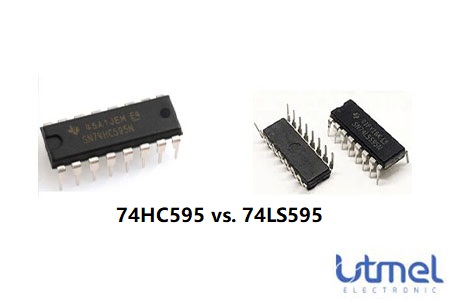
74HC595 vs.74LS595
74HC595 vs.74LS595
The 74LS595 is a TTL-based device that is quick, consumes more power, and is older.
The 74HC595 is a CMOS-based device that is fast, consumes less power, and is the most recent iteration.
To be more specific, the LS series is based on TTL (total transistor logic) and is made with bipolar transistors (BJT). BJT transistors were among the first to appear in integrated circuits.
The HC series uses CMOS (complementary metal-oxide-semiconductor) devices, which are a type of later-generation transistor in which the gate is made of metal rather than oxide (now polysilicon over an oxide).
The input impedance of these devices is much higher than that of a BJT, resulting in significantly lower current and power consumption.
In general (with exceptions), CMOS is utilized in low-power logic devices, while BJTs are employed in higher-power logic devices (switching, power management apps, etc). There are also BiCMOS devices, which combine CMOS and BJTs on the same die and take advantage of each device's finest features.
74HC595 vs. 74HC164
74HC164 Overview
The 74HC164 is a serial-in/parallel-out shift register with an 8-bit resolution.
There are two serial data inputs (DSA and DSB) and eight parallel data outputs on the device (Q0 to Q7). Data is entered serially by DSA or DSB, with either input serving as an active HIGH enable for data entry via the other. On the clock (CP) input's LOW-to-HIGH transitions, data is moved. A LOW on the master reset input (MR) clears the register and causes all outputs to be LOW, regardless of the state of the other inputs. Clamp diodes are used as inputs. This allows current limiting resistors to be used to interface inputs to voltages greater than VCC.
Like the CD4015, the 74HC164 has serial in and parallel out, but the 74HC595 is faster and has a lower voltage.
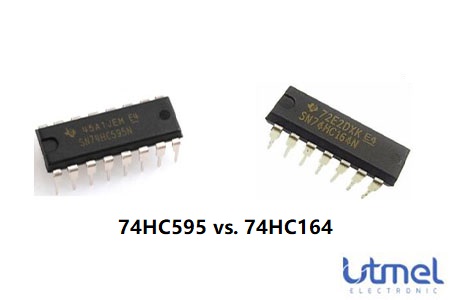
74HC595 vs.74HC164
74HC595 vs. 74HC164
The 74HC164 differs from the 74HC595 in that it does not buffer the data (internal space was present on the 74HC595), therefore the LED FLASHES as it pulls the bits to the tip-toe, producing the flashing effect observed on the 74HC164 but not on the 74HC595.
To be more detailed:
The output of the 74HC595 has a latch, so it can remain unchanged during the shift; the output of the 74HC164 does not have a latch, so it changes every time a shift clock is created. This is the most significant distinction between the two.
To achieve a multi-chip cascade, the 74HC595 utilizes a specific Q7 pin; the 74HC164 cascades directly using output pin Q7.
When the enable OE is faulty, the output pin of the 74HC595 is a high impedance, but the 74HC164 has no enable pin.
The shift register is reset by the 74HC595. If you want to reset the LATCH register, you must load the contents of the shift register into the latch register on the rising edge of ST CP; that is to say, the 74HC595 reset is synchronous, but the 74HC164 reset is asynchronous.
The parallel-to-serial chip 74HC165 corresponds to the 74HC164.
74HC595 vs. MCP23017
MCP23017 Overview
The MCP23017 is a port expander that provides nearly similar PORTS to conventional microcontrollers such as Arduino or PIC devices, as well as interrupts. It uses an I2C interface to provide an extra 16 I/O pins as well as extensive interrupt control.
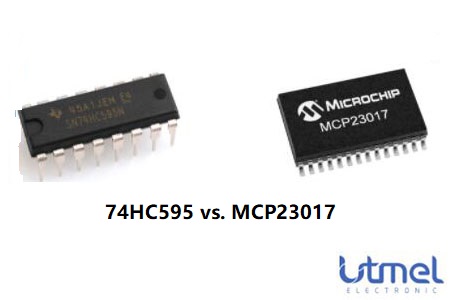
74HC595 vs. MCP23017
74HC595 vs. MCP23017
In a nutshell, the 74HC595 is a shift register and the MCP23017 is an IO Expander.
If you just want to drive LEDs directly, the 74HC595 is a decent choice, but if you want something more flexible in your projects, the MCP23017 is a solid option, and they can both run on the same software.
The key differences between a shift register and an IO Expander are the speed and complexity of driving them.
Shift registers are simpler serial to parallel converters that are easier to drive. Shift registers will run as quickly as you can feed them data.
IO expanders are more adaptable, although they are restricted to the i2c interface, which is quite sluggish. SPI expanders would be preferable, although they are still slower than shift registers. There are advantages and disadvantages to everything, and in most circumstances, you can use either one; yet, individuals prefer to utilize the one with which they are most familiar.
Component Datasheet
What is 74HC595 used for?
The datasheet refers to the 74HC595 as an "8-bit serial-in, a serial or parallel-out shift register with output latches; 3-state." In other words, you can use it to control 8 outputs at a time while only taking up a few pins on your microcontroller.
What does a shift register do?
The shift register is a type of digital circuit using a cascade of flip-flops where the output of one flip-flop is connected to the input of the next. They share a single clock signal, which causes the data stored in the system to shift from one location to the next
What does a 74HC595 do?
74HC595 is a shift register that works on Serial IN Parallel OUT protocol. It receives data serially from the microcontroller and then sends out this data through parallel pins. We can increase our output pins by 8 using a single chip. We can also connect more than 1 shift register in parallel
What is DS in shift register?
An eight-bit shift register accepts data from the serial input (DS) on each positive transition of the shift register clock (SHCP). ... If both clocks are connected together the input shift register is always one clock cycle ahead of the output register.
What is MCP23017?
The MCP23017 is a port expander that gives you virtually identical PORTS compared to standard microcontrollers e.g. Arduino or PIC devices and it even includes interrupts. It gives you an extra 16 I/O pins using an I2C interface as well as comprehensive interrupt control.
How many 3-STATE outputs are on the storage register?
8.
What is used in both the shift register and the storage register?
Positive-edge triggered clocks.
What are installed on all inputs?
Static discharge and transient excess voltage safety circuits.
What is a TTL-based device that is quick
74LS595.
What is the 74HC595 based device?
CMOS
What does the input impedance of a BJT result in?
Lower current and power consumption.
What is the parallel-to-serial chip that corresponds to the 74HC164?
74HC165.
What are the key differences between a shift register and an IO Expander?
Speed and complexity of driving them.
What type of expander would be preferable?
SPI expanders.
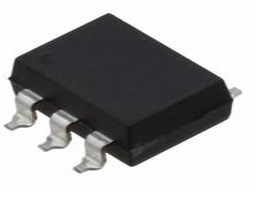 CS124 SSR RELAY SPST-NO 3.5A 0-40V: Datasheet, Features and Equivalents
11 January 2022368
 TDA2822 Audio Amplifier: Pinout, Datasheet, and Test Circuits
19 July 202114324
 OP07CJ8 Linear Amplifier: Product Overview and Applications
06 March 2024227
![An Overview of L298N Motor Driver [Video]](https://res.utmel.com/Images/Article/6925db0e-74c0-4aca-ad94-431f22fa7bce.png) An Overview of L298N Motor Driver [Video]
An Overview of L298N Motor Driver [Video]11 May 202111118
 MCP9808 Temperature Sensor: Datasheet, Pinout and Schematic
20 August 20215750
 ATmega128L 8-bit Atmel Microcontroller: How to use the ATmega128L?
28 June 20223096
 PL133-47 Fanout Buffer IC: Pinout, Equivalent and Datasheet
09 April 2022348
 TCRT5000 IR Sensor: Datasheet, Pinout and Circuit
19 October 202139619
 Aluminum Electrolytic Capacitor: Structure and Features
19 December 20205182
 Emerging Storage Technologies: MRAM, RRAM, and PCRAM
08 January 202617718
 50 World Famous Sensor Manufacturing Companies
31 October 2025898752
 Amkor Technology to Invest $2 Billion in Semiconductor Testing Plant in Peoria, Creating 2,000 Jobs
11 December 20234570
 Classification and Selection of Industrial Connectors
11 February 20226153
 Varistor: Definition, Function, Working and Testing
03 April 202585210
 Linear Induction Motor: Working Principle, Characteristics, and Applications
02 March 202116106
 What is Band Pass Filter?
17 November 20217715
ON Semiconductor
In Stock
United States
China
Canada
Japan
Russia
Germany
United Kingdom
Singapore
Italy
Hong Kong(China)
Taiwan(China)
France
Korea
Mexico
Netherlands
Malaysia
Austria
Spain
Switzerland
Poland
Thailand
Vietnam
India
United Arab Emirates
Afghanistan
Åland Islands
Albania
Algeria
American Samoa
Andorra
Angola
Anguilla
Antigua & Barbuda
Argentina
Armenia
Aruba
Australia
Azerbaijan
Bahamas
Bahrain
Bangladesh
Barbados
Belarus
Belgium
Belize
Benin
Bermuda
Bhutan
Bolivia
Bonaire, Sint Eustatius and Saba
Bosnia & Herzegovina
Botswana
Brazil
British Indian Ocean Territory
British Virgin Islands
Brunei
Bulgaria
Burkina Faso
Burundi
Cabo Verde
Cambodia
Cameroon
Cayman Islands
Central African Republic
Chad
Chile
Christmas Island
Cocos (Keeling) Islands
Colombia
Comoros
Congo
Congo (DRC)
Cook Islands
Costa Rica
Côte d’Ivoire
Croatia
Cuba
Curaçao
Cyprus
Czechia
Denmark
Djibouti
Dominica
Dominican Republic
Ecuador
Egypt
El Salvador
Equatorial Guinea
Eritrea
Estonia
Eswatini
Ethiopia
Falkland Islands
Faroe Islands
Fiji
Finland
French Guiana
French Polynesia
Gabon
Gambia
Georgia
Ghana
Gibraltar
Greece
Greenland
Grenada
Guadeloupe
Guam
Guatemala
Guernsey
Guinea
Guinea-Bissau
Guyana
Haiti
Honduras
Hungary
Iceland
Indonesia
Iran
Iraq
Ireland
Isle of Man
Israel
Jamaica
Jersey
Jordan
Kazakhstan
Kenya
Kiribati
Kosovo
Kuwait
Kyrgyzstan
Laos
Latvia
Lebanon
Lesotho
Liberia
Libya
Liechtenstein
Lithuania
Luxembourg
Macao(China)
Madagascar
Malawi
Maldives
Mali
Malta
Marshall Islands
Martinique
Mauritania
Mauritius
Mayotte
Micronesia
Moldova
Monaco
Mongolia
Montenegro
Montserrat
Morocco
Mozambique
Myanmar
Namibia
Nauru
Nepal
New Caledonia
New Zealand
Nicaragua
Niger
Nigeria
Niue
Norfolk Island
North Korea
North Macedonia
Northern Mariana Islands
Norway
Oman
Pakistan
Palau
Palestinian Authority
Panama
Papua New Guinea
Paraguay
Peru
Philippines
Pitcairn Islands
Portugal
Puerto Rico
Qatar
Réunion
Romania
Rwanda
Samoa
San Marino
São Tomé & Príncipe
Saudi Arabia
Senegal
Serbia
Seychelles
Sierra Leone
Sint Maarten
Slovakia
Slovenia
Solomon Islands
Somalia
South Africa
South Sudan
Sri Lanka
St Helena, Ascension, Tristan da Cunha
St. Barthélemy
St. Kitts & Nevis
St. Lucia
St. Martin
St. Pierre & Miquelon
St. Vincent & Grenadines
Sudan
Suriname
Svalbard & Jan Mayen
Sweden
Syria
Tajikistan
Tanzania
Timor-Leste
Togo
Tokelau
Tonga
Trinidad & Tobago
Tunisia
Turkey
Turkmenistan
Turks & Caicos Islands
Tuvalu
U.S. Outlying Islands
U.S. Virgin Islands
Uganda
Ukraine
Uruguay
Uzbekistan
Vanuatu
Vatican City
Venezuela
Wallis & Futuna
Yemen
Zambia
Zimbabwe
![MC74HC595ADTR2G]() MC74HC595ADTR2G
MC74HC595ADTR2GON Semiconductor
![MC74HC165ADTR2G]() MC74HC165ADTR2G
MC74HC165ADTR2GON Semiconductor
![MC74HC164ADR2G]() MC74HC164ADR2G
MC74HC164ADR2GON Semiconductor
![MC74HC595ADR2G]() MC74HC595ADR2G
MC74HC595ADR2GON Semiconductor
![MM74HC595MX]() MM74HC595MX
MM74HC595MXON Semiconductor
![74VHC595MTCX]() 74VHC595MTCX
74VHC595MTCXON Semiconductor
![MM74HC595MTCX]() MM74HC595MTCX
MM74HC595MTCXON Semiconductor
![MC74HC595ADG]() MC74HC595ADG
MC74HC595ADGON Semiconductor
![MM74HC595MTC]() MM74HC595MTC
MM74HC595MTCON Semiconductor
![MC74HC164ADTR2G]() MC74HC164ADTR2G
MC74HC164ADTR2GON Semiconductor


